When planning a custom home, most buyers in the Tri-Cities are often focused on the grand elements: the layout, the look of the exterior, the custom cabinetry. But one of the most fundamental decisions, one that impacts the safety and long-term usability of the home, is the flooring. I am often asked, “What actually makes flooring ADA compliant?”
This question is at the heart of building with competence and integrity. While the formal Americans with Disabilities Act (ADA) standards are mandatory for public and commercial spaces, they are not legally required for private, owner-occupied homes. However, applying these principles in a custom home is the very essence of Universal Design. It is an act of foresight. It’s about building a home that can serve you, your family, and your guests safely, regardless of age or mobility.
Choosing accessible flooring is the foundation—quite literally—of a home built for a lifetime. It is the difference between a house that is merely beautiful and a home that is truly functional. As a builder, my goal is to provide precise, clear information to help you make the best decisions. Let’s explore what makes flooring safe, accessible, and compliant with these expert standards.
The Three Core Pillars of ADA Compliant Flooring
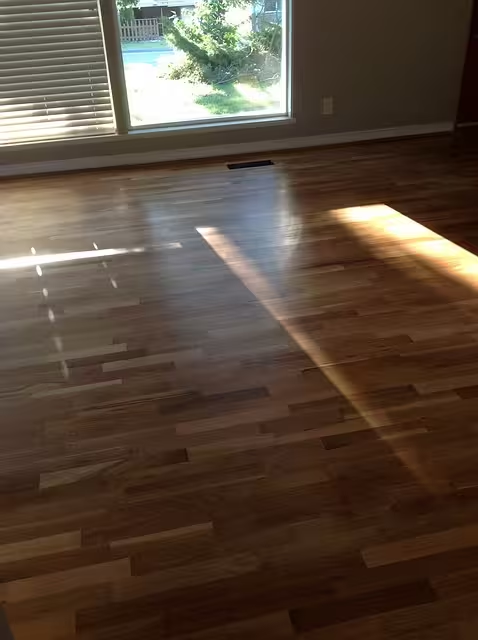
When the U.S. Access Board and other standards organizations define accessible flooring, they are not focused on a specific brand or material. Instead, they focus on three core performance characteristics. For any flooring to be considered accessible, it must be stable, firm, and slip-resistant.
Let’s break down what each of these means in practical terms for your home.
1. Stable Flooring
A stable floor is one that is fixed in place. It cannot shift, buckle, move, or bunch up as someone walks or rolls over it. Imagine a person using a walker. If they place the walker’s legs on a loose area rug, the rug could slide out from under them, leading to a serious fall.
- What it means: The flooring material must be securely attached to the subfloor. This is why loose-laid rugs or vinyl sheets that are not fully glued down are not considered accessible.
- The Danger of Unstable Flooring: Unstable surfaces create hazards for everyone. They can catch the toe of a person’s shoe, snag a cane tip, or stop a wheelchair’s caster wheel dead in its tracks. This instability requires more effort to move across and introduces a constant, low-level risk.
- In a Custom Home: This means we prioritize glue-down flooring installations or secure “click-lock” floating floors that are properly installed with no “give.” Even carpet must be securely fixed, which we will cover later.
2. Firm Flooring
Firmness is about how much “squish” or “give” a flooring material has. To be compliant, a flooring surface must resist indentation under a load.
- What it means: A person in a wheelchair or using a walker should not sink into the flooring, even slightly.
- The Problem of “Rolling Resistance”: When flooring is soft, it creates something called “rolling resistance.” This is the same principle you feel when trying to push a heavy shopping cart through soft grass instead of on smooth pavement. The wheels sink in, and you must use far more energy to move. For a person self-propelling a wheelchair or someone with limited strength using a walker, this added resistance from soft flooring is a significant barrier.
- In a Custom Home: This is why plush, high-pile carpets with thick, soft padding are the biggest offenders against accessibility. The flooring choice must be firm underfoot. This provides a safe, solid base for walking and a low-resistance path for wheels.
3. Slip-Resistant Flooring
This is the third, and perhaps most critical, pillar. A floor surface must provide enough friction or “grip” to prevent accidental slips and falls, especially in areas that might get wet.
- What it means: The texture and finish of the flooring must be chosen with traction in mind.
- The Obvious Danger: A slip-and-fall accident is one of the most common injuries in a home, particularly for older adults. Bathrooms, kitchens, and entryways are high-risk zones.
- In a Custom Home: We must look beyond just how a flooring sample looks (like a glossy, polished tile) and instead focus on how it performs. This topic is so important that it has its own entire field of testing, which is essential to understand.
These three pillars—Stable, Firm, and Slip-Resistant—are the non-negotiable foundation of any accessible flooring. If any flooring fails even one of these three tests, it is not a suitable choice for a universally designed home.
The Big Question: What Does “Slip-Resistant” Actually Mean?
This is where many people, and even some builders, get confused. Clients often ask me for the “ADA number” for slip resistance.
Here is a precise, technical truth: The ADA itself does not set a specific “magic number” or minimum score for slip resistance.
Why? Because slip resistance is complicated. A flooring surface that is safe when dry can become dangerously slick when wet. A test performed in a lab may not match how that same flooring performs in a real-world kitchen with a small cooking oil spill.
Because of this, the industry has moved away from a single, simple test. However, we do have excellent standards that give us a clear, professional benchmark.
The Old Test: Static Coefficient of Friction (SCOF)
For many years, the standard test was for “Static Coefficient of Friction,” or SCOF.
- What it means (simplified): Think of a heavy box sitting on the floor. The SCOF measures how much force it takes to get the box to start moving from a complete stop.
- The Old Guideline: The common (though not official ADA) recommendation was an SCOF of 0.60 or higher. You may still see this number referenced, but it is an outdated way to measure. The problem is that it does not accurately measure what happens when a person is already walking and their foot begins to slide.
The New, Better Test: Dynamic Coefficient of Friction (DCOF)
The industry now relies on a much more reliable and realistic test: the “Dynamic Coefficient of Friction,” or DCOF.
- What it means (simplified): Let’s go back to that heavy box. The DCOF measures the force needed to keep the box moving once it’s already sliding. This moving friction is a much better predictor of what happens in a real-life slip, when your foot is in motion.
- The Standard to Know (The “Precise” Detail): The standard you need to know is ANSI A326.3. This is an industry standard developed by the American National Standards Institute. It specifically outlines the testing method for DCOF.
- The “Magic Number”: This standard states that floor surfaces expected to be walked on when wet must have a DCOF of 0.42 or greater.
This is the number I use as a building expert.
When you are shopping for tile flooring for a bathroom, kitchen, or mudroom, you can—and should—ask for the flooring’s DCOF test results. A competent manufacturer will provide this on the product’s specification sheet. Choosing a tile with a DCOF rating of 0.42 or higher is a decision made with competence and a clear focus on safety.
This standard provides a clear path for choosing safe flooring, especially in the areas of your home where it matters most. It is one of the most important factors in selecting a quality flooring material.
Minding the Gaps: ADA Rules for Transitions and Openings
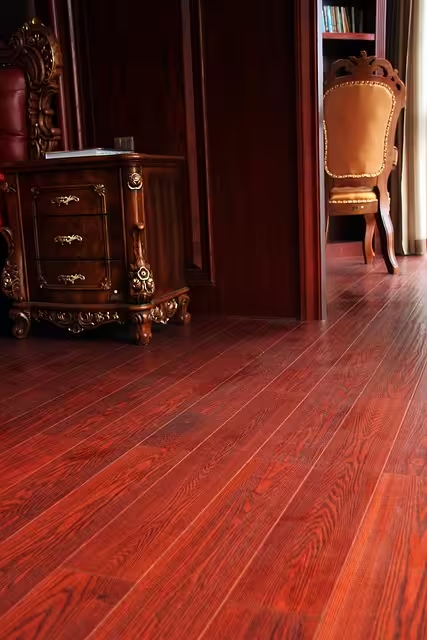
A home can have the most perfectly compliant flooring, but if the paths between rooms are not handled correctly, the home is still full of hazards.
A “transition” is any spot where one type of flooring meets another. The most common example is where the tile flooring of a bathroom meets the hardwood or carpet flooring of a hallway. These transitions must be as smooth and level as possible to prevent trip hazards and to allow wheels to pass over easily.
The accessibility standards are extremely precise about this. The rules for level changes are as follows:
1. Vertical Changes Up to 1/4 Inch
If the height difference between the two flooring materials is 1/4 inch or less, it can be a small, vertical lip.
- A Simple Visual: A 1/4 inch is about the thickness of a standard pencil, or a stack of two or three quarters.
- Why it matters: This small height is generally not enough to catch a toe or stop a wheelchair. It is a manageable “bump.” This is the goal for most flooring transitions. A skilled flooring installer can almost always achieve this.
2. Vertical Changes Between 1/4 Inch and 1/2 Inch
If the height difference is unavoidable and falls between 1/4 and 1/2 inch, it cannot be vertical. It must have a beveled edge.
- What is a Bevel? A bevel is a small, sloped transition piece.
- The Precise Rule: The slope of this bevel must be no steeper than 1:2. This means for every 1 inch of height, there must be 2 inches of horizontal run. So, for a 1/2 inch height, the transition piece must be at least 1 inch wide, creating a miniature ramp.
- Why it matters: This sloped edge prevents the abrupt “stop” of a vertical lip, allowing wheels to roll up and over it and reducing the chance of catching a foot.
3. Changes Greater Than 1/2 Inch
If a change in level is more than 1/2 inch, it is no longer considered a “transition.” It is now a ramp, and it must follow the much stricter rules for ramps.
- The Ramp Rule: The standard slope for a ramp is 1:12. This means for every 1 inch of vertical height, you must have 12 inches (1 foot) of horizontal ramp.
- A Practical Example: This is a detail that often shocks homeowners. If the step from your garage into your mudroom is just 6 inches high, it requires a ramp that is 6 feet long to be compliant. This is why planning for “zero-step” entries from the beginning is a core part of Universal Design. It is much harder and more expensive to add this later.
Openings and Grates in the Flooring
This same precision applies to any openings in your flooring, such as HVAC vents or drains.
- The 1/2 Inch Rule: Openings in the flooring cannot be large enough for a 1/2 inch sphere to pass through. This is designed to prevent cane tips, walker legs, or thin wheelchair caster wheels from getting stuck.
- The Perpendicular Rule: If the grate has long, thin slots, the slots must be placed perpendicular (at a right angle) to the common direction of travel. This way, a wheelchair wheel will roll over the slots, not get caught in one.
As a builder, I see these transitions as a mark of craftsmanship and integrity. Anyone can lay down flooring. A true professional ensures that the entire path is safe, level, and seamless.
Special Case: The Rules for Carpet

Carpet is the single most common flooring material that fails accessibility tests. This is because the qualities many people want in a carpet (soft, plush, and thick) are the exact qualities that make it a barrier.
A soft, high-pile carpet fails the “firmness” test dramatically. As we discussed, it creates immense rolling resistance. Pushing a wheelchair across a thick, plush carpet has been compared to pushing it through dry sand. It is exhausting and, in some cases, impossible.
For carpet flooring to be accessible, it must follow very specific rules.
1. Pile Height: 1/2 Inch Maximum
The “pile” is the length of the carpet fibers. The pile height for an accessible carpet cannot be more than 1/2 inch, measured from the backing of the carpet.
- What to Look For: This rules out almost all “shag” or “plush” style carpets.13 The compliant options are typically “level loop,” “textured loop,” or very low-profile “cut pile” carpets.14 Think of the durable, low-profile carpet flooring you see in a high-end commercial building or office.
2. Installation: Securely Attached
The carpet flooring must be “stable.” This means it must be glued down directly to the subfloor.
- The Problem with “Stretch-In” Carpet: The most common residential installation involves “tack strips” around the edge of the room and a separate pad underneath. The carpet is then stretched over the pad. This type of installation is not compliant. The carpet is not firmly attached and can bunch up or “ripple” over time, creating a significant trip hazard.
3. Cushion: Firm or None at All
The padding underneath the carpet is just as important as the carpet itself.
- The Problem with Soft Pads: A thick, soft, “memory foam” style carpet pad creates the same rolling resistance problem as a plush carpet. Even a low-pile carpet on a thick, soft pad will fail the “firmness” test.
- The Solution: If a pad is used with a glue-down carpet, it must be a specific, high-density, firm cushion designed for this purpose. In many cases, the best option is to have no pad at all and glue the carpet directly.
For homeowners in the Tri-Cities who want the warmth and sound-dampening qualities of carpet, I almost always recommend carpet tiles. Carpet tiles are low-profile, are glued down securely, meet the 1/2 inch pile height rule, and are extremely firm. As a bonus, if one tile is stained or damaged, you can replace that single tile instead of the entire room’s flooring.
Best Flooring Materials for an Accessible Custom Home
So, what flooring should you actually choose? As a builder, my job is to help you find the material that has the right performance, not just the right look.
Here are some of the best flooring options that excel at meeting the three pillars of stable, firm, and slip-resistant.
Compliant-Friendly Flooring Options
- Luxury Vinyl (LVP/LVT): This is one of the most popular flooring choices today, and for good reason. LVP (plank) and LVT (tile) are excellent for accessibility.
- Pillar Check: It is firm (a thin, solid material). It is stable (especially when glued down, which I recommend for accessibility over a “floating” floor).17 And its “slip resistance” is excellent, as many styles are embossed with a texture that provides good grip and high DCOF ratings. This flooring is also durable and handles the humidity in our East Tennessee climate very well.
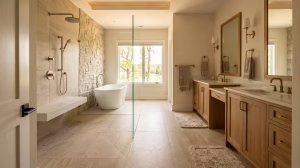
- Ceramic & Porcelain Tile: Tile is a fantastic choice, especially for bathrooms and kitchens.
- Pillar Check: It is perfectly firm and stable. The only pillar to watch is slip resistance. You must avoid highly polished, glossy tiles.
- Hephaestus Tip: Look for tile with a matte finish or a textured surface (like a slate-look or wood-look). Smaller tiles can also improve traction, as the additional grout lines create more “grip” for your feet. Always ask for that DCOF rating of 0.42 or higher for any tile flooring in a wet area.
- Engineered Hardwood: Many people love the timeless look of hardwood.
- Pillar Check: This flooring is both firm and stable. A smooth, glossy hardwood finish can be slippery when wet, but it is generally a safe surface when dry.
- Hephaestus Tip: In the Tri-Cities, I recommend engineered hardwood flooring over solid hardwood. It is more dimensionally stable and handles our seasonal humidity swings with less expansion and contraction. Opting for a matte or “wire-brushed” finish can improve traction over a high-gloss finish.
- Rubber Flooring: This is a less common residential flooring, but it is one of the best for safety.
- Pillar Check: It provides elite performance. It is firm, stable (when glued down), and has the highest slip resistance of almost any flooring material. It also provides a small amount of impact absorption, which can be easier on joints.
- Where to Use: I recommend this flooring for home gyms, utility rooms, mudrooms, and even workshops.
- Low-Pile Carpet Tile: As mentioned before, this is the best and only way I recommend using carpet flooring in an accessible design. It is firm, stable, and has a low pile, meeting all requirements while still providing warmth.
Flooring to Use with Caution or Avoid
- High-Pile or Plush Carpet: This is the #1 offender. It fails the “firmness” test and creates high rolling resistance.
- Polished Marble or Granite: While beautiful, this flooring is dangerously slippery when wet. It fails the “slip-resistant” test in any kitchen or bathroom.
- Thick, Soft “Floating” Floors: Some lower-quality floating LVP or laminate floors that install over a thick, soft foam underlayment can feel “squishy” underfoot. This can fail the “firmness” test and should be avoided.
- Pebblestone or Uneven Natural Stone: While popular in rustic-style showers, this flooring is not accessible. The uneven surfaces are a major hazard for anyone with balance issues and make it impossible for wheeled devices to roll over.
Building with Precision and Integrity
Choosing the right flooring is about more than aesthetics. It is a decision that directly impacts the safety and function of your home for decades to come.
As we’ve covered, a truly accessible flooring is defined by three simple, precise characteristics:
- It must be Stable and securely fixed.
- It must be Firm, with no “squish” or high rolling resistance.
- It must be Slip-Resistant, with a DCOF of 0.42 or higher for wet areas.
And finally, the transitions between all your flooring types must be managed with precision, aiming for a change of 1/4 inch or less.
In my work building custom homes across Johnson City, Kingsport, and the entire Tri-Cities area, these are the standards I follow. This is what it means to build with competence. It is about anticipating your future needs and using precise, expert knowledge to create a home that is safe, functional, and built with integrity.
This article is for informational purposes. Here at WebHeads United we always recommend consulting with a qualified builder or a Certified Aging-in-Place Specialist (CAPS) to ensure your specific material selections and installation plans meet the highest standards of safety and accessibility.