

Think of a professional entryway like a perfectly tailored suit. When someone walks into a room wearing a suit that fits them exactly right, you immediately take them seriously. You might not even know why, but their presence commands respect. It is sharp, it is functional, and it sends a clear message before they even speak.
Your home office entryway needs to do the exact same thing for your business.
In the Tri-Cities of Tennessee, home office are often just spare bedrooms with a desk. When a client visits, they have to awkwardly walk past the family dog, step over shoes in the main hallway, and ignore the smell of last night’s dinner before they get to the “professional” space. By that time, the first impression is already gone. You have lost the chance to show them you are a serious business from the very first second.
Creating a truly professional entryway is about more than just buying a nice welcome mat. It is about engineered separation. It is about designing a space that functions completely independently from your personal life. It requires planning, a bit of technical know-how, and an understanding of how people move through a space.
When you get this right, your entryway transitions your client from “visiting a house” to “arriving at a business.” That mental shift is crucial for your success. Let us look at precisely how to build that experience, from the legal groundwork to the final coat of paint.
Phase 1: The Feasibility Study

Before we ever pick up a hammer or choose a paint color for your new entryway, we must do our homework. In the building industry, we call this a feasibility study. We need to know if what you want to do is legal and possible. Skipping this step can lead to expensive fines or being forced to tear down your hard work.
Zoning and HOAs
Every city has rules about what you can and cannot do with your home. These are called zoning ordinances. In places like Kingsport or Johnson City, the rules might be different than they are out in the county. You need to check your local zoning laws regarding “home occupations.”
Some residential zones do not allow any client traffic at all. Others might allow it but restrict how many people can visit per day. They might also have rules about changing the outside appearance of your house. Adding a new door that is visible from the street might require a special permit.
If you live in a neighborhood with a Homeowners Association (HOA), you have another layer of rules to check. HOAs are often very strict about exterior changes. They might have rules against adding new walkways, changing door styles, or putting up any kind of business signage. Always read your HOA covenants before you start planning your professional entryway. It is better to ask for permission now than to pay a fine later.
The Tax Question
Many buyers wonder if a separate entryway is required by the IRS to claim a home office deduction. The simple answer is no, it is not strictly mandatory. However, it is a very powerful piece of evidence in your favor.
The IRS requires that your home office be used “exclusively and regularly” for business. If your office has its own entryway, it is much easier to prove that the space is not being used for personal reasons. It creates a clear physical line between your home life and your work life. While I am a builder and not a tax accountant, I know that clear boundaries make everything easier, including tax time.
Accessibility Considerations
When you invite the public into your home for business, you have to think about safety and access for everyone. This includes clients who might be elderly or have disabilities.
Look at your proposed entryway area. Are there steep stairs? is the ground uneven? If you have a client in a wheelchair, could they get in?
While standard residential homes often do not strictly have to meet full Americans with Disabilities Act (ADA) standards, it is professional best practice to make your entryway as accessible as possible. This might mean grading the path so it is a gentle slope instead of using steps. It might mean ensuring your new entryway door is at least 36 inches wide instead of the standard 30 or 32 inches. Making your entryway accessible shows clients you care about their comfort and safety before they even meet you.
Phase 2: The Exterior Arrival

The exterior of your entryway is where the client experience truly begins. This is often called “curb appeal,” but for a business, it is also about wayfinding. You never want a client to pull into your driveway and feel confused about where to go.
The Dedicated Path
Confusion is the enemy of a good first impression. If a client has to guess which door to use, they will likely guess wrong and end up at your family’s main front door. Your professional entryway needs its own dedicated path.
This path should clearly lead from the parking area directly to your office door. You can use hardscaping to make this clear. If your main driveway is asphalt, perhaps use stamped concrete or high-quality pavers for the business path.
This change in material is a subtle signal. It tells the client’s brain, “This is a different area; follow this line.” The path should be at least three feet wide so two people can walk comfortably side-by-side. Keep it clear of overhanging bushes or tripping hazards. It needs to look maintained and intentional, not like a side path you use to take out the trash.
Lighting as a Wayfinder
If you ever see clients in the late afternoon or evening, lighting is critical. Lighting does two jobs for your entryway. First, it keeps people safe so they do not trip in the dark. Second, it acts as a beacon.
You want your professional entryway to be slightly brighter or more warmly lit than the rest of the house when you are open for business. Use pathway lights to mark the edges of the walkway. These should face downward to light the ground, not upward into people’s eyes.
At the door itself, use a high-quality sconce or overhead light. The goal is to have enough light so the client can easily see the door handle and lock, and so you can easily see who is at the door before you open it. Motion-sensor lights are also a good idea for security when you are not there, but when you are expecting clients, keep the main entryway lights on steadily.
The Door Itself
The door you choose for your entryway speaks volumes. In residential building, we often use hollow-core doors for interior rooms because they are cheap and light.3 Never use these for your exterior entryway.
Your entryway door needs to be solid. Steel or fiberglass are excellent choices. They are secure, they insulate well against weather, and they block out noise from the street.
Think about the hardware, too. The handle and lock should feel substantial in the hand. A flimsy residential knob feels cheap. A commercial-style lever handle feels professional and is easier for people with grip issues to use.
Consider whether you want glass in the door. Glass lets in natural light, which can make a small entryway feel bigger. However, it also reduces privacy. If you use glass, consider frosted or textured glass that lets light in but keeps prying eyes out.
Signage and Branding
If your zoning allows it, a small, tasteful sign near your entryway confirms to the client they have arrived at the right place. This does not need to be a giant neon sign. A simple metal or carved wood plaque next to the door is often enough.
It should match the style of your home so it does not look out of place, but it should be clear enough to read from the walkway. This is the final reassurance for the client before they knock on the door.
Phase 3: The Interior Transition Zone
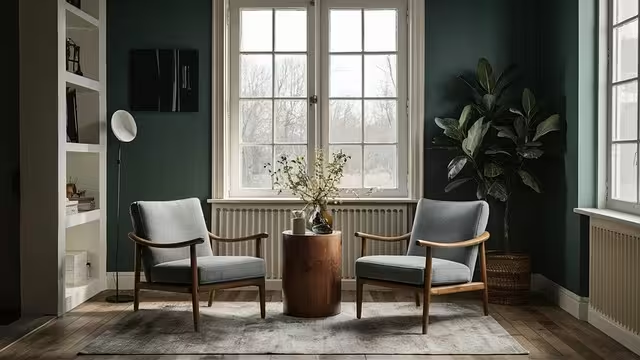
Now the client has stepped through the door. They are inside your house, but they are not yet in your office. This space is what I like to call the “Airlock.”
In building science, an airlock is a transition space that stops air from moving from one area to another. Your interior entryway acts the same way, but it stops noise, smells, and distractions from moving between your home and your business.
Creating Acoustic Privacy
Nothing ruins a professional meeting faster than the sound of a barking dog or a loud television coming from the next room. Your entryway needs to be a sound barrier.
To do this, you need to look at the walls and doors that connect your entryway to the rest of your house. Standard interior walls have very little soundproofing. If you are building new walls for this entryway, use insulation inside the walls specifically designed to dampen sound.
The interior door connecting your office area to the main house should be just as solid as your exterior door. A solid wood core door will block far more sound than a hollow one. You should also use weather stripping around this interior door. It might seem strange to put weather stripping on an inside door, but if air can get through, sound can get through. Sealing those gaps makes a massive difference in how quiet and professional your entryway feels.
The Waiting Area
Even if you do not expect clients to wait, you need a small landing zone just inside the entryway. You do not need a massive lobby, but you need 4 to 6 square feet of dedicated space.
Include a place for them to hang a coat or set down a wet umbrella. A small bench or a single nice chair is helpful if they need to wait for a moment while you finish a phone call.
This area needs to be kept immaculately clean. It should not become a dumping ground for your own mail or gym bag. When a client steps into this entryway, it should feel 100% devoted to their needs.
Durable Materials
Your entryway floor is going to take a beating. It will see mud, rain, snow, and salty grit from the roads. Do not use carpet here. It will get stained and start to look worn out very quickly.
Instead, choose a durable hard surface. Commercial-grade vinyl plank flooring is a great option. It can look like real wood or stone, but it is waterproof and very hard to scratch. High-quality tile is another excellent choice for an entryway.
Whatever you choose, make sure it is slip-resistant. You do not want your client slipping on a wet floor the moment they walk in. A high-quality walk-off mat just inside the door will help catch a lot of that dirt and moisture before it gets tracked into your main office.
Phase 4: Design Elements that Signal “Professional”
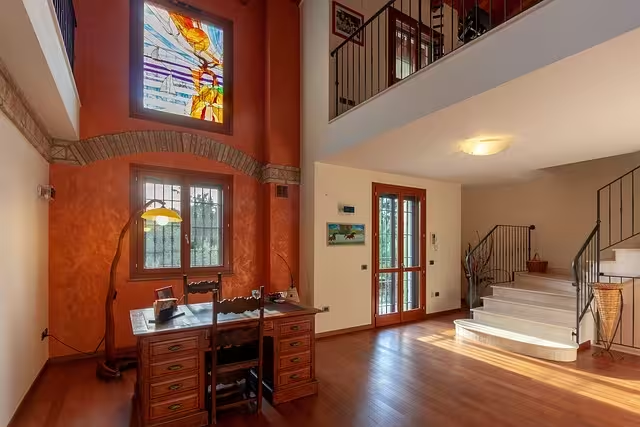
The structure is important, but the finish details are what the client will remember emotionally. The design of your entryway sets the mood for your entire interaction.
Scent and Sightlines
When someone walks into your entryway, what is the first thing they smell? If it is cooking odors, pets, or dampness, you have a problem.
Scent is very powerfully linked to memory and emotion. Your entryway should smell neutral or very lightly fresh. Be careful with heavy air fresheners, as many people are allergic to strong artificial scents. Often, just being clean and well-ventilated is the best scent.
Next, check your sightlines. Stand in your new entryway and look around. What can you see? If the door to the rest of the house is open, can you see a pile of laundry? Can you see into the kitchen?
You want to control the view. The client should only see what you want them to see—your tidy waiting area and the entrance to your office. Use doors, screens, or strategically placed furniture to block any views that look too “residential.”
Lighting the Interior Entryway
We talked about exterior lighting, but interior lighting is just as important. Residential homes often use “soft white” bulbs that have a yellowish color. This is cozy for a living room, but it can feel sleepy in a business setting.
For your professional entryway, you want lighting that is a bit brighter and crisper. Look for LED bulbs in the 3000K to 3500K color temperature range. This light is white and clean without being harsh and blue like a hospital.
Make sure the corners of the entryway are not dark and shadowy. A well-lit space feels confident and open. If you have art on the walls of your entryway, consider a small light specifically to highlight it. It is a small touch that feels very high-end.
Color Psychology
The color you paint your entryway sets a tone. Bright, jarring colors might be fun personally, but they can make some clients anxious. Deep, dark colors can make a small entryway feel claustrophobic.
Generally, neutral colors work best for a professional entryway. Grays, beiges, “greige” (a mix of gray and beige), or soft blues are safe and professional. They create a calm background that lets you and your work be the focus. You can add pops of color with a piece of art or a nice chair, but keep the main walls calm.
Your Questions Answered
Over the years, I have heard many questions from people trying to set up their home offices. Here are some of the most common ones regarding the entryway.
Does a home office need a separate entryway for tax purposes?
As I mentioned earlier, no, it is not an absolute requirement. You can still claim a home office deduction if you use a room in your house exclusively for business, even if you have to walk through the house to get to it.
However, having a separate entryway makes your claim much stronger if you are ever audited. It is hard for an auditor to argue a space is for “personal use” when it has its own dedicated exterior door and is sealed off from the rest of the house. It is a great way to protect yourself and make your accountant’s life easier.
How much does it cost to add an exterior door to an existing room?
This is tough to answer without seeing the house, as prices vary wildly based on where you live and what your house is built of. In the Tri-Cities area, cutting a new opening into a standard wood-framed wall and installing a decent quality door might cost anywhere from $1,500 to $4,000.
If you have a brick or stone exterior, that price will go up significantly because cutting through masonry is difficult labor. If you need to add a sidewalk or stairs, that will also add to the cost. It is an investment, but if it helps you land more high-paying clients, it pays for itself over time.
Can I just use my main front door?
You can, but it is rarely the best choice if you have frequent clients. Using the main front door blurs the line between home and work.
It means your family has to be perfectly quiet and tidy every time a client comes over. It means the client sees your personal living space. It lacks that professional boundary. If you are serious about your home business, I highly recommend working toward a separate entryway eventually, even if you cannot afford it right now.
How do I soundproof an existing entryway door?
If you cannot replace a hollow door right now, you can still improve it. You can buy acoustic panels to mount on the inside face of the door. They do not look amazing, but they help block sound.
The most important thing, however, is the seal. Buy a high-quality weather stripping kit and seal every single gap around that door. If light can get through, sound can get through. You can also buy a “door sweep” that attaches to the bottom of the door to block the gap between the door and the floor.
Conclusion
Creating a professional entryway for your home office is an investment in your business’s future. It is about more than just construction; it is about psychology. You are telling your clients that you take your work seriously, and you are telling yourself that when you step into that space, it is time to work.
It might seem like a lot of effort to worry about door seals, pathway lights, and floor mats. But these details add up. They create a seamless, professional experience that builds trust. When a client trusts you, they are more likely to hire you, more likely to pay your full rate, and more likely to refer you to others.
Do not just patch something together. Plan it out. Check your zoning, sketch out your path, and choose materials that will last. A well-built entryway is a tool that will serve your business for years to come. It is the firm handshake that greets every client before you even say a word. Look to A Proven Guide to Designing a Home Office Based on Your Profession for more.