

When clients plan their dream spaces they often have a variety of ideas. For some, it is a gourmet kitchen. For others, it is a grand master suite. But for a dedicated group, the true heart of the home is the workshop.
For woodworkers, craftspeople, and serious makers, the dream always includes a truly capable workshop. It is a space for creation, precision, and focus. In my experience, the single most common technical question we face when planning a custom workshop is about power. It is the foundation of everything.
Many people start their woodworking journey in a garage or basement with tools they can plug into any standard wall outlet. But a line gets crossed. When you move from hobbyist tools to professional grade stationary machines, you cross a critical threshold. This is the move from standard 110 volt (or 120 volt) circuits to 220 volt (or 240 volt) circuits. This jump feels big, and it often brings confusion. What needs it? Why is it better? Is it dangerous?
In short, a 220v circuit is not something to be afraid of. It is something to be planned for. It is the key that unlocks the next level of capability for your workshop.
This guide will calmly and precisely explain which tools require 220v, why they require it, and how you can (and should) plan for this in your workshop. Understanding this is the first, most critical step in building a truly competent workshop that will serve your craft without limiting your ambitions. A proper workshop deserves proper power.
The “Why”: Understanding Horsepower, Amps, and Efficiency
Before we list the tools, it is critical to understand why 220v is necessary. The reason for 220v is not just “more power.” In fact, it is about using the same amount of power in a much smarter, more efficient, and safer way.
Let’s think about it with a simple analogy. Imagine you need to move 100 gallons of water in one minute.
- 110 Volts is like low water pressure. To move 100 gallons, you would need a massive pipe. The amount of water moving through that pipe is the “current,” or Amps.
- 220 Volts is like high water pressure. Because the pressure is double, you can move the exact same 100 gallons of water through a pipe that is half the size.
Your tool’s motor is the same. A 3 horsepower (HP) motor needs the same amount of power (gallons of water) no matter what.
- At 110v (low pressure), it draws a very high current (Amps) to do its work.
- At 220v (high pressure), it draws half the current (Amps) to do the exact same work.
This is the entire secret. The power is the same, but the delivery is different. And this difference has four huge benefits for your workshop.
1. Less Heat and a Longer Motor Life
Heat is the number one enemy of an electric motor. The “current,” or Amps, is what creates heat in a wire. It is just like friction. A high-amperage 110v tool is like pushing a huge volume of water through a pipe that is too small. It creates a lot of friction and heat. This heat builds up in the motor’s windings, slowly cooking the insulation and shortening its life.
By running at 220v, the tool draws half the amps. Half the amps means dramatically less heat. A cooler motor is a happier motor. It means you get a much longer, more reliable service life from your expensive workshop investments. In a dusty workshop, less heat is also a significant safety benefit.
2. Better Startup Power
A motor draws the most energy by far in the first second it turns on. This is called “inrush current.” It is like trying to push a stalled car. That first shove takes the most effort.
You have seen this in your own home. When a big 110v motor (like a big air conditioner or a shop vac) kicks on, the lights in the room dim for a second. That is the motor drawing a massive amount of amps, momentarily “starving” the rest of the circuit.
In a woodworking workshop, this is a real problem. When you push a thick, 8-quarter piece of hard maple into a 110v table saw, the motor can “bog down.”
A 220v circuit handles this startup surge with ease. There is no dimming of the workshop lights, no hesitation. The tool gets the power it needs instantly. This means a cleaner cut, less burning on the wood, and less strain on the motor.
3. Fewer Tripped Breakers
This one is simple. A 20-amp circuit breaker is designed to “trip” (shut off) if a tool pulls more than 20 amps.
A 2 HP motor running on 110v can pull 20 amps or more all by itself. If you are also running a 110v dust collector on the same circuit (which you should not do!), you are almost guaranteed to trip the breaker, plunging your workshop into darkness.
Because a 220v tool uses half the amps, it is far less likely to trip its breaker. It runs comfortably within its limits, allowing you to focus on your work, not on walking back to the electrical panel.
4. Less Voltage Drop
This is especially important for a workshop in a detached garage or a separate building. Electricity loses a little bit of power, or “voltage,” as it travels over a long wire.3 The higher the amps (like on a 110v tool), the more power is lost along the way.
This “voltage drop” means the tool at the end of a long 110v extension cord is “starved” for power. It will run hot and weak.
Because 220v runs at half the amps, it can travel long distances with almost no power loss. The tool in your detached workshop gets the full, clean power it was designed for.
The “Which”: A Tool-by-Tool Guide to 220v Requirements
Now for the main question: which tools in your workshop need this?
There is a simple rule of thumb. The “tipping point” is horsepower (HP).
- Tools under 2 HP: These are almost always 110v. This includes your drills, routers, sanders, miter saws, and “jobsite” or “benchtop” table saws and planers.
- Tools 2 HP to 3 HP: This is the “gray area.” Many of these tools are “dual-voltage” (we will cover this next).
- Tools 3 HP and above: These almost exclusively require a 220v circuit.
Here is a precise list of the stationary tools that most often require (or strongly prefer) a 220v circuit for a serious workshop.
1. Cabinet Table Saws
This is the most common 220v tool and the heart of most woodworking workshop layouts.
- What it is: A “jobsite” saw is portable (1.5 HP, 110v). A “contractor” saw is a bit bigger (1.75 to 2 HP, 110v). A Cabinet Saw is a heavy, stationary beast with a 3 HP or 5 HP motor.
- Why 220v? It needs this power to spin a heavy 10 or 12-inch blade through 3-inch thick hardwoods all day without bogging down.
- Entities: SawStop Professional (3HP), Powermatic PM2000, Grizzly G1023 series.
2. Large Jointers
- What it is: A jointer flattens the face of a board. A 6-inch jointer is often 110v. But when you move up to an 8-inch, 12-inch, or 16-inch model, the motor must be 2 HP or larger.
- Why 220v? The motor’s job is to spin a very long, very heavy, solid steel cutterhead at high speed. The mass of this part is huge, and 220v is needed to handle the rotational power and startup torque.
3. Large Thickness Planers
- What it is: You have likely seen the portable 12-inch or 13-inch “lunchbox” planers. Those are 110v. A stationary planer for a full workshop is a 15-inch or 20-inch machine with a 3 HP or 5 HP motor.
- Why 220v? These machines often have powerful feed rollers in addition to the main cutterhead motor. They are designed to shave off wood from wide, heavy slabs, which demands a massive amount of sustained power.
4. Heavy-Duty Dust Collectors
This is the one that people planning a workshop often forget.
- What it is: A small “shop vac” or a 1 HP roll-around dust collector is fine on 110v. But a central dust collection system, especially a “cyclone separator” that services your entire workshop, needs a 2 HP, 3 HP, or even 5 HP motor.
- Why 220v? This motor is designed to run continuously for hours. It is the one tool that is on the entire time you are in the workshop. Running a big motor on 110v for that long is a recipe for failure. 220v is essential for the efficiency and longevity of your workshop’s “lungs.”
5. Stationary Air Compressors
- What it is: If your workshop uses air tools (like brad nailers) or you spray your finishes, you need a compressor. A small “pancake” compressor is 110v. A large, 60-gallon or 80-gallon upright compressor that stays in a corner will have a 3 HP to 5 HP motor.
- Why 220v? It needs this power to fill that big tank quickly and efficiently. These motors are built for high-demand, and 220v is standard.
6. Large Bandsaws and Lathes
- Bandsaws: A 14-inch bandsaw is often 110v or dual-voltage. But a 17-inch or larger bandsaw, especially one used for “resawing” (slicing a 12-inch wide board into thin veneers), needs a 2+ HP motor that requires 220v.
- Lathes: Most mini-lathes are 110v. But a full-size, professional lathe designed to spin a heavy, unbalanced 100-pound log blank needs the smooth torque and power that only a 2+ HP, 220v motor can provide.
The “Gray Area”: The Truth About Dual-Voltage Motors
Now we must address the most common point of confusion. Many tools, especially in the 2 HP to 3 HP range, are sold as “dual-voltage.” This means the motor can be run on either 110v or 220v.
This leads to a question: “Can I just run my 220v tool on 110v with an adapter?”
The Myth vs. The Reality
The Myth: You can buy an adapter plug and run a 220v tool on a 110v outlet.
This is dangerously false. If a tool is only 220v, plugging it into a 110v outlet will not work. The tool will get half the “pressure” (voltage) it expects. It will try to compensate by pulling twice the “volume” (amps) through wires that are not designed for it. The motor will stall, hum, and quickly burn out.
The Reality: A true dual-voltage tool does not use an adapter. It must be rewired. Inside the motor’s junction box (often called a “peckerhead”), there are wires that can be changed.
- For 110v, the motor’s coils are wired in “parallel.”
- For 220v, you (or an electrician) physically move jumpers or wires to connect the coils in “series.”
Many tools, like a 2.5 HP cabinet saw, are shipped from the factory “wired for 220v.”
A Word to the Wise
Just because you can rewire a 2.5 HP motor to run on 110v does not mean you should.
Here is why: A 2.5 HP motor rewired for 110v will draw over 24 amps when it is working hard.
Your standard 110v wall outlets are on a 15-amp or 20-amp circuit breaker.
Do you see the problem? The very first time you push a piece of hardwood through that saw, you will be drawing more power than the circuit can handle. You are guaranteed to trip the breaker.
You will be constantly starving the tool for power. It will run hot, it will bog down, and you will be completely frustrated. You will have spent thousands of dollars on a powerful machine for your workshop, only to cripple it with a weak 110v circuit.
My advice is direct and precise: If a tool is dual-voltage, you should make every effort to run it at 220v. It is the competent way to power your workshop. It ensures the tool performs as it was designed and protects your investment for the long term.
Planning for Power: What to Tell Your Builder
This is the most critical part of this entire article. As a home builder, I can tell you this with 100% certainty:
The Golden Rule: The cheapest and easiest time to add a 220v circuit is when the walls are open.
If you are building a new custom home or renovating your workshop, this is the time to plan.
A licensed electrician might charge $250 to $400 to add a dedicated 220v circuit when the studs are exposed.
If you wait until the drywall is up, painted, and finished, that same job can cost $800 to $1,500. It becomes a major repair, involving cutting drywall, patching, and painting.
Planning your workshop power before you build is the single most important thing you can do. Here is your action plan.
1. Hire a Licensed Electrician
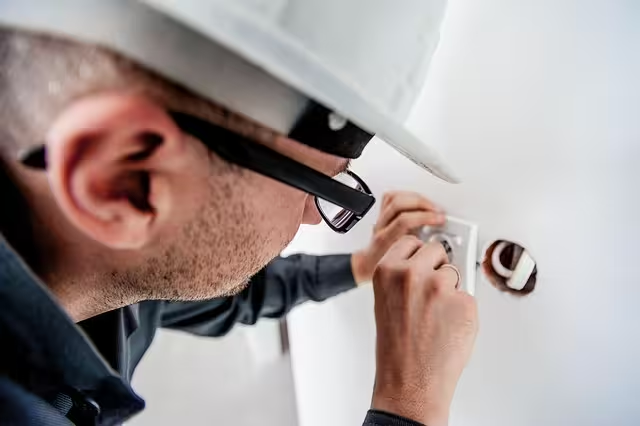
This is my first and most important piece of advice. Do not try to wire a 220v circuit or a new panel yourself unless you are a qualified expert. This is a matter of safety, integrity, and building codes. A licensed electrician will pull the right permits and ensure your workshop is safe.4
2. The Best Solution: A Workshop Subpanel
If you plan on having any of the 220v tools listed above, or even just a very active 110v workshop, do not just “add a circuit.” The most competent, professional, and future-proof solution is to install a workshop subpanel.
- What is it? A subpanel is a mini-breaker box just for your workshop.
- How it works: Your electrician will run one single, heavy-duty cable from your home’s main panel to the subpanel in your workshop. A 100-amp subpanel is an excellent, common-sense choice for almost any home workshop.
- Why is this so much better?
- Isolation: If a tool trips a breaker in the workshop, it only trips the breaker in the subpanel. It will never shut off the lights or the freezer in your house.
- Central Shutoff: The subpanel has its own main breaker. You can shut off all power to your entire workshop with one switch. This is a fantastic safety feature.
- Future-Proof Flexibility: This is the biggest win. Once the subpanel is in, adding a new circuit is easy. Need a 220v outlet for that new planer? It takes an electrician 20 minutes to add a new breaker to your workshop subpanel. You do not have to run a new, expensive wire all the way back to your house’s main panel.
- No Voltage Drop: Because the panel is right there in your workshop, all your circuit runs are short. This means all your tools, both 110v and 220v, get clean, full, efficient power.
When you talk to your electrician, use these words: “I would like a 100-amp subpanel installed in my workshop.” This is the key to a truly professional setup.
3. Map Your Workshop Workflow
Before the electrician arrives, take a piece of paper and draw your dream workshop. Think about your workflow.
- Where does wood enter?
- Where is your “milling station” (the jointer, planer, and table saw)? These are your 220v tools, and they should be grouped together.
- Where is your “assembly station” (workbench)? You will want lots of 110v outlets here.
- Where will the dust collector and air compressor live (likely in a corner or closet)?
This map tells the electrician where to put the outlets.
4. Specify the Right Circuits
Finally, be precise about what you ask for. Here is your checklist.
- For 110v Outlets: Do not use 15-amp circuits (14-gauge wire). A modern workshop needs dedicated 20-amp, 110v circuits (using 12-gauge wire). Have them run multiple 20-amp circuits. Put your workbench outlets on a different circuit than your miter saw station. This way, your sander and shop vac can run at the same time without issue.
- For Lighting: Always put your workshop lights on their own, dedicated circuit. This is a non-negotiable safety rule. If your table saw trips a breaker, you must not be plunged into darkness while a blade is still spinning.
- For 220v Outlets: Tell the electrician what tools you have or plan to have.
- A 3 HP saw or dust collector typically needs a 220v, 20-amp or 30-amp circuit.
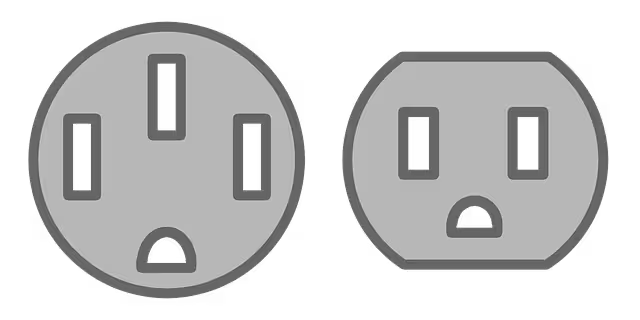
- The electrician will install the correct receptacle (the plug). This is often a NEMA 6-20 (for 20A) or NEMA 6-50 (for 30A).
- For the Future: Even if you do not own a 5 HP cabinet saw today, but you dream of it, run the circuit anyway. Tell the electrician, “I want a 30-amp, 220v outlet right here for a future table saw.” Capping that wire in the wall is incredibly cheap. It makes your workshop “220v-ready” for when your skills and budget grow.
A Competent Workshop Starts with a Competent Plan
As you can see, moving to 220v tools is the clear turning point for a serious workshop. This is not a “scary” high-voltage issue to be avoided. It is a smart, efficient, and precise engineering solution. It is the secret to unlocking the full capability of your tools, protecting them from damage, and ensuring they run for decades.
It all comes down to horsepower. Any tool with a motor 3 HP or larger—like a cabinet saw, a 15-inch planer, an 8-inch jointer, or a central dust collector—will almost certainly require a 220v circuit. Even dual-voltage tools in the 2-3 HP range will perform dramatically better and last longer when run at 220v.
Here in the Tri-Cities, I have buyers build incredible custom homes. And the workshops that bring them the most joy are the ones that were planned with competence and foresight. Planning your workshop’s electrical needs before the drywall goes up is the most precise and intelligent way to ensure your custom home serves your passion for years to come.
A great workshop is built on a foundation of great power. Plan for it.
What 220v tool is at the top of your workshop wish list? Let me know in the comments below.