When people look at building a custom home, they are often pretty good at planning their home for the next five or ten years. But the clients who are an absolute pleasure to work with, the ones who are truly planning for the long term, are those who plan for the next thirty years. They are building their “forever home.” And the foundation of a true forever home starts right at the front door, with a design principle called zero-entry.
We have all had those moments. You are trying to carry six bags of groceries in one trip. You are pushing a child in a stroller. Or maybe you are just helping an older parent navigate the front steps. In all those cases, the one or two steps up to the front porch are a barrier. They are an annoyance at best and a real hazard at worst.
A zero-entry home, also known as a no-step home, is the direct and precise solution to this problem.
At its simplest, a zero-entry home is one that has at least one entrance with no step. This entrance is completely flat and level with the ground, the sidewalk, or the driveway. This entrance is most often the front door or the door leading in from the garage. This single feature is the cornerstone of two very important concepts: Universal Design and “aging in place.”
For most buyers in Johnson City, Kingsport, and Bristol, the idea of a zero-entry home has moved from a rare feature to a “must-have.” They are looking for a home built with competence, designed with precision, and reflecting the integrity of a build that will last them a lifetime. A zero-entry home delivers on all three.
Watch a Video of this Article
The Technical Details: What Precisely Makes an Entry “Zero-Entry”?
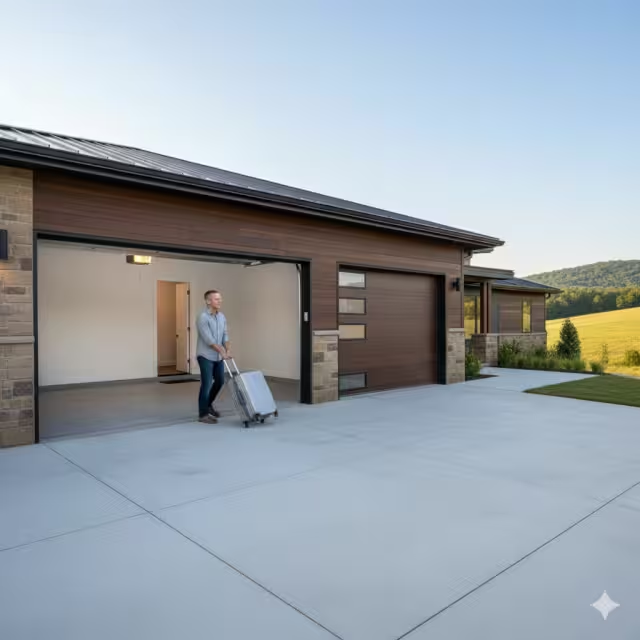
To understand what a zero-entry is, it helps to first understand why most homes have steps. In traditional home construction, especially here in East Tennessee, we build homes with a crawlspace or a full basement. This building method places the home’s main floor system, the wooden “floor” of the house, several inches or even feet above the ground, or “grade.”
This is done for good reasons. It keeps the wooden structure away from ground moisture and pests. But it creates an obvious side effect: you need steps to get from the ground up to the front door.
A true zero-entry home is designed from the very beginning to eliminate this barrier. Generally, there are two primary, high-quality methods to achieve this.
1. The Slab-on-Grade Foundation
This is the most direct method. A “slab-on-grade” foundation is exactly what it sounds like. The foundation is the floor. We pour a thick, reinforced slab of concrete at ground level, and that concrete becomes the subfloor for the entire main level of the home.
Because the interior floor is already at ground level, we can then pour the exterior concrete, like the porch, sidewalk, or driveway, to be perfectly flush with the interior floor. This creates a completely seamless and smooth zero-entry transition from outside to inside. This is a very common and sturdy building style.
2. The Framed Floor Solution
However, many buyers still want a crawlspace or a basement. This is perfectly fine. We can still achieve a beautiful zero-entry. This method just requires more precise engineering.
With a framed floor, the foundation walls are designed to be “recessed” or lower only at the entryway. We then use specialized floor joists (the beams that hold up the floor) in that one area. This allows us to set the interior subfloor at that one door to be level with the outside. The rest of the house can be built on its normal, raised foundation.
This approach gives you the “best of both worlds.” You get the zero-entry access you want, plus the basement or crawlspace you need.
The All-Important Threshold
The final piece of the puzzle is the threshold. This is the strip of material, usually metal or wood, at the very bottom of the door frame. In a traditional home, this piece can be an inch or two tall, creating a lip you have to step over.
In a true zero-entry design, we use a “low-profile” threshold. These are typically beveled (sloped) and no more than a half-inch tall. This is a critical detail. A tiny half-inch rise is low enough for a wheelchair or a walker to roll over easily, completing the barrier-free design.
A Critical Concern: Water Management
Often when the zero-entry concept is explained, the first question to be asked is, “If the door is level with the ground, what stops water from coming in?”
This is where the integrity of your builder is tested. This is a non-negotiable part of the design. A zero-entry home must have proper site grading and drainage. This is not an option; it is a requirement.
It needs to be ensured that all the ground, concrete, and landscaping around the zero-entry door has a clear and definite slope away from the house. This slope is designed long before the concrete is poured. Channel drains or French drains may also be installed in front of the door as a backup. The goal is to engineer a home that is not just accessible, but also dry and secure. A competent builder will not compromise on this.
The “Why”: Key Benefits of a Barrier-Free Home
So, why go through this planning? The benefits of a zero-entry home are not just for one group of people. They make the home better for everyone, at every stage of life.
1. It is the Key to “Aging in Place”
This is the most common reason buyers ask for a zero-entry. “Aging in place” is the ability to live in your own home safely and independently for as long as possible. As we get older, mobility can become a challenge.
A single step can be the one thing that prevents someone in a wheelchair from entering their own home. It can be a dangerous tripping hazard for someone using a walker. A zero-entry design removes that barrier entirely. It ensures that your home remains your home, accessible to you no matter what. It is the ultimate form of future-proofing. It is an investment in your own long-term independence. The AARP and other organizations that support seniors strongly advocate for this type of design.
2. It is Not Just for Seniors (It is Universal Design)
The point needs to be made. A zero-entry home is not an “old person’s home.” It is a smart home. The principle behind it is called Universal Design.
Universal Design is the idea of creating spaces and products that are usable by all people, to the greatest extent possible, without the need for special adaptation.
Think about it. A zero-entry is for:
- Parents pushing a baby stroller.
- The homeowner bringing in a rolling suitcase from a trip.
- Moving day, when you are rolling a heavy dolly with a refrigerator or a sofa.
- The high school athlete who is on crutches for six weeks after a basketball game.
- The owner who just wants a clean, modern, seamless look.
I call this “life-proof” design. A zero-entry home is simply more convenient and more functional for every single person who lives there, every single day. To go further, think about how easy it is to go through the doors that open automatically at the store. These doors make it easier for people with mobility problems, but also for people who do not have these issues.
3. Enhanced Safety and Simple Convenience
From a builder’s standpoint, we are always looking at safety. According to the National Safety Council, falls are a leading cause of unintentional injury at home. The number one place for a fall? Stairs and steps.
A zero-entry removes the most common trip-and-fall hazard right at your main entrance. It is a simple, elegant way to make your home safer. And frankly, it is just more convenient. When you are not actively thinking about navigating a step, the flow of your home just feels better. It is a subtle but powerful improvement to your daily life.
4. Increased and Protected Resale Value
The demand for accessible, single-level, and zero-entry homes is high and getting higher.
As our population ages, more and more buyers are looking for homes that they can live in for the rest of their lives. When you build a custom zero-entry home, you are building a home that appeals to the widest possible range of future buyers. It appeals to young families with strollers, and it appeals to retirees looking for their forever home.
By making your home accessible, you are increasing its demand. When it comes time to sell, your home will be more valuable and more sought-after than a traditional home with steps. A zero-entry design is a smart, long-term financial investment.
Beyond the Front Door: Applying Step-Less Principles Inside
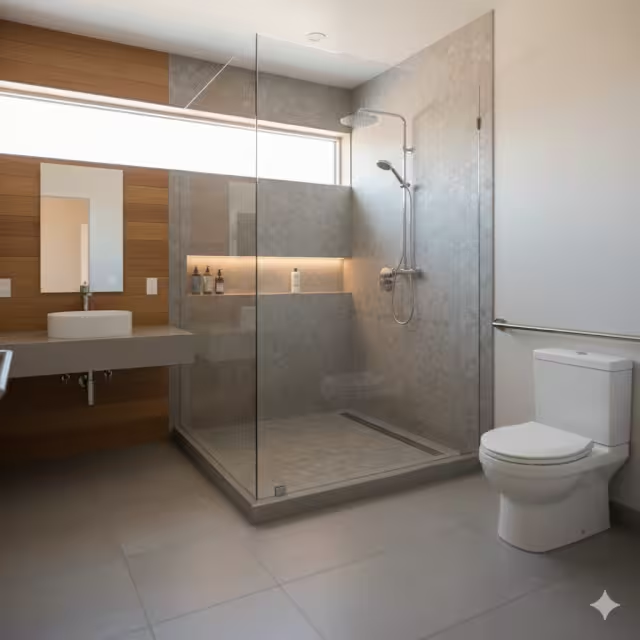
The zero-entry philosophy does not have to stop at the front door. We can take this same principle of removing barriers and apply it throughout the inside of your home. When we combine an accessible exterior with an accessible interior, we create a truly barrier-free environment.
The Curb-less (Zero-Threshold) Shower
This is the most popular interior feature my clients request, right alongside a zero-entry at the front door. A curb-less shower, also called a zero-threshold or roll-in shower, is a shower that has no “curb” or “lip” to step over.
Just like the front door, the bathroom floor flows seamlessly right into the shower. How do we do this? It comes down to precision and integrity in the build.
- Waterproofing: We waterproof the entire bathroom floor, not just the shower stall. We use special membranes under the tile that create a single, unified “pan.”
- Sloping: We gently and precisely slope the entire floor of the bathroom toward the drain, which is usually a long, slim “linear drain” placed against one wall.
- Safety and Style: This design is incredibly safe. It almost eliminates the risk of falling when getting in or out of the shower. It is also the standard in modern, high-end, spa-like bathroom design. It looks clean, open, and beautiful.
Other Key Interior Features
Once you have a zero-entry in place, a few other features complete the accessible design:
- Seamless Floor Transitions: In a barrier-free home, we avoid those annoying “transition strips” between different types of flooring. We work to make the hardwood in the hallway, for example, sit perfectly level with the tile in the bathroom. This prevents a small but significant trip hazard.
- Wider Doorways and Hallways: A standard doorway is often 30 or 32 inches. We recommend building with 36-inch doorways. This small change makes a huge difference. It makes moving furniture easier, and it provides comfortable clearance for a walker or wheelchair. The same goes for hallways. A 42-inch or 48-inch hallway feels more open and is far more functional than a narrow 36-inch one.
- Main-Floor Living: This is a big one. To truly age in place, you need the ability to live entirely on the main floor. We design the home with a “primary suite,” or master bedroom, bathroom, and laundry room, all on the first level. When you combine this with a zero-entry, you can live your entire life in the home without ever needing to go up or down a single step.
Clearing Up Confusion: Zero-Entry vs. ADA-Compliant
This is a technical point, but it is an important one where precision matters. Buyers want to make their home “ADA-compliant.” The terms “zero-entry” and “ADA-compliant” are often used together, but they mean very different things.
“Zero-Entry” is a Feature
As we have discussed, zero-entry is a design principle. It is a feature. It simply means “no step.” A home can have a zero-entry front door and a zero-entry shower and be perfectly suited for that homeowner.
“ADA-Compliant” is a Legal Standard
The ADA, or the Americans with Disabilities Act, is a federal civil rights law. It provides legal standards for accessibility in public and commercial spaces. Think of offices, stores, and restaurants.
The ADA has very specific, non-negotiable rules:
- Ramp slopes must be exactly a 1:12 ratio (one inch of rise for every 12 inches of length).
- Bathrooms must have a 5-foot-diameter clear turning circle for a wheelchair.
- Grab bars must be mounted at precise heights and locations.
- Countertops must be at a specific height.
Our Professional Recommendation
Here is the key takeaway: Your private, custom home is not a public building and is not required to be ADA-compliant.
However, some builders use the ADA guidelines as a “best practice” reference. They are a fantastic guidebook for what works. But we are not legally bound by them in a private home.
This is a good thing. It gives us flexibility. We can build a zero-entry home that is perfectly customized to you. Maybe you do not need a 5-foot turning radius in your bathroom, which saves a lot of space. But we can still install grab bar “blocking” in the walls, so grab bars can be easily added in the exact location you need them, if you ever do.
So, we can build you a zero-entry home using ADA principles as a guide, but without the strict, and sometimes space-consuming, rules of a commercial building.
A Builder’s Perspective: Cost vs. Value

This is a common question and it deserves a direct answer: “Is a zero-entry home more expensive to build?”
The answer depends entirely on when you decide to do it.
In New Custom Construction
When you are building a new custom home from the ground up, the cost of a zero-entry is minimal to negligible.
I cannot stress this enough. The cost difference is almost zero if it is part of the initial design. Why? Because it is not about expensive materials. It is about smart planning. It is about me, as your builder, working with the excavation team to grade the lot correctly from day one. It is about drawing the foundation plan correctly.
This is where the competence of your builder is everything. A builder who is not familiar with zero-entry design might be intimidated by it or try to charge you more. A builder who has done it many times, like my team, knows it is simply a matter of correct planning.
In a Remodel or Retrofit
Now, let’s flip the coin. What if you want to add a zero-entry to an existing home that already has steps?
In this case, the cost is extremely high.
To retrofit a zero-entry, we have to fight the home’s original construction. It often involves:
- Tearing out the entire front porch and sidewalk.
- Hiring an excavation crew to re-grade the entire front yard.
- Potentially cutting into the home’s concrete foundation.
- Rebuilding and reframing the front wall and floor system.
- Rerouting plumbing and electrical lines.
It is a massive, complex, and very expensive structural project.
The Verdict: Value vs. Cost
The value proposition is crystal clear. The cost of a zero-entry is almost nothing when you plan for it. The cost of not planning for it, and trying to add it later, is enormous.
This is why I am so passionate about discussing it with clients before we break ground. It is the single smartest, most cost-effective feature you can add to your home to ensure its long-term value. Building this way from the start is an investment in your future. This is why certifications like the Certified Aging-in-Place Specialist (CAPS) from the National Association of Home Builders (NAHB) exist, to show a builder is competent in these exact principles.
Building a No-Step Home in the Tri-Cities
Now, let’s talk about our home base: the Tri-Cities of Kingsport, Johnson City, and Bristol. Our region is beautiful because it is hilly. The rolling hills of East Tennessee are part of our identity.
But those hills can present a real challenge for a zero-entry. It is rare to find a perfectly flat lot.
This is where precise site planning becomes critical. A less experienced builder might look at a sloped lot and say a zero-entry is impossible. My response is, “Where there is a will, there is a way.”
On a sloped lot, we may not be able to make every door a zero-entry. The front door might be “uphill” and require steps. But we can almost always design a perfect zero-entry from the garage.
By using smart grading, building up the driveway slightly, or using a small, tasteful retaining wall, we can create a perfectly flat, seamless, and protected path from your car, into the garage, and right into your home. Since most of us use the garage as our main entrance anyway, this one feature provides 99% of the benefit.
A Step in the Right Direction is No Step at All
A zero-entry home is not a “trend.” It is a permanent shift toward smarter, more intelligent, and more accessible home design. It is the very definition of a “forever home.”
It is a home that welcomes everyone, from a child in a stroller to a grandparent in a walker.16 It is safer, more convenient, and more valuable.
Building this way reflects the core values I bring to every project.
- It is Competent: It is based on smart engineering and proven building science.
- It is Precise: It solves a specific, daily problem with an elegant and simple solution.
- It has Integrity: It is an honest design, built to serve you and your family not just on the day you move in, but for every single day of your life.