
When looking at features of custom homes, often the most profound luxuries aren’t always the most obvious. Clients often spend months discussing the grain of a hardwood floor or the precise veining of a quartz countertop. But true, daily comfort is often found in the details we take for granted. No detail is more critical to your daily life as you age in place than lighting.
As we mature, our eyes naturally require more, and better, light to see clearly, to read, and to move safely through our homes. Choosing the right light bulbs is not a finishing touch; it’s a foundational element of safety, comfort, and accessibility. A $5,000 sofa is worthless if the light in the room is so poor it gives you a headache.
This guide will provide a precise, technical, yet easy-to-understand framework for selecting the best light bulbs for aging eyes and low vision. Our goal is to give you the competence to understand what to buy, so your home remains a place of clarity and comfort for years to come. The right light bulbs can make a custom home truly feel like your own.
Video Version of this Article
Why Your Eyes Need Different Light as You Age

If you feel like you need a flashlight to read a restaurant menu, it’s not your imagination. The world is, in a very real sense, getting dimmer as we get older. This is a simple, biological fact, and it’s the first thing we must understand before we can talk about which light bulbs to buy.
Two main things happen to our eyes over time.
First, the clear lens inside your eye can slowly start to yellow. It’s a natural process, like a photo aging. This “yellowing” acts like a built-in color filter, making it harder to distinguish between similar colors, like navy blue and black, or purple and brown. It also scatters light more, which is why glare from a car’s headlights or a single, bright, exposed light bulb suddenly feels so uncomfortable.
Second, our pupils change. As we age, our pupils tend to shrink and don’t dilate (open) as easily in dim light. A smaller pupil means less light gets to the retina at the back of the eye. A 60-year-old person may need up to three times more light than a 20-year-old to see the same object with the same amount of clarity.
When you combine these two factors, you get a new set of requirements for your home’s lighting. You need more light, but you also need less glare. You need natural light that shows true colors, not a yellow-tinged version. This is why just buying “brighter” light bulbs isn’t the answer. You must buy the right light bulbs. This is especially true for people managing low vision conditions like Macular Degeneration or Glaucoma, where high-quality light is not just a comfort, it’s a critical tool for independence.
The “Big Three” of Lighting: A Builder’s Guide to the Specs
When looking at lighting for a custom home, we don’t just look at watts. That’s an old, outdated way of thinking. The wattage of light bulbs only tells you how much energy it uses, not how much light it produces.
Instead, we look at a “Lighting Facts” label, which you can find on the side of any box of modern light bulbs. We focus on three precise metrics. If you can understand these three numbers, you can make a competent, informed decision.
A. Lumens (Brightness), Not Watts
This is the single most important change in how we shop for light bulbs.
- What it is: Lumens (lm) measure the actual brightness of a bulb. More lumens mean more light. Simple. Watts, again, just measure energy. A 10-watt LED light bulb can be brighter than an old 60-watt incandescent bulb.
- The Old Way vs. The New Way: We grew up thinking in watts. We knew what a “60-watt bulb” looked like. Today, this is a “60-watt equivalent,” but it’s a confusing term. Don’t look at the “equivalent” number. Look for the lumens number.
- How many lumens are needed for aging eyes?
- Tri-Cities TN Home Recommendation: You need to think about two types of light: general (ambient) and focused (task).
- For General (Ambient) Light: This is the overhead light that fills a room. An old 60-watt bulb was about 800 lumens. For aging eyes, this should be your minimum. I recommend light bulbs that produce 800 to 1,100 lumens (often sold as a “75-watt equivalent”) for your main ceiling fixtures. This gives the room a good, even base of light.
- For Focused (Task) Light: This is the light for reading, cooking, or hobbies. Here, you need a brighter, dedicated source. Look for task lamps or under-cabinet light bulbs that provide 1,000 to 1,600 lumens (a “100-watt equivalent” or more).
When you look at a box of light bulbs, ignore the watts and find the lumens. It’s the true measure of brightness.
B. Kelvin (Color Temperature)
Once you have the right brightness (lumens), you need to choose the right color.
- What it is: Measured in Kelvin (K), this is the “color temperature” of the white light. It’s a scale that typically runs from 2,000K to 6,500K.
- The Scale:
- Low Kelvin (2,000K – 3,000K): This is “Warm White.” It’s a cozy, inviting, yellowish light, similar to an old incandescent bulb or candlelight.
- Mid-range Kelvin (3,100K – 4,500K): This is “Cool White” or “Bright White.” It’s a more neutral, whiter light.
- High Kelvin (4,600K – 6,500K): This is “Daylight.” It’s a very crisp, blue-tinted light that mimics a bright, sunny day.
- What color light is best for elderly?
- Tri-Cities TN Home Recommendation: There is no single “best” color. The right color depends on the room and the task. Using one color temperature for your whole house is a common mistake.
- For Relaxing (Ambient): In living rooms and bedrooms, you want to be comfortable. Here, I recommend Warm White light bulbs (2,700K to 3,000K). The high-Kelvin “Daylight” light bulbs can feel harsh, sterile (like a hospital), and can even interfere with your sleep patterns by tricking your brain into thinking it’s still midday.
- For Tasks (Reading, Cooking, Bathrooms): For these areas, clarity and contrast are key. A warmer light can make text look muddy. Here, I recommend Cool White or Daylight light bulbs (4,000K to 5,000K). This cooler light provides higher contrast, making the black text “pop” against the white page. It’s also great for kitchens (to see if food is fresh) and bathrooms (for applying makeup or shaving).
- The Warning: I generally advise my clients to avoid light bulbs over 5,000K. They can feel unpleasantly blue and increase that feeling of harsh glare. The “sweet spot” for task lighting is 4,000K.
C. Color Rendering Index (CRI)
This is the “Big Three” metric that 99% of people ignore, and it is the most important one for low vision and aging eyes. This is the expert’s secret.
- What it is: CRI is a 0-to-100 scale that measures how accurately a light source reveals the true colors of objects. Natural sunlight has a CRI of 100.
- The Problem: Have you ever been in a parking garage or a warehouse with those old, ugly orange lights? That’s an extreme example of low-CRI light. You can’t tell what color a car is. Many cheap, builder-grade light bulbs have a low CRI (under 80). They make your food, your clothes, and your loved ones’ faces look dull, flat, and “off.”
- Why It Matters for Aging Eyes: Remember that “yellowing” lens? It’s already robbing you of color contrast. A low-CRI light bulb makes this problem worse. When you can’t tell the difference between the black sock and the navy sock, it’s often a CRI problem, not just an eye problem.High-CRI light helps you distinguish edges. It makes it easier to see the edge of a step, the liquid you’re pouring, or the words on a prescription bottle. For those with low vision, a high-CRI light bulb is a tool for safety and independence.
What is CRI and why does it matter for low vision?- Tri-Cities TN Home Recommendation: This is a non-negotiable part of my job. I tell my clients to never buy light bulbs with a CRI under 90. The standard is 80, which is not good enough. A 90+ CRI is considered “High CRI” and will make the colors in your home pop. It’s the difference between seeing a dull, brownish apple and a vibrant, crisp red one. Look for “CRI 90+” or “High CRI” right on the box. These specific light bulbs are the gold standard.
Beyond the Big Three: Critical Factors for Sensitive Eyes
Understanding Lumens, Kelvin, and CRI gets you 90% of the way there. But for sensitive eyes, there are two more factors to consider: flicker and bulb type.
A. The Flicker & Glare Problem
- Are LED lights bad for seniors’ eyes?
- The Answer: No, but bad LED light bulbs are. The two biggest complaints I hear are about flicker and glare.
- Flicker: Some cheap LED light bulbs have an invisible “flicker.” You can’t see it with your naked eye, but your brain can. This can lead to eye strain, fatigue, and even headaches or migraines in sensitive people.
- The Solution: Look for light bulbs that are specifically marketed as “flicker-free.” This is a sign of a higher-quality power supply inside the bulb.
- Glare: This is the bigger enemy. Glare is any light that shines directly into your eyes instead of on the object you’re trying to see. For aging eyes, glare is physically painful and visually debilitating.
- The Solution (The Builder’s Secret): The best way to fix glare is not with the bulb, but with the fixture. An exposed light bulb, no matter how good, is a source of glare.
- In custom homes, we use design to control glare.
- Use Shades: A lampshade is the simplest glare-controller.
- Use Diffusers: Choose fixtures with frosted or milk-white glass. This spreads the light out evenly.
- Use Uplighting: Aim lights at a wall or ceiling. This bounces the light back into the room, creating a soft, even, and glare-free illumination.
You can have the best light bulbs in the world, but if they are in a bad fixture, they will still cause problems.
B. Bulb Type: Why LED is the Clear Winner
You have three main choices for light bulbs today. Generally, there is only one correct answer.
- LED (Light-Emitting Diode):
- This is the winner. LED light bulbs are the modern standard. They are the most energy-efficient, they last for 15-25 years, and they stay cool to the touch. Most importantly, they are the only technology that easily lets you choose the exact Lumens, Kelvin, and High-CRI (90+) that you need. All the best flicker-free light bulbs are LEDs.
- Halogen:
- These are a type of incandescent bulb. Their one benefit is a perfect CRI of 100. However, they are terribly energy-inefficient, and they get dangerously hot. I have seen them scorch drywall and fixtures. We do not recommend these light bulbs for safety reasons.
- CFL (Compact Fluorescent):
- These are the “swirly” light bulbs. We never recommend them. Many take a long time to “warm up” to full brightness. Most have a very poor CRI (around 82). They can flicker visibly, especially when dimming. And they contain mercury, which makes disposal a hassle. Avoid these light bulbs.
The choice is clear. You should be using high-quality, high-CRI, flicker-free LED light bulbs in every fixture.
Room-by-Room Strategy: Applying This in Your Custom Home
Let’s put all this technical knowledge into practice. Lighting is not one-size-fits-all. The best approach is “layering,” using a mix of general (ambient) and focused (task) light. Here are some choices to use in Johnson City and Kingsport.
- 1. The Kitchen:
- Ambient: This is your overhead light. Use recessed cans with high-lumen (1000+) and high-CRI (90+) LED light bulbs. A 4,000K (“Cool White”) temperature is good for kitchens, as it feels clean and shows food colors accurately.
- Task (The Non-Negotiable): The most important light in your kitchen is under-cabinet lighting. This is a non-negotiable for my clients. It puts bright, focused light directly on your countertops, right where you are chopping, mixing, and reading recipes. It completely eliminates the shadows your own body casts from the overhead lights. Use high-CRI LED strips here.
- 2. The Bathroom:
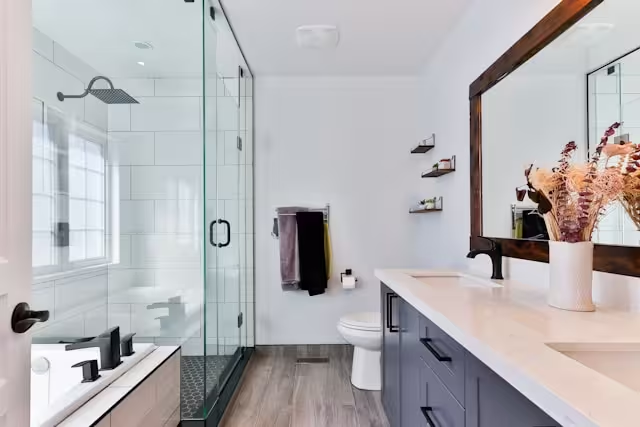
- The Mistake: The most common mistake is the “builder-grade” fixture: a single bar of lights above the mirror. This casts harsh shadows under your eyes, nose, and chin.
- The Solution: The best light for a bathroom is task lighting placed vertically. We install sconces on both sides of the mirror, at eye level. This provides even, cross-illumination with no shadows. Use high-CRI (90+) light bulbs with a 3,000K to 4,000K temperature for the most accurate reflection.
- 3. The Living Room / Reading Nook:
- Ambient: This room is for relaxing. Your overhead light bulbs should be dimmable and Warm White (2,700K – 3,000K). This creates a cozy, comfortable atmosphere.
- Task: This is where you address the question: What is the best light bulb for reading with macular degeneration? The answer is not just a bulb; it’s a dedicated lamp.
- Get a high-quality, adjustable floor lamp or desk lamp. Place it beside or just behind your reading chair so the light shines on the page, not in your eyes.
- For this lamp, use a dedicated task light bulb:
- Lumens: High (at least 1,100)
- Kelvin: Cool (4,000K – 5,000K) for maximum contrast.
- CRI: 90+ (non-negotiable).
Recommended Brands and Products (Specific Entities)
People often ask for specific recommendations. While one brand cannot be endorsed, there are product lines that are built on the principles we’ve discussed. When you shop, look for these names on the box, as they are specifically designed to be better light bulbs.
- Philips “EyeComfort”: Philips created this entire line to address the problems of flicker and glare. Their light bulbs are tested to be flicker-free and are designed for visual comfort.
- GE “Reveal” or “HD Light”: These are GE’s high-CRI light bulbs. They are designed to make colors “pop” and appear more vibrant. This is an excellent choice for kitchens, bathrooms, and reading nooks.
- OttLite: This is a brand often recommended by and for the low-vision community. They specialize in high-contrast, low-glare, “full-spectrum” task lamps. If you need a serious reading lamp, this is a great place to start.
- Feit Electric / Sylvania / Luxrite: All of these major brands now offer excellent “High CRI” or “CRI 90+” LED light bulbs. The key is that you must read the “Lighting Facts” label on the box to confirm you are getting the 90+ CRI, the right Lumens, and the right Kelvin.
These are not just any light bulbs; they are precision tools designed for visual clarity.
Lighting is a Foundation, Not an Accessory
When you are planning a new custom home, or just making your current home safer and more comfortable, do not treat your light bulbs as an afterthought.
Lighting is not an accessory. It is a foundational system, just like your plumbing or your HVAC. It is the system that supports your comfort, your safety, and your independence every single day.
By being precise and intentional, you can create a space that is truly livable. By focusing on the “Big Three”—Lumens (brightness), KelVIN (color), and CRI (clarity)—you are building a home that will support you for life.
Finding the best light bulbs for aging eyes and low vision is not a minor detail; it’s a important part of the job.