Your home’s siding, whether it’s beautiful brick, classic vinyl, or durable fiber cement, is its “raincoat.” But even the best raincoat can leak in a driving storm. Your house wrap, known in the industry as a Weather-Resistant Barrier or WRB, is the high-tech, breathable layer underneath that truly keeps your home’s structure protected.
Many people don’t realize the precise, engineered function of this house wrap. It is not just paper. It is a defense system. A properly installed house wrap is essential for protecting your home’s long term integrity from water, air, and moisture. These are the three elements that can, over time, destroy a building.
This article will explain exactly what a house wrap does, why it’s so important, and what you, as a homeowner, need to know.
The Three Primary Purposes of a House Wrap
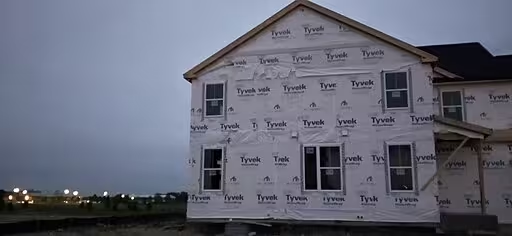
A house wrap is not a simple product. It is a multi-function material designed to perform three specific jobs at the same time. If any of these three fails, your home is at risk.
1. Bulk Water Resistance
This is the most obvious job of a house wrap. It is the “barrier” part of its name. No matter how well it is installed, almost all siding will eventually let some water get behind it. This is not a sign of a bad product. It is just a fact. Driving rain, especially the kind we get here in East Tennessee, pushes water through tiny cracks, seams, and overlaps.
This is where it does its first job.
When water gets past your siding, it hits the house wrap. Because it is installed in a “shingle style,” with the upper layers overlapping the lower layers, gravity takes over. The water hits the surface, runs down, and is directed safely away at the bottom of the wall. It never gets a chance to touch the home’s wood sheathing (the OSB or plywood) or the framing (the 2×6 studs).
Think of your house wrap as a complete, unbroken drainage plane. It is your home’s real protection against liquid water. Without this layer, that water would soak directly into the wood. This leads to wood rot, which weakens your home’s structure. A good house wrap is the first line of defense against this “bulk water.”
2. An Effective Air Barrier
This second function is one that many people miss. A modern house wrap, when the seams are properly taped, also acts as a powerful air barrier.
Why does this matter? Comfort and cost.
Your home’s insulation, that fiberglass or foam in your walls, works by trapping still air. That trapped air is what stops heat from moving. It has a specific “R-value,” which is a measure of its power to insulate.
But what happens when a strong winter wind blows? If there is no air barrier, that cold air can push through tiny cracks in the sheathing and directly into your insulation. This is called “air infiltration.” When this happens, your insulation’s R-value drops dramatically. It’s like wearing a thick wool sweater in a windstorm. The sweater is warm, but the wind cuts right through it.
Your house wrap is the “windbreaker” you wear over the sweater. It stops the wind from getting to the insulation. By sealing the outer shell of your home, it protects your insulation and allows it to do its job.
This function of the house wrap makes your home far more comfortable by stopping drafts. It also makes your home more energy efficient. Your heating and cooling system doesn’t have to work as hard, which saves you money on your utility bills every single month. A well-installed house wrap is a key part of an energy efficient building.
3. Vapor Permeability (The “Magic” Function)
This third job is the most brilliant piece of engineering, but it’s also the most misunderstood. A house wrap is a “breathable” material.
This is critical because your family creates a lot of moisture inside the home. Every time you cook, take a shower, run the dishwasher, or even just breathe, you are releasing water vapor into the air. In the winter, this warm, moist air wants to move to a colder, drier place, which is outside.
This moisture moves right through your drywall and insulation. If it gets trapped, it will hit the cold surface of your wall’s sheathing and condense. This means it turns from a gas (vapor) back into a liquid (water). This condensation, trapped inside your wall, is a recipe for disaster. It is the perfect food source for mold, mildew, and rot.
This is where its magic comes in.
A house wrap is engineered to be vapor permeable. It is designed to stop liquid water, but allow water vapor to pass right through. The material has microscopic pores. A liquid water droplet is too large to fit through the pores, so rain stays out. But a water vapor molecule is tiny and can easily pass through, so moisture from inside can escape.
This is why a good house wrap is essential for a healthy wall system. It lets your house “breathe out,” allowing any moisture in the wall cavity to dry safely to the outside. This “perm rating,” or “permeability,” is what makes a house wrap so different from a simple plastic sheet.
Common Questions About House Wrap
As an expert, I get asked the same questions all the time. Let’s clear up some of the most common points of confusion about house wrap.
“Is house wrap really necessary?”
Yes. It is absolutely necessary. In fact, all modern building codes, including the International Residential Code (IRC), require a “weather-resistant barrier.” It is not an optional upgrade.
Think about it this way: your siding is the “cladding.” It’s the aesthetic, visible layer. But the house wrap is the technical, “protective” layer. A home built without it is a home that is vulnerable from day one. Here in the Tri-Cities, with our humid summers and wet winters, I would never, as a professional, build a home without a proper house wrap. It is a fundamental part of quality construction and protecting your investment.
“What happens if you don’t use house wrap?”
Skipping the house wrap is one of the most dangerous and costly shortcuts a builder can take. The consequences are severe.
First, you will have a drafty, uncomfortable, and expensive home. Without the air barrier function of a house wrap, your energy bills will be high, and you will feel cold spots near the walls on windy days.
But the long term problem is far worse. It is not a matter of if water will get behind your siding, but when. When it does, there is nothing to stop it. That water will soak your home’s OSB or plywood sheathing. The wood will swell, delaminate, and lose its structural strength. The water will then find its way to your wooden studs and the sill plate, which is the wood that connects your house to the foundation.
This leads to wood rot. At the same time, this constant moisture, trapped in a dark wall, is the perfect environment for toxic black mold. This mold can grow for years, unseen, and release spores into your home, which can cause serious health problems and allergies.
Fixing this kind of damage is a nightmare. It requires removing all the siding, tearing off the rotted sheathing, replacing structural framing, and then putting it all back together. A $1,500 house wrap installation can prevent a $75,000 repair job down the road.
“What’s the difference between house wrap and Tyvek?”
This is a very common question, and the answer is simple. It’s like the difference between asking for a “tissue” and asking for a “Kleenex.”
Tyvek is a specific brand name of house wrap made by the company DuPont. They were pioneers in this technology, and their product is so well known that the name “Tyvek” has become a generic term for all house wrap.
Tyvek is a type of house wrap (a spun-bond polyolefin, to be technical). But there are many other excellent house wrap brands, such as Typar, Barricade, and James Hardie. So, all Tyvek is house wrap, but not all house wrap is Tyvek.
“Do you need house wrap with brick or stone?”
Yes. Absolutely, one hundred percent. This is one of the most critical applications for a house wrap.
Many people think brick is waterproof. It is not. Brick and stone are “reservoir claddings.” This means they act like a sponge and absorb a large amount of water when it rains.
Here is the problem: on a hot, sunny day after a rainstorm, the sun beats down on that wet brick. The water in the brick turns to steam (water vapor) and gets “driven” by the heat. This is called “solar drive” or “vapor drive.” Where does that high pressure moisture go? It goes inward, toward your house.
There is a required air gap (usually one inch) between the brick and your home’s sheathing. That high-pressure, moist air will fill that gap. The only thing protecting your home’s wood structure from that moisture is the house wrap.
Without a quality house wrap, this inward-driven vapor would soak your sheathing, leading to rot. However, it is not just for vinyl siding.25 It is arguably even more important behind a reservoir cladding like brick or stone.
House Wrap vs. Vapor Barrier: A Critical Distinction
This is a technical point, but it is vital. A house wrap and a vapor barrier are not the same thing. In fact, they are designed to do the opposite job. Getting them mixed up is one of the worst mistakes a builder can make.
The Job of Your House Wrap
- Location: Goes on the OUTSIDE of the wall sheathing, behind the siding.
- Function: It is VAPOR PERMEABLE.
- Analogy: A GORE-TEX jacket. It blocks rain from getting in, but it lets your sweat (vapor) get out so you stay dry. Your house wrap stops rain, but lets internal moisture escape.
The Job of a Vapor Barrier
- Location: Goes on the INSIDE of the wall, on the “warm-in-winter” side of the insulation (right behind the drywall).
- Function: It is VAPOR IMPERMEABLE.
- Analogy: A plastic sandwich bag. Nothing gets in, and nothing gets out. It is used in very cold climates to stop the warm, moist indoor air from ever getting into the wall insulation in the first place.
Why the Difference Matters
What happens if someone installs an impermeable vapor barrier (like 6-mil plastic) on the outside of the house instead of a proper house wrap?
They create a “plastic bag” around the house. Rain still gets behind the siding. It hits the plastic and gets trapped. Moisture from inside the house still moves into the wall, hits the cold plastic, and condenses.
Now the wall is wet from both sides, and it cannot dry out. The plastic bag (the vapor barrier) traps all that water. The wall will rot in just a few years. This is a “double barrier” problem and guarantees catastrophic failure. Using the correct, breathable house wrap on the exterior is a core principle of building science.
Installation is Everything: Precision & Integrity
The best, most expensive house wrap in the world is completely useless if it is installed incorrectly. The details of the installation are what make it work.
A cheap house wrap installed perfectly will perform better than an expensive house wrap installed poorly.
Shingle-Style Lapping
Water flows downhill. This is a basic rule of physics. Your house wrap installation must respect this.
Every layer must be lapped over the layer below it. This way, any water that hits the surface flows down and off. If an installer puts the bottom layer over the top layer, they create a “scoop” that funnels water into the wall. This is a rookie mistake that I see all the time. Vertical seams must also be lapped correctly, usually by 6 to 12 inches.
Flashing Integration
The most likely place for a home to leak is around windows and doors. This is why “flashing” (the protective material around openings) is so important.
The house wrap and the flashing must be installed as a system. The house wrap must be lapped over the top flashing of a window, so water runs over the window. The window’s side flashing goes over the house wrap. It is a precise sequence of layers that creates a waterproof seal. A failure here is the number one cause of water damage and rot in a new home.
Seam Taping & Fasteners
To get the full air barrier benefit, all the seams of the house wrap must be taped with the manufacturer’s approved house wrap tape. This is what stops the air.
Furthermore, the house wrap should be attached with cap fasteners or cap nails. These are plastic nails with a large, one inch washer head. Using simple staples is a bad practice. Staples create tiny holes and can tear the house wrap in the wind. The caps seal the hole and hold the house wrap firmly, maintaining the integrity of the water and air barrier.
UV Exposure Limit
When you drive by a job site, you may see the house wrap exposed to the sun for weeks. This is a bad sign. All house wrap has a UV exposure limit, usually 90 to 180 days. The sun’s ultraviolet rays will break down and weaken the material. If it is left exposed for too long, it loses its water resistance and strength. It should be covered by siding as soon as possible.
Beyond the Basics: Types of WRBs
The world of house wrap has evolved. While standard house wrap is good, there are now specialized products that offer even higher performance.
- Traditional Asphalt Felt: This is “tar paper.” It was the standard for 70 years. It is a good water barrier and is very breathable. However, it tears easily and can be difficult to install correctly.
- Standard Synthetic House Wrap: These are the common products you see, like Tyvek HomeWrap or Typar. They are made from plastics (polyolefin) and are lightweight, strong, and easy to install.37 They are an excellent, reliable choice.
- Drainable House Wraps: This is a superior category. Products like Tyvek DrainWrap or Benjamin Obdyke’s HydroGap have a special texture, like wrinkles or spacers, that create a tiny drainage gap between the house wrap and the siding. This small gap allows water to drain away much faster and lets the wall dry out even quicker. I recommend these highly, especially behind tight-fitting siding.
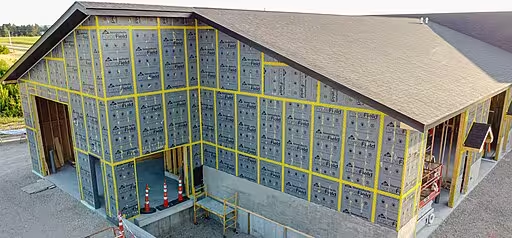
- Integrated Panels: This is a high performance system you may see, like Huber’s ZIP System. This product combines the wall sheathing (the OSB) and the weather-resistant barrier into a single panel.38 The green or brown panels are installed, and the builder simply tapes the seams. This is a very fast, precise, and effective way to create a perfectly sealed water and air barrier.
Conclusion: The Smart Choice for a Durable Home
So, what is the purpose of a house wrap?
It is not just a single thing. It is a precise, three-part engineering system.
- It blocks bulk water from rain.
- It stops air infiltration to save energy.
- It allows water vapor to escape to prevent mold and rot.
It is generally the things you don’t see are often what give a home its lasting value. The integrity of your builder is measured by how much precision they apply to the parts of the home that will be covered up.
A properly selected and installed house wrap is a commitment to quality. It is the un-sung hero that protects your framing, your insulation, and your family’s health.
When you are planning your new home here in the Johnson City, Kingsport, or Bristol area, ask your builder what kind of house wrap they use. Then, ask them how they install it. The precision in their answer will tell you a lot about the quality of the home they build.