Introduction to a House as a System
When you think about building a new custom home, what comes to mind first? For most people, it’s the things you can see and touch: the beautiful kitchen countertops, the layout of the rooms, the color of the siding, or the type of flooring. Those elements are certainly important; they are what make a house feel like your own. But oftentimes, the most critical parts of a great home are the ones you can’t see.
A truly well built house is like a high performance vehicle or even the human body. Every single part, from the engine to the exhaust, from the bones to the skin, has to work together in harmony. If one component is off, the entire system suffers.
This guide is for anyone in the Tri-Cities area of Tennessee who is planning to build, considering a major renovation, or simply wants to understand their home on a deeper level. The principles we will discuss are the difference between a house that constantly fights you with high energy bills, drafts, and moisture problems, and a house that works for you, providing comfort, health, and security for decades. Understanding the concept of the house as a system is the single most important piece of knowledge you can have before you build. It empowers you to ask the right questions and ensure you get the quality and performance you are paying for.
What Does “The House as a System” Actually Mean?
Bascially, the idea of “the house as a system” is a foundational principle of what we call building science. It’s a straightforward but powerful concept: all the components of your home are connected, and they all interact with each other, with you and your family, and with the outside climate. You cannot make a change to one part of the house without causing an effect, sometimes an unexpected one, somewhere else. A builder who doesn’t understand this will treat a build like a checklist of separate items. They’ll hire a framer, then an electrician, then a plumber, and an HVAC contractor, with each one only focused on their individual task. This is how mistakes are made.
So, what is a whole house system approach? It’s a deliberate strategy of looking at the entire house as one big machine designed for living. Instead of just installing insulation, we consider how that insulation will work with the air sealing strategy and the heating and cooling system. Instead of just putting in a powerful bathroom fan, we think about where that fan will pull its makeup air from, ensuring it doesn’t create negative pressure that could pull harmful gases like radon or carbon monoxide into your living space.
This approach is not about adding expensive gadgets or complicated technology. It’s about smart, intentional design from the very beginning. The ultimate goal is to build a house that excels in four key areas:
- Durability: The house must be built to last for generations. This means expertly managing the forces that work to destroy a house, primarily water, air, and heat. A durable house is one that successfully controls these elements.
- Comfort: Your house should be a refuge. That means maintaining consistent temperatures from room to room and floor to floor, managing humidity effectively, and eliminating drafts.
- Health: The air inside your house has a direct impact on your family’s health. A systems based approach focuses on providing excellent indoor air quality by controlling pollutants and ensuring a steady supply of fresh, filtered air.
- Efficiency: A well built house should not waste energy. By designing the systems to work together, we can dramatically reduce the amount of energy needed to heat and cool the house, saving you a significant amount of money on utility bills for as long as you live there.
Thinking this way moves the process from simple construction to true craftsmanship. It requires a builder to be a conductor of an orchestra, not just a manager of individual musicians. Every piece must be in tune and timed correctly for the final performance to be a success.
The Four Primary Interacting Systems of a Home
To truly grasp how a house works, we need to break it down into its four main components. Think of these as the primary players on a team. The success of the team depends entirely on how well these players communicate and work together. The four systems are the building envelope, the mechanical systems, the external environment, and you, the occupants.
1. The Building Envelope (The Skin)
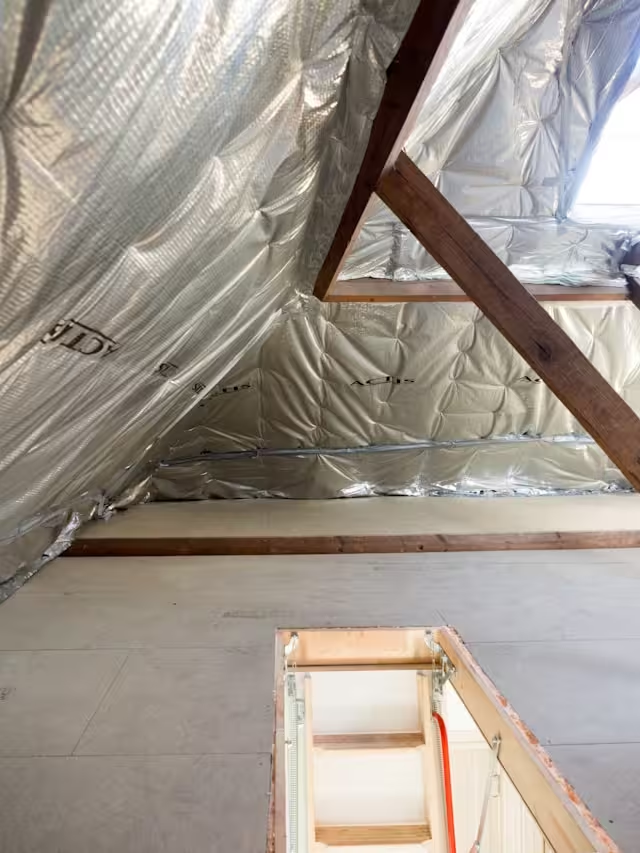
The building envelope is the physical barrier that separates the inside of your house from the outside world. It is everything that surrounds you: your foundation, the exterior walls, the windows and doors, and the roof. Its job is arguably the most important in the entire house. A poor envelope will undermine everything else you try to do. The envelope has three distinct but related jobs to perform.
First is the thermal boundary. This is what most people think of as insulation. Its job is to slow the movement of heat. In the winter, it keeps the heat your furnace produces inside the house. In our hot Tennessee summers, it keeps the sun’s heat outside the house. This boundary must be continuous, like a perfectly wrapped blanket around the entire conditioned space, from the concrete slab or basement floor all the way up to the ceiling of the top floor. Gaps in insulation, like those often found around recessed lights or complex framing, act like holes in the blanket, leaking your expensive conditioned air.
Second is the air barrier. This is just as important as the thermal boundary, but it is far less understood by most people. The air barrier’s job is to stop the uncontrolled movement of air through the envelope. Every little crack and crevice, from the gap under a baseboard to the unsealed top of a wall, adds up.
Studies have shown that these tiny leaks combined can be equivalent to leaving a window wide open all year long. A leaky house is a drafty house, an inefficient house, and it can be an unhealthy house, as it can pull in dust, pollen, and moisture from crawlspaces and attics. Building a tight house is a cornerstone of modern construction. We achieve this with careful taping of sheathing seams, caulking, and using gaskets and sealants at every penetration.
Third is the water and moisture barrier. This layer is designed to keep rain and ground water out of your house. This includes the siding, the house wrap beneath it, flashing around windows and doors, and the waterproofing on your foundation. Just as important, it must also manage moisture vapor. Moisture is constantly trying to move through materials, and if it gets trapped inside your walls, it can lead to devastating mold, rot, and structural failure. A properly designed wall system allows any moisture that does get in to dry out, either to the inside or the outside.
This is why the choice of materials and how they are layered is so critical. A house must be able to breathe, or more accurately, it must be able to dry.
2. The Mechanical Systems (The Organs)
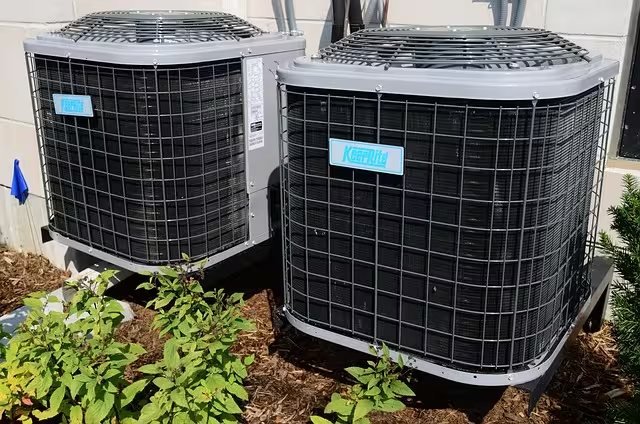
If the envelope is the skin, the mechanical systems are the internal organs that keep the house functioning. They are the active systems that heat, cool, ventilate, and provide power and water.
The most prominent of these is the HVAC system, which stands for Heating, Ventilation, and Air Conditioning. This is the lungs and circulatory system of your house. It moves conditioned air to keep you comfortable. A critical mistake many builders make is installing oversized equipment. They operate on an old belief that bigger is better. In reality, an oversized air conditioner or furnace is inefficient. It will turn on, blast the house with cold or hot air to satisfy the thermostat quickly, and then shut off. This constant starting and stopping is inefficient and causes major wear and tear.
More importantly, this short cycling process does not run long enough to properly dehumidify the air, leaving you with that cold, clammy feeling during our humid summers. A properly sized HVAC system, based on a careful analysis of the house and its specific heat loss and gain, will run longer at a lower level, providing better comfort, superior humidity control, and using far less energy.
Ventilation is the “V” in HVAC, and in a modern, tight house, it is not optional. A house needs to breathe. Since we have sealed up all the unintentional leaks, we must provide a controlled, intentional way to bring fresh air in and exhaust stale, polluted air out. This is usually done with a dedicated ventilation system, such as a Heat Recovery Ventilator (HRV) or Energy Recovery Ventilator (ERV), which brings in fresh air while transferring heat and humidity from the outgoing air, saving energy. Simple exhaust fans in kitchens and bathrooms are also a crucial part of the ventilation strategy.
The plumbing and electrical systems are also integral parts of the whole house system. The location of plumbing lines can affect energy; running hot water lines through a cold crawlspace is a recipe for wasted energy and long waits for hot water at the tap. The electrical system also interacts with the envelope. As we mentioned, every hole cut for a light, switch, or outlet is a potential air leak that must be sealed. Choosing energy efficient lighting and appliances reduces the internal heat load of the house, which in turn reduces the demand on your air conditioning system.
3. The Environment (The Climate)
No house exists in a vacuum. It is constantly interacting with its external environment. The specific climate of the Tri-Cities area, with its hot and humid summers, cold winters, and significant rainfall, must be a primary consideration in every design choice. The strategies for building a great house in Johnson City are different from those for building in a dry climate like Arizona. We have to focus intensely on moisture management and dehumidification.
The specific site of your house also matters. How is the house oriented on the lot? Can we position windows to capture warming sunlight in the winter but shade them with overhangs in the summer? Are there prevailing winds we need to account for? Are there large deciduous trees that will provide free shade in the summer but let sunlight through in the winter? A smart builder uses the natural environment as a partner, not an adversary. This is a key part of the systems approach.
4. The Occupants (The Brains and Inhabitants)
The final, and perhaps most unpredictable, part of the system is you and your family. People have a massive impact on how a house performs. We generate moisture through daily activities like cooking, showering, and even breathing. A family of four can release several gallons of water vapor into the air of a house every single day. We also generate indoor pollutants from cleaning products, personal care items, and cooking fumes.
Your habits directly influence the house. Do you use the exhaust fan every time you shower? Do you keep the thermostat at a constant temperature or adjust it frequently? How you live in the house affects its energy use, its moisture levels, and its overall health. A well designed house is more forgiving of different lifestyles, but it’s important to understand that the occupants are an active part of the system. The house is designed to work for you, but you also have to work with the house.
How These Systems Interact: The Crucial Connections
Understanding the individual parts is only the first step. The real magic, and the place where expertise truly matters, is in understanding how these systems interact with each other. A house is a complex web of cause and effect. Let’s look at a few practical, real world examples that show why a systems approach is not just a theory but a necessity.
Example 1: The Tight House and Fresh Air
As we discussed, modern building science tells us to build the envelope as airtight as possible. This is a huge win for energy efficiency. By stopping uncontrolled air leaks, we dramatically reduce the amount of work your HVAC system has to do. A tight house is much cheaper to heat and cool. However, this creates a potential new problem. If you seal a house up like a plastic bag, you trap all the indoor air pollutants inside. Dust, dander, chemicals from new furniture, and moisture from daily life have nowhere to go. The indoor air quality can quickly become worse than the air outside.
This is where the systems interact. A tight building envelope (System 1) absolutely requires a high quality mechanical ventilation system (System 2). They are not separate choices; they are two parts of a single strategy. The ventilation system provides a controlled supply of fresh, filtered air while exhausting the stale, moist air. Without planned ventilation, a tight house can become an unhealthy house. A builder who doesn’t understand this might focus only on making the house tight for efficiency, completely overlooking the critical need for fresh air, leading to a home that could have issues with mold and poor air quality down the road.
Example 2: Insulation, Windows, and HVAC Sizing
Let’s imagine you are building a new house and you decide to invest in upgrading the building envelope. You choose high performance windows that have special coatings to block summer heat, and you add extra insulation in the walls and attic, going well beyond the minimum code requirements. This is a smart investment in the envelope (System 1).
What is the ripple effect of this decision? A builder using a whole house approach knows that this dramatically changes the needs of your mechanical system (System 2). Because your new house will be so much better at keeping heat out in the summer and in during the winter, it will require a much smaller furnace and air conditioner. A traditional contractor might use an old rule of thumb to size your HVAC equipment, ignoring your upgrades. They would install a large, powerful unit that is now completely oversized for your high performance house. As we discussed, this oversized system will be inefficient, noisy, and poor at controlling humidity.
The proper approach is to perform a detailed engineering calculation (called a Manual J) that takes your specific windows, insulation levels, and house tightness into account to select the perfectly sized equipment. By investing in the envelope, you get to save money on smaller mechanical equipment and then save even more money every month on your utility bills. That is the synergy of a house that works as a system.
Example 3: Recessed Lights and the Air Barrier
Here is a small detail that has a big impact. Recessed can lights are a popular feature in many new homes. From the perspective of the electrical system (part of System 2), they are simple to install. However, from a building science perspective, each light can be a major problem for the building envelope (System 1).
Traditional recessed lights are notoriously leaky. Each one is essentially a five inch hole cut directly through your home’s air barrier and thermal boundary in the ceiling. If you have twenty of these lights in your house, you have created a massive pathway for hot attic air to enter your home in the summer and for your expensive heated air to escape in the winter.
A systems oriented builder knows this. They will insist on using specific models of recessed lights that are rated to be airtight and suitable for direct contact with insulation. They will also take the extra step of carefully sealing around the fixture from the attic side. It’s a small detail that takes a little more time and attention, but it pays huge dividends in comfort and energy efficiency. It’s a perfect example of how one system (electrical) can have a major, negative impact on another (the envelope) if not properly planned and executed.
Why This Matters to You: The Tangible Benefits
All this technical talk about building science and interacting systems is interesting, but what does it actually mean for you as a homeowner? The benefits are very real and impact your daily life and your wallet.
First and foremost is greater comfort. A house built as an integrated system is simply more comfortable to live in. Because the envelope is well insulated and airtight, you eliminate drafts and cold spots near windows and outlets. Temperatures are remarkably consistent from room to room, and between floors. Furthermore, a properly sized HVAC and ventilation system provides superior humidity control, which is essential in our East Tennessee climate. It removes that sticky, clammy feeling in the summer and prevents the overly dry air in the winter that can lead to irritated sinuses and static electricity.
Second is a healthier home. We now know that indoor air can be many times more polluted than outdoor air. A systems built house directly addresses this. By sealing the house off from dirty spaces like garages, crawlspaces, and attics, and then providing a constant, controlled supply of fresh, filtered air, we can dramatically improve indoor air quality. This controlled ventilation reduces the buildup of allergens like dust and pollen, volatile organic compounds (VOCs) from building materials and furnishings, and moisture that can lead to mold and mildew. This can have a real impact on families, especially those with allergies or asthma.
Third is increased durability. Water is the number one enemy of any house. A systems approach places an intense focus on moisture management. This isn’t just about shedding rain. It’s about controlling the flow of water vapor through the wall assemblies and preventing condensation inside your walls where it can cause unseen rot and structural damage. A house that is designed to manage moisture will last longer and require fewer major repairs over its lifetime.
Finally, there are the lower ownership costs. While some high performance components might have a slightly higher upfront cost, the house as a system is designed for efficiency. This translates directly into lower utility bills, month after month, year after year. An efficient house requires a smaller, less expensive HVAC system. The savings on energy bills often provide a rapid return on the initial investment and then continue to put money back in your pocket for as long as you own the house. A house built to standards like those from ENERGY STAR is a testament to how a systems approach can deliver a superior product that costs less to operate.
The Builder’s Role: Finding a Partner with Integrity

Ultimately, the performance of your new house rests in the hands of the person building it. A truly competent builder is more than just a project manager; they are a systems engineer. They understand the science behind how a house works and they have the integrity to ensure that every detail, seen and unseen, is done right.
When you are interviewing potential builders for your custom home, you need to listen for clues that they understand these concepts. If a builder only wants to talk about finishes and square footage costs, be cautious. A great builder will want to talk about performance. They will be passionate about the science behind creating a comfortable, healthy, and durable house.
To help you find the right partner, here are three essential questions you should ask every potential builder:
- “How do you approach the house as an integrated system?”Listen to their answer. Do they talk about the connection between the envelope and the mechanicals? Do they mention building science? Their response will tell you if they see the big picture or if they just see a collection of separate jobs.
- “What are your specific strategies for air sealing the building envelope?”This is a technical question, but a good builder will have a ready answer. They should mention specific techniques like using acoustical sealant at the bottom plate, sealing around windows and doors with high quality tapes or foam, and using airtight electrical boxes. Their answer will reveal their level of detail and commitment to building a tight house.
- “How do you ensure the HVAC system is properly sized for the house?”The only correct answer involves a mention of doing a formal load calculation, like a Manual J. If they mention rules of thumb, like “one ton of AC for every 500 square feet,” that is a major red flag that they do not follow modern best practices.
Building a new house is one of the most significant investments you will ever make. By understanding the core concept of the house as a system, you are no longer just a client; you are an informed partner in the process. You are equipped to ask the right questions and to choose a builder who has the competence and integrity to deliver a home that performs as beautifully as it looks. Your house should be your sanctuary, a place of comfort, health, and security for your family. A systems based approach is the most reliable path to ensuring it will be just that, not a collection of frustrating problems waiting to happen.