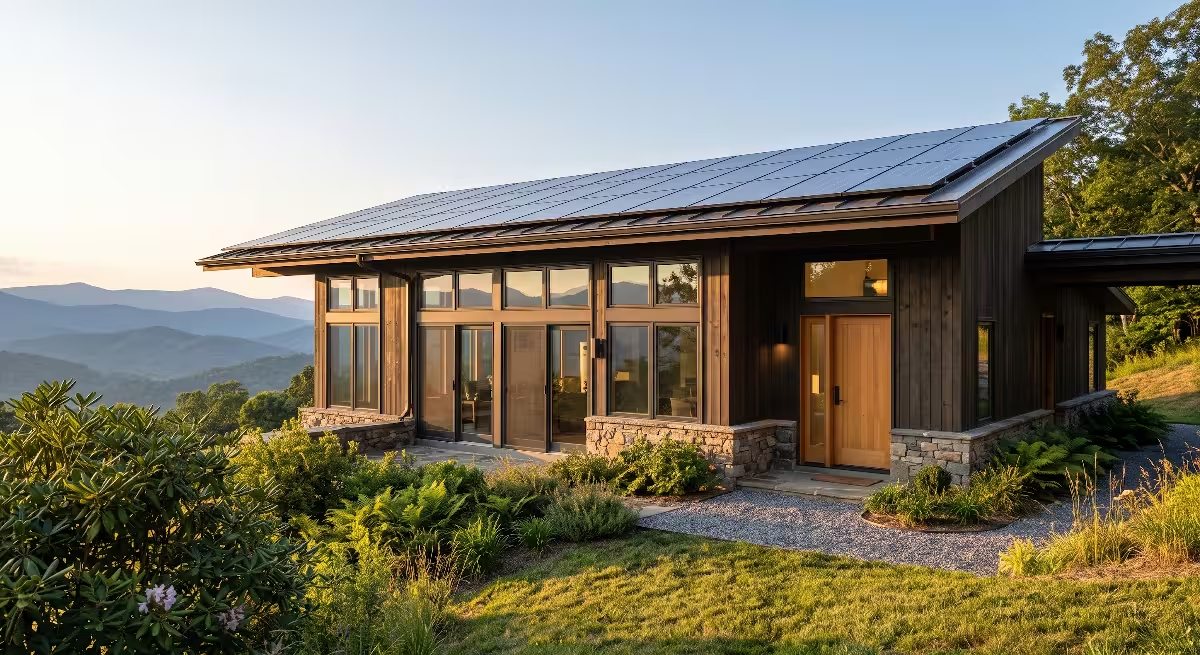


A lot of buyers in the Tri-Cities of TN want a custom home that feels open, airy, and impressive. Nothing achieves that “wow” factor quite like a soaring two-story great room, a vaulted living space, or a dramatic entryway. That high ceiling is often the centerpiece of the design, flooding the room with natural light and giving it a sense of luxury.
But here is the precise problem: that beautiful high ceiling can be a significant engineering challenge. The room with the highest ceiling is almost always the hardest room in the house to keep comfortable. It’s the room where you feel cold drafts on the floor in the winter, even when the thermostat is set to 72. It’s the room where the air conditioner seems to run all summer long, yet the space still feels warm and sticky by the afternoon.
The dream of that stunning ceiling quickly becomes a frustration. You’re paying high energy bills for a room that is never the right temperature. The issue isn’t that a high ceiling is “bad”; it’s that it creates a unique physical challenge that most standard-built homes are simply not equipped to handle. You are not just dealing with floor space; you are dealing with massive air volume.
In this article, we will explain the engineering of why this happens and give you a calm, competent plan to manage it. We’ll cover everything from the physics of the problem to the specific HVAC systems and building techniques you need. Whether you are planning a new custom home in the Tri-Cities area or trying to fix an existing one, this guide will give you the precise information you need to make that beautiful room with its impressive ceiling comfortable all year round.
Video Version of the Article
The Physics of the Problem: Understanding “Thermal Stratification”
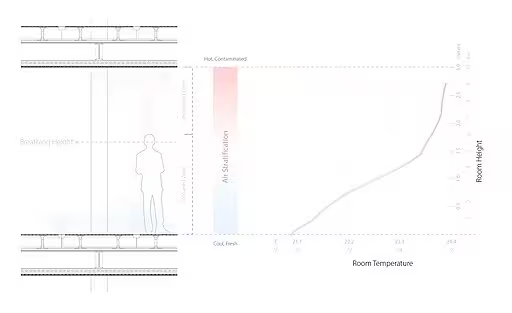
Why is your high ceiling room so uncomfortable? The answer, in technical terms, is thermal stratification. That’s just an engineer’s way of saying “heat stacking,” and it’s the single biggest enemy of comfort in a high-volume room.
The physics are simple and work against you in both winter and summer.
The Winter Challenge: Heat Rises
You know this basic fact: hot air rises. In a standard room with an 8-foot ceiling, this isn’t a major issue. The hot air hits the ceiling and is forced back down, mixing the air.
Now, let’s look at your 20-foot vaulted ceiling. Your furnace, likely located in a basement or crawl space, turns on. It blows warm, light air through the vents, which are often in the floor or low on the wall. Where does that expensive warm air go? Straight up. It rises past you, past your thermostat, and pools at the very peak of your high ceiling.
You can have a 20-degree difference between the floor and the ceiling. The air 25 feet up at the peak of your ceiling might be a toasty 85 degrees, while the air at your feet is a chilly 65 degrees.
Your thermostat, which is mounted on the wall about five feet off the floor, is stuck in the middle. It might read 70 degrees, so it tells the furnace to shut off. But you feel cold because the air around you is cold, and the cold floor is pulling heat from your body. The only part of your room that’s comfortable is the ceiling itself, and you aren’t living up there. This stratification near the ceiling is the core problem.
The Summer Challenge: Trapped Heat
You might think that since heat rises, a high ceiling would be a good thing in the summer. It’s not.
First, that high ceiling often comes with a wall of beautiful windows. The sun’s radiant heat beams through that glass all afternoon, acting like a greenhouse. This heats the air inside, which then rises and gets trapped at the peak of the ceiling. You now have a massive pocket of 90-degree-plus air trapped at the top of the room.
Second, your air conditioner is trying to fight this. It pumps out cold, heavy air. This cold air does the opposite of the hot air: it sinks. It comes out of the vents and pools on the floor, creating a cold, clammy layer at your feet.
Meanwhile, that giant bubble of hot air at the ceiling is constantly radiating heat down into the room, and your AC unit simply cannot keep up. It runs and runs, trying to cool the entire volume of the room, while your thermostat (again, stuck in the middle) gets confusing signals. The system is overworked, inefficient, and failing to make you comfortable. That high ceiling creates a massive buffer of hot air that your system can’t remove.
The Foundation: Passive Solutions & The Building Envelope

Before we talk about fans and furnaces, we have to start with the “building envelope.” This is the shell of your home: the walls, the windows, the foundation, and, most importantly, the roof or ceiling assembly.
However, you cannot fix a comfort problem with a bigger HVAC system. You must first build a better “box.” You must control the environment passively. If you have a high ceiling, this is not a recommendation; it is a requirement.
A. Superior Insulation
Insulation is the single most important part of managing a room with a high ceiling. Its job is to stop the transfer of heat. You’ll hear insulation talked about in terms of R-value. Think of R-value like the rating on a winter coat. A higher number means more protection.
In a room with a vaulted ceiling, the “ceiling” is also your roof assembly. This area is critical. In our Tri-Cities climate, you should be aiming for an R-value of R-38 to R-60 in your ceiling. But it’s not just about the amount of insulation; it’s about the type and quality of the installation.
- Spray Foam Insulation: For a complex vaulted ceiling, closed-cell spray foam is the best product. It’s applied as a liquid and expands to fill every single crack, joint, and gap. It nott only insulates (high R-value per inch), but it also creates a perfect air seal and vapor barrier. This is vital. It stops the warm, moist air from inside your home from hitting the cold roof deck in winter and causing condensation or frost. It’s more expensive up front, but it solves many problems at once.
- Traditional Fiberglass Batts: Standard fiberglass batts can also work, but the installation must be perfect. With a high ceiling, this is difficult. Every gap around a light fixture, every compressed batt, every unsealed joint is a “thermal bridge,” a highway for your expensive heated air to escape. If you use batts in a vaulted ceiling, you must ensure your builder is also installing a separate, meticulously sealed vapor barrier and paying extreme attention to detail. A poorly insulated ceiling will doom your comfort from day one.
B. High-Performance Windows
As I mentioned, a high ceiling almost always comes with a large wall of windows. These windows can be a huge source of heat loss in the winter and heat gain in the summer.
You are not just buying a “window”; you are buying a piece of technology. Here is what you, as an educated home buyer, need to look for:
- Low-E (Low-Emissivity) Coatings: This is a microscopic, invisible metallic coating on the glass. It’s a heat reflector. In the summer, it reflects the sun’s infrared heat out of your home. In the winter, it reflects your home’s own furnace heat back into the room instead of letting it escape.
- SHGC (Solar Heat Gain Coefficient): This is a number between 0 and 1 that measures how much of the sun’s heat the window allows to pass through. In Tennessee, where we have hot, sunny summers, you want a low SHGC. This will stop your high-ceiling room from turning into a greenhouse.
- U-Factor: This measures how well the window insulates (the opposite of R-value). Here, you want a low number.
Always look for the Energy Star label. For our “South-Central” climate zone, it will guide you to the right combination of these ratings. Skimping on windows in a high-volume room is a mistake you will pay for every month on your energy bill.
C. Strategic Window Treatments
Finally, a simple and effective passive solution is to use high-quality window treatments. This is a solution you can add to any home, new or old.
Think of shades or curtains as another layer of insulation for your windows. The best type for insulation is cellular shades (also called honeycomb shades). They are designed with small pockets or “cells” that trap air, slowing down heat transfer.
For those windows 20 feet up near the ceiling, you will obviously need a motorized or remote-controlled system. Keeping these shades down on a hot summer afternoon or a cold winter night will make a noticeable difference in the room’s comfort and take a significant load off your HVAC system.
The “How-To”: Active Solutions for Air Circulation
We have now built a tight, well-insulated “box.” The heat or cold we put into it will stay there longer. But we still have the physics problem: the hot air will go to the high ceiling, and the cold air will stay on the floor.
The solution is not to create more heat, but to move the air you’ve already paid to heat or cool. You must actively mix the air in the room to break up the stratification.
A. The Ceiling Fan: Your Most Valuable Tool
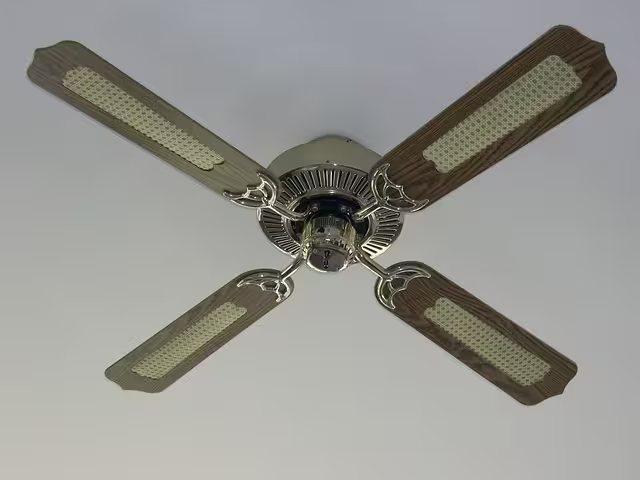
This is your number one weapon. But I find that about 90% of homeowners use their ceiling fan wrong, or they have the wrong size ceiling fan.
A ceiling fan’s job is not just to “cool” you; its job is to circulate air. It must be used correctly for the season.
- In the Winter: This is the most important and most-missed tip. Your ceiling fan must run in REVERSE (clockwise) on a LOW speed. Look for the little switch on the fan’s body. Why? A low-speed clockwise motion pulls the cool air from the floor up toward the ceiling. This gently and slowly pushes that giant, wasted pool of hot air trapped at your high ceiling down the walls and across the floor. You will not feel a draft or a “wind.” You will simply feel the room’s temperature become even. This one change can make a room feel several degrees warmer and lower your heating bills.
- In the Summer: This is the direction you already know. Run the ceiling fan in FORWARD (counter-clockwise). This creates a direct downdraft, which creates a “wind-chill effect” on your skin. It doesn’t lower the temperature of the air, but it makes you feel cooler, allowing you to set your thermostat a few degrees higher.
A quick note on sizing your ceiling fan: A tiny fan in a huge room with a high ceiling is useless. You need a large-diameter fan (60 inches or more) and, critically, a downrod. A downrod is the metal pipe that connects the fan motor to the ceiling. You do not want the fan blades hugging the 25-foot ceiling. The fan should be brought down to a height of about 9 to 11 feet off the floor, where it can actually move the air where you live.
B. Strategic Vent and Return Placement
This is a technical solution that must be planned during the design phase of a new custom home. It is a critical part of a high-performance ductwork design.
Most HVAC systems have “supply” vents (where the air blows out) and “return” vents (where the air is sucked back to the furnace/AC). In most homes, all the returns are low on the wall or in the floor.
For a high ceiling room, this is a mistake. A truly competent HVAC designer will install a “high and low” return system.
- This system gives you two return vents in the room: one very low on the wall (near the floor) and one very high on the wall (near the ceiling).
- These vents are connected to a “damper” system, which is just a little lever or switch that lets you choose which one is open.
- In the Summer: You close the low return and open the high return. Now, your AC system is actively sucking that 90-degree hot air right off the ceiling and sending it back to be cooled. This is dramatically more efficient than trying to let the cold air on the floor “push” the hot air out of the way.
- In the Winter: You do the opposite. You close the high return and open the low return. This pulls the coldest air (which is sitting on your floor) back to the furnace to be heated. This also helps draw the warmer air from the ceiling downward.
This high/low return strategy, combined with a properly used ceiling fan, is the most effective one-two punch against stratification.
The “What”: Choosing the Right HVAC System
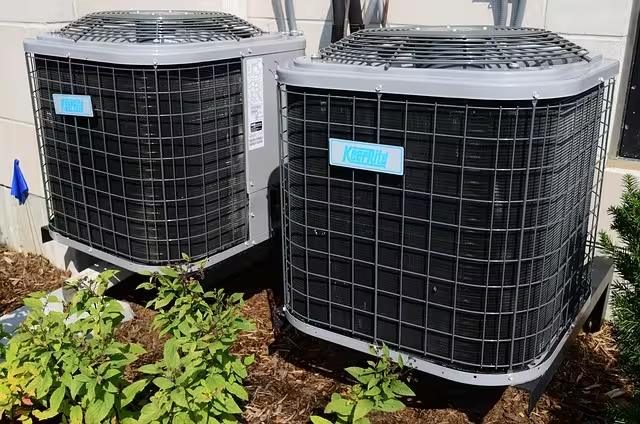
Finally, we get to the “engine” of your comfort: the HVAC (Heating, Ventilation, and Air Conditioning) system itself. You cannot put a 4-cylinder engine in a one-ton truck and expect it to perform. In the same way, you cannot use a basic, builder-grade system and expect it to handle the massive air volume of a high ceiling room.
Here are the systems and strategies you should be discussing with your builder.
A. The Critical Mistake: Sizing by Square Footage
This is the biggest mistake I see in the building industry, and it’s where my engineering background makes me very precise. A lazy or incompetent contractor will size your HVAC system based only on the home’s square footage (the floor area).
This is completely wrong.
You don’t live in a two-dimensional square. You live in a three-dimensional volume. We must heat and cool the entire volume (cubic feet) of the air. A 1,000-square-foot room with an 8-foot ceiling has 8,000 cubic feet of air. That same 1,000-square-foot room with an average 20-foot ceiling has 20,000 cubic feet of air—two and a half times the amount!
A professional builder and HVAC contractor will perform a Manual J calculation. This is a detailed engineering formula that accounts for everything: your home’s volume, the R-value of the ceiling and walls, the number and quality of your windows, which direction the home faces, and even how many people live there.
For a home with a high ceiling, this calculation is non-negotiable. Insist on it. An “undersized” system will run constantly and never keep up.12 An “oversized” system is just as bad. It will blast the room with cold air and shut off quickly, leaving the air feeling cold, damp, and clammy because it never ran long enough to remove the humidity. Sizing must be precise.
B. System 1: Variable-Speed Furnaces & Air Handlers
Standard, single-stage HVAC systems are either “on” (full blast) or “off.” This is jarring and inefficient, and it’s terrible for a high ceiling room. It lets the air stratify, then tries to fix it with a blast of air, then shuts off and lets it stratify again.
The modern, high-efficiency solution is a variable-speed system (also called “modulating”).
Think of this system like the gas pedal in your car. Instead of just “stop” and “full speed,” it can run at 30%, 50%, 70%, or any speed needed to precisely match the heating or cooling load of the room.
What’s the benefit? The system runs for much longer periods at a much lower, quieter speed. This constant, gentle circulation is exactly what a high-volume room needs. It never gives the air a chance to stratify. It continuously mixes the air, filters it, and controls humidity. This is the top-tier system for forced-air comfort, especially when dealing with a difficult high ceiling.
C. System 2: Ductless Mini-Splits (Heat Pumps)
What if you are already living in a home with a problem ceiling and you can’t (or don’t want to) replace your entire central system?
A ductless mini-split is a fantastic and highly efficient solution. You’ve seen them. They have a quiet “air handler” (the indoor unit) that mounts on the wall or ceiling, connected by a small conduit to a “condenser” (the outdoor unit).
The benefit here is targeted control. You can add a single mini-split system just for your great room. You can mount the air handler high on the wall to specifically attack that trapped hot air in the summer and blow heated air down in the winter. They are incredibly efficient, and because they are separate from your main system, they only run when that one room needs it. You can even get “multi-zone” systems where one outdoor unit runs two or three indoor units (for example, one high on the wall and one low) for perfect comfort.
D. System 3: Radiant Floor Heating
In our professional opinion, this is the single best and most comfortable way to heat a room with a soaring ceiling. It is a luxury solution, but it is brilliant because it completely bypasses the problem of stratification.
Radiant heating doesn’t heat the air. It heats objects.
The system consists of hot water tubes (hydronic) or electric warming mats (electric) installed directly under your flooring. The system turns your entire floor into a giant, gentle, warm radiator.
This “radiant heat” warms the floor, the furniture, and you. It’s like the feeling of sun warming your skin. The heat starts at your feet and warms your whole body. Because it’s not heating the air, it doesn’t matter that the hot air rises. The air at the 25-foot peak of your ceiling can stay cool, but you and everything in the “living zone” will be perfectly comfortable. It is silent, efficient, and delivers an unmatched quality of comfort. It is easiest to install in a new build (especially on a concrete slab) but can be added to retrofits as well.
E. System 4: HVAC Zoning
Zoning is a “smart” control solution that fixes a common problem. Think of it: your thermostat is on the wall in your great room, trying to manage that giant space. But that one thermostat also controls your bedrooms. To get the great room comfortable, the AC runs so long that the bedrooms become ice-cold.
HVAC Zoning divides your home into two or more “zones.” Your high ceiling great room becomes its own zone, with its own dedicated thermostat. The bedrooms are on a second zone, the kitchen on a third, and so on.
Automated “dampers” inside your ductwork open and close to send the heated or cooled air only to the zone that is “calling” for it. This is a game-changer. Your great room can now run its own schedule, and its high ceiling won’t “steal” all the comfort from the rest of the house. This is often combined with smart thermostats (like Ecobee or Nest) that have remote sensors, allowing you to place a sensor on the far side of the room to get a more accurate reading of its true temperature, not just the air at the thermostat.
Conclusion: A Competent Plan for a Comfortable Home
That beautiful, soaring ceiling in your custom home is a mark of luxury and good design. It doesn’t have to be a source of frustration, high energy bills, or cold feet.
Like any part of a custom build, a high ceiling just needs to be engineered with competence and precision. You cannot treat a 25-foot vaulted ceiling the same as a standard 8-foot ceiling and expect it to work.
The solution is a three-part, integrated plan:
- Control: Build a superior, well-sealed building envelope. This means a high R-value in the ceiling, high-performance windows, and meticulous air sealing.
- Circulate: Actively fight thermal stratification. Use a large, properly-sized ceiling fan (running in reverse in winter) and a “high-low” return vent system to keep the air mixed.
- Condition: Choose the right HVAC system. Size it for air volume (cubic feet), not just square footage. Invest in variable-speed technology, radiant heat, or a zoned system to deliver comfort efficiently.
If you are planning a custom home here in the Tri-Cities area, from Bristol to Johnson City, make sure your builder and your HVAC contractor are on the same page and are discussing these specific strategies. A high ceiling is a signature feature of a custom home, but it must be engineered correctly. When it is, you get to enjoy the “wow” factor and the comfort, all year round.