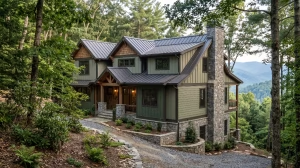
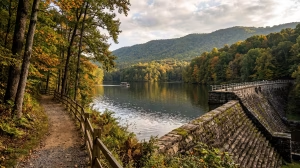
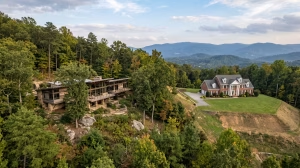
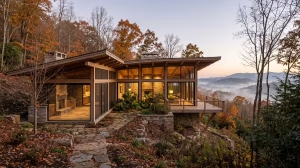
In East Tennessee, the dream of a custom home usually pulls you in one of two directions: down to the shimmering, cool edge of Watauga Lake, or up into the silent, mist-covered ridges of Roan Mountain. However, with all of these projects from the muddy banks of the Holston to the rocky spines of Unicoi County, it all comes down to the fantasy is about the view, the reality is about the dirt.
In 2025, the landscape of home building in our region has shifted. We aren’t just dealing with the usual variables of lumber prices and labor shortages; we are navigating a post-Helene world where logistics, regulation, and site accessibility have become the primary drivers of your budget. There are folks every week who have their floor plans perfected but haven’t considered that a concrete truck might not make it up their driveway, or that the TVA’s shoreline rules are more ironclad than the foundation they plan to pour.
The truth is, the cost to frame a house doesn’t change much whether you are at 1,500 feet elevation or 4,000. A 2×4 is a 2×4. But the cost to develop the site, to tame the land enough to build on it, creates a massive financial divide between the lake and the mountain. This guide isn’t just a list of prices; it’s a strategic formulation. We are going to break down the real costs of excavation, permitting, and infrastructure so you can decide not just where you want to live, but what you can actually afford to build.
The Baseline: Cost Per Square Foot in the Tri-Cities (2025)
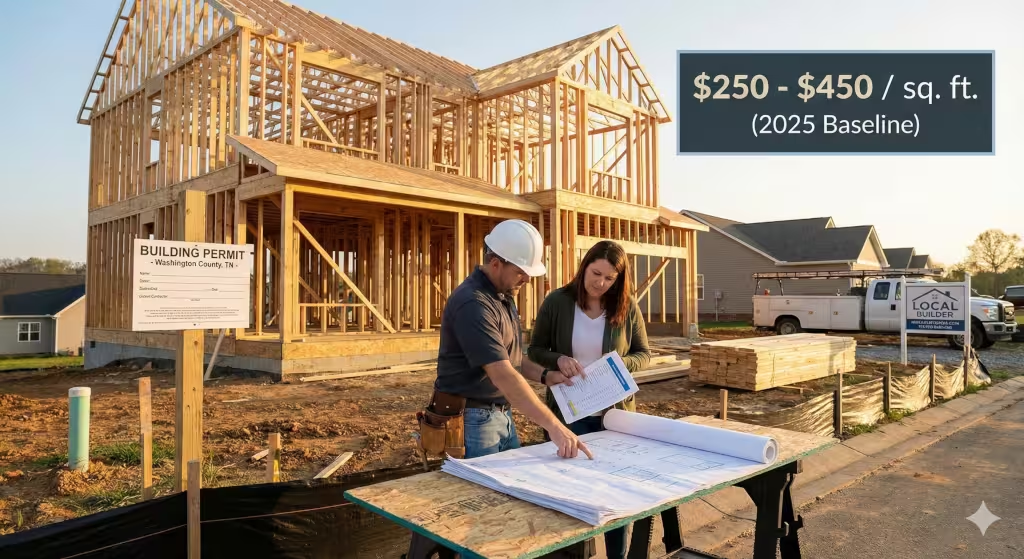
When you start to build a home, the first number everyone asks for is the “price per square foot.” It is the industry’s favorite shorthand, but in the Tri-Cities area, Johnson City, Kingsport, and Bristol, it can be dangerous if you treat it as gospel. In 2025, the baseline costs have settled into a new normal that reflects both global supply chains and hyper-local labor realities.
For a standard custom home in our region, you should expect to pay between $250 and $450 per square foot. This covers your typical “stick-built” home with high-quality finishes, hardwood floors, custom cabinetry, and energy-efficient windows. If you are looking to build a true luxury estate with heavy timber detailing or stone exteriors, that number can easily climb north of $500 per square foot.
Log and timber frame cabins, which are incredibly popular in our mountain counties, often carry a different price tag. While kit homes might advertise lower upfront material costs, the labor to assemble and finish them is specialized. For a turnkey log cabin, you are looking at a range of $200 to $350+ per square foot.
The Labor Shortage Factor
The biggest line item driving these costs in 2025 isn’t materials; it is labor. The construction workforce in the Tri-Cities has been stretched thin. We are seeing a significant shortage of skilled framers, masons, and electricians. When you plan to build, you are competing for the same limited pool of qualified subcontractors that are also working on large-scale commercial projects and regional infrastructure repairs. This supply-and-demand imbalance keeps labor rates high, meaning that “waiting for prices to drop” is likely a losing strategy.
Building a Lake House: The Cost of the Water
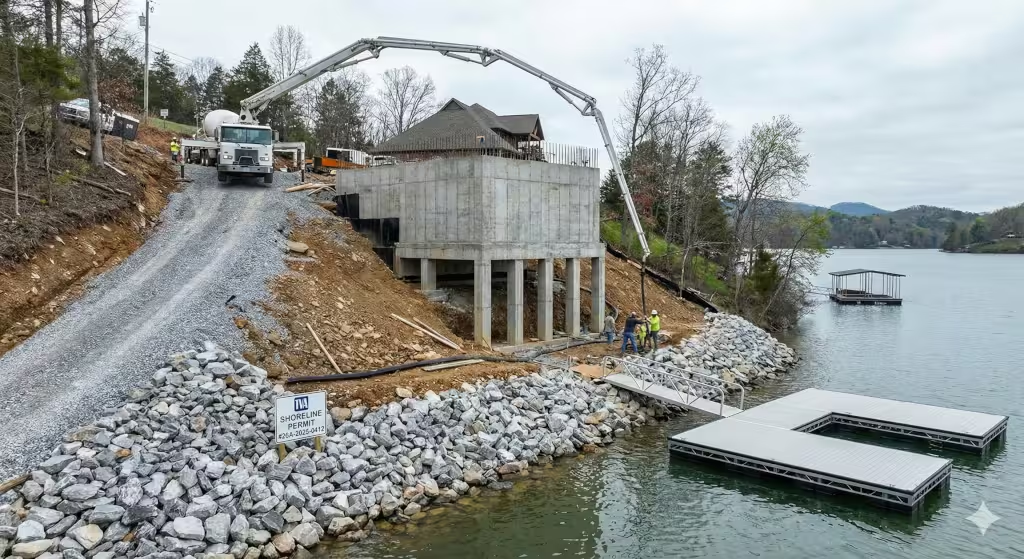
There is a premium on the water. When you look to build on Watauga, Boone, or South Holston Lake, you are buying into a federally managed ecosystem. The Tennessee Valley Authority (TVA) owns the flowage rights, and their regulations will dictate almost every move you make near the shoreline.
The Hidden “Lake Tax”: Site Prep & Permitting
The most critical acronym you need to know is 26a. This refers to Section 26a of the TVA Act, which requires a permit for any construction that affects the shoreline.
The Permit Cost: The application fee itself is relatively low, typically around $500 to $1,000 for a new dock or major shoreline alteration.
The Compliance Cost: The real expense comes from what the permit requires you to do. You may be required to install extensive erosion control measures, such as rip-rap (stone reinforcement) along the water’s edge for the entire water frontage. To properly build and stabilize a shoreline can cost anywhere from $10,000 to $50,000 depending on the length of your frontage. If you do not budget for this, your project will stall before you even break ground.
The Dock: A lake house without a dock has significantly lower resale value. However, you cannot just build whatever you want. TVA has strict rules on dock size (often limted to 1,000 square feet for residential), flotation materials (no un-encased styrofoam), and electrical safety. A permitted, professionally built dock in 2025 will run you $30,000 to $80,000 over and above the cost of the house. In addition, you must verify that the lot you are buying actually has dock rights. Some shoreline is classified as “Conservation” or :Sensitive Resource Management,” meaning you can never build a dock there, regardless of how much land you own.
Flood Insurance & Elevation
Post-2024 flooding events have made insurance providers and local building departments incredibly cautious. To build near the water now often means building up. You may be required to elevate your main living level several feet above the 100-year floodplain. This requires specialized foundation work, often reinforced concrete piers or tall block walls, which adds complexity and cost compared to a simple slab-on-grade. A “flow-through” foundation, which allows floodwaters to pass underneath the home without collapsing the walls, can add $15,000 to $30,000 to your foundation budget compared to a standard crawlspace.
If you build below the base flood elevation (BFE), your flood insurance premiums can be astronomical; sometimes exceeding $10,000 a year. By elevating the home properly during the build phase, you can reduce this premium drastically, but you pay for it upfront in concrete and engineering.
Construction Logistics: The Descent
Most lake lots in East Tennessee are not flat; they slope down from the road to the water. This “descent” is a logistical nightmare for heavy machinery.
Concrete Pumping: A standard concrete truck can’t drive down a steep, winding gravel driveway to the water’s edge. You will likely need to hire a concrete pump truck for every pour, footers, walls, and slabs. At $1,500 to $2,500 per visit, this adds up quickly.
Material Handling: If a delivery truck can’t get to the build site, materials have to be offloaded at the road and moved down by hand or with smaller equipment (skid steers). This “double handling” slows down the schedule and increases labor hours.
Building a Mountain Cabin: The Cost of the Climb
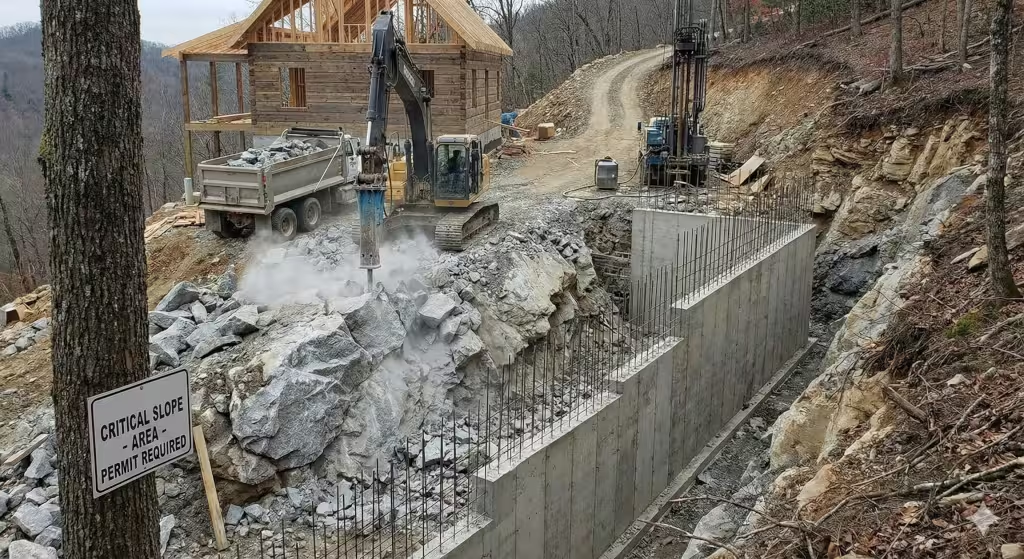
If the lake is about managing water, the mountain is about managing gravity and rock. When you build in Unicoi County, Carter County, or on the slopes of Roan Mountain, you are entering a physical battle with the terrain. The views are breathtaking, stretching across the Blue Ridge, but the price you pay for that vantage point is buried in the ground beneath your feet.
In 2025, the cost to build a mountain cabin has little to do with the style of the house and everything to do with the “climb;” the expense of getting materials, machines, and infrastructure up to a site that nature never intended for habitation.
The “Slope Penalty” and Critical Areas
In 2025, we are seeing stricter enforcement of “Critical Area” regulations due to the impacts of Hurricane Helene. Local planning commissions are wary of landslides and runoff.
Steep Slope Ordinances: Generally, any land with a grade over 15-25% falls into a “steep slope” category. To build here, you may need additional engineering stamps on your site plan, proving that your excavation won’t cause a slide.
Engineered Foundations: You cannot simply flatten a mountain ridge without massive expense. Instead, we often build on “steep slope foundations.” This usually involves a walk-out basement with tall, reinforced poured concrete walls on the downhill side.
Excavation & Blasting: This is the wildcard. East Tennessee mountains are full of limestone, granite, and shale. When we start digging for a foundation, there is a high probability we will hit solid rock, before reaching the depth we need. “Hammering” rock out requires a hydraulic breaker attachment for the excavator, which costs an extra $150 – $250 per hour. If the rock is too hard to hammer, we have to blast. Blasting can cost $10,000 to $30,000 instantly, blowing your budget before you even pour a footer.
Utilities & Infrastructure: The Remote Tax
When you build in a subdivision, you pay a tap fee and you have water and sewer. On the mountain, you are on your own.
Well Drilling: You need water. Drilling a well in the mountains is a gamble on depth. You might hit good water at 200 feet, or you might have to drill to 800 feet. At roughly $15-$25 per foot for drilling, plus the cost of the pump and casing, a deep mountain well can cost $15,000 to $25,000. Sometimes, we drill 800 feet and only get a trickle, about a half-gallon a minute. To fix this, we have to “frack” the well by injecting high-pressure water to crack the rock seams and open up more flow. This can add $2,500 to $4,000 to the bill.
Septic Challenges: Mountain soil is often rocky or thin, meaning it doesn’t “perc” (drain) well. If a standard gravity system won’t work, you have to build an alternative system, like a drip irrigation septic system. These require pumps, detailed engineering, and more expensive materials. While a standard septic might cost $6,000, a mountain drip system can easily run $20,000 to $25,000.
Head-to-Head Cost Comparison Table
To help you visualize where the money goes when you build, here is a comparison of the site development costs. Note that the “House Construction” cost is assumed to be roughly the same ($350/sq ft) for both, so we are focusing on the variable site costs.
| Cost Category | Lake House (Boone/Watauga) | Mountain Cabin (Unicoi/Carter) |
| Land Premium | High: You pay for the water frontage. | Moderate: You pay for the view/privacy. |
| Excavation | Moderate: Focus is on erosion control & descent. | High: Focus is on rock removal & slope stability. |
| Permits | High: TVA Permits + Local Building Permits. | Moderate: County Permits + Critical Area Review. |
| Foundation | High: Elevated for flood zone/slope. | Very High: Tall walls or piers for steep grade. |
| Utilities | Low/Med: Public water often available nearby. | High: Well & Complex Septic almost guaranteed. |
| Insurance | High: Flood Insurance + Wind riders. | High: Wildfire risk + Distance from Fire Dept. |
| Est. “Site” Premium | +15-20% added to base build cost. | +10-25% added to base build cost. |
The “Helene Effect”: 2025 Construction Realities
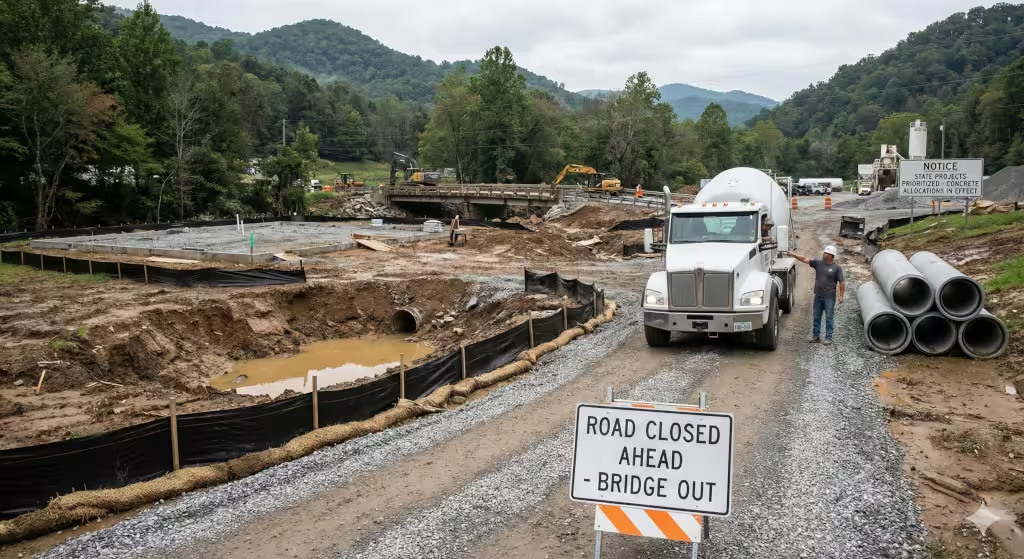
We cannot talk about building in this region without addressing the aftermath of Hurricane Helene. The storm reshaped our topography and our local industry.
Infrastructure Delays
Many secondary roads and bridges in Carter and Unicoi counties are still undergoing long-term repair. When you plan to build, you need to physically drive the route to your lot with a heavy truck in mind. Is the temporary bridge rated for a fully loaded concrete mixer (60,000+ lbs)? If not, you cannot build with concrete. You might have to switch to alternative methods like ICF (Insulated Concrete Forms) or lighter materials, which changes your design.
Material Scarcity
The massive effort to rebuild public infrastructure, bridges, retaining walls, highways, consumes a huge amount of the local concrete and aggregate supply. In 2025, residential builders often face “allocations” or delays. When we order concrete, we might be told it’s a three-week wait because the local plants are prioritizing state road projects. You must build these delays into your schedule. If you are financing the build, remember that every month of delay is another month of interest payments.
Regulatory Tightening
The storm exposed weaknesses in how we used to build. Local building inspectors are now hyper-vigilant about water management. Expect stricter scrutiny on your grading plan. They want to know exactly where the rainwater from your roof and driveway is going. If you build on a slope, you will likely be required to install more robust drainage systems, French drains, swales, and retention ponds, to prevent your runoff from washing out the neighbor below you.
Your Questions Answered
Below are some common questions about lake houses
Is it more expensive to insure a lake house or a mountain home?
Generally, a lake house carries higher premiums due to the necessity of flood insurance, which can be astronomical depending on your elevation relative to the floodplain. However, a remote mountain cabin isn’t cheap to insure either. If you build more than 5 miles from a fire station, your “Protection Class” rating drops, causing your fire insurance premiums to spike.
Does a dock add value to a lake house?
Yes, significantly. A permitted dock is the “golden ticket” for resale on Boone or Watauga. If you build a lake house without one, you are severely capping your investment’s potential growth. Always verify the dock permit transferability before you buy the land.
What is the cheapest foundation for a cabin on a slope?
A “pier and beam” foundation (building on wooden or steel posts) is typically cheaper than pouring a full concrete basement on a steep slope. It requires less excavation and less concrete. However, you must insulate the floor heavily to prevent pipes from freezing in our winters. It also gives the home a different aesthetic—more “treehouse,” less “fortress.”
Tri-Cities TN Home Strategic Advice for Buyers
If you are ready to take the plunge and build, here is our advice to keep your project from becoming a money pit.
For Lake Buyers: The Map is the Territory
Before you sign a contract on a lake lot, you must look at the TVA shoreline map. Do not take the real estate agent’s word for it. Verify the shoreline classification. Some zones are “conservation” or “sensitive,” meaning you can never build a dock there, no matter how much money you have. If you can’t get a permit, that “lakefront” lot is really just a “lake view” lot, and it should be priced accordingly.
For Mountain Buyers: Soil Science First
Before you buy that breathtaking ridge-top acreage, hire a soil scientist to perform a soil map (often better than a simple perc test). If the soil is too thin or rocky for a standard septic system, you need to know that upfront. Discovering you need a $25,000 drip system after you close on the land is a painful surprise. If the land won’t perc at all, you cannot build a house on it, period.
The “Hybrid” Option
If the costs of the deep mountains or the direct lakefront are too high, consider the “hybrid” areas. Towns like Jonesborough, Gray, or the outskirts of Elizabethton offer rolling hills that give you a mountain feel, but often come with access to public water and better roads. You can build a beautiful home for significantly less site cost because you aren’t fighting the extreme topography.
Conclusion
Deciding between a lake house and a mountain cabin in East Tennessee is about more than just which view you prefer with your morning coffee. It is a choice between two different sets of challenges. When you build on the lake, you are navigating a maze of federal regulations and flood mitigation. When you build on the mountain, you are engaging in a physical battle with rock, gravity, and logistics.
In 2025, the winner isn’t the one with the biggest budget, but the one with the most patience for site preparation. The “Helene Effect” has taught us that we must respect the land. We cannot just force a house onto a lot; we have to engineer it to survive and thrive there. Whether you choose the sound of the waves or the silence of the peaks, the key to a successful project is understanding that the “dirt work” is just as important as the woodwork.