
When you decide to build a custom home, you are making one of the most significant investments of your life. Here in the Tri-Cities area of Tennessee, that investment can take many shapes, from beautiful homes overlooking Boone Lake to sprawling properties in the hills outside Kingsport. One of the most fundamental decision you will make, the one that affects everything else from cost to your monthly utility bills, is choosing your home’s “skeleton.” This is its structural frame.
You have two primary choices for this frame: traditional stick framing or the much older craft of timber frame construction. One method is defined by modern efficiency and speed; the other is defined by artistry, strength, and legacy. The choice you make between a stick frame and a timber frame will dictate the feel of your home, its design possibilities, and its performance for decades to come.
Our goal is not to sell you on one or the other. That means giving you a precise, competent breakdown of both methods. We will look at the technical differences, the real-world costs, the long-term strength, and the energy efficiency of each type of frame. By the end, you will have the knowledge to make an informed, confident decision for your custom home’s frame.
The Standard: What is Traditional Stick Framing?
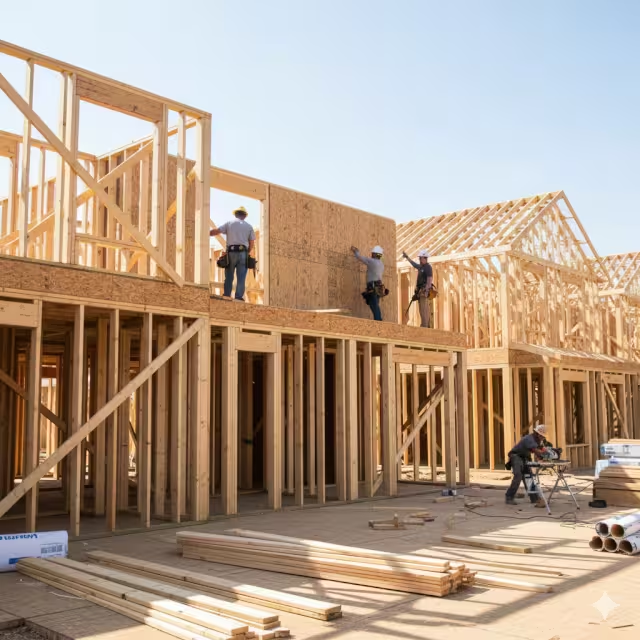
Traditional stick framing is, without a doubt, the most common method for building homes in America, and that is certainly true here in Johnson City and the surrounding region. When you see a new neighborhood going up, this is the method you are watching in action.
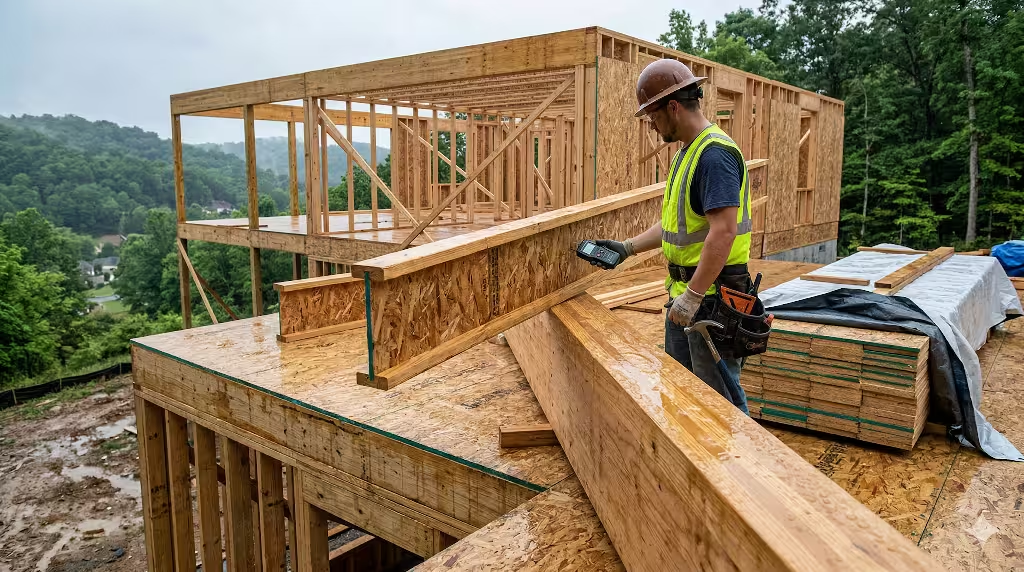
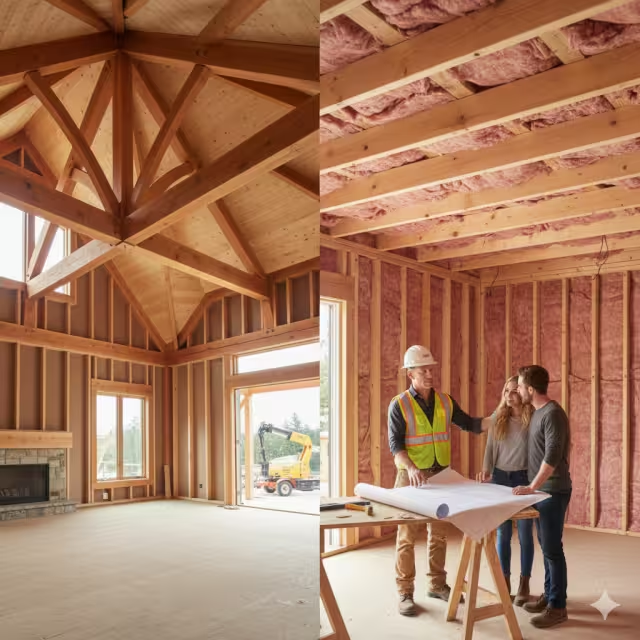
So, what is it? At its simplest, stick framing is a construction method that uses standardized, dimensional lumber. These are the 2x4s and 2x6s you see stacked at any hardware store. These “sticks” are spaced closely together, typically 16 inches from the center of one stud to the center of the next. These studs, nailed together with top and bottom plates, create the wall frame. This wall frame, along with the floor frame and roof frame, creates a complete structural system.
A key concept you must understand with a stick frame is the “load-bearing wall.” In this system, the interior and exterior walls together hold up the weight of the floors above them and the roof. The strength of the home’s frame is not in any single piece of wood but in the system of all these small pieces working together, connected and covered with a “skin” of sheathing, like OSB (Oriented Strand Board) or plywood.
Once the wall frame is built, the empty cavities between the studs are filled with insulation, such as fiberglass batts or spray foam.
Pros of a Stick Frame:
- Cost-Effective: This is the primary driver. The materials are mass-produced, relatively inexpensive, and readily available everywhere.
- Skilled Labor: Because this is the standard, the vast majority of builders and carpentry crews in the Tri-Cities are experts in stick framing. You will have no trouble finding a competent crew to build this type of frame.
- Speed: A good crew can build the entire frame of an average-sized house in a matter of weeks. The process is standardized, fast, and understood by all trade partners.
Cons of a Stick Frame:
- Design Limitations: Those load-bearing walls I mentioned are a critical design constraint. If you want a wide-open, 40-foot-wide great room, you can’t just leave out walls. It requires complex (and expensive) engineered beams to carry the load that the wall frame would have supported.
- Thermal Bridging: This is an engineering concept that directly impacts your utility bills. Every single wooden stud in your wall frame is a pathway for heat to travel. In the winter, heat from your home “bridges” across the wood stud to the cold outside.6 In the summer, heat does the reverse. Each stud is a small, uninsulated gap in your home’s thermal envelope. With a stud every 16 inches, that adds up to a significant loss of efficiency in the complete frame.
The Artisan Method: What is Timber Frame Construction?
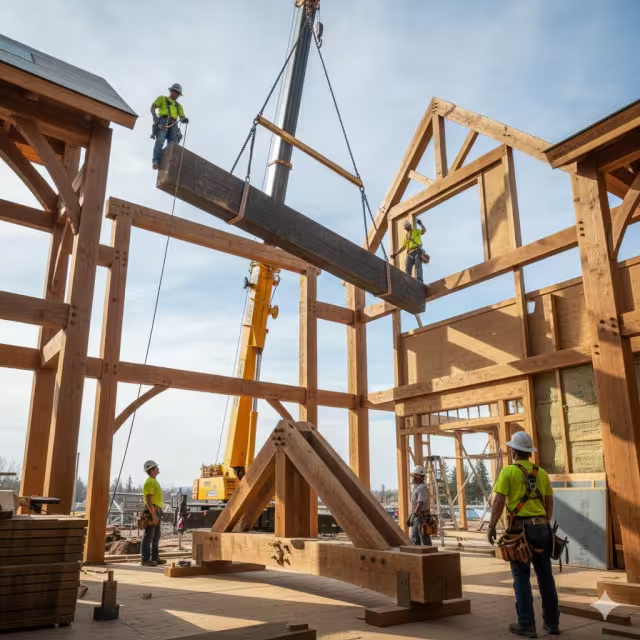
Timber frame construction is something entirely different. This is a historic craft, a way of building that predates modern lumber mills and nail guns. This method uses large, heavy timbers (think 6×8, 8×12, or even larger) to create the structural frame of the house.
The magic of a timber frame is not just in the size of the wood, but in how it is joined. Instead of nails, a timber frame is connected using “joinery.” This is the art of cutting interlocking joints directly into the wood. The most famous is the mortise and tenon joint: a builder carves a precise square hole (the mortise) into one timber and a matching “tongue” (the tenon) on the end of another.9 The two pieces fit together perfectly and are then locked in place with a wooden peg, or “trunnel.” This joinery creates a frame of incredible strength and beauty.
The most important difference from a stick frame is this: in a timber frame, the heavy timber frame alone supports the entire load of the home.10 None of the walls are load-bearing. This means the walls are just “curtains.”
Because the frame is the star, you don’t fill it with insulation. Instead, the modern and most competent way to finish a timber frame is to wrap the entire frame from the outside with Structural Insulated Panels (SIPs). A SIP is like a giant, high-performance sandwich. It has a core of rigid foam insulation bonded between two strong boards. These panels attach to the outside of the timber frame, creating a continuous, airtight, and incredibly well-insulated “skin” for the house.11
Pros of a Timber Frame:
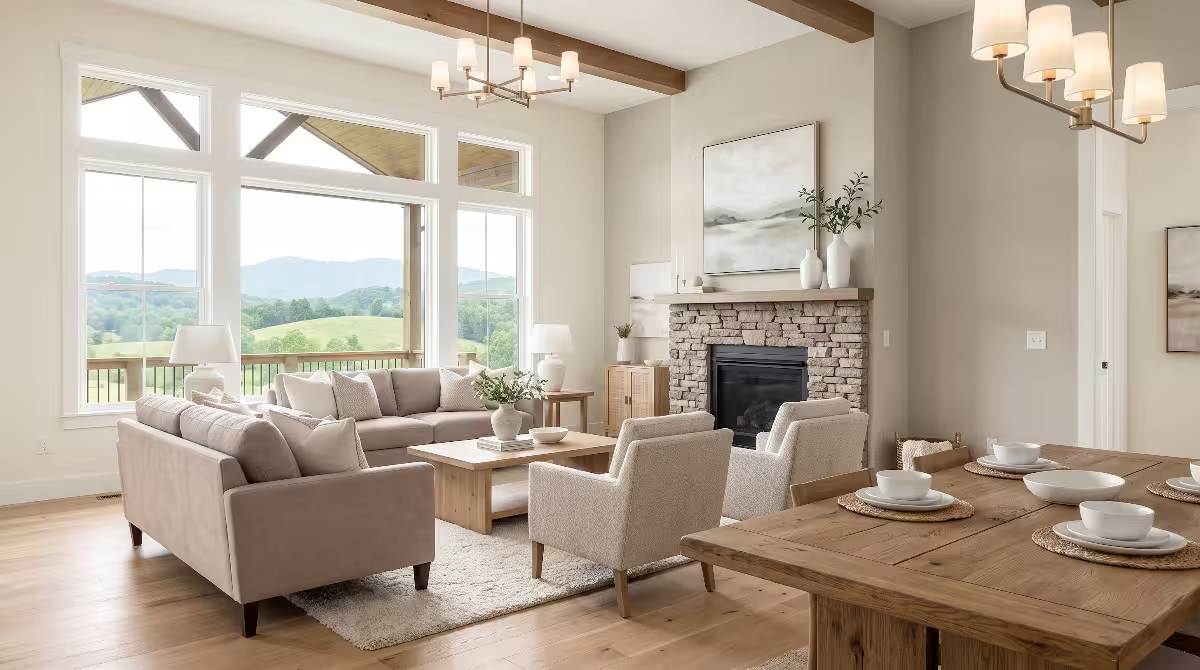
- Unmatched Aesthetics: The primary draw is the beauty. A timber frame allows for dramatic, open-concept spaces with vaulted ceilings. The exposed wood beams and joinery become the central architectural feature of the home.
- Incredible Strength & Longevity: A timber frame is exceptionally strong and resilient. So “How long does a timber frame house last?” The answer is centuries. There are barns and churches in Europe, and even here in East Tennessee, with a timber frame that is hundreds of years old.
- Complete Design Freedom: Because the frame does all the work, you have total freedom with your floor plan. You can place interior walls anywhere you want, or not have them at all. You can even move walls decades later without affecting the home’s structural integrity, because the frame is independent.
Cons of a Timber Frame:
- The Main Disadvantage: Cost: I will be direct. A true timber frame home is a premium product and is significantly more expensive than a stick-built home.
- Specialized Labor: Building a timber frame requires a “Timberwright,” a master artisan with a very specific set of skills. These builders are much rarer and more in-demand than standard framing crews.
Head-to-Head Comparison: Timber Frame vs. Stick Framing
This is the core of the issue. As a home buyer, you need a precise comparison of the factors that matter to you. Let’s break them down.
Cost: Is Timber Frame More Expensive?
Yes. “Is it cheaper to build a timber frame?” has a very clear answer: no, it is not. A stick frame will almost always be the more affordable option upfront, and here is a detailed breakdown of why.
- Material Costs: The wood itself is a major factor. A stick frame uses mass-produced, commodity 2x4s. A timber frame requires massive, high-quality beams of woods like Douglas Fir, Oak, or Eastern White Pine. These timbers must be “structurally graded” and are often “FOHC” (Free of Heart Center) to control how they crack or “check” as they dry. A single, 30-foot-long beam for your great room’s frame could cost more than the material for the entire wall frame of two bedrooms in a stick-built home.
- Labor Costs: This is the single biggest difference. Building a stick frame is fast. A crew of four or five can have a house frame up in a few weeks. The skill is common and the labor rates are competitive.
Building a timber frame is an act of craft. The joinery for the frame is often cut off-site in a specialized shop over weeks or even months. This can be done with high-tech CNC machines for precision or, in very traditional builds, by hand. This labor is performed by a highly paid artisan. The “raising” of the frame on your job site may only take a few days, but the skilled labor to get to that point is immense. You are paying for expertise that is, frankly, rare. - Insulation & Finishing: As I mentioned, the correct way to insulate a timber frame is with SIPs. These panels are a superior product, but they are more expensive per square foot than the fiberglass batts and drywall used to finish a standard wall frame.
- The Total Picture: When you account for the materials, the specialized labor, and the associated finishing systems like SIPs, a full timber frame home can easily cost 20% to 40% more than a high-quality stick frame home of the same square footage. It is not just a different method; it is a different class of product.
Energy Efficiency
This is where the long-term value equation begins to shift. Yes, the timber frame costs more upfront, but its performance over time is superior.
Let’s revisit “thermal bridging” in a stick frame. Imagine your wall is a warm winter coat. A stick frame coat is like one that has hundreds of thin metal zippers (the studs) running all over it. Even if the puffy filling (insulation) between the zippers is excellent, you will still feel the cold coming through those metal-to-metal contact points. A stick frame wall acts the same way. The R-value of a wood stud is only about R-4, while the insulation next to it might be R-21. The heat takes the path of least resistance, right through the wood frame.
Now, let’s look at the timber frame with SIPs. This is like a modern, one-piece, high-tech ski suit. There are no gaps, no seams, and no zippers. It is a continuous, unbroken envelope of insulation that is wrapped around the outside of the structural frame.
This has two massive benefits:
- It eliminates thermal bridging. The structural frame is on the inside of the insulation, in the “warm” part of the house. It cannot act as a bridge for heat to escape.
- It creates an airtight home. A SIP-wrapped frame is exceptionally airtight, meaning you don’t have all the tiny drafts and air leaks common in a stick frame house.
Here in the Tri-Cities, with our hot, humid summers and surprisingly cold winters, this matters. A home with a timber frame and SIPs will require far less energy to heat and cool. The upfront cost is higher, but the savings on your utility bills every single month for the life of the home are real and significant.
Strength & Fire Resistance
This is a category that surprises people. “Is timber framing stronger?” Yes, it is stronger, and in ways you might not expect.
- Structural Strength: A stick frame is strong as a system. It’s like a finely woven basket: many small, relatively weak pieces work together to create a rigid structure. It’s strong, but it’s also vulnerable. In an extreme event like a tornado or high winds, if one part of the system fails, it can cascade. A timber frame is strong because its parts are strong. It’s built like a fortress. The massive beams and posts, locked with joinery, create an incredibly resilient and flexible frame. In an earthquake, this type of frame can move and flex, absorbing the energy without breaking. The joinery actually tends to tighten over time as the wood frame dries. This is why those 150-year-old barns are still standing.
- Fire Resistance: This is the most counter-intuitive point. People think, “big wood frame = big fire.” This is exactly backward. Think about starting a campfire. You use small “sticks,” or kindling, to get it going. You don’t try to light a massive log. A stick frame is a house frame built entirely of kindling. In a fire, the 2x4s and 2x6s in the wall frame catch fire quickly and burn through, leading to a rapid structural failure of the home’s frame.Now, think about that massive log. If you put it in a hot fire, the outside of the log will get black and “char.” This black charcoal layer actually becomes an insulator, protecting the solid, structural wood inside. A heavy timber frame behaves exactly the same way. In a house fire, the massive beams will char, but they will maintain their structural integrity for a very long time—far longer than a stick frame. This is a proven engineering principle called “sacrificial char,” and it gives you and your family precious time to get out safely. A heavy timber frame is, without question, superior in a fire.
Construction Timeline
This is a nuanced comparison, as the workflow is completely different.
A stick frame build is linear. The crew pours the foundation. Then, they show up with stacks of lumber and build the floor frame. Then they build the wall frame, one stud at a time. Then they build the roof frame. It’s all done on-site. This part of the project is relatively fast, but it is also 100% dependent on good weather. A rainy month in Kingsport can bring your whole project to a halt.
A timber frame build is parallel. While your foundation contractor is digging and pouring your foundation on-site, the entire timber frame is being precision-cut in a specialized, climate-controlled shop, sometimes hundreds of miles away.
The “raising” of the frame is the most dramatic part. The finished frame components, each one labeled, arrive on a truck. A crane is brought in, and the crew lifts and fits these massive pieces together like a giant puzzle. The entire structural frame of the house can be assembled and standing in just two to four days. It’s an incredible event to watch.
Immediately after the frame is up, the SIPs are installed, also with the crane. This means the house can be fully “dried in” (weatherproof) in a fraction of the time of a stick frame home. So, while the prep time for a timber frame is much longer (months of shop time), the on-site assembly of the frame and envelope is dramatically faster and far less weather-dependent. The total project time for the complete frame is often very similar.
Our View for the Tri-Cities Buyer
A Note on “Post and Beam” vs. “Timber Frame”
We must be precise here, as this is a common point of confusion. You will hear the term “Post and Beam.” This is not the same as a true timber frame. Post and Beam construction also uses large timbers, but they are typically connected in simpler ways—often just butted together and held with visible metal plates, brackets, and bolts. It’s a perfectly good way to build a strong frame, but it does not involve the same level of artistry or the traditional wood-to-wood joinery that defines a timber frame. When you are talking to builders, be precise with your language. Know the difference and ask to see examples of their joinery.
The Hybrid Solution: A Path of Integrity
For many of my clients in Johnson City and the surrounding area, a full timber frame home is simply outside the budget. But they still want the “wow” factor: the open great room, the vaulted ceiling, the beautiful wood.
In my professional opinion, the best solution for most people is the Hybrid Timber Frame. This is a competent, practical compromise that I recommend often. This is how it works:
- We use the beauty and strength of a true timber frame in the main “public” spaces of the home—the great room, the dining area, and the kitchen. This gives you the dramatic, open-plan living space you want.
- Then, in the “private” spaces—the bedrooms, bathrooms, and utility rooms—we use conventional, cost-effective stick framing.
This hybrid frame approach gives you the aesthetic and open feel where it matters most, while controlling the budget in the rest of the home’s frame. You get the best of both worlds: the craft of the timber frame and the efficiency of the stick frame.
Conclusion: Which Skeleton is Right for Your Home?
This is not a choice between a “good” method and a “bad” one. As an engineer, I can tell you that both a stick frame and a timber frame, when built with integrity and to code, create safe, strong, and durable homes.
This is a choice between two different philosophies of building.
You should choose Traditional Stick Framing if your primary drivers are managing your upfront budget, working with a conventional timeline, and you are building a home with a more traditional, standard design. It is the efficient, proven, and most common way to build a wonderful home frame.
You should choose Timber Frame Construction (or a hybrid frame) if your primary drivers are aesthetics, a desire for wide-open living spaces, exceptional energy efficiency, and a sense of legacy. It is a premium product, an investment in craft and artistry that results in a truly unique and long-lasting home frame.
This choice is the foundation for your entire project. It’s a decision that requires precision and foresight. If you are planning a custom home in the Tri-Categories area and want to discuss which structural frame is the right foundation for your vision, contact us at WebHeads United. We can help you analyze the choice with competence and integrity.