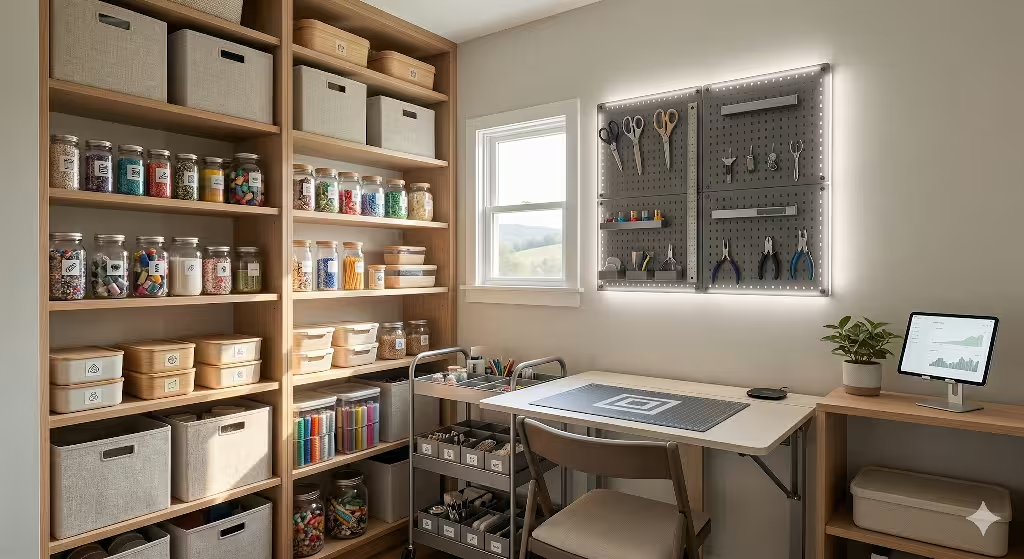


The dream of a dedicated workshop in the basement is one of the most common requests for buyers in the Tri-Cities of TN. It is an appealing idea. It’s a space carved out just for you, safe from the elements, where you can build, create, and repair. You can picture the layout of the tools, the workbench, the first project.
But then, winter reality sets in.
The moment you make your first cut, the air fills with fine sawdust. The moment you open a can of stain, the fumes are sharp and powerful. Your natural instinct is to open a window, but you can feel the cold Johnson City air pouring in. You are, quite literally, pumping the heat you paid for straight outside. This is the core problem. How do you keep your air clean without freezing yourself out or getting an astronomical heating bill?
This isn’t just about comfort or energy. Improper ventilation in a basement is a serious health hazard. This is especially true for an East Tennessee basement. Our region is known for moisture, mold, and critically, radon gas.
If you simply install a powerful exhaust fan, you can actually make these problems worse. You risk pulling dangerous gases from the soil right through the concrete of your basement floor.
In this article, we are not going to talk about cheap fixes that just move the problem around. We are going to walk through the building science of your basement. We will cover the right way to approach this challenge, from the science of air pressure to the specific systems that will keep your basement workshop healthy, safe, and efficient all winter.
The “Why”: Understanding the Building Science of Winter Ventilation
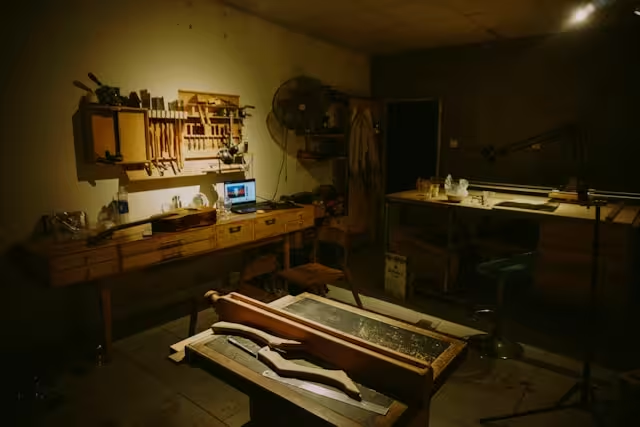
Before you can fix a problem, you must understand the system. Your house is a system. Your basement is a key part of that system. And in winter, that system is dominated by one powerful force: the stack effect.
Think of your house as a big chimney. All day long, the warm air inside your home rises. It finds tiny leaks in your attic, around light fixtures, and through ceilings, and it escapes. This rising air creates a tiny, steady vacuum in the lower levels of your home, especially in the basement.
This vacuum is called negative pressure.
Your house, like any system, wants to be balanced. To fill that vacuum, it will suck in replacement air from anywhere it can. This is called “infiltration.” This new air might come from under doors, around windows, or through tiny cracks in your foundation.
This is where the real danger in your basement workshop begins.
When you turn on a simple exhaust fan in your basement, you are making that vacuum much,much stronger. You are mechanically sucking air out, and your house will find a way to replace it.
It will pull in freezing cold air, for one. But it can also pull in dangerous things:
- Radon Gas: Radon is a natural, radioactive gas that comes from the breakdown of uranium in the soil. It is colorless and odorless. East Tennessee has significant radon zones. This gas can be pulled right through the concrete slab of your basement. It is the number one cause of lung cancer in non-smokers.
- Carbon Monoxide (CO): If you have a furnace, water heater, or fireplace, that exhaust fan can be strong enough to “backdraft.” This means it can literally pull the poisonous exhaust, including carbon monoxide, back down the chimney or flue and into your home.
So, our goal is not just to “get the dust out.” Our goal is to create a ventilation system that doesn’t create this dangerous negative pressure.
The Pollutants We Need to Control
When you work in your basement workshop, you are creating three types of pollutants.
- Particulate Matter (PM2.5): This is the science-y term for the fine, invisible sawdust. The big chips from your saw are not the problem. It’s the microscopic dust that hangs in the air. This dust is small enough to get deep into your lungs and even your bloodstream, causing serious long term health problems.
- Volatile Organic Compounds (VOCs): These are the fumes. They come from paints, stains, lacquers, glues, epoxies, and solvents. These fumes can cause headaches and dizziness in the short term and damage your liver, kidneys, and nervous system in the long term.
- Moisture & Humidity: This is the classic basement enemy. Your concrete basement walls and floor are naturally porous. Moisture from the surrounding soil can seep in, raising the humidity. Your own breath and any unvented heaters also add moisture. Once the humidity in your basement gets above 50% or 60%, you have created a perfect breeding ground for mold and mildew.
Is a basement a good place for a workshop?
I get asked this all the time. My answer is always the same: Yes, a basement is an excellent place for a workshop, if you treat it like the unique space it is. A basement is not just another room in your house. It is a concrete box in the ground. You must control for dust, fumes, and humidity. If you do that, your basement workshop will be a safe and comfortable space for years. If you ignore them, it will become a damp, unhealthy, and dangerous part of your home.
Ventilation Strategies: From Basic to Best-in-Class
Once clients understand the “why,” they want to know the “how.” People often try to solve their basement ventilation problem in stages. Let’s look at the common strategies, from the least effective to the most professional.
Strategy 1: “Spot” Exhaust (The Cheap, Incomplete Fix)
This is the most common first attempt. You go to a home improvement store, buy a simple bathroom exhaust fan or a more powerful inline duct fan, cut a hole to the outside, and flip a switch.
This is effective for one specific task: venting acute fumes. If you are applying lacquer to a single piece, you can place it under the fan and pull the worst of the fumes out. This is a common answer to the query, “How do I ventilate a basement for fumes?”
Our Verdict: This is an incomplete and potentially unsafe solution. It is a component, not a system.
This fan does one thing: it exhausts air. It does nothing to supply fresh air. Therefore, it creates the very negative pressure we just discussed. It puts your basement and your entire home at risk of backdrafting and pulling in radon. It also dumps all your paid for heat outside, making your furnace work harder and costing you money. This is not a real solution for a workshop you plan to spend real time in.
Strategy 2: Air Filtration (The “Clean Air” Myth)
The next strategy people try is to clean the air inside the basement. You will see this when you ask, “How do I get sawdust out of my basement air?”
The solution is an air filtration unit. This is often a box with a powerful fan and a large HEPA filter (High-Efficiency Particulate Air). You might get a portable unit on wheels or a larger one you hang from the ceiling of your basement.
These units are excellent at trapping particulate matter. They are fantastic at grabbing that fine sawdust. A good one with a thick carbon filter can also help reduce the smell of VOCs.
Our Verdict: This is a critical part of your workshop, but it is not ventilation.
This is a point of precision that many people miss. Filtration cleans the air that is already in the room. Ventilation exchanges stale, polluted air for fresh, clean outdoor air.
Think of it this way: a filter is like a kidney. It cleans the blood. But you still need lungs to bring in fresh oxygen and get rid of carbon dioxide.
An air filter will not:
- Bring in fresh oxygen.
- Remove all VOCs (the carbon filters saturate quickly).
- Reduce humidity.
- Fix the carbon dioxide buildup from you breathing in a sealed basement.
You absolutely need an air filter for the dust. But you need it in addition to a true ventilation system.
Strategy 3: Balanced Ventilation (The Professional Solution)
This brings us to the professional, engineering solution. This is what we design into new custom homes. It is called balanced ventilation.
The concept is simple but precise. A balanced system does two things at the same time:
- It exhausts stale, polluted air from your basement.
- It supplies fresh, clean air to your basement.
And most importantly, it does this at the exact same rate.
If it pushes 80 cubic feet per minute (CFM) of stale air out, it brings 80 CFM of fresh air in. The pressure in your basement stays neutral. This means no vacuum. No backdrafting. No pulling radon from the soil. It simply exchanges the air, as if you had two large, opposing windows open, but without the energy loss.
This is the only way to correctly and safely ventilate a modern, well sealed basement workshop.
The “How”: Choosing Your Balanced System
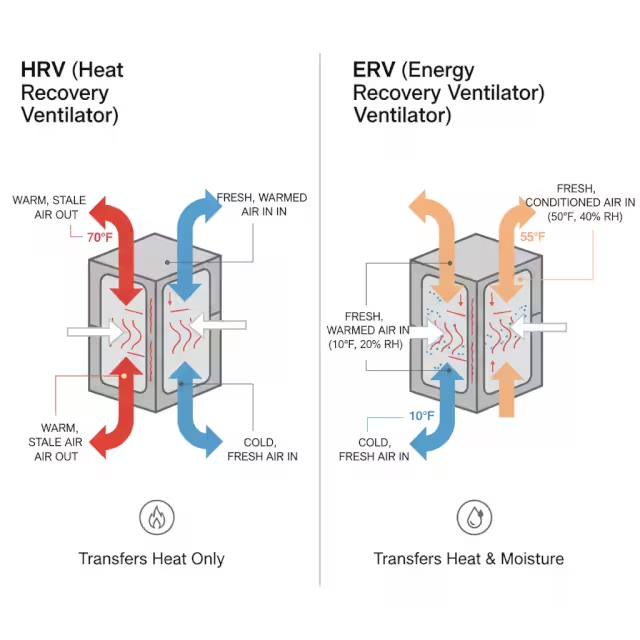
This is the part I enjoy. We get to talk about the specific technology that makes this possible. You don’t get a healthy basement by guessing. You get it with the right equipment.
The technology that provides balanced ventilation is called a Recovery Ventilator. It is a machine that manages the air exchange. It comes in two main types.
Option A: The Heat Recovery Ventilator (HRV)
An HRV, or Heat Recovery Ventilator, is the key to solving the winter problem.
Here is how it works. The machine has two fans and a special “heat exchanger core.”
- One fan pulls stale, warm, polluted air from your basement workshop.
- The other fan pulls fresh, cold, clean air from outside.
The magic happens in the core. The two air streams pass each other in thousands of tiny, separate channels. They never mix. But the core itself is made of a material that transfers heat (thermal energy).
The stale, warm air passes its heat to the core. The core then passes that same heat to the fresh, cold air.
The result? The air vented outside is now cold, and the fresh air coming into your basement is pre-warmed. A good HRV can recover 70% to 80% of the heat you would have just thrown away.
This is the solution. You get fresh air, you get rid of pollutants, and you save a massive amount of energy. An HRV is ideal for cold climates where the main challenge is keeping heat inside.
Option B: The Energy Recovery Ventilator (ERV)
An ERV, or Energy Recovery Ventilator, is the next step up. It does everything an HRV does, but with one extra, crucial function.
An ERV’s core can transfer both heat and a small amount of moisture (humidity).
This is a huge benefit for us here in the Tri-Cities, because our climate gives us both extremes.
- In the Winter: Our air gets very dry. An HRV will just dump that cold, dry air into your basement, which can be uncomfortable. An ERV, however, will pull some of the humidity from your (moister) indoor air and add it to the (drier) incoming fresh air. It helps keep your basement from getting uncomfortably dry.
- In the Summer: This is where an ERV really shines. In August, the air outside is hot and humid. An HRV would bring all that sticky moisture right into your basement, overwhelming your dehumidifier. An ERV does the opposite. It takes the excess humidity from the incoming fresh air and transfers it to the outgoing stale air, dumping it outside.
Our Verdict: For a new custom home in East Tennessee, an ERV is almost always the superior, year-round solution. It is a true energy recovery system that manages both temperature and humidity. An HRV is a great choice, but an ERV is precisely tuned for a mixed-humidity climate like ours. When I design a high performance home with a finished basement, an ERV is part of that plan.
Your Action Plan: Designing the System
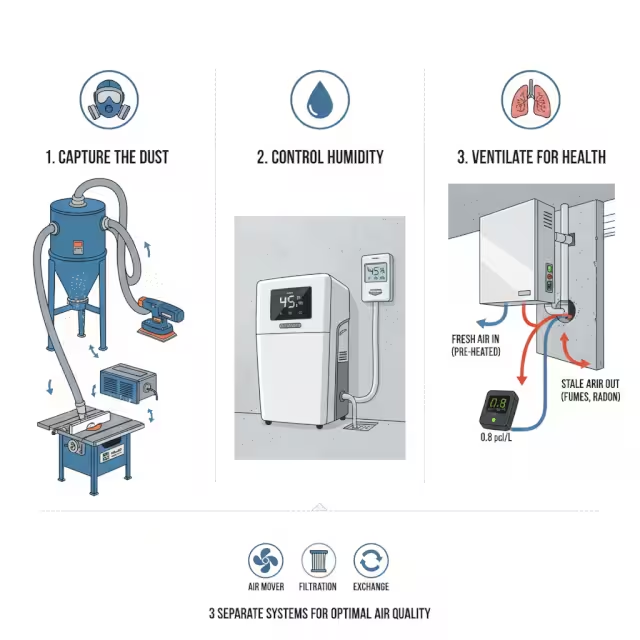
You don’t have to be a builder to understand how to plan this. A competent plan follows logical steps. Here is your action plan for a safe, efficient basement workshop.
1. Address the Baseline: A Dry Basement
First things first. You cannot have a healthy basement workshop if you have a wet basement. You cannot ventilate your way out of a moisture problem.
Before you buy a single fan, you must ensure your basement is dry and stays dry.
- Waterproofing: This means making sure your gutters and downspouts are clean and directing water far away from your foundation. It means proper grading, so the ground slopes away from your house. For a new build, this means proper exterior waterproofing and a good foundation drain.
- Dehumidifier: Every single basement should have a good dehumidifier. For a workshop, do not rely on a small, portable unit you have to empty every day. Invest in a quality, high-capacity dehumidifier with a drain hose that runs to a floor drain or a sump pump. Your goal is to keep the relative humidity in your basement stable, between 30% and 50%, all year long.21 This prevents mold and stops your tools from rusting. A dry basement is the foundation for everything else.
2. Separate Your Systems
This is the most common mistake I see. People try to make one machine do three jobs. This is an engineering error. Your basement workshop needs three separate systems for air management.
- Dust Collection: This is your “point of source” system. It is your shop vacuum or, ideally, a cyclone dust collector. It has a large hose that attaches directly to your miter saw, table saw, or sander. Its job is to capture the big chips and heavy dust before they get into the air. Do not vent this outside; it’s inefficient.
- Air Filtration: This is your “ambient air” system. This is the HEPA filter unit we discussed. Its job is to capture the fine dust that the dust collector missed. It is constantly “polishing” the air that is already in your basement.
- Ventilation: This is your ERV or HRV. Its job is to manage air quality. It brings in fresh oxygen and exhausts VOCs, humidity, carbon dioxide, and any background radon.
You must keep these separate. You should never hook your dust collector up to your ERV. You will destroy the expensive heat-exchanger core in a matterof days by clogging it with sawdust. Each system has one precise job. Let them do it.
3. Solve the “Windowless Basement” Problem
This is a common question. “How can I ventilate my basement? I don’t have any windows.”
This is the beauty of an ERV or HRV. They are the perfect solution for a windowless basement. They do not require windows at all.
An ERV or HRV is a box that can be installed in a mechanical room or hung from the joists in your basement. It connects to the outside world with just two small (usually 6-inch) ducts.
- One duct is the Fresh Air Intake.
- The other duct is the Stale Air Exhaust.
During a build, or even as a retrofit, contractors use a concrete core drill to create two small, clean holes through your foundation’s rim joist or wall. These are then sealed completely against weather and pests. It is a clean, minimal, and permanent solution. This system gives your windowless basement something better than a window: a constant, controlled supply of fresh, pre-warmed air.
4. Calculate Your Need (The Technical Bit)
How big of a unit do you need? This is determined by ACH, which means Air Changes per Hour.
This is just a measure of how many times you want to replace all the air in your basement workshop in one hour.
- A typical, quiet living room might only need 0.35 ACH.
- A basement workshop where you are actively sanding or staining might need 4 to 8 ACH to stay safe and clear the air quickly.
Let’s do some simple math. If your basement workshop is 20 feet long by 15 feet wide, with 8-foot ceilings:
- 20 x 15 x 8 = 2,400 cubic feet of air.
If you want 6 air changes per hour:
- 2,400 cubic feet x 6 ACH = 14,400 cubic feet of air per hour.
To get the “CFM” (Cubic Feet per Minute) rating for your fan, you just divide by 60:
- 14,400 / 60 = 240 CFM.
This tells you that you need a ventilation system capable of moving 240 CFM of air. This is why you must put your basement workshop on its own ventilation system. You do not want to mix this air with the rest of your home’s HVAC. You want to contain the dust and fumes to your basement, treat them there, and exhaust them directly.
A Competent, Precise Plan for Your Workshop
Your dream of a basement workshop is a great one. It’s a fantastic addition to a custom home and a valuable use of your basement space.
But to do it with integrity, you must respect the unique environment of a basement. In winter, this means you cannot choose between clean air and warm air. You must have both.
Ventilating a basement workshop isn’t about just opening a window or buying a fan. It’s about a complete, competent system.
- Control the Baseline: Start with a 100% dry basement and a high-quality dehumidifier.
- Capture the Dust: Use a dust collector at your tools and a HEPA filter for the fine, ambient dust.
- Ventilate for Health: Install a balanced ventilation system (an ERV or HRV). This is the only way to bring in fresh, pre-warmed air and exhaust fumes, moisture, and radon without creating a dangerous negative pressure.
When you are planning a new custom home in the Kingsport, Johnson City, or Bristol area, don’t let your dream workshop become an afterthought. Don’t let it become a damp, hazardous room that puts your family’s health at risk.