


The “Airtight Home” Problem in Tennessee
Over the years, our building standards improve dramatically. We can now build custom homes that are incredibly energy efficient. We use advanced framing techniques, high-performance windows, and extensive insulation to create a very “tight” building envelope. This is fantastic for your utility bills. It means the expensive conditioned air you pay to heat in the winter and cool in the summer stays inside your home, where it belongs.
But this engineering success creates a new challenge, one that builders 50 years ago never had to consider: the airtight home problem.
A home that doesn’t “breathe” on its own also doesn’t let anything out. This means that every bit of moisture from cooking, showering, and even breathing gets trapped. All the chemical gases from new carpets, paint, and furniture, known as Volatile Organic Compounds (VOCs), build up inside. Allergens, dust, and odors have nowhere to go.
Here in Tennessee, this problem is made much worse by one simple fact: our humidity. During our long, humid summers, all that moisture gets trapped, creating a perfect environment for mold and mildew. This is a serious risk to both your home’s structure and your family’s health.
The solution is mechanical ventilation. But this is where homeowners and even some builders get confused. You have two primary technologies: the Heat Recovery Ventilator, or HRV, and the Energy Recovery Ventilator (ERV). The question of HRV vs. ERV is one of the most important decisions you will make for the long-term health and efficiency of your new home. The goal of this article is to explain what these systems are, how the HRV and ERV differ, and which one is the right choice for a high-performance home in Tennessee.
What is a “Balanced” Ventilation System?
Before we can compare an HRV and an ERV, we must first understand the “balanced” part of the equation. For decades, the old way of thinking about ventilation was to just put a powerful exhaust fan (like a “fart fan”) in the bathroom. This is called “exhaust-only” ventilation. It’s cheap, but it’s also inefficient and can cause problems.
Think about it. When you turn on that fan, you are actively sucking air out of your home. To replace that air, new air has to get in somehow. In an airtight home, this means air gets pulled in through tiny, uncontrolled cracks around windows, doors, or electrical outlets. This is called infiltration. That incoming air is un-filtered, bringing in dust, pollen, and, in Tennessee, a massive amount of humidity. This is not a good “system.”
A “balanced” system, on the other hand, is like giving your home a set of lungs. It uses two fans and two dedicated air streams.
- One fan pulls stale, polluted, and moist air from inside your home (usually from “wet” rooms like bathrooms and the kitchen).
- A second, separate fan pulls fresh, clean air from outside.
These two streams of air are moved through a special device, typically a metal box that connects to your ductwork. The magic happens inside this box, in what is called the “core.” The two air streams pass each other in this core without ever physically mixing. This is where the “R” in both HRV and ERV comes in: Recovery.
The system “recovers” the energy you’ve already paid for. In the winter, it uses the heat from your stale outgoing air to pre-heat the fresh, cold incoming air. In the summer, it uses the cool air from your outgoing stale air to pre-cool the hot, fresh incoming air.
This is a massive leap forward. Instead of just dumping your expensive heated or cooled air outside, you are recovering 70%, 80%, or even 90% of that energy. Both an HRV and an ERV do this. They are both balanced ventilation systems.
So, if both an HRV and an ERV are balanced systems that recover energy, what is the difference? And why does it matter so much? The difference is small in technical terms, but the impact on your home’s comfort and efficiency is enormous. The choice between an HRV or an ERV is critical. An HRV is a great piece of technology, but its function is very specific. We need to be precise about what an HRV does and what it doesn’t do.
The Core Difference: HRV vs. ERV
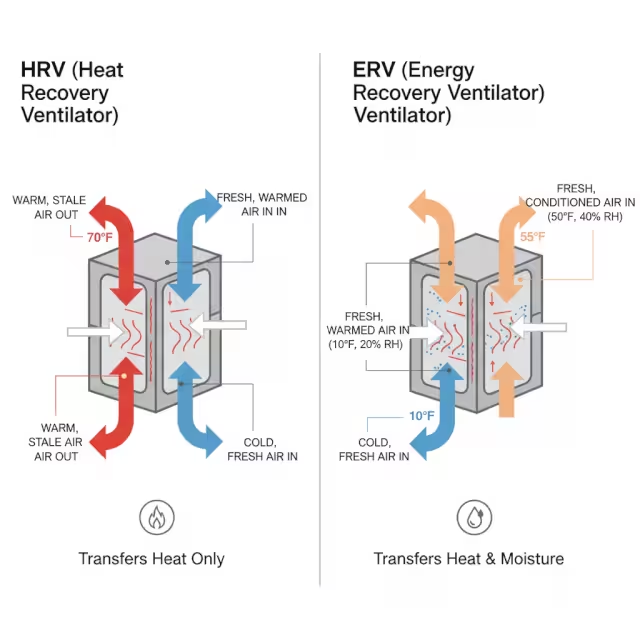
The entire debate between an HRV and an ERV comes down to one single thing: moisture.
A. The HRV (Heat Recovery Ventilator)
An HRV, or Heat Recovery Ventilator, is what we call a “sensible-only” device. That is a technical term, but it just means it can only transfer “sensible heat,” which is the heat you can feel and measure with a thermometer.
An HRV cannot transfer moisture.
The core of an HRV is typically made of thin sheets of plastic or aluminum. The two air streams pass on either side of this material. The heat passes through the material, but the moisture (humidity) does not.
Let’s use an analogy. Think of an HRV core as two plastic straws glued side-by-side. If you blow hot soup broth through one and cold water through the other, the heat will transfer, and the water will get warm. But none of the broth will ever get into the water, and none of the water will get into the broth. The plastic is a barrier to moisture. This is exactly how an HRV works.
So let’s walk through what happens when you have an HRV system in a Tennessee home.
- HRV in Summer:
- Outside: It’s a typical Johnson City day. 92°F and 85% humidity.
- Inside: You have your air conditioner set to a comfortable 72°F.
- The HRV at work: Your HRV pulls in that 92°F, 85% humidity air. It passes it next to the 72°F stale air you are exhausting. The HRV core works perfectly! It transfers heat. It cools that incoming 92°F air down to, say, 78°F.
- The Problem: The HRV does nothing to the humidity. It dumps that full 85% humidity load directly into your house. Now, your air conditioner has to work much, much harder to rip all that new moisture out of the air. Your A/C is working overtime, you feel sticky, and your energy bills go up. The HRV is, in this case, actively working against your air conditioner.
- HRV in Winter:
- Outside: It’s a cold, 30°F day. The air is very dry.
- Inside: Your furnace is keeping the house at 70°F, and the air has a comfortable 40% humidity (from cooking, showers, etc.).
- The HRV at work: Your HRV pulls in the 30°F dry air. It passes it next to the 70°F, 40% humidity air you are exhausting. The HRV core works great! It transfers heat, pre-heating the incoming air to a much more comfortable 60°F. This saves you on your heating bill.
- The Problem: Remember, the HRV is a barrier to moisture. It takes all that nice 40% humidity from your indoor air and dumps it all outside. It replaces it with bone-dry 30°F air. What happens? Your indoor humidity plummets. Your house becomes uncomfortably dry. You get dry skin, static shock, and your wood floors can even start to show gaps.
An HRV is a good system, but it is designed for a specific climate: a cold, dry climate where homes have too much humidity in the winter (from people being bundled up inside). An HRV is perfect for places like Minnesota or Canada. It is not designed for Tennessee.
B. The ERV (Energy Recovery Ventilator)
An ERV, or Energy Recovery Ventilator, is a much smarter device for our region. It is an “enthalpic” device, which means it transfers both heat AND moisture.
The core of an ERV is not made of plastic. It is made of a special “desiccant” material, which is a big word for a material that is like a high-tech paper or sponge. It is permeable to water vapor. It can move moisture from one air stream to the other.
Let’s use a new analogy. An ERV is like two high-tech, GORE-TEX straws. They can pass heat, but they can also “breathe” and pass water vapor… but not the liquid or the pollutants.
Now, let’s run the same scenarios with an ERV system in Tennessee.
- ERV in Summer:
- Outside: Again, it’s 92°F and 85% humidity.
- Inside: Your home is at 72°F.
- The ERV at work: The ERV pulls in that hot, soaking-wet air. As it passes the cool, dry indoor air, two things happen at once:
- The heat transfers, pre-cooling the air (just like the HRV).
- The moisture is wicked away by the desiccant core and transferred to the outgoing stale air.
- The Result: The air that enters your home is not just pre-cooled, it is also pre-dehumidified. This is the critical difference. The ERV is now helping your air conditioner. It’s reducing the A/C’s workload, saving you energy, and making your home far more comfortable. This is a massive win.
- ERV in Winter:
- Outside: It’s 30°F and dry.
- Inside: It’s 70°F and 40% humidity.
- The ERV at work: The ERV pulls in the cold, dry air. As it passes the warm, moist outgoing air:
- The heat transfers, pre-heating the incoming air (just like the HRV). The moisture from your outgoing air is captured by the core and transferred back into the incoming fresh air.
- The Result: The ERV saves your heat and it saves your humidity! It helps keep your home from drying out, protecting your health and your home’s wood finishes.
As you can see, in a side-by-side comparison, the HRV system fails in our climate in both summer and winter. The ERV system works with our climate to improve comfort and efficiency in both seasons. The debate of HRV vs. ERV in Tennessee has a very clear winner.
The Verdict: The Best System for a New Home in Tennessee
As you can see, here in the Tri-Cities, and across all of Tennessee, the right tool is the Energy Recovery Ventilator (ERV).
The reason is simple and technical: we live in a Mixed-Humid Climate.
This isn’t just our opinion. The U.S. Department of Energy and ASHRAE (the organization that sets the standards for all things HVAC) classifies the entire state of Tennessee as Climate Zone 3A or 4A (Mixed-Humid). This classification defines our building codes and guides every smart decision we make.
“Mixed-Humid” means we have a significant heating and cooling season. But more importantly, “Humid” means our biggest energy load in the summer is not just heat, it’s moisture. Removing moisture from the air (dehumidification) costs a lot of energy.
Therefore, any ventilation system we choose must be able to manage moisture.
- An HRV (Heat Recovery Ventilator) does not manage moisture. In our summer, it adds to the humidity problem, making your home less comfortable and your A/C less efficient.
- An ERV (Energy Recovery Ventilator) does manage moisture. It pre-dehumidifies fresh air in the summer and helps retain humidity in the winter.
For the reasons stated above, we could never recommend a standalone HRV for a new custom home in this region. The limitations of an HRV are just too great. People often ask, “But can’t I just use an HRV? It’s a little cheaper.” Our answer is that an HRV will actively fight against your air conditioner for three to five months of the year. Any small amount you save on the initial purchase of the HRV will be lost very quickly in higher electricity bills and reduced comfort.
An HRV is a fine piece of technology. But it is a tool for a different place. Using an HRV in Tennessee is like trying to hammer a nail with a screwdriver. It’s the wrong tool for the job.
Commonly Asked Questions

The tools described above are often a new concept for many. This usually leads to a few very smart follow-up questions.
Q: Is an ERV really worth the money?
Yes. An ERV system will have a higher upfront cost than a simple bathroom exhaust fan, and it is slightly more expensive than a comparable HRV. But you are not just buying a fan; you are buying a system that saves you money in two key ways.
- Energy Savings: This is the big one. Your air conditioner is one of the largest energy consumers in your home. By pre-cooling and pre-dehumidifying all the fresh air, the ERV takes a huge workload off your A/C. This allows you to potentially install a smaller, less expensive A/C unit. Even if you don’t, your A/C will run for shorter periods, saving you money on your electric bill every single month. These savings are far greater than what a homeowner with an HRV would experience, because the HRV system makes the A/C work harder.
- Comfort and Health: This value is harder to put a number on, but it’s more important. An ERV provides superior humidity control. This prevents that “sticky” feeling in the summer. It reduces the risk of mold and mildew growth. And it provides a constant, 24/7 stream of fresh, filtered air for your family. This isn’t a luxury; in a modern airtight home, it is a necessity for good indoor air quality.
Q: Can I just open a window?
Opening a window is not a ventilation strategy; it’s a hole. I love opening windows on a nice spring or fall day, but it is not a reliable solution.
Opening a window is “uncontrolled” ventilation.
- It lets in 100% of the outside heat and humidity, forcing your HVAC system to run at full blast.
- It lets in 100% of the pollen, dust, and pollution from outside, which is terrible for allergies.
- It doesn’t work. You can’t open a window when it’s 95°F, or 25°F, or when it’s raining, or when the pollen count is high.
An ERV or HRV provides controlled, filtered, and conditioned ventilation. It works 24/7, in all weather, to give you the perfect amount of fresh air without the energy penalty or the allergens.
Q: Does an ERV replace my HVAC system or dehumidifier?
No. This is a common point of confusion. An ERV (or HRV) is an accessory that works with your main HVAC system.
- Your HVAC system (furnace and A/C) is responsible for heating and cooling the air already inside your home.
- Your ERV system is responsible for managing the fresh air you bring into the home.
An ERV helps with dehumidification, but it may not replace a dedicated dehumidifier. Your family, your cooking, and your showers all create “internal” humidity. A high-efficiency A/C will remove a lot of this, but in some home designs, a whole-home dehumidifier may still be recommended to give you precise control. The ERV’s job is to simply not make the problem worse by dumping humid outdoor air inside. An HRV, by contrast, does make the problem worse.
Think of it as a team. The HVAC is the star player, the ERV is the critical support player, and the HRV is the guy who (in our climate) would be on the wrong team’s bench.
Installation, Maintenance, and Working with Your Builder
A high-quality ERV is a fantastic piece of equipment. But like any advanced technology, it is only as good as its installation. A poorly installed ERV is just an expensive and noisy box. A poorly installed HRV is even worse.
This is where my core value of competence comes in. When you talk to your builder about an ERV or HRV, you need to ask about two things: installation and maintenance.
Installation
There are two main ways to install an ERV.
- Fully Ducted System: This is the best, high-performance method. The ERV has its own set of small, dedicated ducts. It pulls stale air from all bathrooms, the kitchen, and the laundry room. It supplies fresh, conditioned air to the living room and all bedrooms. This creates a perfect, balanced airflow through the whole house.
- HVAC Integration: This is a more common, budget-friendly method. The ERV is connected directly to your main HVAC ductwork. It pulls stale air from the main return duct and supplies fresh air into the main supply duct, using your furnace fan to distribute it. This is a good solution, but it’s not as precise as a fully ducted system.
You must ensure your builder or HVAC contractor has experience installing and, most importantly, balancing the system. Balancing involves using special tools to measure the airflow in and out to ensure they are equal. A contractor who has never installed an HRV or ERV before should not be learning on your custom home.
Maintenance
This is not optional. Like a car, your ERV (or HRV) needs simple, regular maintenance to work.
- Filters: Both the incoming and outgoing air streams have filters. These must be vacuumed clean or replaced every 3 to 6 months. This is a simple 10-minute task you can do yourself. If you don’t, the filters clog, airflow drops, and the system stops working efficiently.
- Core: The ERV or HRV core itself needs to be cleaned. Once a year, the core slides out and can be vacuumed. For an ERV core, you should not wash it with water, as it can damage the desiccant material. An HRV core can typically be rinsed.
You should look for quality systems from established brands like Panasonic, Broan, Carrier, or Zehnder. And always make sure the model is Energy Star rated for our climate. This ensures it has been tested and certified for high efficiency.
Building a Healthy, Efficient Home in the Tri-Cities
When building a modern, airtight home, you must have a plan for mechanical ventilation. It is not an option.
When we look at the two main choices, the HRV vs. ERV, the science is clear.
An HRV (Heat Recovery Ventilator) is a good product for a cold, dry climate. In our mixed-Humid Tennessee climate, an HRV system will actively work against you in the summer, loading your home with humidity and driving up your A/C bills. In the winter, it will make your home too dry.
An ERV (Energy Recovery Ventilator) is the technically superior and precise choice for our climate. It saves energy by recovering heat, just like an HRV, but it also manages moisture. It pre-dehumidifies air in the summer and saves humidity in the winter.
This is the system that provides the most comfort, the best indoor air quality, and the highest energy savings for your new home. When you are sitting down to plan your custom home, don’t just talk about countertops and flooring. Be sure to ask your builder, “What is our strategy for whole-home balanced ventilation?”
If they are a competent builder, they will have a precise answer for you.