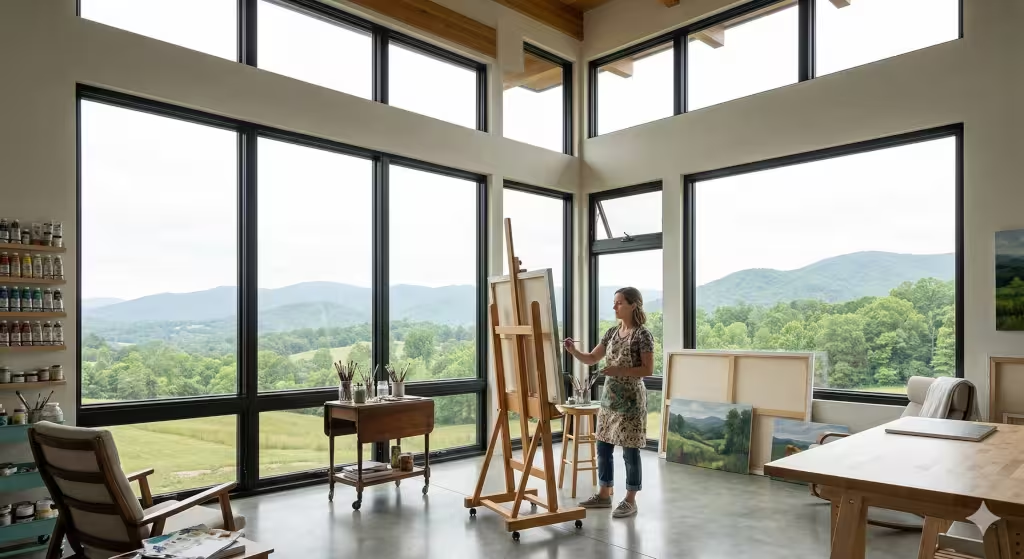

Here at Tri-Cities, TN home we spend most of our time writing about the technical details of custom homes here in the Tri-Cities. Custom home buyers in Johnson City, Kingsport, and Bristol are savvy. They know what they want. Most buyers are for siting the home to get the best view of the mountains or to make sure the back porch catches the morning sun. But every so often, a buyer is looking to satisfy a special need. This buyer, often one of the many talented artists in our region, will look at a floor plan and say, “I need a room with perfect north-facing light.”
This preference isn’t just an old myth or a romantic idea. It’s a precise technical requirement based on the simple, predictable physics of light. For centuries, this specific orientation has been the gold standard for art studios, and for good reason. For these artists, the quality of the light is as important as the foundation of the house itself.
Understanding why artists prefer north-facing light (in the Northern Hemisphere, of course) gives us a valuable insight. It teaches us how to design custom spaces that are perfectly suited to their function. It’s a lesson in precision. Whether you are one of these artists needing a dedicated studio or you just want a home office where you can work without glare, understanding how light works is the first step to a truly custom home.
Video Version of this Article
The Physics of North Light: Consistency is Key

The entire reason artists seek north light can be summed up in one word: consistency.
Here in Tennessee, as in the rest of the Northern Hemisphere, the sun rises in the east, travels across the southern part of the sky, and sets in the west. This means a south-facing window gets blasted with intense, direct sunlight all day. East and west windows get it for half the day.
But a north-facing window? It never receives direct sunlight.
The light that enters a north-facing room is indirect, reflected light from the sky itself. This one fact provides three critical benefits that artists have relied on for centuries.
1. No Moving Shadows
Imagine you are one of these artists, a painter working on a portrait. You spend six hours carefully trying to capture the subtle shadow under a person’s jawline. If you are in a south-facing room, a direct beam of sunlight is a disaster. That beam of light will creep across the room, meaning the shadow on your subject’s face will change shape, get longer, and change position every few minutes.
The artist is forced to “chase the light,” trying to paint a moving target. It’s an exercise in frustration.
North-facing light solves this. Because there is no direct sunbeam, there are no hard-edged, moving shadows. The light is stable. The form of the subject—whether it’s a person, a bowl of fruit, or a sculpture—looks the same at 10 AM as it does at 3 PM. This gives artists the long, uninterrupted work sessions they need for detailed work.
2. Diffuse, Indirect Light
The second benefit is the quality of the light. North light is diffuse.5
“Diffuse” means the light is scattered and coming from many directions at once, rather than from a single, sharp point like the sun. Think of the difference between a bare light bulb (harsh, direct) and a frosted glass fixture (soft, diffuse). North light is nature’s frosted glass.
This soft, even illumination does two things that are critical for artists:
- It reduces glare. Direct sun on a white canvas or on wet, glossy oil paint creates blinding glare. This forces artists to squint, misjudge colors, and can lead to eye strain. Diffuse north light is gentle, making it comfortable to work for a full day.
- It reveals mid-tones. When light is too harsh, you see two things: bright highlights and dark shadows, with very little in between. Diffuse light “wraps around” an object. This allows artists to see all the subtle, in-between values and colors. For realist artists, these mid-tones are what make an object look three-dimensional and real.
3. A Cool, Clear Color Temperature
This is the most technical—and most important—part. All light has a “color temperature,” which is measured on the Kelvin (K) scale.
- A candle flame or a warm, “soft white” bulb is very warm and orange. It has a low Kelvin temperature (around 2,000K–3,000K).
- The direct midday sun is more of a neutral white (around 5,000K–5,500K).
- The light from a clear blue sky—which is what a north-facing window “sees”—is very cool and blue. It has a high Kelvin temperature (often 6,500K or much higher).
This cool light is the result of a process called Rayleigh scattering. It’s the same reason the sky is blue. As sunlight enters our atmosphere, the air scatters the short, blue wavelengths of light in all directions.8 The longer, warmer wavelengths (like red and yellow) travel straight through.
A north-facing window doesn’t get the “warm” light coming straight from the sun. It gets the “cool” light that is being scattered by the sky.
For artists, this is a huge advantage. Why? Because it is consistently cool. A painter mixing a skin tone in a south-facing room will be fooled. The warm, yellow light of the room will make their paint mixture look different than it really is. They will add too much blue to compensate. Then, when they take their finished painting into a different room, the colors will look “off” and wrong.
North light provides a cool, constant baseline. Artists can trust the colors they mix. They know that the color on their palette is the true color, allowing for incredible accuracy.
North vs. South: A Tale of Two Exposures

If north light is so great, why isn’t every room in a house north-facing? Because what is perfect for artists is often the exact opposite of what most people want in a living space.
Why Not South-Facing Light?
As a builder, I design for south-facing light all the time. It’s the “passive solar” direction. In the winter, the low southern sun streams in and provides free heat, lowering utility bills. It’s bright, warm, and cheerful. This is perfect for a great room, a kitchen, or a living room.
But for artists, it’s their worst enemy.
- It is Variable: The light and shadows are constantly moving.
- It is Harsh: It creates those hard-edged shadows that hide detail.
- It is Warm: The color temperature is all over the place. It’s golden at sunrise, bright white at noon, and orange at sunset. This makes accurate color mixing impossible. The painting a client sees in the gallery would look completely different from the one the artists painted in their studio.
The Trouble with East and West
East and west-facing rooms are just as bad, only for half the day.
- East-Facing: An east-facing room is great for a breakfast nook. You get that lovely, warm morning sun. But after 11 AM, the sun is overhead and to the south, and the room goes into deep, cool shadow. This is far too inconsistent for artists who work all day.
- West-Facing: A west-facing room is dim all morning. Then, in the afternoon, it gets blasted with hot, intense, low-angle sun. This is arguably the worst direction for any kind of color-sensitive work, as the light is extremely warm (orange and red) and creates the longest, most dramatic shadows.
For the specific type of artists who need stability, north is the only choice. It’s the only direction that provides a full 8-hour “work window” where the light remains the same.
Myths, Realities, and Exceptions

In order to be precise, it’s important to clear up some common questions. The “north light” rule is a powerful one, but it has important exceptions and nuances.
Q: What about artists in the Southern Hemisphere?
This is the most common question, and the answer proves the principle. In the Southern Hemisphere—in places like Australia, Chile, or South America—the sun’s path is the opposite. It travels across the northern part of the sky.
Therefore, artists in the Southern Hemisphere seek south-facing light for the exact same reasons.
The rule isn’t magically about the direction “north.” The rule is to always face away from the sun’s direct path. It’s about getting that consistent, cool, indirect light from the open sky.
Q: What are the disadvantages of a north-facing room?
However, from a home-design perspective, north-facing rooms have two major drawbacks.
- They are Cold: This is the biggest one. As I mentioned, a south-facing room gets free passive solar heat. A north-facing room gets none. In fact, in the winter, it’s the coldest, darkest part of the house. This has a major impact on comfort and utility bills.
- They Feel “Gloomy”: That same “cool, blue” light that artists love can feel sterile, cold, or even depressing to other people. It’s not the “cozy” light you want for a family room or a bedroom. Many people would describe a north-facing room as “dark” or “gloomy” because it lacks that bright, cheerful sunshine.
This is why, when we design a custom home, we can’t just stick a studio anywhere. We have to plan for these factors.
Q: Do all artists prefer north light?
No. This is a crucial distinction. The type of artists who value north light are typically those focused on realism, portraiture, and still-life painting.
The historical artists most famous for this are the Dutch Golden Age masters.14 When you look at a painting by Johannes Vermeer, like “The Milkmaid” or “The Art of Painting,” you are seeing a masterclass in north light. His studio in Delft is famous for its north-facing windows. That soft, luminous, gentle quality that makes his paintings glow? That is the effect of perfect, diffuse north light. Later, artists like Paul Cézanne built his famous studio at Aix-en-Provence with a massive wall of north-facing glass.
But some artists want the exact opposite.
The Impressionists, like Claude Monet, were not interested in stable, consistent reality. Their entire goal was to capture the fleeting, changing effects of light and color. Monet famously painted the same haystack or cathedral dozens of times, at different times of day and in different seasons, specifically to study how the direct sun changed its appearance. For these artists, a stable north-lit studio would have defeated their entire purpose.
So, the type of artist and their goals determine what kind of light they need.
Q: Do modern artists still need it with today’s technology?
This is the big question. With modern technology, do artists still need to be so specific about their windows?
The answer is no, not always. Many modern artists, like the famous Francis Bacon, were known to black out their windows completely. They prefer to have 100% control over their environment, 24/7, without worrying if it’s a sunny or a cloudy day.
Instead of north light, these artists use specialized artificial lighting. But they can’t just use any old bulb from the hardware store. They need bulbs that replicate the best qualities of daylight.18 To do this, they look at two numbers:
- Color Rendering Index (CRI): This is a scale from 0 to 100 that measures how accurately a light bulb shows an object’s true colors. Sunlight is 100. A cheap, old fluorescent bulb might be 70, which is why food can look strange in a convenience store. Artists need bulbs with a CRI of 90 or higher, and ideally 95+, to see color accurately.
- Kelvin (K): We discussed this. Interestingly, most artists don’t use 6,500K bulbs, which would mimic the “too-blue” feel of true north light. Instead, they use “neutral daylight” bulbs, which are in the 5,000K to 5,500K range. This is the industry standard for color-accurate work, as it’s considered a pure, neutral white without a warm or cool color cast.
This technology gives artists perfect consistency. However, many artists will tell you that even the best bulbs can’t perfectly replicate the full-spectrum, living quality of true, natural north light.
Building for the Light: Applying This to Your Custom Home
When a buyer in the Tri-Cities says, “I am an artist, and I need a studio,” the planning process changes completely. It’s no longer about building a “spare room.” It’s about engineering a piece of precision equipment.
1. Siting the Home and Floor Plan
The very first and most important decision is siting the house on the lot. Before we even pour the foundation, we have to use a compass and a sun chart. We must orient the entire floor plan to ensure the studio room is on the north side of the house.
But it’s more complex than that. I also have to look at what’s outside that north-facing window. Is there a neighbor’s house painted bright red? Is there a dense forest of dark green pine trees?
Anything outside will reflect its color into the studio. That red house will cast a pinkish glow, and those green trees will cast a greenish one. This “tints” the pure north light and ruins the color neutrality for the artists. We have to site the room to avoid this color contamination.
2. Windows, Glazing, and Skylights
This is not the place for a standard window. The artists I work with need specific solutions.
- Size and Placement: Artists want large windows to gather as much light as possible. We often place these windows high on the wall, closer to the ceiling. This does two things: it pulls in more light from the open sky (which is what they want) and less light from the ground (which can have a color cast).
- Skylights: A classic feature in historic studios, like the Gainsborough Studios in New York, is a large, north-facing skylight or “roof light.” By angling it to the north, we can dramatically increase the amount of light in the room without ever getting a direct sunbeam.
- Glazing: The glass itself matters. Some modern energy-efficient windows have a very slight green or gray tint to block heat. For artists, this is unacceptable. We must source high-quality glass that is as clear and color-neutral as possible, while still providing the UV protection needed to keep the artists’ finished paintings from fading.
3. Interior Finishes and Color
In a-normal room, finishes are about aesthetics. In a studio for artists, the finishes are part of the lighting system.
The walls around the artist and behind their easel should almost never be white. Bright white walls will bounce too much light around, creating new sources of glare and “filling in” the subtle shadows the artists are trying to see. Black walls, on the other hand, absorb too much light and make it difficult to judge values.
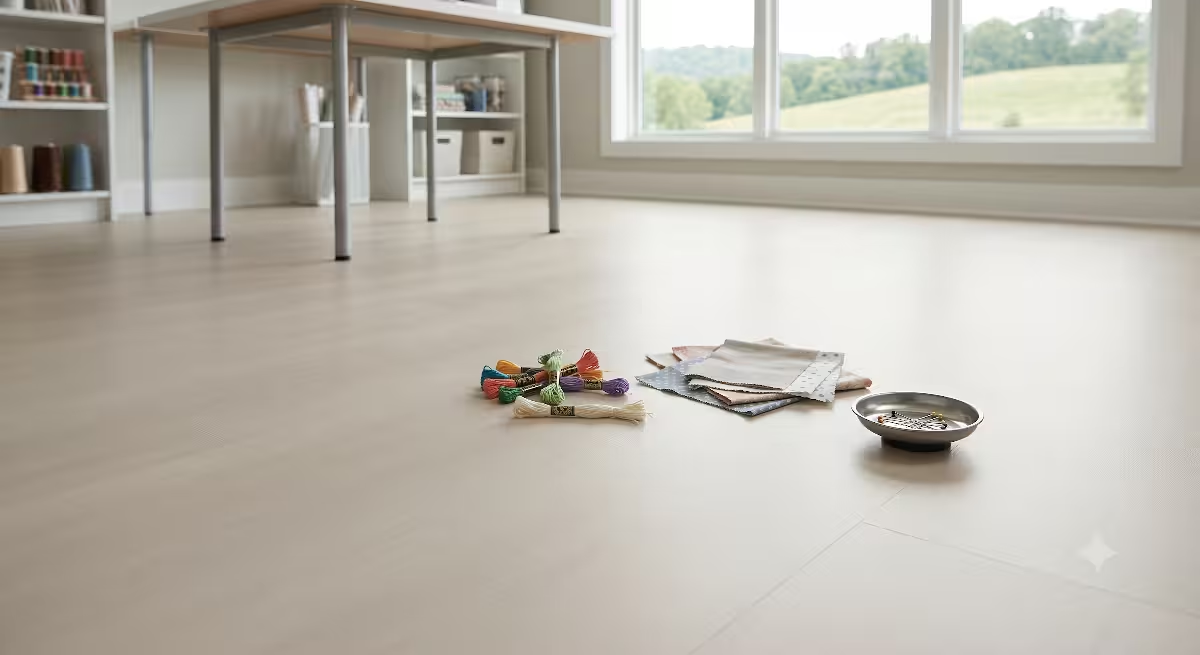
The ideal color for the walls of a studio is a neutral, middle gray. This neutral gray effectively becomes “invisible” to the eye. It doesn’t reflect a color cast, and it doesn’t create new glare. It allows the artists to see only the light on their subject and the true color on their canvas. Flooring should also be neutral and have a matte, non-reflective finish.
4. Energy, Insulation, and HVAC
Finally, we have to address the “cold room” problem. My values of competence and integrity mean I can’t build a room that is technically perfect for painting but physically uncomfortable to be in.
As I’ve said, this room will be the coldest in the house. To fix this, we must over-engineer the room’s “thermal envelope.”
- Insulation: We use a higher R-value insulation in the walls and ceiling of this room than in the rest of the house.
- Windows: We use high-performance, triple-pane windows (with that clear glass I mentioned) to minimize heat loss.
- HVAC: This is the most critical part. We cannot have the studio on the same heating zone as the south-facing living room. If we did, the living room would get warm from the sun, its thermostat would shut off, and the north-facing studio would be left to freeze. We must create a separate HVAC zone for the studio, with its own thermostat. Often, a high-efficiency mini-split system is the most precise and cost-effective solution for these artists. This allows them to keep their studio at a comfortable working temperature without overheating the rest of the house.
Conclusion: Precise Design for a Specific Purpose
The long-standing tradition of the north-lit studio isn’t just a romantic quirk. It is a perfect example of form following function. It is a precise, technical solution to a very real problem that artists have faced for centuries.
It shows that a true custom home isn’t just about the finishes, the square footage, or the number of bedrooms. It’s about a competent and precise design that starts with the land itself. It’s about considering how the orientation of the sun will impact the life lived inside those walls.
Understanding how light moves across your property is the first step to a successful build. Whether you are one of the many artists in our community needing that perfect, consistent light, or a family who simply wants a warm, sunny kitchen for breakfast, the orientation of your home is the most fundamental and important design choice you will ever make.