When you’re planning a custom home here in the Tri-Cities, you want it to be comfortable, efficient, and built to last. You are making one of the largest investments of your life, and you want to do it right. In your research, you have likely come across two popular terms: “passive house” and “net-zero.”
Many buyers think these two concepts are the same thing, or that they are competing standards you must choose between. The truth is, they are two different approaches to the same ultimate goal: a better, higher performing, and more sustainable home.
The simple answer is this way: Passive House is the method (the “how”) and Net-Zero is the goal (the “what”).
Understanding this key difference is the first step to making the right long term investment for your family. A passive house focuses on building a fundamentally better, more resilient building. A net-zero home focuses on balancing an energy budget. You can have one without the other, but as I’ll explain, one path makes a lot more sense than the other.
This article will break down exactly what each standard means, how they compare, what they cost, and most importantly, what makes the most sense for our unique climate here in East Tennessee.
Video Version of this Article
What is a Passive House? Focusing on “Fabric-First” Efficiency
The first thing to understand is that passive house (or Passivhaus, as it was originally called in Germany) is not an architectural style. A passive house can be a modern colonial, a rustic farmhouse, or a sleek contemporary home.
Instead, a passive house is a rigorous, performance based building standard. The entire philosophy is built on one simple, powerful idea: radically reduce the need for energy in the first place.
The analogy I always use is a high quality thermos.
Before you ever worry about how to heat the coffee inside, you first build a container that is so well insulated and sealed that it doesn’t let the heat escape. A passive house is a thermos for your family. It’s designed to maintain its comfortable indoor temperature, regardless of what’s happening outside, with almost no effort.
A passive house achieves this remarkable performance by focusing relentlessly on the “fabric” or “envelope” of the building. This is what we call a “fabric-first” approach. It’s not about high tech gadgets; it’s about superior engineering and craftsmanship.
There are five core principles to every certified passive house.
1. Superinsulation
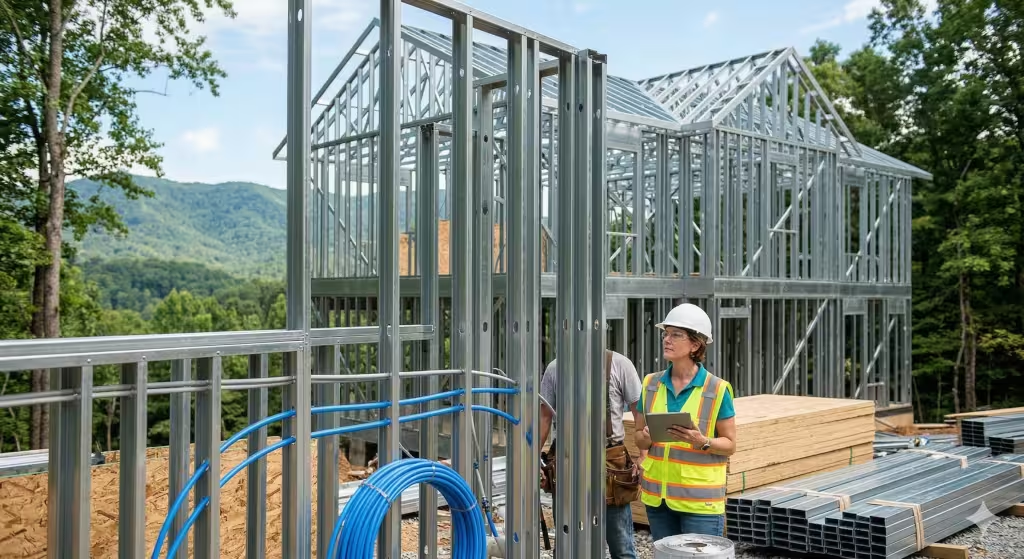
A passive house is “superinsulated.” This means we install a continuous layer of insulation in the foundation, the walls, and the attic that goes far beyond what standard building code requires. We are not just talking about putting batts between studs. We are talking about designing a thick, unbroken thermal blanket around the entire home.
In a typical home, the wood studs in your wall, for example, have a much lower insulation value (R-value) than the insulation itself. Heat can travel through those studs, creating cold spots on your walls in the winter. A passive house design solves this by adding a layer of continuous insulation on the outside of the studs, stopping that heat transfer completely.
2. An Airtight Envelope
This is one of the most critical and least understood parts of a passive house. We build the home to be exceptionally airtight. This means meticulously sealing every single joint, every window opening, every place a wire or pipe goes through the wall.
Why? Because uncontrolled air leaks are the number one source of energy loss and discomfort in a standard home. They are the cold drafts you feel by the window in winter and the humid air that leaks in during a Tennessee summer.
We measure this airtightness with a tool called a “blower door.” We close the house, mount a powerful fan in a doorway, and suck all the air out. This test measures exactly how many “Air Changes per Hour” (ACH) the house has. A typical new home might have 3 to 5 ACH. A passive house is required to be less than 0.6 ACH. It is so tight you can no longer rely on random leaks for “fresh” air, which brings us to the next point.
3. Thermal-Bridge-Free Construction
This is a concept that truly separates a passive house from standard construction. A thermal bridge is like a high speed lane for heat to escape your home.
Think about a concrete patio slab that is poured right up against your home’s foundation. That solid piece of concrete acts as a “bridge,” pulling warmth directly from your conditioned interior and dumping it into the cold ground outside. Other common thermal bridges are uninsulated window frames, wood studs, and any place where a balcony structure connects to the house.
In a passive house, we design every one of these connections to be “thermally broken.” We use special materials or clever designs to ensure there are no direct paths for heat to escape. This is a level of precision that requires a builder to understand building science, not just follow a blueprint.
4. High-Performance Windows
You can have superinsulated, airtight walls, but if you put in cheap, leaky windows, you have completely defeated the purpose. A passive house uses high performance windows, which are almost always triple pane.
These windows have special, invisible “low-e” coatings and are filled with a harmless gas (like argon) that slows down heat transfer. But it’s more than just the window itself. We also “tune” the windows for the home’s location.
For example, on the south side of a passive house in Tennessee, we would select windows that allow the sun’s heat to enter during the winter, giving you free warmth (this is called “passive solar gain”). On the east and west sides, we would use a different coating to block the hot morning and afternoon sun in the summer, reducing your cooling load.
5. Continuous Ventilation with Heat Recovery
This is the component that brings it all together. When people hear “airtight house,” they often ask, “Won’t the air get stuffy and stale?”
This is a valid concern, and the answer is that a passive house has the best indoor air quality of any home, because its ventilation is managed.
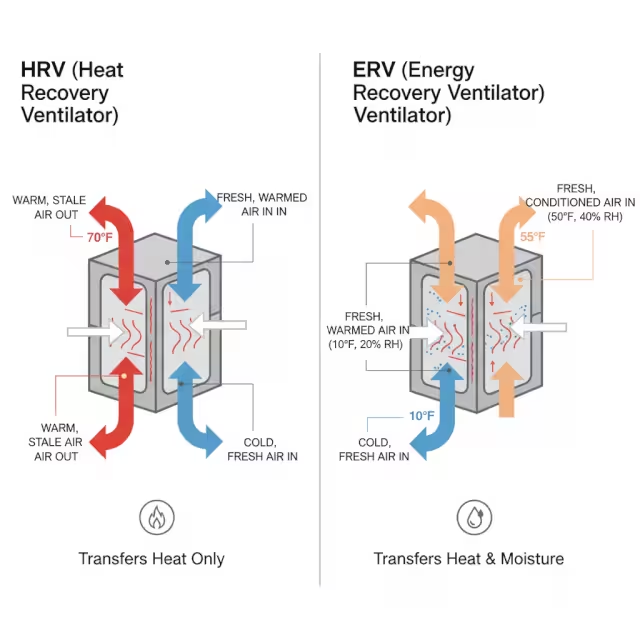
Because the home is so airtight, we install a balanced ventilation system. The most common tool for this is a Heat Recovery Ventilator (HRV) or an Energy Recovery Ventilator (ERV).20 I recommend an ERV for our humid climate.
This machine acts as the “lungs” of the home. It runs 24/7, constantly pulling stale, moist air out of bathrooms and the kitchen, and simultaneously supplying fresh, filtered air to bedrooms and living spaces.
Here is the magic: Inside the machine, the two air streams pass each other in a special core without ever touching. The core transfers the heat (and in an ERV, the moisture) from the outgoing air to the incoming fresh air.
In the winter, this means the fresh -10°F air coming in is pre-warmed to 65°F by the time it enters your home, using only the heat from the stale air you were kicking out anyway. In the summer, it does the reverse, pre-cooling and dehumidifying the hot, sticky outside air.
The result of these five principles?
A passive house is a home that provides a level of comfort that is simply impossible to achieve with standard construction. There are no drafts. The temperature is perfectly even from room to room and floor to floor. It is also incredibly quiet, as the insulation and airtightness block most outside noise.
And because it needs so little energy, a passive house uses up to 90% less energy for heating and cooling than a standard home. It is a home that is high performance, healthy, and incredibly resilient. A passive house is, in my professional opinion, the most robust and comfortable way to build.
What is a Net-Zero Home? Focusing on “Net” Energy Production
Now, let’s look at Net-Zero. A Net-Zero home is defined by a different goal. It is not a building standard, but an accounting standard.
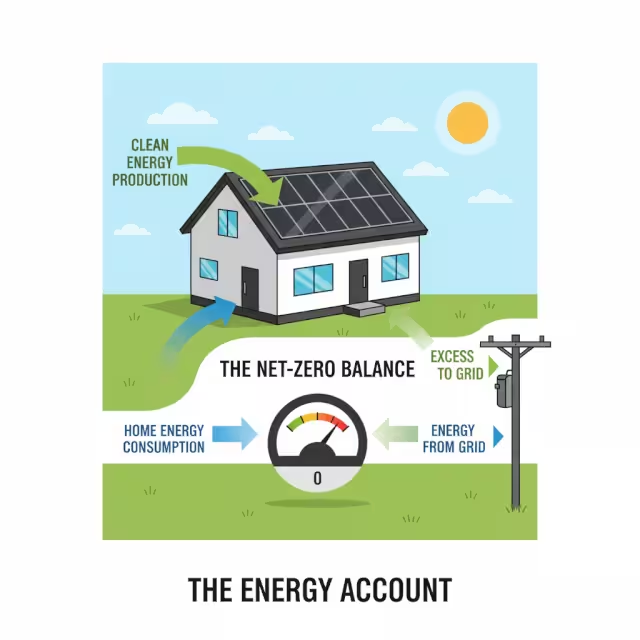
The goal of a Net-Zero home is to produce as much renewable energy on-site as the home consumes over a one year period.
The analogy here is a bank account. You are trying to make your energy “deposits” (the energy you create) equal or exceed your “withdrawals” (the energy you use from the grid).
How It’s Achieved
A Net-Zero home is a two-step process:
Step 1: Be Efficient. First, you must make the home as energy efficient as possible. Why? Because it would be financially impossible to make a standard, leaky, code-built home Net-Zero. The house would consume so much energy that you would need to cover your entire roof and half your yard in solar panels. It just doesn’t make sense. So, the first step is to reduce your “withdrawals.”
Step 2: Add Renewables. Once you have a very efficient home that sips energy, you install an on-site system to produce your own power. In almost every case, this means a solar photovoltaic (PV) system on the roof.
During the day, your solar panels will often produce more electricity than the home needs. This extra power is sent back to the utility grid (your “deposit”). At night, or on a cloudy day, you pull power from the grid (your “withdrawal”).
At the end of the year, you and the utility look at the “net” total. If you sent back as much as you took, you are a Net-Zero home.
A Key Term: “Net-Zero Ready”
This is a concept I strongly support, one that is promoted by the U.S. Department of Energy (DOE) through its Zero Energy Ready Home (ZERH) program.
A Net-Zero Ready home is one that is built to be extremely efficient (it often uses many, if not all, of the passive house principles) but does not have the solar panels installed yet.
It is “ready” for them. The roof is built to handle the load, the conduit (the pipe for the wires) is already in place, and the electrical panel is set up. This is a brilliant, phased approach. It allows you to invest your money first in the “fabric” of the home—the parts you can never change, like the insulation, windows, and airtightness.
Then, you can live in the home for a year, see what your (already tiny) energy bills are, and add the exact right size solar array when your budget allows, or when technology prices drop even further.
Building a passive house is the single best way to create a “Net-Zero Ready” home.
Answering Your Questions (Passive vs. Net-Zero)

Here are some the common questions from buyers trying to compare these two ideas. Let’s clear them up directly.
Is one “better” than the other?
This is often the most common question. As stated at the start, it’s a false choice, because they are not competing. One is a method, and one is an outcome.
But if you need an answer, it is this: A passive house is always the better starting point.
You can build a passive house and choose to never add solar panels. You will still live in one of the most comfortable, healthy, and resilient homes in the world, with laughably small utility bills. You have locked in that quality for the 100-year life of the home.
You cannot, however, (sensibly) build a Net-Zero home without first using the passive house principles. If you build a standard home and just add a massive solar array, you have a home that is still drafty, uncomfortable, and completely dependent on the grid and its own equipment to function. If the power goes out, your solar panels (for safety reasons) shut down too, and your leaky home will be cold in hours.
The recommendation is always the same: Focus on the “fabric-first” approach of a passive house. Get the bones of the house right.
What is the cost difference? Upfront Investment vs. Lifetime Savings
Building to either of these standards carries an upfront premium over a standard, “code-built” home. You are using more materials, higher quality components (like triple-pane windows and an ERV), and it requires more skilled, precise labor.
Estimates vary, but you can expect a passive house to cost 5-10% more upfront than a standard custom home.
But here is the smart math that many people miss: Building to the passive house standard dramatically reduces the cost of achieving Net-Zero.
Because your home will use 75-90% less energy, you only need a tiny solar panel system to get to Net-Zero. Your neighbor in his “code-built” home might need a 15-kilowatt solar array. Your passive house will only need a 3 or 4-kilowatt system. You just saved tens of thousands of dollars on the solar, which often pays for the entire passive house upgrade.
The long-term savings are obvious. Your utility bills for heating and cooling will be almost zero, for the life of the home. But the real return on investment, in my opinion, is the non-financial value. You get a quiet, comfortable, and healthy home.28 That is a return you feel every single day.
Is a passive house automatically Net-Zero?
No. This is a common point of confusion.
A certified passive house is designed to be hyper-efficient. It is a home that sips energy. That is its only goal.
A Net-Zero home is an active home. It is a home that produces energy.
You can have a passive house that is not Net-Zero. It just sips a tiny amount of energy from the grid. But, as I mentioned above, a passive house is the easiest, most sensible, and most affordable path to becoming Net-Zero.
When you do add solar panels to a certified passive house, it often gets a special designation, like “Passive House Plus.” This is the best of all worlds: a home that is fundamentally comfortable and resilient and produces its own power.
How do standards like LEED or ENERGY STAR fit in?
You will hear about many other “green” programs. It helps to think of them as a ladder of performance.
Standard Building Code: This is the absolute legal minimum. It is not a standard for quality or efficiency.
ENERGY STAR: This is a great, trusted program from the EPA. An ENERGY STAR-certified home is a solid step up, guaranteeing it is at least 10-20% more efficient than a standard home.31
LEED for Homes: This is a broad, point-based system from the U.S. Green Building Council (USGBC).32 LEED awards points for energy efficiency, but also for water use, site location, sustainable materials, and more. A passive house design is a fantastic way to get all the energy points needed for a high LEED certification.
Passivhaus Institut vs. Phius: This is an important distinction. The Passivhaus Institut (PHI) is the original German organization. Phius (Passive House Institute US) is the leading American organization.
Here in East Tennessee it is often best to use the Phius standard. Why? Because Phius has developed certification standards that are specifically adapted for our different North American climate zones. The performance targets for a passive house in dry, cold Minnesota should be different than for one in our mixed-humid climate in East Tennessee. Phius understands this.
Furthermore, Phius has aligned its program directly with the DOE’s Zero Energy Ready Home (ZERH) and ENERGY STAR programs, creating a clear, logical, and certified “ladder” for builders and buyers to follow. A Phius-certified passive house is, in my view, the new “gold standard” for American home building.
The Local Take: What This Means for Building in the Tri-Cities, TN
All this theory is great, but what does it mean for your custom home, here in Johnson City, Kingsport, or Bristol? This is where my local experience as a builder comes in. Our climate presents specific challenges that a passive house is uniquely built to solve.
Our Climate-Specific Challenges
We live in a “mixed-humid” climate. We have hot, sticky, humid summers and surprisingly cold, damp winters.
- Humidity: In a standard home, humidity is the enemy. That sticky air gets pulled into your home through all those tiny leaks. It forces your air conditioner to work overtime, not just cooling the air, but also trying (and often failing) to wring all that moisture out. This is why basements feel damp and indoor air feels “sticky.”A passive house, with its airtight envelope and the Energy Recovery Ventilator (ERV), gives you total control. The ERV actively transfers moisture out of the incoming fresh air in the summer, keeping your home perfectly comfortable and dry, all while using almost no energy. This also prevents moisture and mold issues within your walls.
- Temperature Swings: We get cold snaps and we get heat waves. In a standard home, you feel those. Your furnace or AC is constantly kicking on and off, and the rooms on the south side are hot while the north side is cold.A passive house doesn’t care. The “thermos” design means the indoor temperature stays stable, day and night, all year round. The small amount of heating or cooling it needs is delivered gently through the ventilation system.
- Resilience: This is a big one for me. We get ice storms and heavy thunderstorms that knock out the power. When the power goes out, a standard, leaky home gets dangerously cold in just a few hours.A passive house is the ultimate “resilient” home. Because it’s a thermos, it holds onto its heat. A certified passive house can stay at a safe, comfortable temperature for days without any power, just from the body heat of the occupants and the sun coming through the windows. This is not just a “nice to have”; it is a matter of safety and security for your family.
The Builder’s Perspective
Generally, in our region, building a passive house is not something you can ask just any crew to do.
This is not “building to code.” It is building science put into practice. It requires a builder and a team that are committed to precision. You have to understand why you are air-sealing a joint a certain way, or how to design a foundation that has no thermal bridges.
A passive house requires both. It requires the builder to be on-site, checking the details, and working with the framers, insulators, and window installers to make sure every part of the “thermos” is perfect.
Local Utilities and Your Net-Zero Goal
If your goal is to go all the way to Net-Zero, you have to work with our local utilities. Whether you are served by BrightRidge in Johnson City, Bristol Tennessee Essential Services (BTES), or another provider, your system will be connected to the grid.
All of these utilities operate under the umbrella of the Tennessee Valley Authority (TVA). The TVA sets the policies for how homeowners with solar panels are compensated for the energy they send back to the grid. This is called “net metering” or, more recently, an “energy buy-back” program.
These policies change, but the logic does not: the smaller your solar array, the simpler your interconnection agreement and the faster your payback. A passive house, which requires the smallest possible solar array, makes the entire process of going Net-Zero simpler, cheaper, and smarter.
Your Best Path Forward for a Custom Home
To bring this all together, let’s go back to the beginning. We are not looking at “Passive House vs. Net-Zero.” We are looking at “Passive House and Net-Zero.”
They are partners in creating a truly high performance home.
A passive house is the design standard.46 It is the set of engineering principles that you build into the very “bones” of your home. It is the investment that locks in comfort, health, quiet, and extreme efficiency for the entire life of the building.
A Net-Zero home is the energy goal.47 It is the final step of adding renewable power to offset your (now tiny) energy footprint.
As a builder and as the Home Building Expert for WebHeads United, my advice to every single custom home client is consistent and, I believe, has the most integrity:
Start with a “fabric-first” passive house design. Build the best “thermos” you possibly can.
This is the smartest, most durable, and most valuable investment you can make. It gives you options. You can add the solar panels on day one and achieve Net-Zero immediately, or you can live in your incredibly comfortable, efficient passive house for five years and add the panels when your budget allows.
The most important investment is in the core of the home, the parts you can’t see and can never easily change. Get that right, and you will have a home that serves your family for generations to come.