

Have you ever walked into a luxury home that looked stunning but smelled a little like an old basement? Or perhaps you have visited a house with beautiful granite countertops, but the master bedroom is always freezing in the winter. This is the difference between architecture and physics. One is about how the house looks. The other is about how the house works.
Most people think building a home is just about choosing the right floor plan and picking out finishes. One facet of custom homes in the Tri-Cities area is that the most important parts of your home are the ones you never see. This is where we answer the question: what is building science in residential construction?
Building science is the study of how heat, air, and moisture move through your home.
It is not just a fancy term for engineers. It is the rulebook that decides if your home will last for a hundred years or if it will rot in twenty. It combines physics, chemistry, and engineering to view the “house as a system.” When we ignore these rules, we get high energy bills, mold, and uncomfortable drafts. When we follow them, we get homes that are healthy, durable, and comfortable.
In this article, we are going to look under the hood of your home. We will strip away the drywall and the siding to show you the invisible forces at play. We will talk about why homes in Johnson City and Kingsport face unique challenges, and how understanding building science can save you thousands of dollars.
Video Version of this Article
The Four Control Layers (The “Perfect Wall” Concept)
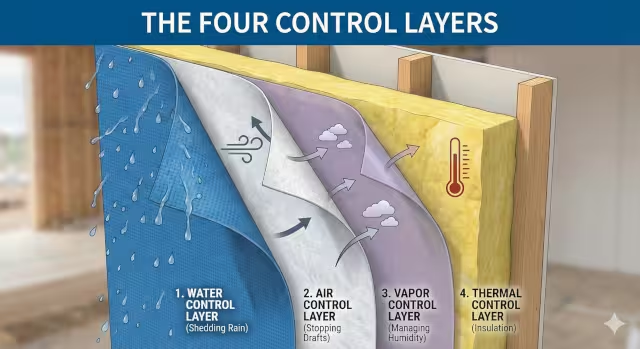
When we design a wall, we are not just stacking wood and brick. We are building a shield. In the world of building science, we call this the “Perfect Wall.” This wall has to stop four things from getting inside. The order of these layers is critical. If you get the order wrong, you trap water inside the wall, and that is when the trouble starts.
1. The Water Control Layer
This is your first line of defense in building science. It is the most important layer because water is the number one enemy of any building. This layer includes your roof shingles, the siding, and the flashing around your windows.
Think of this layer like a raincoat. Its only job is to shed bulk water. When it rains in Tennessee, we can get inches of water falling in just a few hours. The water control layer grabs that water and directs it down and away from the house.
If this layer fails, nothing else matters. You can have the best insulation in the world, but if the roof leaks, that insulation just becomes a wet sponge. In building science, we always prioritize water management above everything else.
2. The Air Control Layer
Once we stop the rain, we have to stop the wind. The air control layer stops air from leaking in and out of the house. You might know this as “house wrap” or the white paper you see on buildings under construction.
Many older homes do not have a good air barrier. That is why they feel drafty. But it is not just about cold air coming in. It is about money going out. If your home leaks air, your heater has to work overtime to warm up the neighborhood.
A good air control layer also keeps out bugs, pollen, and dust. It makes the house feel solid and quiet.
3. The Vapor Control Layer
This is where things get tricky, especially here in the South. Water vapor is different from rain. It is humidity. It is the water in the air that you cannot see.
In a mixed-humid climate like ours, vapor wants to move from the warm side of the wall to the cold side. In the summer, the hot, humid outdoor air tries to push its way into your cool, air-conditioned house.13 In the winter, the moist air from your shower and cooking tries to push its way out to the cold yard.
The vapor control layer manages this flow. We do not want to stop it completely, or the walls cannot dry out if they get wet. We just want to slow it down. Building science teaches us that walls need to “breathe” slightly to release trapped moisture.
4. The Thermal Control Layer
Finally, we have the thermal layer of building science. This is your insulation. It keeps the heat in during the winter and out during the summer.
Most people think insulation is the most important part of efficiency. But building science proves that insulation does not work well if the other layers are broken. Imagine wearing a thick wool sweater on a windy, rainy day. The wind blows right through the wool, and the rain soaks it. You will be freezing. But if you put a windbreaker (air barrier) and a raincoat (water barrier) over that sweater, you stay warm.
Your house works the same way. Insulation is the sweater. The other control layers protect it so it can do its job.
The Big Three: Heat, Air, and Moisture
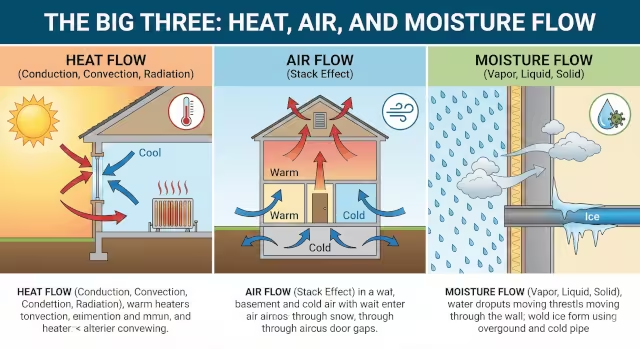
To really understand building science in residential construction, we have to look at the three forces that are constantly attacking your home. These are the laws of physics, and they never take a day off.
Heat Flow: How Energy Moves
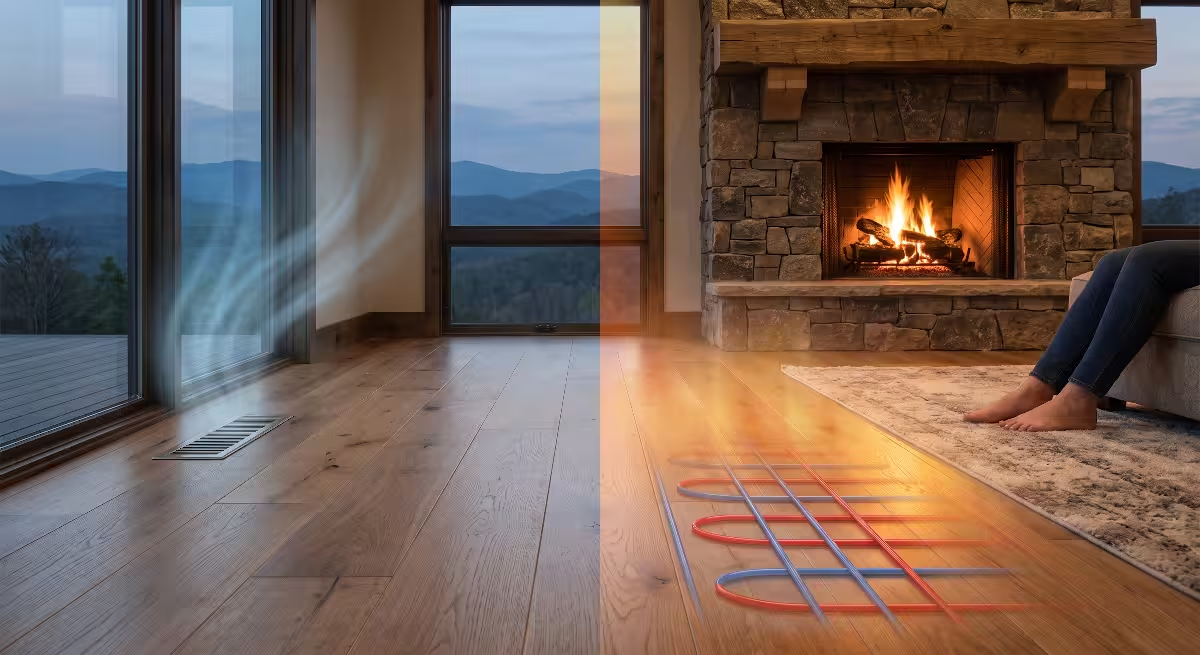
Heat always moves from a hot place to a cold place. It never stops trying to find balance. In the winter, the heat in your living room is desperate to escape to the cold outdoors. In the summer, the heat from the sun is pounding on your roof, trying to get inside.
There are three ways heat moves, and a good builder fights all of them:
Conduction: This is heat moving through solid materials. If you touch a hot pan, that is conduction. In a house, heat travels right through the wooden studs in your walls. We call this “thermal bridging.”
Convection: This is heat moving through the air. Warm air rises, and cold air sinks. If you have a two-story foyer that is always hot at the top, that is convection.
Radiation: This is heat traveling in waves, like sunlight. When the sun hits your roof, it radiates heat into the attic.
Building science uses insulation to slow down conduction. It uses air sealing to stop convection. And it uses reflective barriers to stop radiation.
Air Flow: The Stack Effect
Air movement is a powerful force. One of the most common concepts in building science we teach is the “Stack Effect.”
Imagine your house is a tall chimney. In the winter, you heat the air inside. Warm air is lighter than cold air, so it rises. It goes up to the second floor and pushes against the ceiling. It finds tiny cracks around your attic hatch or recessed lights and escapes into the attic.
But physics says that if air leaves the house, new air must come in to replace it. This creates a vacuum at the bottom of the house. Cold air gets sucked in through the basement rim joist, the crawlspace vents, and under the doors.
This means you are paying to heat air that just floats away, while simultaneously sucking dirty, cold air into your home from the bottom. Building science solves this by sealing the “lid” (the attic) and the “bucket” (the foundation) to stop the airflow.
Moisture Flow: The Silent Killer
Moisture is the hardest thing to control. It changes forms. It can be a liquid (rain), a solid (ice), or a gas (vapor).
The most dangerous type for a home is usually vapor. It moves through drywall and wood. When it hits a cold surface, it turns back into liquid water. This is called condensation.
If this happens inside your walls, you get black mold. You get rot. You get termites. And you might not know it is happening until the wall falls apart. Building science is largely the art of managing moisture so that when a wall gets wet (and it will), it has a way to dry out.
Regional Specifics: Building Science in East Tennessee
Building a home in Arizona is different from building one in Vermont. But here in East Tennessee, we are in Climate Zone 4A. This is a “mixed-humid” climate. It is one of the hardest places to build correctly.
The “Goldilocks” Problem
We do not have it easy. We have summers that are almost as hot and humid as Florida. We have winters that can get freezing cold. This means our homes have to handle everything.
In Florida, the vapor drive is always pushing in (hot outside, cool inside). In Canada, the vapor drive is usually pushing out (warm inside, cold outside). In Tennessee, the drive changes direction twice a year.
This matters because of where we put the vapor barrier. If you put a plastic sheet on the inside of the wall (like they do in the North), you will trap moisture in the summer. If you put it on the outside, you trap it in the winter. Building science tells us we need “smart” materials that adapt, or we need to avoid plastic barriers altogether in our walls.
The Crawlspace Debate
This is the biggest argument in our area. For fifty years, codes said we should build crawlspaces with vents. The idea was that the wind would blow through and dry out the soil.
Building science has proven that this is wrong for our climate.
When you open vents in the summer, you are letting hot, humid air into a cool, dark space. The ground under your house is cool naturally. When that hot humid air hits the cool floor joists, it drops its water. The wood sweats.
This leads to:
Cupped hardwood floors inside the house.
Mold growing on the floor joists.
Musty smells rising into the living room.
The solution is the “encapsulated” crawlspace. We seal the vents. We put a heavy liner on the ground. We insulate the walls. We treat the crawlspace like a mini-basement. This keeps the humidity out and protects the structure.
HVAC Sizing: Bigger is Not Better
I often see homeowners asking for the biggest air conditioner they can buy. They want the house to cool down instantly. This is a mistake.
An air conditioner does two things: it cools the air, and it removes humidity. To remove humidity, the unit needs to run for a long time.
If you buy a unit that is too big, it cools the house in ten minutes and then shuts off. It does not run long enough to pull the water out of the air. You end up with a house that is 68 degrees but feels clammy and damp. This is the perfect environment for mold.
Building science uses a calculation called “Manual J” to size the unit perfectly.29 We want it to run longer and slower, keeping the house dry and crisp.
Common Building Science Failures (and How to Spot Them)
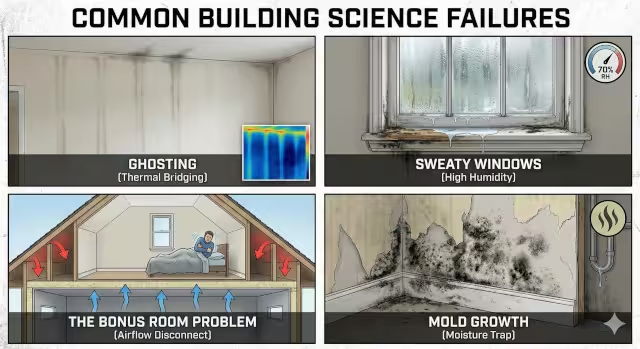
You do not need a degree to spot when building science has been ignored. The house will tell you. Here are some common signs of failure I see in our area.
Ghosting
Have you ever seen faint black lines on a light-colored carpet? Or dark vertical stripes on a wall? We call this “ghosting.”
It happens when there is a cold spot on the wall or floor. Usually, it is because there is no insulation behind a stud (thermal bridging) or there is a cold draft leaking in.
Dust and soot in the air like to stick to cold surfaces. Over time, they paint a picture of the framing behind the wall. It tells me that the thermal control layer is broken.
Sweaty Windows
If your windows are wet on the inside during the winter, you have a problem. It might mean your windows are cheap, but more likely, it means your indoor humidity is too high.
The warm, moist air inside the house hits the cold glass and condenses. This water drips down and rots the window sill. This is a ventilation failure. The house is not exchanging stale air for fresh air properly.
The Bonus Room Problem
Everyone loves a room over the garage. But almost everyone complains that it is the hottest room in the summer and the coldest in the winter.
This happens because the room is surrounded by the outdoors. It has a roof above it, exterior walls on the sides, and a cold garage underneath it. It is hard to air seal the floor of that room.
Car exhaust and cold air from the garage leak up into the floor. The knee-walls (the short walls on the sides) often lack proper backing for the insulation, so the insulation falls down. Building science requires us to treat this room like a separate insulated box, sealing it tight from the garage fumes and the attic heat.
The House as a System
The most important takeaway frombuilding science in residential construction is that you cannot look at things in isolation. Everything is connected.
If you replace your old drafty windows with new airtight ones, you might suddenly get mold in the bathroom. Why? Because the old windows were leaking so much air that they accidentally ventilated the house. Now that the house is tight, the bathroom moisture has nowhere to go. You need to add a mechanical fan.
If you upgrade your insulation but do not seal the air leaks, the insulation will not work.
If you install a massive range hood in your kitchen, it might suck air so hard that it pulls exhaust gas down your fireplace chimney.
A builder who understands building science looks at the whole picture. We anticipate how one change will affect the rest of the house. We use tools like blower doors (to test air tightness) and infrared cameras (to see heat loss) to verify that the system is working.
Indoor Air Quality: The Health Connection
We spend 90% of our time indoors. The quality of the air in your home affects your health more than the air outside. Building science is directly tied to Indoor Air Quality (IAQ).
When a house is built poorly, it breathes through the wrong places. It sucks air through the insulation in the attic. It pulls air through the moldy crawlspace. It drags dust from inside the walls.
A properly built home is airtight, but it is not a suffocating plastic bag. We follow the mantra: “Build it tight, and ventilate it right.”
We seal the bad air out. Then, we install a dedicated fresh air system. This machine brings in clean, filtered air from the outside. It mixes it with your indoor air. This way, you are breathing air that has passed through a filter, not air that has passed through a dead mouse in the attic.
This is vital for families with allergies or asthma. By controlling the air layer, we control the pollutants.
Conclusion
So, what is building science in residential construction? It is the difference between a house that is just a collection of wood and brick, and a home that is a high-performance machine.
It is the assurance that your hardwood floors will not buckle in July. It is the comfort of walking into a bonus room that is the same temperature as the rest of the house. It is the peace of mind knowing that your walls are dry and free of rot.
In the Tri-Cities, where our weather throws everything at us, ignoring these principles is a costly mistake. A pretty house without building science is just a high-maintenance shed.
If you are planning to build or renovate, do not just look at the floor plan. Ask about the control layers. Ask about the water management. Ask about the HVAC sizing.
Building a custom home is a journey. It requires a guide who understands the terrain. At WebHeads United, we do not just build for today; we build for the physics of tomorrow.