

When building a custom home in the Tri-Cities of TN, the most common source of friction between good people and good builders is a single word: “allowances.”
A client in Bristol is thrilled as their home takes shape. The framing is perfect, the roof is on. Then the selection process begins. They pick out the lights, the faucets, and the flooring they have always wanted. Suddenly, they are hit with a “budget shock,” an invoice for thousands of dollars in “overages” they never saw coming. Their excitement turns to anxiety.
This is a scenario some buyers experience. It is almost always avoidable. The problem is not the cost of the items; the problem is a fundamental misunderstanding of what allowances are and how they work.
This article is designed to prevent that exact situation. Our goal is to calmly and precisely explain what construction allowances are. We will show you the red flags to look for, and will give you the exact questions you must ask your builder. This guide will help you protect your budget and ensure the home building experience is the best it can be.
So, what is a construction allowance?
In simple terms, an allowance is a specific dollar amount allocated in your build contract for an item that you, the buyer, have not yet selected. Think of it as a placeholder.
When you sign your contract, we know you need kitchen cabinets. We just do not know if you want a simple white shaker style or a high end, custom walnut cabinet. We know you need faucets, but we do not know if you will pick a $150 standard model or a $1,500 designer fixture.
To create a total contract price, the builder must put a number in for that item. That number is the allowance. These allowances give you the flexibility to make design choices later in the process.
The core problem, and the source of all the conflict, is when these placeholder allowances are set unrealistically low. This is sometimes done to make the total contract price seem more competitive. Your builder gives you a $20,000 allowance for cabinets, knowing full well that the type of cabinets you showed him in a picture will actually cost $35,000.
Understanding allowances is the key to protecting your budget. This article will be your guide.
Video Version of this Article
The “Big 3” of Your Contract: Allowance vs. Contingency vs. Fixed Price

Before we go deeper, it is critical to understand three different terms that control your money: Allowances, Contingency, and Fixed Price. They are not the same thing. Mixing them up is a fast track to budget problems.
Allowances: Your “Shopping Fund”
As we just defined, allowances are for known unknowns. These are specific, predictable items you will be selecting for your home. Your allowances are a pre set budget for you to go “shopping” with. This can include items like flooring, countertops, appliances, and light fixtures.
Your builder should provide you with a detailed list of all the allowances in your contract. These allowances are part of your total build price. If you have a $500,000 build contract, that price already includes all of your allowances. For example, it might include a $15,000 allowance for flooring. You are not paying extra for allowances unless you go over them.
Contingency: Your “Emergency Fund”
A contingency fund is for unknown unknowns. This is money set aside for true, unforeseen problems that are not related to your design choices. Think of it as your project’s insurance policy.
What if we start digging your foundation in Johnson City and hit a massive shelf of solid rock that no one could have predicted? That rock has to be excavated, which costs significant time and money. This is what the contingency fund is for. It covers surprise termite damage in a renovation, sudden material shortages, or weather disasters.
Your contingency fund is not for your allowances. If you have a $5,000 lighting allowance but fall in love with a $7,000 chandelier, you cannot “just use the contingency.” That is a design choice, or an “overage,” which is a different matter. Using your contingency fund on allowance overages early in the build is dangerous. It leaves you with no safety net for real emergencies later.
Fixed Price Contract (or GMP): Your “Total Price Tag”
A fixed price contract, or a Guaranteed Maximum Price (GMP), is the total cost the builder agrees to build your home for. This is the “bottom line” number that you and the bank are working with.
Here is the most important concept to understand: Your allowances are included inside this fixed price.
Let’s use simple math.
- Your Fixed Price Contract = $500,000
- This price includes a flooring allowance of $15,000.
- It also includes an appliance allowance of $10,000.
If you go to the store and pick $15,000 worth of flooring, you are fine. You pay nothing extra.
If you go to the store and pick $18,000 worth of flooring, you have gone over your allowance by $3,000. That $3,000 will be added to your total contract price, making it $503,000.
This is how budgets get broken. The final price is only “fixed” if you stay within all the allowances that are part of that price. Your contract’s total price is only as realistic as the allowances within it.
What’s Actually Included? The Two Types of Allowances You Must Know
This is the most precise, technical detail, and it is the one that costs homeowners the most money. My engineering background values precision, and this is where it matters most.
When your builder gives you a $10,000 cabinet allowance, you must ask a very specific question: “Is this a ‘Material’ allowance or an ‘Installed’ allowance?”
The answer can change your budget by thousands of dollars.
1. Material Allowance
A material allowance, as its name suggests, covers only the cost of the material itself. It is the price of the item in the box.
Using our $10,000 cabinet allowance example, this would cover only the cost of the cabinet boxes, doors, and shelves.
It would NOT include:
- Sales Tax (which in Tennessee is significant)
- Delivery or freight charges to get the cabinets to your job site
- Installation labor to hang and level the cabinets
- Cabinet hardware (knobs and pulls)
- Crown molding
- Any other “soft costs” associated with it
Imagine your shock when you pick $10,000 worth of cabinets, thinking you are on budget, only to receive a separate bill for $4,500. This bill covers the tax, shipping, and the carpenter’s time to install them. This is a common and very painful surprise. Unfortunately, many contracts are written with material only allowances.
2. Installed Allowance (or “Turn Key”)
This is the second type of allowance, and it is what most buyers think they are getting. An “installed” or “turn key” allowance is a complete, all inclusive budget for that item.
If you have a $10,000 installed cabinet allowance, that $10,000 is meant to cover everything:
- The cabinets themselves
- All applicable sales tax
- All delivery fees
- All labor required for a complete installation
- All associated parts like hardware and molding
This type of allowance gives you a much more accurate picture of your real budget. It means $10,000 truly means $10,000.
Our Expert Tip (Core Value: Integrity):
As a matter of personal integrity and professional competence, I advise all buyers to always assume an allowance is “material only” unless the contract explicitly states in writing that it is an “installed” allowance.
Do not accept a verbal “oh yeah, that covers everything.” Get it in writing. A simple line in the contract defining all allowances as “installed” or “turn key” is sufficient. A builder who is committed to transparency will have no problem providing this. A builder who hedges or refuses to define their allowances is telling you everything you need to know.
A Typical Allowance List in a Custom Home Contract
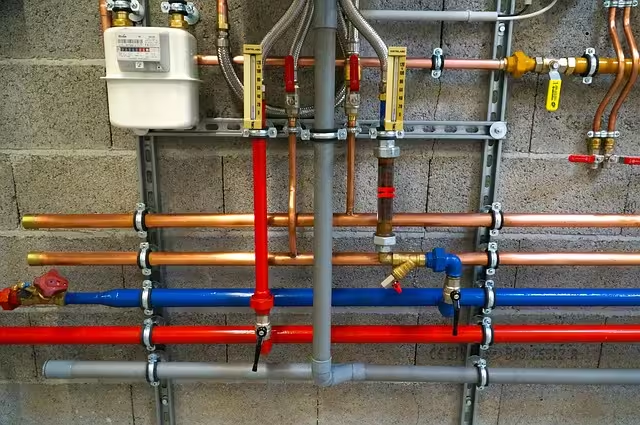
So, what parts of your new home will be covered by allowances? While every project in the Tri-Cities is different, most custom home contracts will have allowances for the same categories. These are the items where your personal taste and choice directly impact the price.
Here is a list of the most common construction allowances you will see.
- Flooring: This is a classic allowance. The price difference between basic builder grade carpet and a wide plank, site finished hardwood is enormous. The builder cannot know your choice, so they provide an allowance, often as a dollar amount per square foot (e.g., $4.50 per square foot).
- Cabinets: This is one of the biggest allowances in any build. It typically covers the kitchen, all bathroom vanities, and any laundry room or built in cabinetry. The range of styles, materials, and features (like soft close drawers or custom pull outs) makes this allowance critical.
- Countertops: This allowance is for your kitchen, bathroom, and any other surfaces. Will you choose an inexpensive laminate? A mid grade granite? Or a high end, exotic quartz with a waterfall edge? Your countertop allowances set the budget for this key design choice.
- Appliances: This is another major allowance. Your builder needs to know if they should budget for a standard set of appliances or a $20,000 professional grade range, built in refrigerator, and drawer microwave. This is one of the easiest allowances for you to check. Just go to a local appliance store and see what you can get for the allowance you have been given.
- Plumbing Fixtures: This includes every faucet, sink, tub, shower head, and toilet in the house. You can spend $100 on a bathroom faucet or $1,000. With multiple bathrooms, these choices add up fast. Your plumbing allowances are meant to cover these selections.
- Electrical Fixtures: This means all your light fixtures. This includes chandeliers, pendant lights, bathroom vanity lights, outdoor lanterns, and ceiling fans. This is a very common place for overages, as people often underestimate how many fixtures a home needs and how much stylish lighting can cost.
- Hardware: This is a smaller allowance but one that matters. It covers your interior and exterior door knobs or levers, as well as the pulls and knobs for all your cabinets.
- Landscaping: Some, but not all, contracts will have an allowance for a landscaping package. This might include a certain number of trees, shrubs, and sod. If it is not in your contract, assume you are responsible for it separately.
Red Flag: How to Spot an Unrealistic (Low Balled) Allowance
The biggest red flag is an allowance that seems too good to be true. Some builders will intentionally “low ball” the allowances. They will put a $1,000 appliance allowance in a $700,000 custom home contract. They know you cannot actually buy a full kitchen suite for that price.
Why do they do this? To make their total contract price look lower than another builder’s.
A builder who gives you an honest, realistic appliance allowance of $12,000 might have a total contract price of $511,000. The “low ball” builder with the $1,000 allowance has a contract price of $500,000. On paper, they look cheaper. They win the bid. But when it is time for you to buy appliances, you will have an $11,000 overage. The “cheaper” builder just cost you more money.
As a buyer, you must have the competence to spot these unrealistic allowances. Here is how you protect yourself.
1. Ask for the “Basis.”
This is the most direct question you can ask. “Mr. Builder, I see you have a $5,000 lighting allowance. What brand, what fixtures, and what supplier is this allowance based on?”
If the builder can immediately answer, “That is based on the Kichler ‘builder package’ from the showroom in Johnson City, and here is a printout of the fixtures,” that is a good sign. It means they have done their homework.
If they hesitate, or say, “oh, it is just a number I put in,” that is a major red flag. It means the allowance is not based on anything and is probably too low.
2. Get a “Specification Sheet.”
A professional builder should be able to provide you with a “Specification Sheet,” or “spec sheet.” This document lists, in detail, all the builder’s standard, “default” materials. It will list the exact model of faucet, the brand of window, and the type of insulation they use.
Your allowances should, at a minimum, be able to purchase the items on that spec sheet. If your builder cannot provide one, how can they give you an accurate price?
3. Go Shopping Before You Sign the Contract.
This is the single most valuable piece of advice I can give you. It is your homework.
Take your allowance list from the builder’s contract and go to local suppliers.
- Take your $10,000 appliance allowance to an appliance store. Tell the salesperson, “I need a refrigerator, range, microwave, and dishwasher. My budget is $10,000. What can you give me?”
- Take your $5,000 lighting allowance to a lighting showroom.
- Take your $20,000 cabinet allowance to a cabinet designer.
If you find that you cannot buy the quality of items you want (or even basic items) for the allowances you have been given, then those allowances are unrealistic. You can now go back to the builder before signing and say, “We need to adjust these allowances to be more realistic. Our research shows I will need $30,000 for cabinets, not $20,000.”
This forces an honest conversation upfront. It may raise the total contract price, but it eliminates the “surprise” overage later. A builder with integrity will respect you for doing this.
Managing Your Budget: Overages, Underages, and Change Orders

Even with realistic allowances, you may still decide to go over or under. You are in control of your choices. But you must understand the process for handling these changes. This process is managed with a document called a “Change Order.”
Overages (Going Over Your Allowance)
This is simple. Your plumbing allowance is $7,000. You fall in love with a freestanding tub and a faucet system that totals $9,000. You have an “overage” of $2,000.
You are responsible for paying this $2,000 difference. But it is not that simple. You must ask one more question.
The Markup Question:
You must check your contract to see if the builder adds their profit and overhead (P&O) to your overages. This is a very standard practice. If the builder’s fee is 20%, they will add 20% to the overage.
- Your overage: $2,000
- Builder’s P&O (20%): $400
- Total cost to you: $2,400
This is not a “hidden fee” if it is in your contract. It is standard compensation for the builder’s time to source, order, manage, and warranty the more expensive item. But you need to know this. That $2,000 overage just cost you $2,400.
Underages (Going Under Your Allowance)
What if the opposite happens? Your lighting allowance is $5,000, but you are a minimalist and find fixtures you love for only $4,000. You have an “underage” of $1,000.
You should receive a $1,000 credit. Your total contract price should go down by $1,000.
Our Warning (Core Value: Precise): Check your contract. Ensure it states that you will be credited for underages. Most good contracts will. You should also check if the builder’s markup works in reverse. If you saved $1,000, is your credit the full $1,000, or is it $1,000 minus the builder’s 20% margin ($800)? Your contract must be precise.
Change Orders: Your Official Paper Trail
No matter if it is an overage or an underage, the change must be documented in a “Change Order.”
A Change Order is a simple, one page document that describes the change and the cost. For example: “Change from standard tub to freestanding tub model X. Cost: $2,400.” You and the builder both sign it.
This is your legal and financial paper trail. It officially amends the contract and acknowledges the new total price.
- Do not approve overages on a text message.
- Do not accept a verbal “OK, we can do that.”
A builder who is not precise with paperwork is a builder who will be sloppy with your budget. Demand a written Change Order for every deviation from your allowances. This protects you and the builder equally.
A 5 Step Plan for a “No Surprise” Allowance Experience
Building a home should not be an emotional roller coaster. It should be a precise, predictable process.
Here is a 5 step plan. Follow this, and you will eliminate all surprises related to your allowances.
1. Demand Precision in the Contract
Before you sign anything, get every allowance defined in writing. You will ask your builder two questions for every single allowance: “Is this a material only or an installed allowance?” and “What specific product is this allowance based on?” Get the answers added to the contract as an addendum. Precision is your best defense.
2. Get the Specification Sheet
Ask for the builder’s standard “spec sheet.” This is your baseline. This document proves what your builder considers “standard” quality. Your allowances should, at a bare minimum, be enough to purchase these standard items. If they are not, the builder’s pricing is not based in reality.
3. Create Your “Selection Sheet”
This is your personal homework. Create a simple spreadsheet.
- Column A: Allowance Item (e.g., Kitchen Faucet)
- Column B: Allowance Amount ($500)
- Column C: Your Selection (e.g., Delta Model X from supplier Y)
- Column D: Actual Cost ($750)
- Column E: Difference (+$250)
As you make your selections before they are ordered, you will fill this in. This sheet becomes your real time budget tracker. You will always know exactly where you stand. You will see an overage coming and can choose to cut back on another allowance to make up for it.
4. Approve All Overages with a Change Order
I will say this again because it is that important. Never, ever give a verbal “OK” to an upgrade or an overage. When your builder says, “I can do that, but it will be an overage,” your response must be, “Great, please send me the Change Order in writing with the exact cost.” This single habit forces you to pause and acknowledge the budget change, and it creates the perfect paper trail.
5. Build with Integrity
You are not just hiring a builder; you are entering into a long term financial partnership. You are interviewing them for one of the most important jobs in your life. Ask them about their process for allowances. A builder who values integrity, as we do at WebHeads United, will have a clear, transparent system. They will welcome your questions and your precision. A builder who gets defensive or says “don’t worry about it” is a builder you should not hire.
Conclusion: Allowances Are About Flexibility, Not “Gotchas”
Allowances are not inherently bad. They are not “gotchas” or traps. They are a necessary and useful tool in custom home building. They give you, the buyer, the freedom to make personal design choices that turn a house into your home.
The problems only arise from a lack of precision and a lack of transparency.
By asking these direct questions, doing your homework, and tracking your selections on a sheet, you move from being a passenger to a co-pilot in your build. You are in control.
Here in the Tri-Cities, your home is your biggest investment.