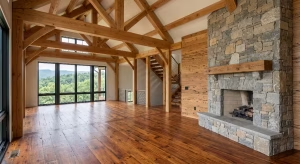
Building a custom home is a significant undertaking, and it all starts with a solid financial foundation. That is what we are going to discuss today in this post.
There’s a unique appeal to building a new home here in our beautiful corner of East Tennessee. The decision to build in Washington County, TN means you can choose your perfect setting, whether it is a neighborhood inside the Johnson City limits or a quiet piece of land with views of the mountains near historic Jonesborough. But before you can break ground, you need to navigate the world of new construction loans. This process is quite different from getting a standard mortgage for an existing house.
The goal of this article is to pull back the curtain and demystify how these loans work. We will provide a clear, step by step guide so you can move forward with confidence and build your dream home in Washington County.
What Exactly is a Construction Loan? (And How It Differs from a Mortgage)
Most of us are familiar with a traditional mortgage. You find a house you love, you agree on a price, and the bank gives you a large sum of money to buy it. You then spend the next 15 or 30 years paying it back. A construction loan is a different financial tool for a different purpose.
At its core, a construction loan is a short term loan, usually lasting about 12 to 18 months, that covers only the cost of building your house. This includes everything from the materials and labor to the permits and fees required by Washington County. The biggest difference is that you are borrowing money for a home that does not exist yet. Because of this, the bank is not looking at a finished product. Instead, they are lending based on the projected future value of the home once it is completed according to your plans. This requires a lot of trust and detailed documentation, which we will cover later.
Think of it this way: with a regular mortgage, the house is the collateral from day one. With a construction loan, the collateral is being built piece by piece over time. This introduces a level of risk for the lender, which is why the process is more involved. Lenders in Washington County, TN need to be sure that the project is planned well, the budget is realistic, and the builder is reputable.
The Payout System: The “Draw Schedule”
Unlike a mortgage where the seller gets all the money at once, a construction loan is paid out in stages. This system is called a draw schedule. It is a pre approved payment plan that releases funds to your builder as they complete specific milestones in the construction process. You, the builder, and the lender will all agree to this schedule before any work begins.
A typical draw schedule for a new home in Washington County might look something like this:
- Draw 1: Foundation. Once the land is cleared and the foundation is poured and cured, the builder can request the first draw.
- Draw 2: Framing and “Dry-In”. After the house is framed, the roof is on, and the windows and doors are installed, the house is considered “dried in” and protected from the elements. The builder can now request the second draw.
- Draw 3: Rough-Ins. This stage includes installing the internal workings of the house, like plumbing, electrical wiring, and HVAC ducts, before the drywall goes up.
- Draw 4: Drywall and Interior Finishes. Once the drywall is hung and finished, and things like cabinets, flooring, and basic fixtures are installed, the next draw can be requested.
- Draw 5: Final Touches. This final draw is for completing the last items, such as landscaping, final paint, appliance installation, and obtaining a Certificate of Occupancy from the Washington County building inspector.
Before releasing the money for each draw, the lender will send an inspector to the job site. This inspector’s job is to verify that the work for that stage has been completed correctly and according to the plans. This protects both you and the lender by ensuring the project is progressing as it should be before more funds are paid out. It is a system of checks and balances that keeps the project on track.
Interest Only Payments
Another key feature of construction loans is how you make payments during the building phase. Instead of paying principal and interest like you would on a mortgage, you typically only pay interest on the money that has been drawn so far.
For example, if your total loan is for $400,000, you will not pay interest on the full amount from day one. After the first draw of, say, $50,000 for the foundation, your monthly payment will only be the interest on that $50,000. When the builder takes the next draw of $100,000 for framing, you will then pay interest on the new total of $150,000. Your payments gradually increase as more of the house is built and more money is used. This helps keep your monthly costs lower during construction, a time when you might also be paying rent or a mortgage on your current home. This financial flexibility is essential for many families building in Washington County, TN.
The Two Main Paths: Types of Construction Loans
When you start talking to lenders about financing your new build in Washington County, you will hear about two primary types of construction loans. Each has its own structure, benefits, and drawbacks. Understanding the difference between them is critical to choosing the right path for your financial situation.
A. The One Time Close Loan (Construction to Permanent)
The one time close loan, often called a construction to permanent loan, is exactly what it sounds like. It is a single loan that covers both the construction phase and your permanent mortgage. You go through one application process and one closing.
How it Works: You apply for the loan before construction begins. At the closing, you lock in the interest rate for your long term mortgage. For the first 12 to 18 months while the house is being built, the loan functions as an interest only construction loan. Once the home is finished and the Washington County inspector issues the Certificate of Occupancy, the loan automatically converts into a standard principal and interest mortgage. You just start making your regular monthly payments.
Pros:
- Simplicity: One application and one set of closing costs saves you time, paperwork, and money.
- Rate Security: You lock in your permanent mortgage interest rate before the first shovel of dirt is ever turned.15 If rates go up during the 12 month build, you are protected. This provides significant peace of mind.
- No Re-Qualification: You do not have to worry about qualifying for a mortgage again after the build is done. A major life change, like a job loss or new credit issues, will not jeopardize your final loan.
Cons:
- Potentially Higher Rate: Because the lender is locking in a rate for you far in the future, the interest rate might be slightly higher than what you could get on a standalone mortgage at that moment.
- Less Flexibility: If interest rates happen to fall significantly during your build, you are stuck with the higher rate you already locked in (unless you decide to refinance later, which comes with its own costs).
This is an extremely popular option among lenders and borrowers here in the Tri-Cities. Many local credit unions and banks in Washington County are very experienced with this loan type and often recommend it for its simplicity and security.
B. The Two Time Close Loan (Standalone Construction)
The two time close loan is a bit more traditional and involves two separate financial transactions.
How it Works: First, you apply for and close on a construction loan that is for the building phase only. This is a short term, interest only loan. As you near the end of construction, you will then start the process of applying for a regular mortgage. You can apply with any lender you want, not just the one who gave you the construction loan. The money from your new mortgage is then used to completely pay off and close out the construction loan. This is your second closing.
Pros:
- Rate Shopping: It gives you the flexibility to shop around for the best possible mortgage rate and terms when your home is nearly complete. If rates have dropped, you could save a lot of money over the life of the loan.
- More Lender Options: You can choose a specialized construction lender for the first loan and then a completely different national or local lender for the permanent mortgage, opening up more competitive options.
Cons:
- Two Sets of Costs: You have to pay for closing costs twice: once for the construction loan and again for the permanent mortgage. This can add thousands of dollars to your overall expenses.
- Interest Rate Risk: This is the biggest drawback. If mortgage rates rise during the construction of your home, you will have to accept a higher rate on your final mortgage. A one percent increase on a large loan can mean hundreds of dollars more per month.
- Re-Qualification Risk: You must qualify for the mortgage all over again. If your credit score has dropped, your income has changed, or lending standards have tightened, there is a risk you may not be approved for the mortgage you need to pay off the construction loan. This is a serious risk to consider before choosing this path for your Washington County home build.
The Blueprint for Approval: Your Step by Step Guide in Washington County

Securing a construction loan is a detailed process, but it is not complicated if you take it one step at a time. Here is a practical blueprint for navigating the journey, tailored to the specifics of building in Washington County.
Step 1: Financial Pre-Qualification & Choosing a Lender
Before you do anything else, you must determine your budget. This is the most critical first step. You need to know how much you can comfortably afford to borrow before you start looking at land or hiring an architect. Speaking with a loan officer will give you a realistic budget to work with.
It is highly recommended that you work with a local lender. A loan officer who is based in or serves Washington County will have invaluable knowledge of the local market. They understand land values, they know the reputations of local builders, and they have relationships with local appraisers. This local expertise can make the entire process smoother. Community banks and credit unions in the Washington County area are often excellent sources for construction loans.
Step 2: Assembling Your “A-Team”: The Builder and the Land
Once you have a budget, it is time to find your two most important partners: your builder and your land. The lender will not approve a loan without knowing who is building the house and where it will be located.
Your choice of builder is crucial. The lender will perform a thorough review of any builder you choose. They will check their license, insurance, financial stability, references from past clients, and relationships with suppliers. They need to be confident that the builder can complete the project on time and on budget. A well established builder with a long history of successful projects in Washington County will make the approval process much easier.
Simultaneously, you will be looking for land. Whether it is a lot in a new subdivision or several acres out in the country, the land will be part of the loan collateral. If you do not own the land already, the construction loan can often include the cost of purchasing it.
Step 3: The Application Package – More Than Just a Credit Score
The application package for a construction loan is much thicker than for a standard mortgage. The lender needs a complete picture of the project. You will need to provide:
- A Signed Contract with Your Builder: This legally binding document outlines the scope of work, the cost, and the timeline.
- Detailed Home Plans and Blueprints: These are the architectural drawings that show exactly what the house will look like.
- A “Spec Sheet”: This is a detailed list of all the materials that will be used to build your home, from the brand of windows to the type of flooring. The spec sheet helps the lender and appraiser understand the quality and value of the home you intend to build in Washington County.
- A Detailed, Line Item Budget: The builder will provide a full breakdown of all anticipated costs. This includes everything from foundation concrete to doorknobs. The lender will review this to ensure it is realistic.
- Proof of Builder’s License and Insurance: This protects both you and the bank.
Step 4: The Appraisal – Valuing Your Future Home
Since the house does not exist yet, the appraisal process is different. The appraiser will perform what is called an “as completed” or “subject to completion” appraisal. They will review all of your documents, including the blueprints and the spec sheet. They will then compare your proposed home to other similar new homes that have recently sold in Washington County. Based on this analysis, they will determine what the market value of your home will be on the day it is finished. The loan amount you are approved for will be based on this future value.
Step 5: Closing and Breaking Ground
Once the appraisal is complete and all your financial documents have been approved, you will go to closing. Here, you will sign all the final loan documents. After closing, the loan is official. The lender will typically give the builder the first draw, allowing them to break ground and begin construction on your new Washington County home.
Step 6: Construction, Draws, and Inspections
As construction progresses, your builder will follow the draw schedule you all agreed upon. At each major milestone, they will request the next payment. The lender’s inspector will visit the site to confirm the work is done, and then the funds will be released. You will also see inspectors from the Washington County Building Inspector’s Office at the site periodically. They are there to ensure the home is being built to code for safety and structural integrity.
Step 7: Final Walk-Through and Loan Conversion
When the builder has finished the house, you will do a final walk through to make sure everything is perfect. The final Washington County inspection will be performed, and you will receive a Certificate of Occupancy. This document certifies that the home is safe to live in. Once this is issued, the lender will release the final draw to the builder. If you have a one time close loan, it will now automatically convert to a permanent mortgage. If you have a two time close loan, this is when you will finalize and close on your separate mortgage.
Answering Your Questions

Many people have the same questions when they first consider building a home. Let’s address some of the most common ones that come up for projects in Washington County.
How much down payment is needed for a construction loan in TN?
A construction loan is seen as riskier than a standard mortgage, so lenders typically require a larger down payment. The standard is often 20% to 25% of the total project cost (the cost of the land plus the cost of construction). For example, if your land and build cost a total of $500,000, you should be prepared for a down payment of $100,000 to $125,000.
However, there is a very important exception. If you already own your land free and clear, you can often use the equity in your land as your down payment. If the value of your land is equal to or greater than the required down payment percentage, you may not need to bring any additional cash to the closing. This is a huge advantage for many people building in Washington County who have inherited land or purchased it years ago.
What credit score do you need for a construction loan?
Because of the higher risk involved, lenders have stricter credit requirements for construction loans. While it can vary from lender to lender, you will generally need a credit score of at least 680 to be considered. To get the best interest rates and terms, a score of 720 or higher is strongly recommended. Lenders need to see a history of responsible credit management before they will finance a large scale project like a new home build in Washington County.
Is it hard to get a construction loan in Tennessee?
It is not necessarily “hard” to get a construction loan, but it is definitely more demanding and requires more organization than getting a standard mortgage. The key is preparation. If you have a strong credit score, a stable income, a reasonable amount of debt, and a down payment saved, you are already in a good position. The other critical piece is pairing up with a reputable builder who has a good track record in Washington County. A good builder makes the lender feel much more confident in the project, which in turn makes your loan approval process much smoother.
Can I be my own General Contractor (GC)?
This is a very common question, and the short answer is that it is very difficult. A loan where the homeowner also acts as the builder is called an “owner builder” loan. Most lenders in the Washington County area, and indeed across the country, will not approve these loans. The risk is simply too high for them. They have no way of knowing if you have the skills, time, and network of subcontractors to complete the project successfully. Unless you are a licensed and experienced general contractor by profession, you should plan on hiring a professional builder for your project.
Conclusion: Laying the First Stone of Your Dream Home
Building a custom home is an incredible journey. It allows you to create a space that is perfectly suited to your family’s needs and lifestyle. While the financing can seem intimidating at first, it is a manageable and straightforward process when you break it down into logical steps.
The keys to success are planning and partnership. Start by getting your finances in order and partnering with a local lender who understands the unique aspects of the Washington County market. Then, assemble your team by choosing a reputable, experienced builder who can bring your vision to life. By understanding the draw process, the appraisal, and the different loan types available, you can navigate the path to your new front door with confidence. Building a home in Washington County is an opportunity to put down deep roots in a wonderful community. With the right financial planning, that opportunity is well within your reach.