

Mold and Moisture in Sealed Attics
In the world of custom home building here in the Tri-Cities, there is a massive push toward energy efficiency. Everyone wants the lowest power bill on the block. As writers about homes and buildings, we applaud that goal. However, there is a trend sweeping through Kingsport, Johnson City, and Bristol that worries us when it is not done with precision. That trend is the unvented, spray-foamed attic.
When you walk into a model home or talk to a sales rep, they will sell you on the idea of the “perfect seal.” They tell you it works like a thermos, keeping your expensive conditioned air inside and the hot, humid Tennessee summer air outside. On paper, the math looks brilliant. But a house is not a thermos. A house is a complex system that interacts with the environment. When you seal an attic completely, you fundamentally change the physics of how your home breathes.
If you change the physics without changing how you manage the air inside, you are inviting disaster. The biggest enemy of any home is water. In a traditional attic, airflow helps dry things out. In a sealed attic, there is no natural airflow. If moisture gets in, it stays in.
This article is going to take a hard look at the risks of moisture and mold in unvented attics. We are going to look at why it happens, how our local climate makes it worse, and exactly what you need to do to build a safe, efficient home that will last for generations.
The Stack Effect and Humidity Migration
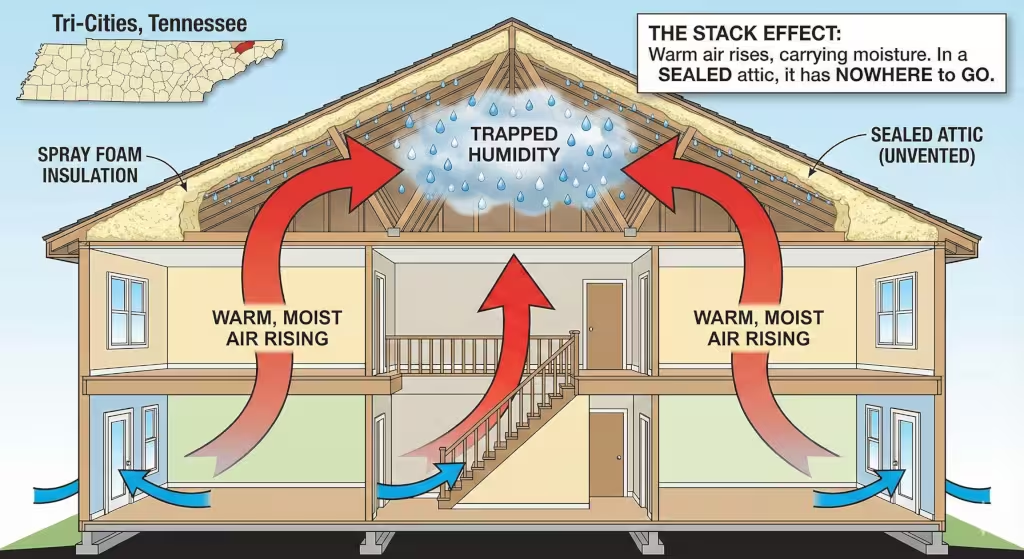
To understand why moisture is such a threat in a sealed attic, you first have to understand how air moves inside your house. We call this the “stack effect.” Think about a hot air balloon. Hot air is lighter than cold air, so it rises. In the winter, your heating system warms the air on the first floor. That warm air rises up the stairs, through the second floor, and pushes against the ceiling of the top floor.
In a traditional home with a vented attic, some of that air leaks into the attic and then vents out through the ridges or soffits. It is not energy efficient, but it keeps the air moving. When you spray foam the roof deck to create an unvented attic, you are putting a lid on the jar. That warm air rises, but now it has nowhere to go.
The problem is that warm air carries moisture. Humans generate a lot of humidity just by living. We cook, we shower, we breathe, and we sweat. All of that adds water vapor to the air. If your attic is sealed tight, that humidity migrates upward and gets trapped in the peak of your roof. Without a way to cycle that air out, the moisture levels build up over time. It is silent and invisible, but the pressure is there. If the humidity in that sealed space gets too high, the air becomes heavy with water, looking for any cold surface to land on.
The Sandwich Effect: Solar Drive
One of the most technical but important concepts in building science is “solar drive.” In the Tri-Cities, we have hot summers where the sun beats down on our roofs. Dark shingles can reach temperatures well over 150 degrees Fahrenheit. When it rains, those shingles get wet. Then the sun comes out and heats that water up rapidly.
This creates a massive amount of vapor pressure. The heat drives that moisture downward, through the shingles and into the wood roof deck (usually OSB or plywood). In an old-school attic, the wind blowing through the vents would dry that wood out from the bottom. But in an unvented attic, the bottom of that wood is covered in spray foam.
We call this the “sandwich effect.” The moisture is driven into the wood by the sun, but it hits the foam and stops. It cannot go through the foam, so it sits in the wood. If the foam is not applied perfectly, or if it is the wrong type for our climate, that moisture accumulates in the wood sheathing. Over years, this trapped moisture turns the structural wood of your roof into mush. You might not see it from the inside because the foam hides the rot, and you might not see it from the outside until the shingles start to curl.
Hidden Roof Leaks
Every roof, no matter how well it is installed, will eventually leak. A stray nail, a fallen branch, or just failing flashing can let water in.
In a vented attic with no insulation on the roof deck, if a leak happens, the water drips down. You might see a stain on your ceiling drywall. That stain is annoying, but it is a good thing. It is an alarm bell telling you to fix the roof.
In an unvented attic with closed-cell spray foam, the foam is glued directly to the wood. Closed-cell foam is waterproof. If water leaks through the shingles and hits the foam, it cannot drip down. It is trapped between the wood and the foam. The water spreads out sideways, soaking a larger and larger area of the wood deck.
Because the foam blocks the water, you never see a leak on your ceiling. You have no idea there is a problem. The moisture sits there, feeding mold and rot fungus, eating away at the structure of your home for years. By the time you realize there is an issue, you might need to replace the entire roof structure.
Tri-Cities Specifics: The Climate Zone 4A Challenge
Location matters in construction. Building a house in Johnson City, Tennessee, is not the same as building one in Arizona or Vermont. We live in what the building code calls “Climate Zone 4A.” This stands for “Mixed-Humid.”
“Mixed” means we have a mix of weather. We have freezing cold winters and scorching hot summers. “Humid” means we have a lot of moisture in the air almost all year round. This combination makes building unvented attics very tricky.
In the winter, the outside of your roof is freezing cold. The inside of your attic is warm. If you don’t have enough insulation (R-value), the surface of the roof deck inside the foam can get cold. If warm, moist air from your house hits that cold surface, it condenses. It turns from invisible vapor into liquid water droplets. This usually happens right at the peak of the roof or near the eaves.
In the summer, the reverse happens. The outside is hot and wet, and the inside is cooled by your air conditioner. The vapor drive pushes inward. Our high humidity levels in East Tennessee mean the air is always trying to push moisture into our buildings. If we seal the attic but don’t account for this swing in temperature and humidity, we are building a moisture trap.
The Dew Point Danger
Let’s talk about the “dew point.” This is a term meteorologists use, but builders and buyers need to know it too. The dew point is the temperature at which the moisture in the air turns into liquid water. Think about a cold can of soda on a hot day. The can is colder than the dew point of the air, so water beads up on the outside of the can.
In your attic, you never want your building materials to reach the dew point temperature. If you have an unvented attic, the goal is to keep the roof deck warm enough in winter so that moisture doesn’t form on it.
This is why the thickness of the insulation matters so much. If a builder tries to save money and sprays only two inches of foam when they should have sprayed five, the wood roof deck will get too cold in the winter. The moisture in the attic air will find that cold wood and condense. Over a single winter, this can create gallons of water inside your walls or roof assembly. That water has nowhere to go, so it starts the process of decay.
Open Cell vs. Closed Cell Risks
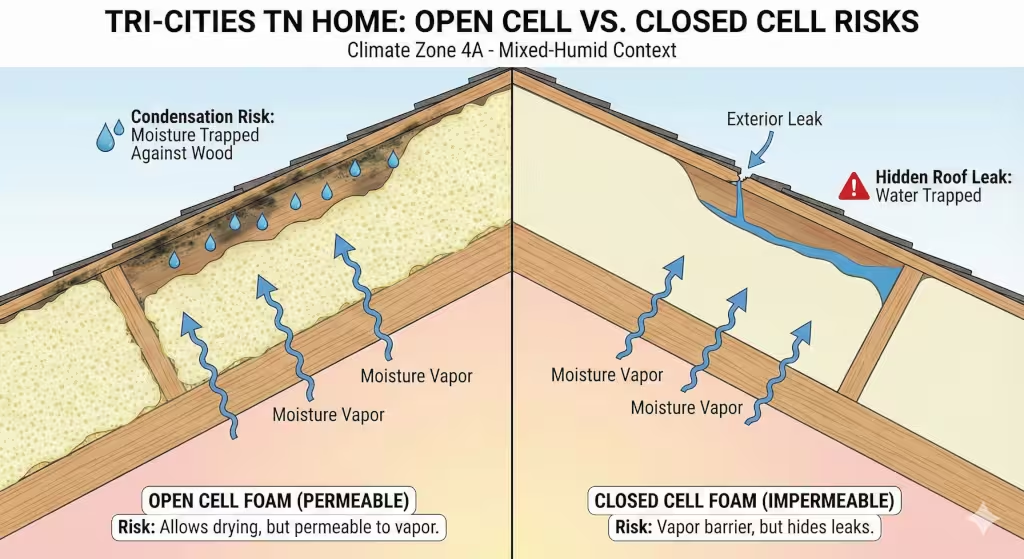
When you hear about spray foam, you need to know there are two main types: Open Cell and Closed Cell. They handle moisture very differently.
Open Cell foam is soft, like a sponge. It is cheaper and expands a lot. However, it is “permeable,” meaning moisture vapor can pass right through it. In our climate zone (4A), this can be risky on a roof deck. If moisture moves through the foam and hits the cold roof deck in winter, it condenses. The sponge-like foam then holds that water against the wood. It can rot the roof out very quickly if you don’t have a special paint layer called a “vapor retarder” applied over it.
Closed Cell foam is hard and rigid. It blocks moisture vapor. It adds structural strength to the roof. It is generally the safer choice for unvented attics in Tennessee because it stops the warm, moist air from touching the cold roof deck. However, as we discussed earlier, if a leak happens from the outside, closed cell foam hides it.
Choosing between them is a game of managing risks. One risks condensation from the inside; the other risks hiding leaks from the outside. Both require an expert to install them correctly to manage moisture.
The Mold Equation
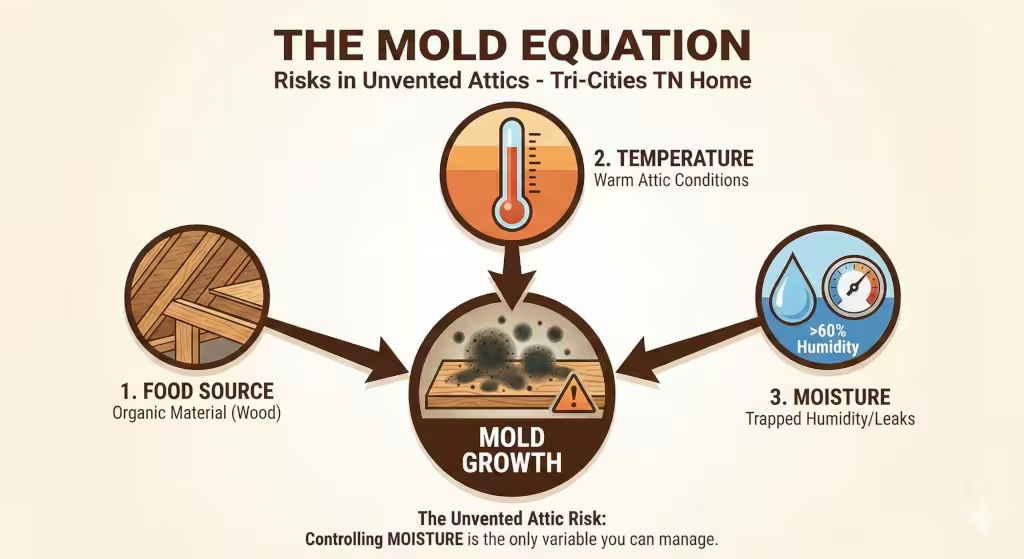
Mold is a simple organism. It does not need much to survive. It only needs three things: a food source, a comfortable temperature, and moisture.
In an unvented attic, you have plenty of food. The wood rafters, the trusses, and the roof sheathing are all organic materials that mold loves to eat. You also have a comfortable temperature. Because the attic is sealed and semi-conditioned, it stays in a range that mold thrives in.
The only variable you can control is moisture. If you keep the moisture content of the wood low and the humidity in the air low, mold cannot grow. But if you fail to manage the moisture, you have created a perfect mold factory.
One major issue is “construction moisture.” When we build a house, the lumber we use often sits out in the rain. It has a high water content. If a builder sprays foam over wet wood, sealing that moisture inside the wood, mold will begin to grow immediately between the foam and the wood. I have seen roofs that were sprayed while wet, and when we cut the foam away a year later, the wood was black with mold.
Health Implications
Why should you care about mold in a sealed attic? After all, it is just the attic, right? Wrong. In a traditional vented attic, the air in the attic is “outside” air. It is separated from your living space by insulation and drywall.
In an unvented, sealed attic, that space is now part of your “building envelope.” It is connected to the air you breathe. Often, the HVAC system (your furnace and air conditioner) is located in this attic. If the attic is full of mold spores because of trapped moisture, those spores can be sucked into your ductwork and blown into your bedrooms and kitchen.
This leads to poor indoor air quality. It can cause allergies, asthma, and what we call “sick building syndrome.” You cannot separate the health of your attic from the health of your family when you build an unvented assembly.
Prevention: HVAC Integration
So, does this mean you should never build an unvented attic? No. It means you have to engineer it correctly. The most critical step is integrating the attic into your HVAC system.
You cannot just seal the attic and walk away. You must treat it like a room in your house. The code actually requires “conditioned air” to be supplied to the space. This means your heating and cooling system needs to blow a little bit of air into the attic (supply) and pull air out of the attic (return).
This air exchange is vital. It sweeps the attic air, removing stale, humid air and replacing it with dry, conditioned air. This keeps the moisture levels down and prevents the air from becoming stagnant. Roughly 50 CFM (Cubic Feet per Minute) of air supply per 1000 square feet of attic space is a good starting point, but an engineer should calculate the exact need.
Prevention: Dehumidification
In East Tennessee, even a good air conditioner sometimes isn’t enough. We have “shoulder seasons,” spring and fall. In April or October, it might be 70 degrees outside. You don’t need to run the A/C to cool the house, and you don’t need the heat. So, your HVAC system sits idle.
However, it might be raining and 90% humidity outside. Without the A/C running, there is nothing removing moisture from your house. Humidity levels inside can spike.
For a truly safe unvented attic, most builders always recommend a dedicated whole-house ventilating dehumidifier. This machine has one job: manage moisture. It runs independently of your cooling system. It monitors the air, and if the humidity goes above 50%, it kicks on and dries the air out. It ensures that your attic never reaches those dangerous moisture levels that support mold growth.
The “Ignition Barrier” Requirement
While this article focuses on moisture, we also have to mention safety. Spray foam is plastic. If it catches fire, it burns hot and fast. Because unvented attics are often used for storage or have mechanical equipment in them, the building code requires protection.
You cannot leave spray foam exposed in an attic that can be accessed. You must cover it with an “ignition barrier.” This is usually a special intumescent paint that swells up when it gets hot, protecting the foam from fire for a short time.
Sometimes, builders skip this step to save money. Do not let them. Not only is it a fire risk, but that paint layer can also act as an additional calmative layer for moisture control depending on the product used. It is a sign of a quality build.
Monitoring Your Home
You wouldn’t drive a car without a dashboard, so don’t fly blind with your home. The best way to prevent moisture disasters is to know what is happening.
We recommend buying a simple remote hygrometer. This is a sensor that measures temperature and relative humidity. Put one sensor in your unvented attic and keep the display in your kitchen.
You want to see the humidity stay below 60% at all times, ideally around 45-50%. If you see that number climbing up to 70% or higher, you know you have a moisture problem before rot sets in. It is a cheap insurance policy for a very expensive investment.
Commonly Asked Questions about Moisture and Mold
Does spray foam rot roof sheathing?
Spray foam itself does not rot wood. However, if spray foam traps moisture inside the wood, or if a leak occurs that the foam hides, the wood will rot. The foam creates the condition where moisture cannot escape, which leads to rot if water is present.
Do I need a dehumidifier in a sealed attic?
In the Tri-Cities TN area, we highly recommend it. Our humidity is too high to rely solely on the air conditioner. A dehumidifier guarantees that the moisture levels stay safe regardless of the weather outside.
Can you have a gas furnace in an unvented attic?
You have to be very careful here. A standard gas furnace needs air to burn (combustion air). If you seal the attic, you cut off that air supply.16 You must use a “direct vent” furnace that pulls air from outside through a pipe, or you must install a dedicated combustion air intake. If you don’t, the furnace will create carbon monoxide, which is deadly.
What does a fishy smell in the attic mean?
If your attic smells like fish or rotten shrimp, it usually means the spray foam was not mixed correctly. The chemicals were “off-ratio.” This is not just a smell; it can indicate that the foam did not cure properly and might not be performing its job as a vapor retarder, leading to moisture issues.
Conclusion: Build with Integrity
Building a custom home is a journey. It requires making hundreds of decisions. Deciding to seal your attic is a big one. It can make your home incredibly energy efficient, quiet, and comfortable. But as we have discussed, the risks of moisture and mold in unvented attics are real.
You cannot fight the laws of physics. If you seal a space, you must manage the air and the water within that space. In the Tri-Cities, where our climate throws everything at us, you need to be precise. You need a builder who understands that an unvented attic is a system, not just a product you spray on a roof.
Don’t let a contractor talk you into shortcuts. Insist on proper HVAC integration. Consider a dehumidifier. Monitor your humidity levels. If you respect the moisture, your home will stand strong. If you ignore it, nature will eventually take it back. Build it right, build it tight, but most importantly, build it dry.