

Anyone who’s spent a July afternoon in Kingsport or a humid August evening in Johnson City understands the kind of persistent heat the Tri-Cities can hold. We see it in our summer electricity bills. On the other hand, a cold snap in January coming over the mountains can have our heating systems working just as hard. For decades, many have seen a roof as little more than a necessary shield against rain and snow. But in modern home building, we understand it’s a dynamic system. Your roof should be working for you, actively helping to manage your home’s temperature and, by extension, your energy costs.
Choosing to install an energy-efficient roof is a significant consideration. It’s a long-term investment in your property’s comfort, durability, and financial performance. The purpose of this guide is to move past the sales pitches and provide a straightforward analysis for homeowners in Johnson City, Kingsport, Bristol, and the surrounding Tri-Cities area. We will examine the most practical options, laying out the upfront costs against the real-world lifespan and energy savings you can expect, allowing you to make a precise and competent decision for your home.
The Science of an Energy-Efficient Roof in East Tennessee
Before we can compare different roofing materials, we need to understand what makes one “energy-efficient.” It isn’t just about the brand or the thickness. It comes down to how a material handles the sun’s powerful energy. Three key scientific principles are at play, and they’re much simpler than they sound.
Solar Reflectance Index (SRI)
Imagine you’re standing outside on a hot, sunny day. You’re wearing a black cotton t-shirt. After a few minutes, you feel the shirt getting warm, even hot to the touch. Now, imagine you switch to a crisp white t-shirt. You’d feel noticeably cooler. Why? The white shirt is reflecting the sun’s light and heat away from your body, while the black shirt is absorbing it.
Solar Reflectance Index, or SRI, is simply a scientific way to measure this effect for a roofing material. It’s a number on a scale from 0 to 100. A standard black asphalt shingle has a very low SRI, maybe around 5 or 6, because it absorbs almost all the sun’s heat. A highly reflective white metal roof, on the other hand, could have an SRI of 80 or higher.
Here in the Tri-Cities, where our air conditioners run hard from May through September, having a roof with a high SRI means less heat is penetrating your roof deck and super-heating your attic. A cooler attic means your A/C unit doesn’t have to work as hard to keep your living space comfortable, which directly translates to lower utility bills.
Thermal Emittance
Thermal emittance is the second part of the equation, and it’s just as important. It measures how quickly a material releases the heat that it has absorbed. Think of a cast-iron skillet on the stove. After you turn the burner off, that skillet stays hot for a long time. It has low thermal emittance. Now think of a thin aluminum pan. It cools down almost immediately. It has high thermal emittance.
You want a roof that acts like that aluminum pan. After the sun sets, you want your roof to quickly “exhale” all the heat it soaked up during the day. A material with high thermal emittance (most metal and tile roofs, for example) will cool down rapidly, preventing your attic from staying like an oven all night long and allowing your home to cool more effectively overnight. Materials like standard asphalt shingles tend to hold onto that heat for longer.
Insulation and the R-Value
Your roofing material—the shingles or metal panels you see from the street—is the outer shell. It’s the raincoat. But the insulation in your attic is the warm fleece jacket underneath. The two must work together. Insulation’s effectiveness is measured by its R-value. The higher the R-value, the better it resists the flow of heat.
An energy-efficient roof reduces the amount of heat that your insulation has to fight in the first place. If your roof reflects 70% of the sun’s heat, your attic insulation only has to deal with the remaining 30%. If your old, dark roof is absorbing 90% of the heat, your insulation is put under enormous strain and some of that heat will inevitably make its way into your home. A great roof can’t make up for poor insulation, and great insulation can’t stop a dark roof from absorbing a massive amount of solar heat. They are a team.
The Color Factor: Does It Really Matter?
Yes, absolutely. For our specific climate in East Tennessee, color is one of the easiest and most effective choices you can make. Lighter colors—whites, light grays, tans, and even some specially formulated “cool” dark colors—have a naturally higher SRI. They simply reflect more sunlight.1 While a dark, dramatic roof might look appealing, it’s important to understand you are making a trade-off. That dark roof will absorb more heat, leading to a hotter attic and higher cooling costs over its entire lifespan. When choosing, you should always ask your contractor for the SRI value of the specific color you are considering.
Analyzing Roofing Materials: A Tri-Cities Cost vs. Lifespan Breakdown
Now that we understand the science, let’s apply it to the real-world options available to homeowners in our area. The costs listed here are general estimates for the Tri-Cities market for a full roof replacement, including materials, labor, and disposal of the old roof. Prices can vary based on the complexity of your roof (its pitch, number of valleys, dormers, etc.), but these figures provide a solid baseline for comparison.
A. Cool-Coated Architectural Shingles
- Description: These are not your parents’ old, flat asphalt shingles. Architectural shingles (also called dimensional shingles) are thicker, have a more varied and textured look, and last much longer. The “cool-coated” versions are a step above. They look just like standard architectural shingles, but the small, sand-like granules on their surface are specially designed with reflective pigments that bounce a surprising amount of solar radiation away.
- Tri-Cities Cost: $$ (Typically $4.50 – $7.50 per square foot installed). For a typical 2,000 square foot roof, you might expect a total cost in the range of $9,000 to $15,000.
- Lifespan: 20-30 years. Our region’s mix of intense summer sun and occasional winter ice can be tough on asphalt. A well-installed, high-quality architectural shingle will reliably serve for this duration.
- Pros:
- Cost-Effective: This is often the most affordable energy-efficient option, providing a good balance of performance for the initial price.
- Familiar Look: It’s the classic American roofing look, which fits well with almost any home style in our area, from historic homes in Bristol to new constructions in Johnson City.
- Good Selection: Major brands like GAF, Owens Corning, and CertainTeed all offer ENERGY STAR certified “cool roof” shingle lines in a variety of colors.
- Cons:
- Shorter Lifespan: While 25 years is a long time, it’s significantly less than metal or slate. You will likely face a full roof replacement at least once more in your time as a homeowner compared to other options.
- Performance Can Degrade: Over time, some of the reflective granules can wear away, slightly reducing the roof’s energy efficiency.
- Less Durable: They are more susceptible to damage from high winds or falling limbs compared to harder materials.
B. Standing Seam Metal Roofing
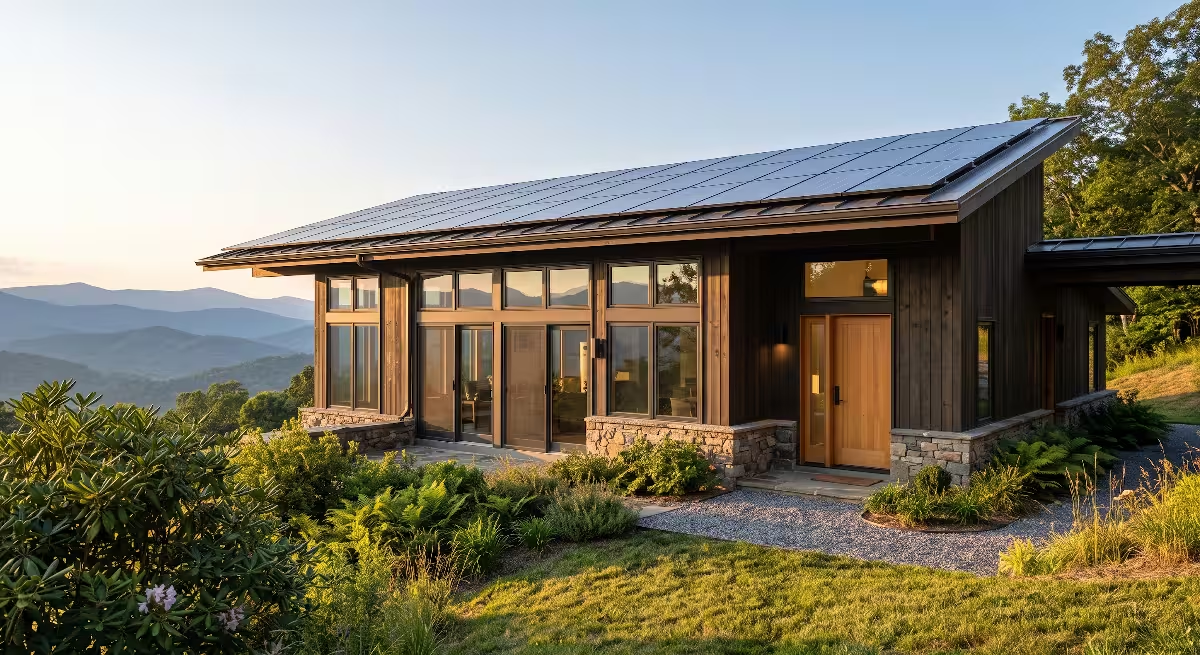
- Description: This is the type of metal roof you see with clean, straight lines running from the peak to the edge. The panels interlock with a raised seam that hides the fasteners, protecting them from the elements. These roofs are made from steel or aluminum and come with advanced, factory-applied coatings that are incredibly durable and highly reflective.
- Tri-Cities Cost: $$$ (Typically $9.00 – $16.00 per square foot installed). For that same 2,000 square foot roof, the cost would likely be between $18,000 and $32,000.
- Lifespan: 50+ years.2 It is not an exaggeration to call this a “lifetime” roof. Many come with 50-year warranties on the material and the color finish. It is a one-time purchase for most homeowners.
- Pros:
- Highest Energy Efficiency: A standing seam metal roof with a light-colored, high-SRI finish is the most energy-efficient option widely available. It reflects the most heat and releases it the fastest.
- Exceptional Durability: It easily sheds snow and rain, is highly resistant to fire, rot, and insects, and can withstand wind gusts well over 100 mph. It’s a perfect match for the sometimes-unpredictable Appalachian weather.
- Low Maintenance: You don’t have to worry about shingles blowing off or granules washing into your gutters. An annual inspection is typically all that is needed.
- Lightweight: Metal is surprisingly light, which puts less stress on your home’s structure compared to slate or multiple layers of old shingles.3
- Cons:
- Higher Upfront Cost: This is the primary barrier for many. The initial investment is significantly more than shingles.
- Requires Specialized Installation: Not every roofer is an expert in installing standing seam metal. It requires special tools and training to get the flashing and details right. Hiring an experienced crew is non-negotiable.
- Noise: Some people are concerned about the sound of rain. However, when installed correctly over a proper roof deck with insulation, modern metal roofs are not significantly louder than other types.
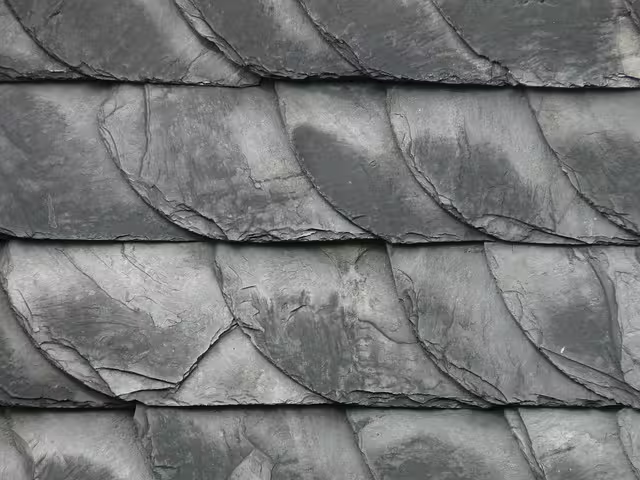
C. Slate & Synthetic Slate Roofing
- Description: Natural slate is the king of roofing materials. It is literally quarried rock, split into tiles. It has an unmatched beauty and a lifespan measured in centuries, not decades. Synthetic slate is a modern marvel, engineered from composites of rubber and plastic to mimic the look of real slate at a fraction of the weight and cost.
- Tri-Cities Cost: $$$$ (Typically $15.00 – $30.00+ per square foot installed for natural slate; synthetics are slightly less). A slate roof is a five-figure investment that can easily exceed $40,000 or $50,000.
- Lifespan: 75-200 years for Natural Slate, ~50 years for high-quality Synthetics.
- Pros:
- Unmatched Longevity: A natural slate roof installed on a home today will likely still be there for your great-grandchildren.
- Timeless Beauty: It provides a classic, elegant aesthetic that can significantly increase a home’s curb appeal and value.4
- Extremely Durable: Slate is fireproof, waterproof, and impervious to rot and insects.
- Natural Insulator: The sheer mass of the stone provides some inherent insulating properties.
- Cons:
- Prohibitive Cost: This is one of the most expensive roofing options on the market, period.
- Extreme Weight: Natural slate is incredibly heavy. A home’s structure must often be analyzed and potentially reinforced by an engineer before installation, adding to the cost.
- Fragile to Impact: While durable against weather, slate tiles can crack if walked on improperly or struck by a large falling branch. Repairs require a specialist.
- Synthetic Limitations: While good, synthetic slate does not have the same proven, century-long track record as the real thing.
The Financial Calculation: Are Energy-Efficient Roofs Worth the Cost?
This is the central question. Answering it requires looking beyond the initial price tag and thinking in terms of “lifetime cost.” Let’s create a hypothetical scenario for a typical home in our area to illustrate the point.
Scenario: The Jones Family of Johnson City
- Roof Size: 2,200 square feet
- Current Utility Bill: Average of $150/month for cooling in the summer (4 months). Total summer cooling cost = $600.
Option 1: Cool Architectural Shingles
- Estimated Cost: 22 squares x ~$600/square = $13,200
- Lifespan: 25 years
- Energy Savings: ENERGY STAR estimates cool shingles can reduce cooling costs by 7-15%. Let’s be conservative and say 10%.
- Annual Savings: 10% of $600 = $60/year.
- Lifetime Savings (25 years): $60 x 25 = $1,500.
Option 2: Standing Seam Metal Roof (Light Gray)
- Estimated Cost: 22 squares x ~$1,200/square = $26,400
- Lifespan: 50+ years5
- Energy Savings: Studies show reflective metal roofing can cut cooling costs by up to 25%. Let’s use 20%.
- Annual Savings: 20% of $600 = $120/year.
- Lifetime Savings (50 years): $120 x 50 = $6,000.
The Real Return on Investment (ROI):
At first glance, the upfront cost difference is a staggering $13,200. It would take a very long time to make that back in energy savings alone. But that’s the wrong way to look at it.
The key is the lifespan.
Around year 25, the Jones family with the shingle roof will have to pay for a complete roof replacement again. Assuming prices rise, that could be another $15,000-$20,000 out of pocket.
At year 25, the Jones family with the metal roof will still have a perfectly functional roof with another 25+ years of life left in it. They have completely avoided that second massive expense. That $15,000-$20,000 they didn’t have to spend is the real return on their initial investment. The $6,000 in energy savings over 50 years is simply a bonus.
Local Incentives and Rebates
Before you make any decision, it is essential to check for local programs that could help offset the cost. The Tennessee Valley Authority (TVA) often runs programs through its EnergyRight platform that provide resources and sometimes rebates for homeowners who make energy-efficient upgrades. You should also call your local utility provider directly—whether it’s BrightRidge, Bristol Tennessee Essential Services (BTES), or another local co-op—and ask their energy services department if they have any current incentives for installing an ENERGY STAR certified roof.
Commonly Asked Questions

As a builder, I hear the same questions often. Here are direct answers to the most common ones.
- Q1: What is the single most energy-efficient type of roof for the Tri-Cities?A professionally installed, light-colored standing seam metal roof with a high Solar Reflective Index (SRI) and high thermal emittance is, without question, the top performer for our climate. When combined with proper attic insulation and ventilation, it offers the best possible defense against our hot, humid summers.
- Q2: How much does a typical new roof cost in East Tennessee?For a standard-sized single-family home in our region, a full replacement with architectural shingles will generally fall between $8,000 and $15,000. A metal roof replacement on the same home would likely be in the $17,000 to $30,000+ range. This is a very broad estimate; the final price depends entirely on the size, slope, complexity of the roof, and the specific materials chosen.
- Q3: Is a metal roof noticeably more efficient than shingles?Yes. The difference is measurable. While cool shingles are a definite improvement over standard ones, the physics of a highly reflective metal surface are superior. An ENERGY STAR metal roof can reflect a much larger percentage of solar radiation, which can keep your attic up to 50-60 degrees cooler on a hot afternoon compared to a dark asphalt shingle roof. This significantly reduces the heat load on your home.6
- Q4: What’s more important: the roofing material or the installation?They are equally critical, and one is useless without the other. You can buy the most expensive, longest-lasting roofing material on the planet, but if it is installed incorrectly, it will fail. Leaks, poor ventilation, and improper flashing can cause thousands of dollars in damage. It’s like buying the best engine for a race car but having a novice bolt it in. It doesn’t matter how good the part is if it’s not connected correctly. Your roof is the same way. Always hire a reputable, licensed, and insured Tri-Cities roofing contractor with specific experience in the material you choose.
Conclusion: A Strategic Decision for Your Home’s Future
Choosing a new roof is one of the most important decisions you will make as a homeowner. By shifting your perspective from viewing it as a mere expense to seeing it as a long-term investment in your home’s performance, the choice becomes clearer.
An energy-efficient roof, particularly in the Tri-Cities climate, is a strategic upgrade. It directly impacts your monthly comfort, lowers your energy consumption, and, in the case of long-lasting materials like metal, can save you the massive expense of a future replacement.
The right choice depends on your specific circumstances: your budget, how long you plan to live in your home, and your aesthetic preferences. For those planning to stay in their homes for the long haul, the data consistently shows that the higher upfront cost of a 50-year metal roof provides the superior lifetime value. For those on a tighter budget or with a shorter timeframe, modern cool architectural shingles offer a very respectable and sensible middle ground.
Before you make a final decision, I always advise getting at least three detailed quotes from reputable local professionals. Show them you’ve done your research. Ask them about the Solar Reflective Index of the specific products they recommend. Discuss ventilation. A true professional will respect your knowledge and provide you with a precise plan, not just a price.