

You’re in the exciting phase of designing your dream home here in Johnson City. You’ve pictured it all: the perfect home theater for immersive movie nights, a quiet and productive home office for focused work, and peaceful bedrooms for restful sleep.
To achieve that vision, you know you need to control sound. In your research, two terms keep popping up: ‘soundproofing’ and ‘acoustic treatment.’ While they sound similar and are often used interchangeably, they serve completely different purposes. This common confusion can lead to costly mistakes and spaces that don’t perform as you dreamed they would. Understanding the difference is critical, especially during the new construction planning phase, to get it right from the start and avoid expensive retrofits down the road.
This article will serve as your expert guide. We will clearly define soundproofing and acoustic treatment, explain the science and specific materials behind each method, and provide practical, real-world scenarios to help you decide exactly what your new custom home needs to be perfect.
Synopsis of Soundproofing vs. Acoustic Treatment
The Core Difference: A Simple Analogy

To truly grasp the distinction between these two concepts, let’s set aside the technical jargon for a moment and use a simple analogy involving water. Imagine you have a large, sturdy bucket.
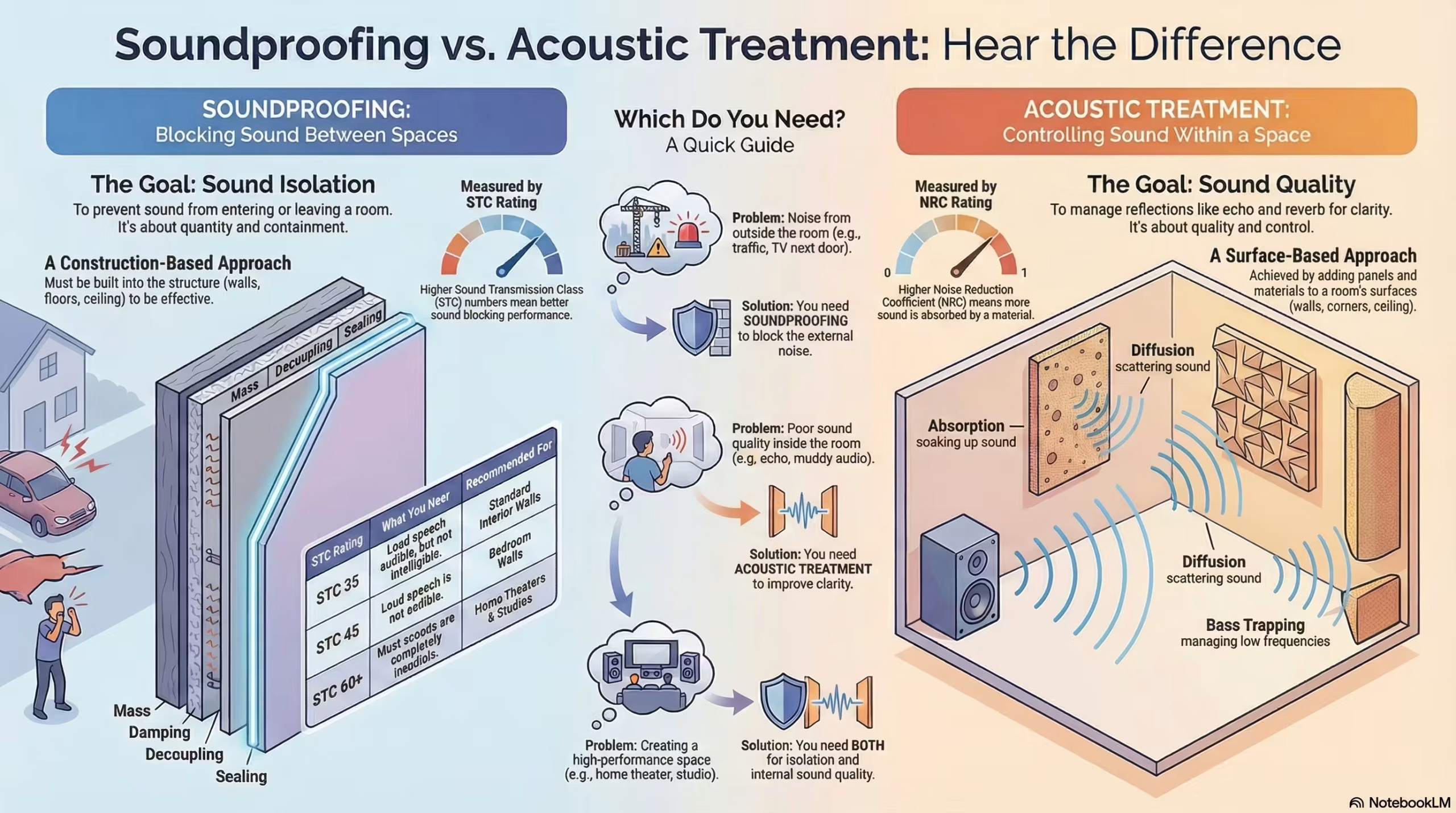
Soundproofing is the bucket itself. The entire purpose of the bucket is to be solid and watertight. It is designed to prevent water from leaking in or out. It is all about isolation and containment. When we talk about soundproofing a room, our goal is the same. We are building a container that stops sound waves from passing through its walls, floor, or ceiling, either from the outside in or the inside out. This is the essence of effective soundproofing.
Acoustic treatment, on the other hand, is what you put inside the bucket. Imagine placing a series of carefully designed baffles, sponges, and angled surfaces inside the bucket. Their purpose has nothing to do with stopping leaks. Instead, they are there to control how the water behaves within the container. They stop the water from splashing wildly, calm the waves, and control the flow. This is precisely what acoustic treatment does for sound. It’s not about blocking sound; it’s about controlling sound reflections (like echo and reverberation) to improve the sound quality within a room.
So, the key takeaway is this: soundproofing stops sound from traveling between spaces, while acoustic treatment improves the sound experience within a single space. They are two different tools for two different jobs, and the best acoustic environments often require both. True soundproofing is a construction-based approach, while acoustic treatment is about managing the room’s surfaces.
A Deeper Look at Soundproofing (The Bucket)

The primary goal of any soundproofing effort is to achieve sound isolation. This means drastically reducing the amount of sound energy that can pass from one space to another. It’s a fundamental concept in construction, especially for custom homes where owners desire privacy and control over their environment. A successful soundproofing strategy isn’t about using a single magical product; it relies on applying four key scientific principles during the construction process. Neglecting any one of these can compromise the entire system, much like leaving a small hole in our bucket.
The Four Key Principles of Soundproofing
- Mass: The simplest way to stop sound is to put something heavy and dense in its path. Think about why you can hear someone talking clearly through a thin interior door but can barely hear a loud truck through a thick concrete wall. The concrete wall has significantly more mass. In construction, achieving effective soundproofing means adding mass to the assemblies. This is often done by using thicker or multiple layers of drywall. For instance, using 5/8 inch thick drywall instead of the standard 1/2 inch adds significant mass. For even better soundproofing, applying two layers of 5/8 inch drywall can make a world of difference. Other high-mass materials, like Mass Loaded Vinyl (MLV), can also be used. MLV is a thin but very heavy rubber-like material that is installed directly on the studs before the drywall, adding a lot of mass without taking up much space. Adding mass is a foundational step in any serious soundproofing project.
- Damping: Sound travels as a vibration. When a sound wave hits a wall, it makes the drywall vibrate, and that vibration passes through the studs to the drywall on the other side, which then reproduces the sound in the next room. Damping is the process of eliminating that vibrational energy. This is accomplished by using viscoelastic compounds. These are gooey, flexible materials that, when sandwiched between two rigid layers (like two sheets of drywall), convert the sound vibration into a tiny, negligible amount of heat. A popular product for this is Green Glue Noiseproofing Compound. You apply it in a random pattern between two sheets of drywall. When sound waves hit the wall, the compound shears and dissipates the vibrations before they can pass through. This principle of damping is a critical component of high-performance soundproofing.
- Decoupling: This is perhaps the most effective principle for superior soundproofing. Decoupling means physically separating the two sides of a structure so that there is no rigid connection for vibrations to travel across. If the drywall on one side of a wall is not touching the same studs as the drywall on the other side, it’s much harder for sound to make the journey. There are a few ways to achieve this. The most effective method is building a double-stud wall, which is literally two separate walls with an air gap in between. A more common and cost-effective method is using resilient channels or sound isolation clips. These are metal components that attach to the studs, and then the drywall is attached to them. They create a flexible connection point that “floats” the drywall off the studs, effectively decoupling it and breaking the path for sound vibrations. This is a crucial technique for proper soundproofing in home theaters and recording studios.
- Sealing: Sound is a lot like water; it will find and exploit any crack or gap. Even the most massive, decoupled wall will fail at soundproofing if there are air gaps around its perimeter, electrical outlets, or door frames. A 1% air gap can let in up to 50% of the sound. Sealing these gaps is a non-negotiable final step. This is done using a high-quality acoustical sealant, which is different from standard caulk because it remains flexible and non-hardening for decades. This allows it to maintain a seal even as the building naturally settles and shifts. Every potential air leak, no matter how small, must be diligently sealed to complete the soundproofing assembly. Proper soundproofing requires an airtight enclosure.15
Key Metric: Sound Transmission Class (STC)
When you look at different materials and wall designs for soundproofing, you’ll see them rated with a Sound Transmission Class (STC) number. This is a single-number rating for how well a building partition reduces airborne sound. The higher the STC number, the better the soundproofing.
- STC 25: Normal speech can be easily understood.
- STC 35: Loud speech is audible but not intelligible. This is a typical rating for a standard interior wall in a home.
- STC 45: Loud speech is not audible. You might hear faint murmurs. This is a good target for bedroom walls.
- STC 60+: Most sounds are inaudible. This is the level of performance you’d want for a home theater or a professional recording studio, requiring a serious approach to soundproofing.
Understanding these ratings helps you set realistic goals for your soundproofing efforts and select the right combination of materials and techniques to achieve them.
Understanding Acoustic Treatment (The Sponges)
Now let’s move inside our bucket. Once you have a room with proper soundproofing, you can be confident that outside noises won’t disturb you, and your activities won’t disturb others. But this doesn’t guarantee the room will actually sound good. A room with great soundproofing can still have terrible acoustics, making it an unpleasant place for listening to music, watching a movie, or even having a conversation. This is where acoustic treatment comes in. Its goal is to control sound reflections to achieve optimal room acoustics.
The Main Problems Acoustic Treatment Solves
When sound is produced in a room, it travels outward and bounces off every surface: the walls, the ceiling, the floor, and the furniture. Our brains process these reflections to get a sense of the space. In a poorly treated room, these reflections can become problematic.
- Reverberation (Reverb): This is what happens when sound bounces off so many surfaces that the reflections merge into a continuous, lingering sound. Think of the sound of a handclap in a large, empty gymnasium. The sound hangs in the air for a long time. While a little reverb can make music sound rich, too much of it muddies sound and makes speech difficult to understand.
- Echo: An echo is a distinct, delayed reflection of a sound. If you clap in a large hall and hear a clear “clap… clap” back at you, that’s an echo. This is usually caused by a single, hard, reflective surface located at a distance.
- Standing Waves: These are low-frequency (bass) sounds that get trapped between parallel walls. Certain bass notes will seem much louder in some parts of the room (usually the corners) and almost disappear in other spots. This creates an uneven, “boomy” bass response that is very noticeable when listening to music or watching movies.
The Tools of Acoustic Treatment
To solve these problems, we use three main tools. Unlike soundproofing, these are typically products that are added to the surfaces of a room.
- Absorption: This is the most common form of acoustic treatment. It involves using porous, soft materials to literally soak up sound energy and convert it into a tiny amount of heat, just like a sponge soaks up water. This is highly effective at taming reverb and killing echoes. The goal is not to create a “dead” room with no reflections, but to control the reflections to achieve clarity.
- Diffusion: While absorption removes sound energy from a room, diffusion scatters it. A diffuser is a panel with varied shapes and depths that takes a sound wave hitting it and breaks it up into many smaller reflections that go in different directions. This eliminates harsh, direct echoes without removing the sound energy from the room. It makes a space sound larger, more open, and more natural.
- Bass Trapping: This is a specialized, very important type of absorption. Because low-frequency sound waves are very long and powerful, they are much harder to control than mid and high frequencies. They build up most strongly in the corners of a room. Bass traps are large, very thick absorptive panels designed specifically to be placed in corners to absorb this powerful low-frequency energy, which helps to even out the bass response and eliminate boominess.
Common Materials and Products
- Absorption: The most effective materials are dense fibrous substances like fiberglass (Owens Corning 703 is a popular choice) or mineral wool (like Rockwool). These are cut into panels, wrapped in fabric, and placed on walls or ceilings. Other absorbers include thick curtains, plush rugs, and yes, “acoustic foam,” though professional-grade fiberglass panels are far more effective, especially at lower frequencies.
- Diffusion: Diffusers are typically made from wood, plastic, or even dense foam. They can be engineered to scatter sound in one or two dimensions and can look like a piece of modern art on the wall.
- Bass Trapping: These are almost always thick, fabric-wrapped panels of fiberglass or mineral wool, often built into triangular shapes to fit neatly into a room’s corners from floor to ceiling.
Key Metric: Noise Reduction Coefficient (NRC)
Absorptive materials are rated with a Noise Reduction Coefficient (NRC). This is a number between 0 and 1 that represents the average sound absorption of a material. A material with an NRC of 0 is perfectly reflective (like polished concrete), while a material with an NRC of 1 is perfectly absorptive (like an open window). A typical acoustic panel might have an NRC of 0.85, meaning it absorbs 85% of the sound that hits it. This rating helps in choosing the right materials to achieve the desired level of absorption in a room.
Commonly Asked Questions
Even with a clear understanding of the principles, homeowners often have practical questions about how these concepts apply to their projects. Let’s address some of the most common ones.
Q: Do I need soundproofing or acoustic treatment?
A: This is the most important question, and the answer depends entirely on your goal for the room.
- If your problem is noise from outside the room (traffic, a nearby television, kids playing), you need soundproofing. No amount of acoustic panels inside your office will stop you from hearing a loud TV in the adjacent living room.
- If your problem is the sound quality inside the room (it’s echoey, conversations are hard to understand, music sounds muddy), you need acoustic treatment. A perfectly soundproofed room can still sound terrible without it.
- For high-performance spaces like a home theater, a listening room, or a home recording studio, you absolutely need both. You need soundproofing to isolate the room from the rest of the house and the outside world, and you need acoustic treatment to make sure the sound inside the room is clear, balanced, and immersive.
Q: Is acoustic foam for soundproofing?
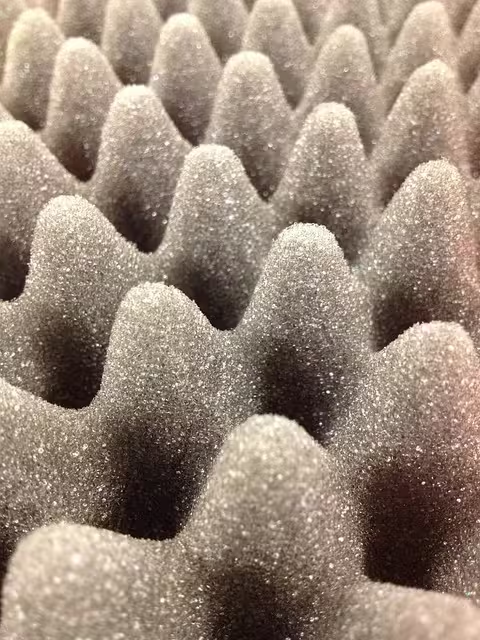
A: No, absolutely not. This is one of the biggest and most persistent myths in the world of acoustics. The thin, egg-crate style foam you can buy online is a lightweight absorber. It has very little mass and does nothing to damp or decouple a structure. It is a tool for acoustic treatment. It can help reduce some flutter echo and high-frequency reverb within a room, but it will do virtually nothing to stop sound from passing through your wall. If your goal is soundproofing, spending money on acoustic foam is a complete waste. You need to invest in mass, damping, and decoupling as part of the wall’s construction.
Q: Does acoustic treatment reduce noise?
A: This is a nuanced question. Acoustic treatment reduces the perceived noise level inside a room. By absorbing reflections and cutting down on reverb, it can make a space feel quieter and calmer because your ears are not being bombarded by chaotic, lingering sound energy. However, it does not reduce the level of noise that is transmitted through a wall. It quiets the room you are in; it doesn’t quiet the noise from the room next door. For that, you need soundproofing.
Q: Can you have acoustic treatment without soundproofing?
A: Yes, and this is a very common scenario. You can dramatically improve the sound quality of almost any room by adding acoustic treatment. For example, placing a few attractive, fabric-wrapped absorption panels in a dining room with hardwood floors and a lot of glass will make conversations much more pleasant and easier to understand. You can improve the clarity of your home office for video calls with a single panel. In these cases, you are not concerned about soundproofing; you are simply making the room a better-sounding space.
Practical Scenarios for Your Tri-Cities Custom Home

Let’s apply these concepts to rooms you might be planning for your new custom home here in the Tri-Cities area.
Scenario 1: The Dedicated Home Theater
This is the ultimate example of a room that requires a dual approach.
- Soundproofing: This is essential and non-negotiable. You want to be able to enjoy an action movie at cinema volume without shaking the entire house or disturbing someone sleeping in the next room. During construction, the soundproofing plan would involve building decoupled walls (ideally double-stud walls), adding mass (two layers of 5/8 inch drywall), including a damping compound (like Green Glue) between the layers, and ensuring everything is perfectly sealed with acoustical caulk. We would also install a heavy, solid-core door with a full sealing kit. This comprehensive soundproofing ensures total sound isolation.
- Acoustic Treatment: Once the soundproofing is built in, we focus on the sound inside the room. We would install large bass traps in the corners to control the subwoofer’s powerful low frequencies. We would then place absorption panels at the key reflection points on the side walls and ceiling to prevent distracting echoes from the surround sound speakers. Finally, we would place diffusers on the back wall to scatter the sound energy, creating a spacious and immersive audio experience. The combination of serious soundproofing and strategic acoustic treatment is what creates a truly professional-grade home theater.
Scenario 2: The Quiet Home Office
In today’s world, a quiet and functional home office is a necessity. The goal here is different from a home theater.
- Soundproofing: This is the absolute priority. The main problem is usually noise from the rest of the household intruding on your workspace. The soundproofing strategy would focus on the walls shared with noisy areas like a kitchen, living room, or hallway. We would add mass with thicker drywall and consider adding a damping compound. The single most important element is often the door. Replacing a standard hollow-core door with a solid-core door and adding perimeter seals can make a massive improvement in the soundproofing of the room.
- Acoustic Treatment: This is a secondary concern but can be very beneficial. A home office often has many hard surfaces (desk, monitor, windows), which can create a slight echo that makes your voice sound unprofessional on video and conference calls. Adding a single, well-placed fabric-wrapped absorption panel on the wall opposite you can dramatically clean up the sound, making your voice clearer to others.
Scenario 3: The Great Room with Vaulted Ceilings
Large, open-concept living areas are a popular feature in modern homes, but their large volume and abundance of hard surfaces (drywall, hardwood floors, large windows) can make them an acoustic nightmare.
- Soundproofing: This is not usually a primary concern unless the great room is open to a second-floor loft or bedrooms where noise transfer would be an issue. In that case, soundproofing the floor/ceiling assembly would be a consideration.
- Acoustic Treatment: This is highly recommended to make the space comfortable. In a large, untreated room, conversations can be difficult, the television can sound harsh, and the space can feel cold and cavernous. The solution is not to eliminate all reflections but to control them. This can be done in ways that blend seamlessly with your interior design. We can use large, aesthetically pleasing absorption panels that look like pieces of art, or install specialized acoustical ceiling clouds that float overhead to absorb reflections without being obtrusive. Even simple additions like a thick area rug and heavy curtains can help. The goal is to reduce the reverberation time, making the space feel more intimate and sound more pleasant.
Conclusion
As you can see, while they both deal with sound, soundproofing and acoustic treatment are two distinct disciplines that use different materials, techniques, and principles to achieve very different goals. To recap the core idea: soundproofing is about blocking sound from entering or leaving a room, focusing on quantity. Acoustic treatment is about controlling sound reflections within a room to improve its quality.
The most critical takeaway for anyone building a custom home is that true soundproofing is a construction-level effort. The best and most cost-effective time to implement mass, damping, and decoupling is when the walls are open and being built. Trying to add effective soundproofing to a finished room is significantly more difficult and expensive. Acoustic treatment, on the other hand, can be added to any room at any time, but planning for it during the design phase allows for cleaner, more elegant, and more integrated solutions.
When you’re ready to design your custom home here in the Tri-Cities area, let’s have a detailed conversation about the purpose of each and every room. By understanding how you plan to live in your home, we can engineer the perfect acoustic environment for your lifestyle, ensuring you get both the peace and quiet you need and the high-quality sound you want, exactly where it matters most.