
Introduction to Private Flood Insurance
One of the most critical decisions you will face when planning a custom home along our scenic creeks is selecting the right insurance. Throughout this comprehensive guide, we will explore why private flood insurance has become the standard for homeowners building in the Tri-Cities and why private flood insurance gives you the protection you need for high-value properties.
Motivations of Custom Home Buyers in East Tennessee
When women plan and design a custom home, they look at the house through both an emotional and a practical lens. A home is not just a collection of building materials. It is a sanctuary for daily living, family gatherings, work, rest, and future memories. Women often prioritize practical flow, natural lighting, clean indoor air, intelligent storage spaces, and overall peace of mind.
Safety and long-term security sit at the very top of that priority list. When a family chooses a parcel of land nestled against a mountain brook in Carter, Unicoi, Washington, or Sullivan County, the dream is tranquility. However, the practical reality of living near water requires proactive risk management. Female buyers want to know that their investment is safe against unexpected storms. This is why private flood insurance plays such a prominent role in our early planning sessions. Standard insurance policies do not protect against surface water, and relying on basic options can leave a family vulnerable. Choosing private flood insurance ensures that every dollar invested in custom cabinetry, hardwood floors, and quality finishes is fully protected.
Furthermore, female home buyers tend to look deeply into the fine print of living expenses during an emergency. If a severe storm damages a driveway or ground-level room, where will the family stay? How will daily life continue without severe financial stress? A tailored private flood insurance policy addresses these exact concerns by offering loss of use coverage. By addressing these needs early, private flood insurance transforms a potential source of anxiety into a well-managed detail of smart homeownership.
Understanding Home Interiors and Exteriors for Mountain Living

Building in the mountains of East Tennessee requires a thoughtful balance between interior luxury and exterior resilience. Our regional climate brings warm summers, crisp winters, and sudden rainfall events that sweep across the Appalachian ridges. The exterior envelope of your home must be engineered to handle heavy water runoff, while the interior should provide warmth, beauty, and effortless organization.
On the exterior, we favor natural Tennessee fieldstone, durable fiber-cement siding, composite decking, and heavy-gauge standing seam metal roofing. These materials withstand moisture and resist weathering. However, if your home sits near a mountain run, exterior durability must be paired with comprehensive private flood insurance. Heavy rains can push creeks over their banks in a matter of minutes. Even the strongest exterior wall cannot stop rising water if the site is not graded properly. Having private flood insurance gives you the backing needed to repair exterior masonry, structural framing, and landscape features if a flood occurs.
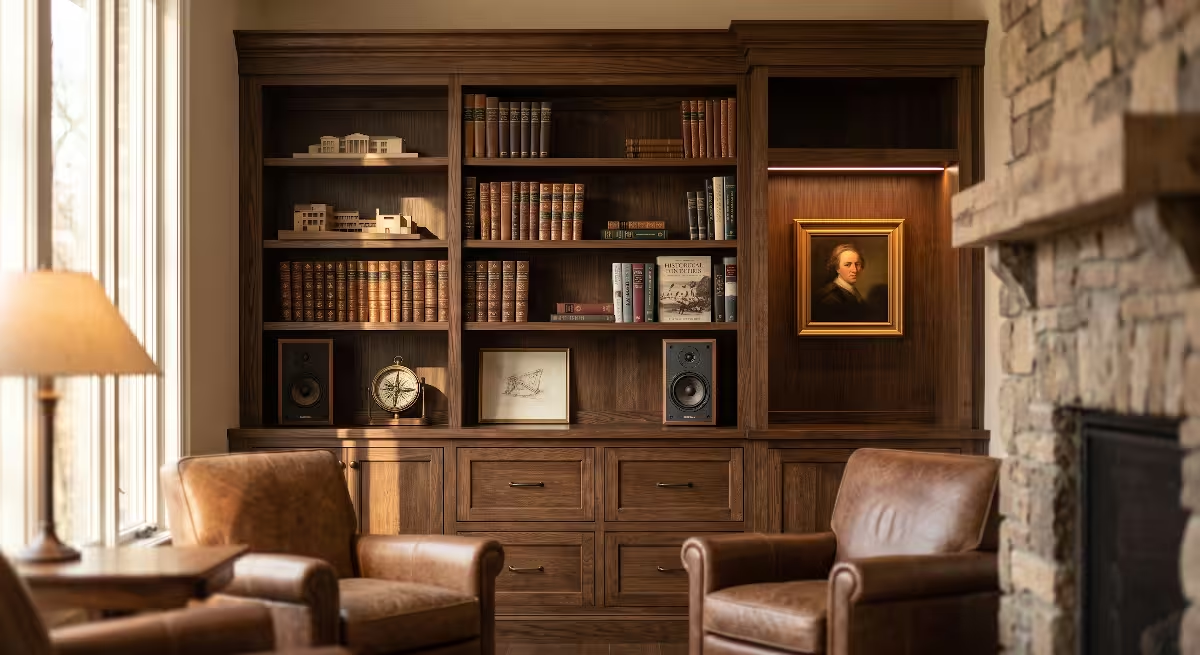
Inside the home, modern layouts focus on open floor plans, large walk-in pantries, drop zones near the garage, and finished walkout basements designed for recreation or guest suites. Below-grade spaces are wonderful for entertainment rooms and home offices, but they carry unique risks. Traditional government flood plans place heavy restrictions on what they will cover in a basement. In contrast, private flood insurance allows you to insure interior wall finishes, built-in cabinetry, and mechanical systems located on lower levels. Making sure your private flood insurance covers these custom interior elements protects your hard work and design choices.
Development Trends and Legal Aspects in the Tri-Cities Area
The Tri-Cities housing market is experiencing steady growth. Buyers from across the country are moving to Johnson City, Kingsport, and Bristol for our low tax rates, mountain scenery, and high quality of life. This migration has led to increased development along rolling hillsides, former farmland, and wooded creek bottoms. As a result, local planning commissions and building departments have updated their stormwater and subdivision regulations.
When you purchase a parcel in East Tennessee, you must understand local zoning laws, riparian setbacks, and floodplain management ordinances. Cities and counties enforce strict rules about how close you can build to a natural stream. These legal setbacks exist to protect water quality and reduce structural risk. However, local building codes only set the minimum safety threshold. They do not guarantee that your home will never experience water intrusion. Lenders require proof of coverage before issuing a construction loan, and securing private flood insurance satisfies both federal lending rules and regional banking requirements.
Private flood insurance has gained widespread acceptance under the federal Biggert-Waters Flood Insurance Reform Act. This law requires federally regulated lenders to accept private flood insurance as long as the policy meets the required standard of coverage. Working with an insurance provider who understands Tennessee real estate laws ensures that your private flood insurance policy will be approved quickly by your mortgage company, preventing delays during closing.
Appalachian Hydrology and Why Water Matters on East Tennessee Lots

To build safely in our region, you must understand how water moves through our Appalachian landscape. Unlike the flat coastal plains where floodwaters rise slowly over several days, mountain hydrology is fast and dynamic. When a heavy storm sits over the Unaka Mountains or the Holston Range, rain falls on steep rock faces and heavily forested slopes. Gravity pulls this water down into narrow valleys and hollows within minutes.
A peaceful stream that is two feet wide during July can become a roaring torrent twenty feet wide after a heavy mountain storm. The soil in our region contains dense clay, which limits how quickly water can soak into the ground. Once the top layer of soil becomes saturated, all remaining rainwater turns into surface runoff. If your home site sits on a bench above a stream, you must account for both the rising creek and the water running down the mountain behind your house.
Because mountain runoff moves with high velocity, it can carry rocks, silt, and tree branches. Standard home insurance policies strictly exclude damage caused by this type of moving water. This is why private flood insurance is an absolute necessity for mountain properties. With private flood insurance, you have a safety net that accounts for the sudden nature of Appalachian flash floods. The right private flood insurance policy covers the physical force of water and the debris it carries, helping you restore your site quickly after a storm.
Why Standard Homeowners Policies Fall Short for Rising Water
One of the most common misconceptions among new custom home buyers is the belief that their standard homeowners policy covers all types of water damage. Many agents spend a great deal of time clarifying this distinction. A standard homeowners policy, known in the insurance industry as an HO-3 or HO-5 policy, covers water damage only if the water comes from above or from inside your plumbing system.
For example, if a heavy windstorm tears shingles from your roof and rain pours into your attic, your standard policy will generally cover the damage. If a pipe bursts inside a second-floor bathroom wall, that damage is typically covered as well. However, as soon as water touches the ground outside before entering your home, it is legally classified as surface water or floodwater. The moment that water crosses your threshold, your standard policy provides zero coverage.
This exclusion applies to overflowing creeks, hillside mudflows, ground saturation, and water that backs up through drains due to an external flood. If you do not have a dedicated flood policy, you will be forced to pay for all repairs out of your own pocket. Choosing private flood insurance closes this dangerous coverage gap. By securing private flood insurance, you ensure that rising waters from nearby mountain runs are fully covered, protecting your personal finances from sudden and devastating repair bills.
The National Flood Insurance Program vs. Private Flood Insurance
For decades, property owners who needed flood coverage had only one main option: the National Flood Insurance Program, commonly known as the NFIP, managed by the Federal Emergency Management Agency (FEMA).While the government program provided a basic safety net, the growth of the private insurance market has created far better alternatives for modern custom homes.
The government program operates under rigid federal rules and strict coverage caps that were established decades ago.For a residential single-family home, the government policy caps structural building coverage at $250,000 and personal contents coverage at $100,000. In today’s construction market, where building a quality custom home in East Tennessee costs between $300 and $450 per square foot, a $250,000 limit is simply not enough. If a 3,500-square-foot custom home is severely damaged, a government policy will leave the homeowner with hundreds of thousands of dollars in unpaid rebuild costs.
This is where private flood insurance steps in to provide real security. Unlike government policies, private flood insurance is offered by specialized private insurance carriers that write coverage based on the actual replacement value of your home. A private flood insurance policy can easily cover building values of $1 million, $2 million, or more. Furthermore, private flood insurance provides higher limits for personal property, making private flood insurance the logical choice for any custom home build.
Coverage Limits: Why High-Value Custom Builds Need Private Flood Insurance
When planning a custom build, every detail is chosen with care. You select custom quarter-sawn oak cabinets, quartz or granite countertops, premium hardwood flooring, commercial-grade kitchen appliances, and designer bathroom tile. These high-end materials elevate the comfort and aesthetic beauty of your home, but they also increase the total replacement cost.
If you rely solely on a standard government flood policy, your personal belongings are capped at $100,000, and claims are often paid out at Actual Cash Value rather than Replacement Cost Value. Actual Cash Value factors in depreciation, meaning you will receive only a fraction of what it costs to buy new furniture, clothing, electronics, and decor. In contrast, private flood insurance policies frequently offer true Replacement Cost coverage on both the dwelling and your contents.
When you purchase private flood insurance, you can tailor your coverage limits to match the true cost of your home. If your custom residence costs $800,000 to construct, your private flood insurance policy can be written for the full $800,000. If your furniture, art, and personal possessions total $300,000, private flood insurance can cover that entire amount. This complete financial alignment is why I advise all my clients to explore private flood insurance before breaking ground on their dream home.
Finished Basements and Walkout Living Spaces under Private Flood Insurance
In our hilly East Tennessee terrain, walkout basements and daylight terraces are extremely popular design features. A walkout basement allows you to take advantage of a sloping lot, creating extra square footage for guest bedrooms, a media room, a home gym, or a dedicated craft workshop. These spaces often open directly onto covered stone patios that face the creek.
However, below-grade and semi-below-grade spaces represent a major blind spot under government flood insurance policies. Federal policies provide almost no coverage for finished basement walls, drywall, carpeting, hardwood, or personal belongings stored on lower levels. If a creek rises and sends six inches of water into a finished walkout basement, a federal policy will only pay for basic utility cleanup and specific mechanical equipment, leaving you with tens of thousands of dollars in uninsured drywall and flooring damage.
Private flood insurance solves this problem by offering comprehensive basement endorsements. Many private flood insurance carriers allow you to add coverage specifically for finished lower levels, including wall paneling, luxury vinyl tile, custom built-ins, and furniture. When designing a home with a walkout terrace, securing private flood insurance ensures that your investment in that lower-level living space remains fully protected.
Additional Living Expenses and Loss of Use Coverage in Private Flood Insurance
If your home suffers water damage during a severe mountain storm, the repair process takes time. Drywall must be removed, framing must be professionally dried and treated against mold, and new floors and cabinetry must be installed. During this restoration period, which can take several months, your home may not be safe or comfortable to live in.
Where will your family stay while the home is being repaired? How will you pay for temporary rent, hotel bills, storage units, and extra dining costs? Under a standard government flood policy, there is zero coverage for Additional Living Expenses, also known as Loss of Use. Homeowners are left to cover all temporary housing costs out of their own personal savings while continuing to pay their regular monthly mortgage.
This is another reason why private flood insurance is superior for family peace of mind. Most private flood insurance policies include built-in Loss of Use coverage or allow you to add it for a modest premium. If your home is temporarily uninhabitable due to a covered flood, your private flood insurance policy will pay for rental accommodations, moving costs, and storage fees. Having private flood insurance ensures that your family’s daily routine is preserved during a challenging time.
Topography, LiDAR Mapping, and Risk Ratings in Private Flood Insurance
Understanding how insurance companies calculate risk is an essential part of site planning. For decades, flood risk was determined solely by paper maps published by FEMA. These maps often used broad generalizations, grouping large parcels of land into single risk categories without accounting for micro-topography.
Today, the private flood insurance sector uses sophisticated digital tools, including high-resolution aerial LiDAR mapping. LiDAR uses laser pulses from aircraft to map the exact elevation of the ground down to a few inches. When a private flood insurance company evaluates your property, their computers analyze your precise building footprint, the exact height of your foundation, and the distance to the watercourse.
This advanced modeling means that private flood insurance pricing is often much more accurate and fair. If your home sits on an elevated bench ten feet above a creek, a private flood insurance underwriter can clearly see that your structure is at low risk, even if a portion of your lot touches the water. As a result, private flood insurance can offer lower premium rates for well-elevated homes compared to outdated government formulas. Choosing private flood insurance allows you to benefit directly from smart site engineering and proper elevation.
The Truth About Flood Zone X and Private Flood Insurance Needs

Many home buyers believe that if their parcel is located in Flood Zone X, they do not need flood coverage. Flood Zone X is defined on federal maps as an area of minimal or moderate flood hazard, lying outside the 100-year floodplain. Lenders do not legally require flood insurance for homes in Zone X, which leads many families to assume they are completely safe.
In reality, more than 25 percent of all flood insurance claims nationwide happen in low-risk zones like Zone X. In the mountains of East Tennessee, a sudden cloudburst can overwhelm natural swales and roadside ditches, sending water pouring across properties that have never flooded before. Water does not stop flowing just because a line is drawn on a map.
Because properties in Zone X are statistically at lower risk, private flood insurance is exceptionally affordable for these parcels. You can often secure a high-limit private flood insurance policy in Zone X for a fraction of the cost of a high-risk policy. Buying private flood insurance for a Zone X home provides an inexpensive safety net, giving you complete protection against unusual weather events.
Foundation Engineering, Vents, and Stem Walls to Optimize Private Flood Insurance
It is helpful to always look for ways that physical construction choices can lower ongoing ownership costs. How you design and build your foundation has a direct impact on the rates you will pay for private flood insurance.
In our region, homes built along creeks should avoid flat slab-on-grade foundations whenever possible. Instead, we prefer elevated stem-wall foundations with conditioned crawlspaces or open pier-and-beam structures. Elevating your main living floor even two or three feet above the surrounding ground creates a protective buffer against rising water. When private flood insurance underwriters see an elevated finished floor, they view the property as significantly lower risk.
Another crucial engineering feature is the installation of certified engineered flood vents. If water surrounds a foundation, the weight of the water creates intense hydrostatic pressure against the foundation walls. Without vents, this pressure can crack concrete block or cause foundation walls to collapse. Engineered flood vents allow water to enter and exit automatically, equalizing the pressure on both sides of the wall. Installing these vents protects the structural integrity of your foundation and qualifies your home for substantial discounts on private flood insurance premiums.
Mechanical Elevations, Drainage Swales, and Site Protection
Protecting a home from flood damage involves more than just the foundation walls. You must also protect the mechanical systems that keep your home running. In standard home designs, exterior heat pump compressors, backup generators, and electrical disconnects are often placed directly on the ground. If water rises only twelve inches, these expensive electrical units can be ruined.
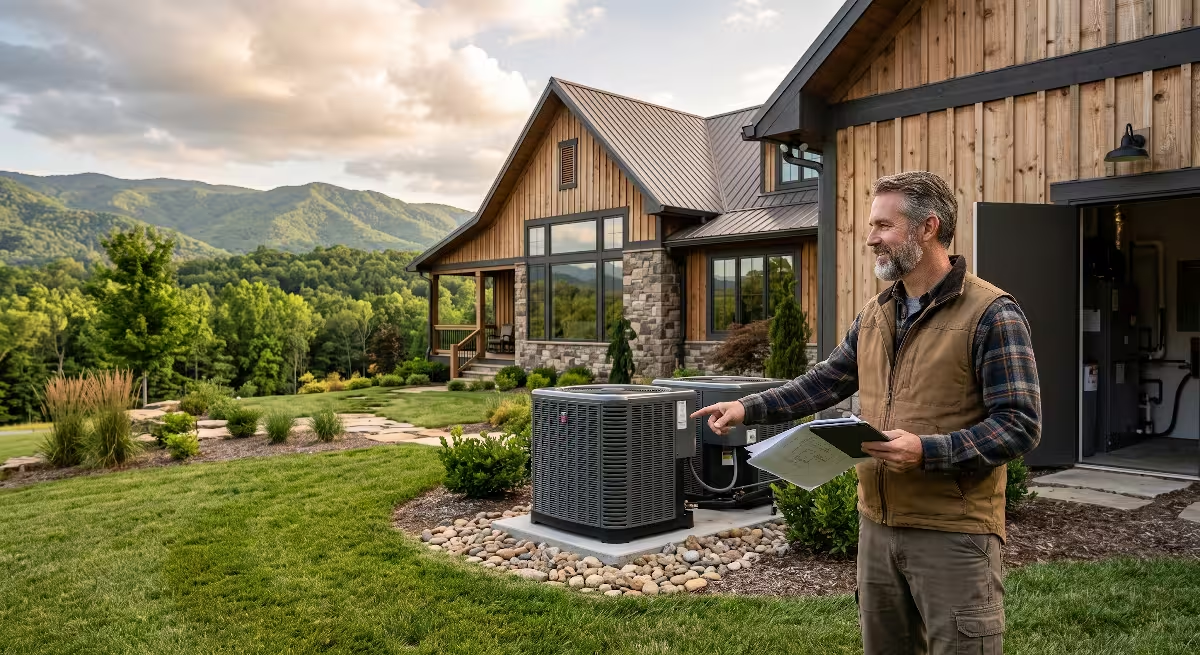
When we build near mountain streams, we mount heat pump compressors on heavy-duty wall brackets or elevated masonry platforms set well above the expected water level. We also place the main electrical panel, transfer switches, and tankless water heaters high on interior walls. Taking these steps prevents costly mechanical repairs and makes your home far more attractive to private flood insurance underwriters.
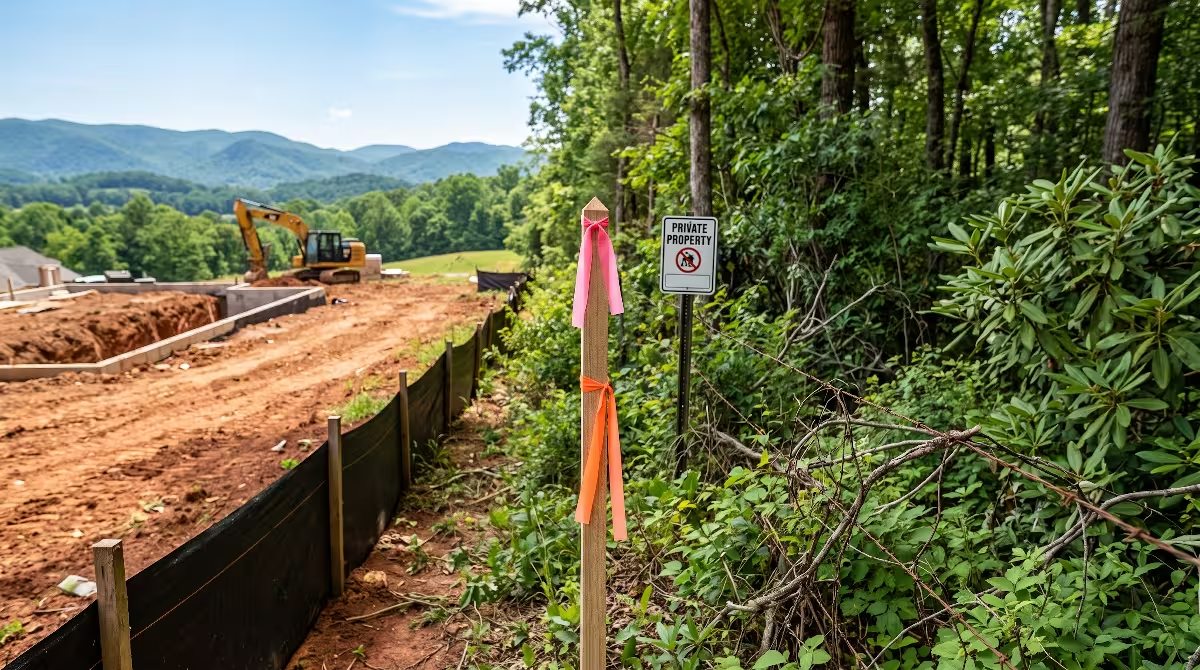
Around the exterior of the house, civil site grading plays a critical role. We cut gentle drainage swales and install gravel-filled French drains to catch sheet flow coming down the mountain slope. These channels redirect runoff safely around the house and back into the natural stream bed. Combining intelligent grading with a solid private flood insurance policy ensures that your site is physically prepared for storms while your finances remain protected by private flood insurance.
Working with Tennessee Licensed Surveyors on Elevation Certificates
When applying for flood coverage, one of the most valuable documents you can obtain is an Elevation Certificate.In the state of Tennessee, an Elevation Certificate must be prepared and signed by a licensed professional land surveyor.This document provides exact measurements of your property’s ground elevation, the lowest adjacent grade touching your foundation, and the height of your finished living floor.
While some private flood insurance carriers use aerial data and do not strictly require an Elevation Certificate, having one completed is always a wise investment.An official survey provides verified proof of your home’s elevation relative to local watercourses. When you provide an Elevation Certificate to a private flood insurance agent, they can submit the exact numbers to multiple private flood insurance underwriters.
If your surveyor confirms that your finished floor is several feet above the base flood level, your private flood insurance provider can apply maximum safety credits to your policy. This can save you hundreds of dollars each year on private flood insurance premiums, easily paying for the cost of the survey over the first few years of ownership.
Detached Garages, Workshops, and Outbuildings Covered by Private Flood Insurance
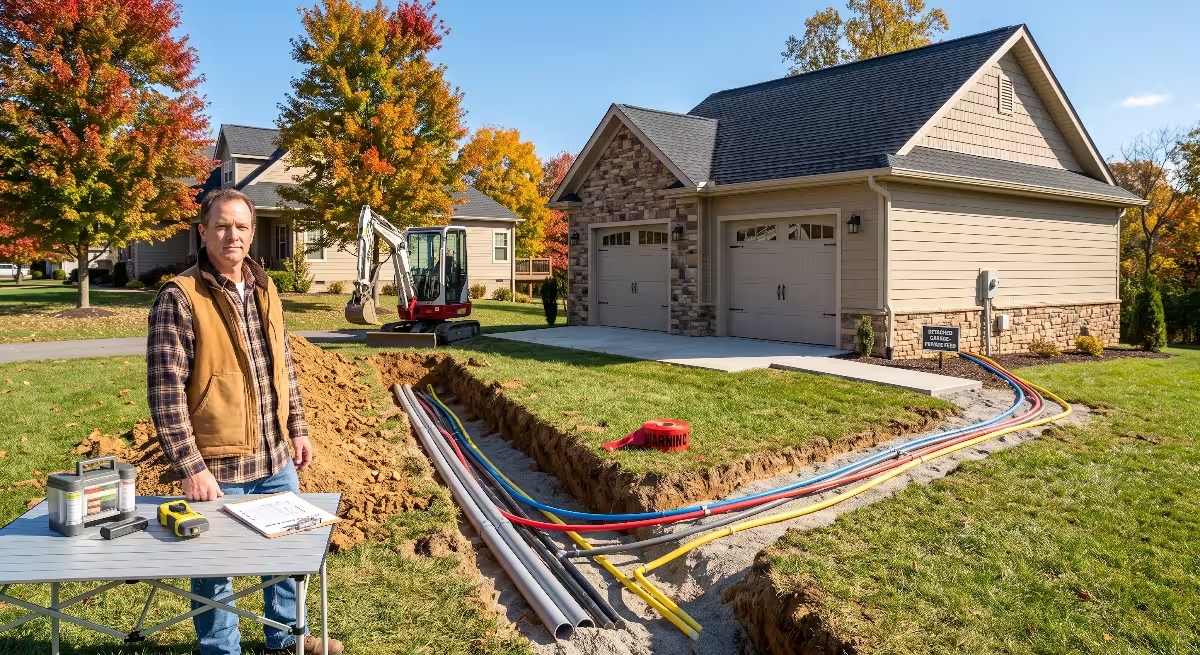
Many custom home builds in the Tri-Cities include detached structures. Our clients frequently build detached two-car garages with upstairs guest suites, standalone woodworking shops, garden sheds, or covered outdoor kitchens. These outbuildings add immense value and enjoyment to mountain living, but they require dedicated insurance planning.
Under traditional government flood insurance, coverage for detached structures is severely limited. A federal policy will only allow you to apply up to 10 percent of your primary home’s structural limit toward a detached garage, and that amount is subtracted from your main dwelling coverage rather than added to it. Furthermore, federal rules completely exclude outbuildings that are used for living spaces, workshops, or business purposes.
Private flood insurance provides a much better solution for property owners with outbuildings. A comprehensive private flood insurance policy allows you to list detached garages, barns, workshops, and guest cottages with their own independent coverage limits. This means your detached woodworking shop or studio apartment can be fully insured to its true replacement value without reducing the coverage on your main home. Choosing private flood insurance guarantees that every building on your property is safe from flood hazards.
Navigating Mortgages, Lenders, and Private Flood Insurance Guidelines
If you are financing your custom home through a construction loan or permanent mortgage, your lender will have specific requirements regarding flood insurance. Federal law requires banks, credit unions, and mortgage companies to ensure that any property located in a designated flood zone carries sufficient coverage.
In past years, some lenders were hesitant to accept non-government policies because they were unfamiliar with the private market. However, federal lending rules now explicitly mandate that lenders must accept private flood insurance as long as the policy meets the statutory definition of flood coverage under federal regulations. A qualified private flood insurance policy contains standard compliance language confirming that it matches or exceeds federal requirements.
When shopping for private flood insurance, work with an independent insurance agent who understands these lending standards. Your agent will provide your lender with a private flood insurance binder that includes all necessary compliance endorsements. By choosing private flood insurance early in the loan process, you ensure a smooth underwriting experience and avoid unexpected delays when closing your loan.
Shorter Waiting Periods and Smooth Loan Closings with Private Flood Insurance
Timing is everything in custom home construction. As your home approaches completion, your builder will request a final inspection, the local building department will issue a Certificate of Occupancy, and your bank will schedule the closing on your permanent mortgage.
One major drawback of government flood insurance is its mandatory 30-day waiting period.If you purchase a government policy, it does not take effect until 30 days have passed, unless it is tied directly to a loan closing. If there is any paperwork delay or change in closing dates, this 30-day waiting rule can cause frustrating scheduling issues.
Private flood insurance offers much greater flexibility with significantly shorter waiting periods. Most private flood insurance companies have waiting periods of only 10 to 14 days, and many private flood insurance providers can waive the waiting period entirely for real estate closings. This speed allows you to secure your private flood insurance policy quickly, ensuring that your home is protected the moment construction finishes and you receive the keys.
Long-Term Peace of Mind: A Step-by-Step Plan for Your Dream Home
Building a custom home in the Tri-Cities area of East Tennessee is a deeply rewarding experience. When you stand on your back porch, listening to the gentle sound of a mountain creek while looking out over wooded hillsides, you realize that our region offers one of the finest lifestyles in the country.
To protect that lifestyle, smart planning is essential. As an engineer, builder, and local resident, my mission is to help you navigate every stage of the building process with clarity and confidence. From selecting the right building parcel and designing an elevated foundation to installing proper drainage and securing private flood insurance, every step you take builds a safer home.
Private flood insurance is not just an extra line item on your monthly budget; private flood insurance is a fundamental pillar of responsible property ownership. By partnering with experienced local builders, licensed surveyors, and knowledgeable insurance agents, you can build a home that is as safe as it is beautiful. Choosing private flood insurance ensures that your custom mountain retreat remains a source of joy, comfort, and financial security for generations to come.
Key Takeaways for Building Along Mountain Streams
- Standard homeowners insurance policies do not cover damage caused by rising creek waters, surface runoff, or ground saturation.
- The National Flood Insurance Program caps structural coverage at $250,000, which is insufficient for modern custom homes in East Tennessee.
- Private flood insurance provides high structural limits, true replacement cost coverage, and protection for finished basements and detached outbuildings.
- Engineering practices such as installing flood vents, elevating mechanical equipment, and shaping drainage swales help lower your private flood insurance rates.
- Private flood insurance offers shorter waiting periods and flexible coverage tailored to the unique hydrology of our Appalachian region.