

When you build a custom house, you make hundreds of critical decisions. You pick the floor plan, you choose the framing lumber, you select the subfloor adhesive, and you pick the finish hardware. If you are building here in Northeast Tennessee, you are putting your hard-earned money and your dreams into the ground. Whether you are building on a wooded ridge in Sullivan County, a rolling pasture in Washington County, or near the water around Boone Lake, you want that house to stand strong. You also expect every single piece of machinery inside it to run smoothly from day one.
Many homeowners find themselves facing a puzzle right around closing time. You have just built a high-performance home filled with brand-new, modern appliances, smart control boards, and multi-stage heating systems. Then, someone hands you a flyer or your insurance agent mentions an endorsement. Suddenly, you have to weigh equipment breakdown insurance vs home warranty custom build options.
Should you pay for a standalone home warranty contract, or should you add equipment breakdown insurance to your homeowners policy? Are they the same thing, or do they serve entirely different goals?
When you spend your life studying how mechanical systems function, the answer becomes straightforward. A custom home is not like a thirty-year-old tract house that has seen decades of neglect. The equipment inside your new home is modern, efficient, and sensitive. To protect your budget without throwing money down the drain, you need to understand how equipment breakdown insurance works, how a home warranty functions, and how they both fit alongside your builder warranty.
Baseline Definitions: What Are You Actually Buying?
Before we compare these options, let us establish what each protection plan actually provides. The industry uses marketing terms that can sound confusing, but when you strip away the sales pitch, the mechanical principles are very simple.
What Is Equipment Breakdown Insurance?
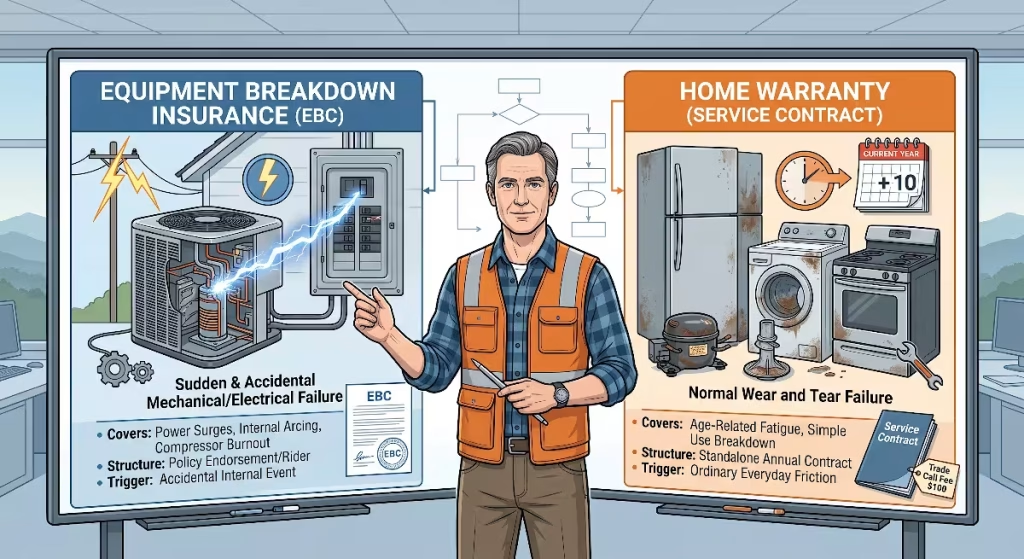
At its most basic, equipment breakdown insurance is a special addition, often called an endorsement or a rider, that attaches directly to your standard homeowners insurance policy.
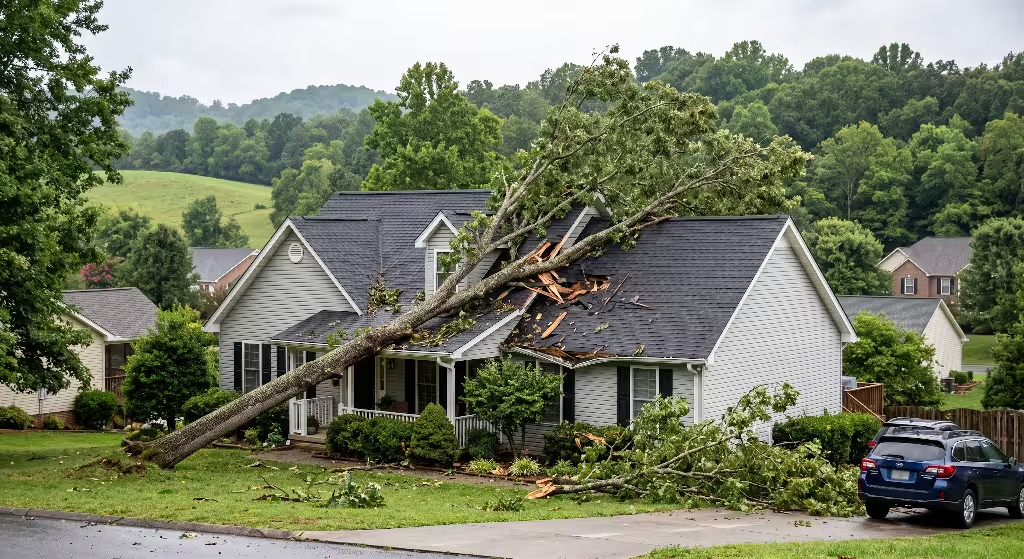
Your regular homeowners insurance is designed to protect your structure and personal belongings from sudden external hazards. If a tree falls on your roof during a mountain storm, or if a lightning strike starts a fire in your attic, your standard policy steps in. However, standard homeowners policies specifically exclude losses caused by mechanical failure or electrical burnout. If the compressor inside your brand-new heat pump suddenly fries its own motor coils on a hot July afternoon, standard insurance offers zero help.
This is precisely where equipment breakdown insurance steps into the gap.
Equipment breakdown insurance is designed to cover sudden, direct, and accidental physical loss to mechanical, electrical, and pressure equipment in your home. It handles events that happen from within the machine itself, rather than external tree branches or hail.
Common causes of loss covered by equipment breakdown insurance include:
- Electrical arcing and power surges that destroy sensitive microprocessors.
- Mechanical breakdown, such as a fan motor seizing up and shearing a shaft.
- Pressure system explosions or sudden ruptures, such as an expansion tank failure on a water heater.
- Centrifugal force failures, such as an impeller blowing apart inside a circulation pump.
The defining characteristic of equipment breakdown insurance is that the damage must be sudden and accidental. It does not cover gradual wear and tear. If a machine simply gets tired and wears down over ten years of slow friction, equipment breakdown insurance will not pay for that gradual loss. Instead, equipment breakdown insurance protects against catastrophic internal failures that happen in an instant.
What Is a Home Warranty?
A home warranty is not an insurance policy at all. In legal and financial terms, a home warranty is a residential service contract sold by a private, third-party company.
When you purchase a home warranty, you pay an annual fee or a monthly subscription. In exchange, the warranty provider agrees to arrange and pay for the repair or replacement of designated appliances and built-in systems when they break down due to normal wear and tear.
Normal wear and tear refers to the everyday friction, heat, and age that slowly degrade a machine over time. For instance, if an older dishwasher has run three thousand cycles, and its plastic spray arm finally cracks or its water inlet valve slowly starts leaking due to mineral buildup, that is normal wear. That is the exact situation a home warranty is built to address.
When a covered item fails under a home warranty, you do not call your favorite local heating contractor. Instead, you contact the warranty company. The company logs the claim, charges you a fixed trade service call fee, and then assigns an independent contractor from their pre-approved network to visit your home. If that contractor determines that the problem was caused by normal wear, the warranty company pays for the repair or replacement, subject to the limits and exclusions spelled out in their fine print.
Understanding this clear difference between sudden internal accidents and slow wear is the first step in resolving the equipment breakdown insurance vs home warranty custom build decision.
The Custom Build Nuance: The Three-Tier Warranty Layer
When people buy an older existing home, they often purchase a home warranty because they have no idea how the previous owner treated the air conditioner, the water heater, or the refrigerator. The equipment might be twelve years old, coated in dust, and ready to quit. In that scenario, paying for wear and tear coverage can occasionally provide peace of mind.
Building a custom home creates an entirely different mechanical environment. In a custom build, every single piece of machinery is brand-new. Every wire was pulled recently, every copper pipe was soldered or pressed recently, and every appliance was pulled out of a factory crate.
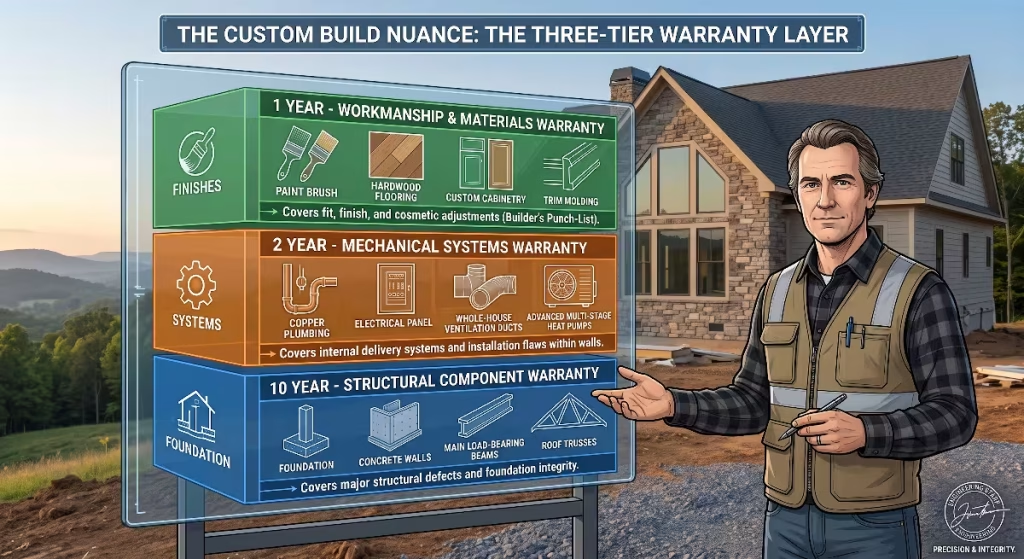
Because of this fresh start, your custom home already comes wrapped in multiple layers of protection. In the construction industry, we look at this as a three-tier warranty structure.
+-------------------------------------------------------+
|  Tier 3: Structural Warranty (Years 1 to 10)          |
|  Foundations, Load-Bearing Framing, Trusses           |
+-------------------------------------------------------+
|  Tier 2: Mechanical Distribution (Years 1 to 2)       |
|  Ductwork, Wiring, Plumbing Behind the Drywall        |
+-------------------------------------------------------+
|  Tier 1: Workmanship & Materials (Year 1)             |
|  Trim, Fixtures, Finishes, Builder Punch-List         |
+-------------------------------------------------------+
|  Plus: OEM Factory Warranties (Years 1 to 10)         |
|  Direct coverage on compressors, heat exchangers, etc. |
+-------------------------------------------------------+
Tier 1: The Builder Workmanship and Materials Warranty
In standard custom residential construction, your general contractor provides an express warranty covering workmanship and materials for at least your first full year in the home.
If an interior door does not latch properly, if a joint in your crown molding opens up during winter, or if an installer forgot to tighten a drain trap under the kitchen sink, your builder is legally and contractually responsible for correcting it. During that first year, you should not be paying a service fee to anyone. Your builder should walk through your door and make it right.
Tier 2: The Mechanical Systems Distribution Warranty
Most quality custom builders follow the standard residential performance guidelines, which often provide two years of coverage for the delivery systems inside your walls, floors, and ceilings.
This covers the wiring runs, the main breaker panel connections, the supply and return ductwork, and the primary plumbing rough-in pipes. If a joint in your heating duct separates behind the drywall or a drain pipe develops a leak at a fitting during the first two years, your builder warranty addresses the installation flaw.
Tier 3: The Ten-Year Major Structural Defect Warranty
The third tier covers the skeleton of your home, including load-bearing foundation walls, footings, floor joists, structural beams, and roof trusses. This coverage lasts for up to ten years, protecting you against structural settlement or load failures.
The Manufacturer Warranty (OEM Coverage)
Running parallel to your builder warranty is your Original Equipment Manufacturer (OEM) warranty. Every appliance and mechanical unit you purchase comes with factory backing.
When you install high-efficiency equipment, manufacturers provide substantial parts warranties out of the box, provided you register them within sixty to ninety days of move-in.
- High-performance heat pumps and air handlers routinely carry a ten-year limited warranty on compressors and all functional internal parts.
- Quality tankless water heaters often include a twelve-year warranty on the primary heat exchanger and five years on electronic components.
- Luxury kitchen suites, such as professional ranges and built-in refrigerators, typically provide two to five years of comprehensive parts and labor coverage, with extended coverage on sealed refrigeration systems.
Why This Redefines the Equipment Breakdown Insurance vs Home Warranty Custom Build Debate
Consider what this means when you move into your newly completed home.
Your builder covers installation mistakes and workmanship during the early period. Your equipment manufacturers cover factory defects and parts for five to ten years.
Because your equipment is brand-new, it has zero wear and tear. It will take years of operating hours before mechanical friction, heat cycling, and mineral scale build up to the point of everyday wear-related breakdown.
If you purchase a traditional home warranty for a custom home during its first few years, you are essentially paying for wear and tear protection on parts that are not worn out, while paying for parts that the manufacturer already guarantees. You are paying a third-party company hundreds of dollars a year for coverage that duplicates what you already own.
However, neither the builder warranty nor the factory parts warranty covers sudden, catastrophic electrical damage from utility line problems or accidental mechanical events. If a voltage spike surges through your home and fries the circuit boards in your multi-stage heat pump, the manufacturer will test that board, see the burned traces caused by an external surge, and deny the claim because it was not a factory defect. Your builder will rightly tell you that their crew wired it to code and the failure was caused by power conditions.
That exact scenario is where equipment breakdown insurance proves its value. Equipment breakdown insurance protects you from the very failures that new equipment faces, without charging you for wear-and-tear coverage that you do not need.
Detailed Comparison: Equipment Breakdown Insurance vs Home Warranty
To help you see the mechanical, financial, and procedural differences clearly, let us place equipment breakdown insurance alongside a traditional home warranty across the operational factors that matter to a homeowner.
| Operational Factor | Equipment Breakdown Insurance | Traditional Home Warranty |
| How You Buy It | An endorsement attached directly to your existing homeowners policy. | A separate annual service contract bought from an independent company. |
| Primary Trigger | Sudden, accidental mechanical, electrical, or pressure failure. | Slow wear, tear, and age-related operational failure. |
| Annual Premium | Low cost, generally between $25 and $60 per year. | High cost, generally between $600 and $1,400 per year. |
| Cost Per Incident | Your policy deductible, usually $250 to $500 per claim. | A trade call fee of $75 to $150 every time a technician visits. |
| Overall Coverage Limit | Large aggregate limit, commonly $50,000 to $100,000 per occurrence. | Strict per-system limits, often capped at $1,500 to $2,500 per item. |
| Who Does the Work | You choose your own licensed, factory-certified contractor. | The warranty company assigns an independent contractor from their network. |
| Smart Tech & Controls | Broadly includes integrated automation, microprocessors, and panels. | Regularly excludes high-end smart controls, or requires expensive add-on riders. |
| Secondary Losses | Frequently covers refrigerated food spoilage and temporary living costs. | Covers only the mechanical repair itself; no spoilage or living costs. |
| Efficiency Upgrades | Many policies pay up to 125% to 150% to replace units with greener models. | Replaces failed units with basic, builder-grade contractor models. |
Financial Structure and Cost Differences
When analyzing construction and ownership budgets, cash flow matters. Let us look at the financial math behind equipment breakdown insurance compared to a home warranty over five years of living in your custom home.
With equipment breakdown insurance, your annual cost is remarkably low. Because the insurance company bundles this endorsement into your main homeowners policy, their administrative overhead is minimal. You will typically see equipment breakdown insurance add between $30 and $50 to your annual insurance premium. Over a five-year period, you will spend roughly $150 to $250 total for equipment breakdown insurance.
A home warranty requires an ongoing monthly fee or an upfront annual payment. A decent plan covering major mechanicals and kitchen appliances easily runs $75 to $100 per month. That equals $900 to $1,200 per year. Over five years, you will pay between $4,500 and $6,000 in subscription premiums alone.
Now look at the out-of-pocket costs when something fails.
With equipment breakdown insurance, you pay a single deductible. If a massive power event destroys the inverter board on your heat pump, ruins the motor on your well pump, and blows out your refrigerator board all in one afternoon, equipment breakdown insurance treats this as a single occurrence. You pay your deductible, usually $500, and equipment breakdown insurance handles the rest of the covered damage up to the aggregate limit, which is typically $50,000 or more.
With a home warranty, you pay a trade service call fee for every single specialty trade that comes to your house. If your heating system fails, that is one fee. If your refrigerator also fails, that is a second fee. Even worse, if the contractor comes out to diagnose the problem, orders a part, and has to return two weeks later, some contracts charge an additional visit fee. If you experience two or three minor issues a year, you can easily spend several hundred dollars in service fees on top of your steep annual premium.
Payout Caps and Dollar Limits
One of the most dangerous traps for custom home builders is the payout cap hidden inside traditional home warranty contracts.
In a basic tract house, the builder might install an entry-level, minimum-efficiency 14-SEER air conditioner and a basic 30-inch electric range. If that air conditioner fails, a contractor might replace it for a modest price. Home warranties are built around these basic builder-grade units. As a result, home warranty contracts routinely place strict dollar caps on what they will pay. It is common to see a $1,500 or $2,000 maximum limit on heating and cooling systems, and a $1,000 cap on kitchen appliances.
Now consider your custom build.
You probably installed a high-efficiency 18 to 20-SEER variable-speed inverter heat pump, or perhaps a geothermal system. Replacing an inverter compressor or a complex blower assembly on a high-efficiency system can easily cost $3,500 to $6,000 in parts and specialized labor. If you rely on a home warranty with a $1,500 cap, you are left paying thousands of dollars out of your own pocket.
Equipment breakdown insurance operates under a much broader financial ceiling. Most equipment breakdown insurance endorsements provide a total coverage limit of $50,000 to $100,000 per breakdown occurrence. If your high-end mechanical equipment suffers a catastrophic internal burnout, equipment breakdown insurance covers the actual cost to repair or replace that equipment with materials of like kind and quality, minus your straightforward deductible. For high-value custom installations, the coverage ceiling of equipment breakdown insurance provides vastly superior financial protection.
Contractor Selection and Quality of Workmanship
As an engineer and someone who has built custom homes, I care deeply about who works on advanced mechanical systems. High-performance homes feature tightly balanced duct systems, advanced variable-refrigerant controls, and precision plumbing. You do not want an untrained hand working on these systems.
This is where the difference between equipment breakdown insurance and a home warranty becomes critical.
When you file a claim under equipment breakdown insurance, you maintain control over the repair process. You can call the exact mechanical contractor who installed your system during construction. You can hire a factory-authorized, certified dealer who understands the specific brand and programming of your equipment.
The technician diagnoses the issue, writes a clear report stating that the failure was a sudden electrical or mechanical breakdown, submits the repair estimate, and completes the work. Equipment breakdown insurance reimburses you or pays the contractor directly according to the policy guidelines. This ensures that your factory warranties stay intact, because authorized technicians do the work using genuine manufacturer parts.
Under a home warranty, you surrender contractor selection entirely. The warranty company maintains a roster of third-party repair vendors who have agreed to work for discounted labor rates. Quality, established contractors with full schedules rarely work for discounted warranty rates.
As a result, home warranty companies frequently dispatch independent repair companies that may lack specific factory certifications for high-end equipment. If a non-certified technician works on your high-efficiency heat pump or luxury European range, their work could inadvertently void your remaining manufacturer parts warranty. Furthermore, because these contractors must get repair approvals from an off-site warranty adjuster, your family might wait days or weeks in the heat or cold while the warranty company searches for the cheapest possible aftermarket part.
Equipment breakdown insurance respects the caliber of your equipment by allowing you to hire the right professionals to fix it.
Regional Realities: Why Custom Builds in East Tennessee Face Specific Risks
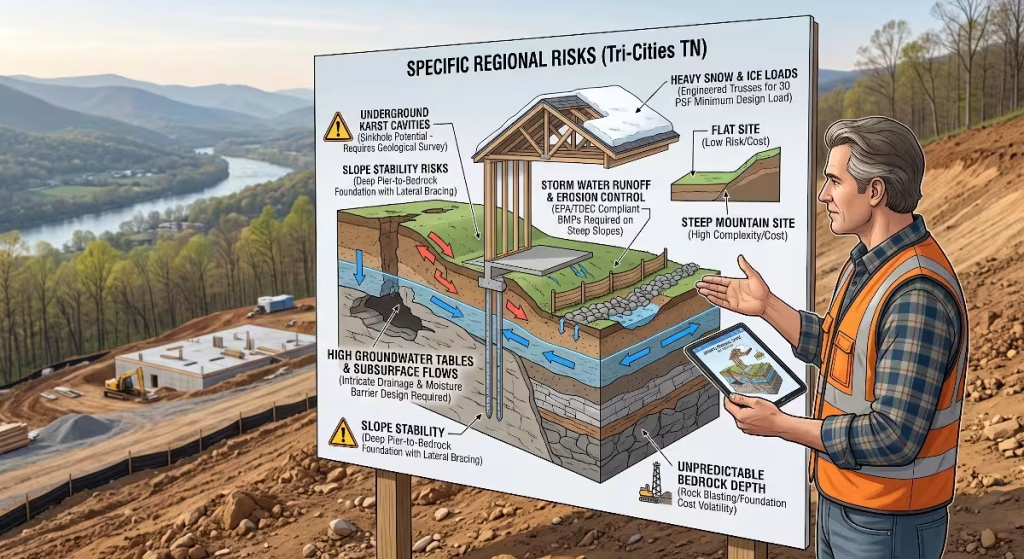
Every region presents unique environmental and operational challenges for home construction. When building in the Tri-Cities area of Tennessee, spanning Johnson City, Kingsport, and Bristol, down through Greeneville and out into the surrounding mountain hollows, our local terrain and climate directly impact your mechanical systems.
+-----------------------------------------------------------------+
|       East Tennessee Environmental Stresses on Custom Homes     |
+-----------------------------------------------------------------+
|  1. Mountain Ridge Utility Surges & Transient Voltage           |
|  2. Steep Summer Humidity & Winter Inversion Freezes            |
|  3. Deep Well Pumps & Multi-Stage Water Filtration Loads        |
|  4. Heavy reliance on Inverter-Driven Heat Pump Electronics     |
+-----------------------------------------------------------------+
Topography, Rural Power Distribution, and Electrical Surges
East Tennessee is famous for its rolling hills, mountain ridges, and river valleys. It is an incredible place to live, but running electrical utilities across this rugged topography is demanding for power companies.
Many custom homes in our region are built on large private lots, scenic knolls, or rural acreage outside municipal utility lines. These properties are often served by long overhead power lines that run through heavily wooded areas.
During our summer thunderstorm season, lightning storms pass through our mountain corridors regularly. Even if lightning does not hit your house directly, strikes near utility lines create massive transient voltage spikes. In winter, falling limbs from wet snow and freezing rain can cause power lines to slap together, generating rapid power dropouts, brownouts, and phase imbalances.
Modern custom homes are packed with delicate solid-state electronics. We use smart breaker panels, variable-speed fan motors, communicating thermostats, and inverter compressor drives. An inverter drive takes alternating current from the grid, converts it to direct current, and uses high-speed transistors to control the motor speed down to the single percentage point.
These electronic components are extremely sensitive to power quality. A sudden power surge or brownout can instantly destroy the capacitors and microprocessors on those control boards.
Standard homeowners insurance will not cover that damage unless an external fire occurred. A home warranty will often reject the claim, arguing that a power surge is an electrical incident rather than normal wear and tear. Equipment breakdown insurance is specifically designed to step in and pay for the sudden electrical burnout of those very components. For anyone building in Sullivan, Washington, or Carter counties, having equipment breakdown insurance is one of the smartest ways to hedge against the realities of our local electric grid.
Temperature Swings and Heat Pump Demands
Our climate in Northeast Tennessee brings distinct four-season weather. We experience humid, hot summer afternoons where cooling and whole-home dehumidification systems run continuously. In winter, we see sharp cold snaps where temperatures drop rapidly into the teens or single digits.
To handle these shifts efficiently, custom builders in our area install multi-stage or variable-capacity heat pumps. These units do not just kick on and off like old furnaces; they adjust their output constantly to maintain even indoor comfort.
However, running advanced heat pump equipment year-round puts steady demands on motor bearings, electronic expansion valves, and reversing valves. If an internal valve seizes suddenly or a fan motor bearing locks up during a hard winter freeze, equipment breakdown insurance covers that sudden mechanical failure. It provides the security you need to ensure your primary comfort system is restored promptly.
Private Well Pumps and Water Treatment Equipment
A significant percentage of custom builds across the Tri-Cities region rely on private drilled wells for their domestic water supply rather than municipal city water.
In our mountainous limestone geology, private wells can be deep, often reaching depths between 200 and 600 feet. The submersible pump that sits at the bottom of that well casing works against heavy head pressure to push water up to your pressure tank.
If that deep well pump suffers a sudden mechanical seizure or an electrical winding failure, pulling several hundred feet of heavy drop pipe and replacing the pump is a difficult, expensive job. A complete well pump replacement can easily cost $3,500 to $6,000.
Most traditional home warranties either exclude well pumps completely or limit their coverage to a tiny $500 or $1,000 sub-cap, which barely covers the cost of mobilizing a pump truck.
Equipment breakdown insurance, on the other hand, routinely includes deep well pumps and whole-home water treatment systems under its mechanical and electrical coverage umbrella. If that submersible motor burns out unexpectedly, equipment breakdown insurance provides the financial backing needed to pull the line and install a new pump without draining your savings account.
Commonly Asked Questions about Equipment Breakdown Insurance
When homeowners start exploring equipment breakdown insurance vs home warranty custom build choices, several practical questions arise. Here are direct, straightforward answers to the questions building clients ask most often.
Does homeowners insurance cover mechanical breakdown automatically?
No, a standard homeowners insurance policy does not cover mechanical breakdown. Standard homeowners policies, whether you have an HO-3 or an HO-5 policy form, are built to protect your property against specific perils like fire, windstorm, hail, theft, and falling objects. They explicitly contain exclusions for mechanical failure, electrical arcing, and pressure system ruptures. To get protection for those events, you must explicitly ask your insurance carrier to add an equipment breakdown insurance endorsement to your policy.
Can you have both equipment breakdown coverage and a home warranty?
Yes, you can legally have both, but for a brand-new custom home, carrying both is almost always an unnecessary waste of money.
If you hold both, you are paying hundreds of dollars each year for a home warranty to cover wear and tear on new appliances that are not worn out and are already backed by factory parts warranties. At the same time, you are paying for equipment breakdown insurance to cover sudden internal accidents.
The two products cover different failure triggers, but the home warranty’s scope heavily overlaps with your existing manufacturer protections. For the vast majority of custom homeowners, carrying equipment breakdown insurance alongside your builder and manufacturer warranties provides complete, logical protection without paying duplicate fees.
Does equipment breakdown insurance pay for labor and diagnostics?
Yes. When you file a legitimate claim for a covered loss under equipment breakdown insurance, the policy pays for the necessary diagnostics, the labor required to remove the broken component, the cost of the replacement parts or complete unit, and the labor to reinstall and test the system. You are responsible only for your agreed-upon policy deductible.
What happens if a custom appliance cannot be repaired?
If a covered appliance or mechanical unit experiences a sudden failure and the technician determines that parts are no longer available or the unit is damaged beyond economical repair, equipment breakdown insurance pays to replace the item with a new unit of like kind and quality.
Furthermore, many top-tier equipment breakdown insurance endorsements include an environmental or green upgrade provision. If your old equipment fails, the policy may pay an extra 25% to 50% above the replacement cost to upgrade you to a more energy-efficient, Energy Star-rated model. This is an incredible feature for homeowners dedicated to maintaining high efficiency.
Will a home warranty cover high-end luxury systems?
In most cases, standard home warranties do not adequately cover high-end luxury systems. If you have installed a commercial-style 48-inch range, a built-in refrigeration system, a high-efficiency geothermal heat pump, or an integrated solar inverter, standard home warranty contracts will either exclude them or place strict dollar limits that fall far short of real-world replacement costs.
To cover such systems, home warranty companies often require you to purchase expensive optional riders, which drives your annual cost even higher. Equipment breakdown insurance, by contrast, automatically applies its high overall limit to all permanently installed mechanical systems and appliances in your home, regardless of brand or luxury status.
What is excluded from equipment breakdown insurance?
To keep your expectations grounded, it helps to understand what equipment breakdown insurance does not cover:
- Gradual wear and tear, rust, and corrosion that develop slowly over time.
- Intentional damage or gross neglect, such as operating equipment without recommended fluids or filters.
- Cosmetic flaws, like scratches or dents on an appliance door that do not prevent the machine from working.
- Software glitches that do not involve physical damage to hardware.
- Structural damage to the house itself, which belongs under your primary homeowners insurance coverage.
Knowing these boundaries makes it easy to see that equipment breakdown insurance is designed as a safety shield against sudden mechanical shock, not as a substitute for routine maintenance.
Equipment Breakdown Insurance vs Home Warranty Custom Build: Feature-by-Feature Analysis
To appreciate why equipment breakdown insurance fits custom construction so well, let us take a closer look at specific equipment categories found in modern builds.
Heating, Ventilation, and Air Conditioning (HVAC)
Your HVAC system is the mechanical lungs of your home. In our modern custom builds, we prioritize indoor air quality and comfort. That means installing variable-speed blowers, communicating heat pumps, and whole-house dehumidifiers tied into dedicated ductwork.
+-------------------------------------------------------------------------+
|                  HVAC Mechanical Breakdown Scenario                     |
+-------------------------------------------------------------------------+
| Event: A sudden power fluctuation causes an electrical arc that destroys|
| the inverter control board and burns out the variable-speed motor.      |
|                                                                         |
| Manufacturer Response: Denies claim; failure caused by incoming power,  |
| not a factory assembly defect.                                          |
|                                                                         |
| Home Warranty Response: May deny claim citing electrical surge as an    |
| excluded peril, or cap payout at $1,500, leaving thousands unpaid.     |
|                                                                         |
| Equipment Breakdown Insurance: Covers diagnostic fees, labor, and       |
| replacement of the fried boards and motor under sudden electrical arcing|
| provisions, subject only to your flat deductible.                       |
+-------------------------------------------------------------------------+
Under equipment breakdown insurance, this catastrophic failure is covered cleanly. You call your original mechanical installer, they replace the fried boards with factory-original parts, and equipment breakdown insurance covers the invoice minus your deductible. Under a home warranty, you face delays, potential denials regarding surge causes, and strict payout caps that leave you with significant out-of-pocket costs.
Luxury Kitchen Appliances
A hallmark of custom homes is a carefully planned kitchen. Many homeowners invest heavily in custom cabinetry built around professional appliances like induction cooktops, dual-fuel convection ranges, and panel-ready dishwashers.
These appliances rely heavily on electronic touch controls and integrated computer chips. If a power spike burns out the main control module of an induction cooktop, repairing it requires a skilled technician who knows how to handle luxury appliances without damaging surrounding custom cabinetry or stone countertops.
With equipment breakdown insurance, you can bring in the factory-certified luxury appliance technician who knows the equipment inside and out. Equipment breakdown insurance covers the repair costs without forcing you to accept an unfamiliar contractor dispatched by a third-party warranty call center.
Backup Generators and Transfer Switches
Many custom homes in East Tennessee feature automatic standby generators. When winter weather knocks out grid power on a mountain road, a whole-home generator starts automatically, and an automatic transfer switch safely isolates your house from the grid while routing power from the generator.
Standby generators combine internal combustion engines, alternators, sensitive voltage regulators, and heavy mechanical switches.
If the voltage regulator fails suddenly or the alternator windings short out during an emergency run cycle, repairing that machine requires specialized generator technicians. Equipment breakdown insurance covers standby generators as permanently installed home equipment. Most home warranties completely exclude whole-house generators unless you pay for an expensive specialty rider, and even then, their payout limits rarely cover the cost of heavy generator repairs.
Solar Power Systems and Battery Storage
Energy independence is an increasingly popular goal for custom builds. More homeowners are incorporating rooftop solar panels, grid-tied solar inverters, and lithium battery storage systems into their building plans.
A solar inverter is a sophisticated piece of power electronics. It works continuously during daylight hours to convert variable direct current electricity from your panels into clean alternating current for your home.
If an internal component inside your solar inverter experiences a sudden electrical breakdown, replacing that unit can cost thousands of dollars. Equipment breakdown insurance treats solar power equipment and inverters as covered mechanical and electrical property. In contrast, standard home warranty companies rarely touch residential solar or battery storage systems.
Maintenance Responsibilities: Keeping Your Coverage Strong
Regardless of whether you use equipment breakdown insurance or any other protection plan, you must remember that no policy excuses a homeowner from basic maintenance.
A home is an active system. Just like you cannot expect a truck to run without regular oil changes, you cannot expect your home mechanicals to perform without ongoing attention. If equipment fails because it was abandoned and neglected for years, equipment breakdown insurance will not step in to save the day.
To keep your mechanical systems running smoothly and ensure your equipment breakdown insurance claims remain uncontested, establish a simple seasonal maintenance routine:
1. Filter Replacements and Airflow Management
Change your HVAC air filters every sixty to ninety days. High-performance variable-speed blowers require steady airflow. If a filter becomes completely clogged with construction dust, pet hair, or dirt, the blower motor must work harder, causing internal temperatures to spike. While equipment breakdown insurance covers sudden mechanical failure, insurance adjusters can tell when a motor burned out simply because it was starved of air for a year.
2. Water Heater Flushing
Whether you have a standard tank heater or a high-efficiency tankless unit, our regional water contains dissolved limestone and minerals. Over time, that mineral content precipitates out as scale. In a tankless unit, scale coats the copper heat exchanger, reducing heat transfer and forcing the burners to run hotter. Flush your tankless water heater with a mild descaling solution once every twelve to eighteen months to keep your heat exchanger clear and protect your warranty rights.
3. Electrical Surge Protection Strategy
Equipment breakdown insurance is your financial safety net against power surges, but you should also use physical defenses to protect your home.
Have your electrical contractor install a Type 2 whole-house surge protective device directly inside your main electrical panel during construction. This device clamps high-voltage utility spikes at the panel before they travel downstream to your appliances.
Pairing a whole-house surge protector with equipment breakdown insurance gives you physical protection at the panel, while equipment breakdown insurance provides the financial backstop if a massive surge overwhelms the protector.
4. Keep Detailed Service Records
Whenever a technician services your heat pump, tests your well water equipment, or inspects your backup generator, save that invoice in a dedicated home maintenance folder. If you ever need to file a claim under equipment breakdown insurance, having clean maintenance records proves that the machine was well cared for and that the failure was indeed a sudden, unexpected event.
Strategic Recommendation and Implementation Plan
When you weigh equipment breakdown insurance vs home warranty custom build options, you are deciding how to allocate your money wisely. You want robust protection that respects the quality of your home, without paying for redundant services.
For a newly constructed custom home, the strategic choice is clear: Equipment breakdown insurance paired with your builder warranty and factory manufacturer warranties offers the most effective, comprehensive, and cost-efficient protection available.
+-------------------------------------------------------------------+
|               The Ideal Custom Build Protection Plan              |
+-------------------------------------------------------------------+
|  Step 1: Enforce Builder Warranty (Years 1 to 2)                  |
|  Hold your builder accountable for all installation and setup.    |
|                                                                   |
|  Step 2: Formally Register All OEM Warranties                     |
|  Lock in your 5- to 10-year factory parts protection early.       |
|                                                                   |
|  Step 3: Add Equipment Breakdown Insurance to Your HO Policy     |
|  Gain $50k+ in surge, mechanical, and pressure protection for     |
|  around $35 to $50 per year.                                      |
|                                                                   |
|  Step 4: Skip Third-Party Home Warranties During Years 1 to 5     |
|  Avoid paying $1,000/yr for redundant wear-and-tear coverage.     |
+-------------------------------------------------------------------+
Your Step-by-Step Implementation Roadmap
To put this protection strategy into action on your custom build, follow this straightforward plan:
Step 1: Work Closely With Your Builder During the Punch-Out Phase
As your build nears completion, walk through the house with your builder. Test every single disconnect switch, run every appliance through a complete operational cycle, check the temperature split across your heat pump coils, and verify that all plumbing shutoff valves move freely. Ensure that your builder handles any startup bugs or improper installations under their initial one-year warranty.
Step 2: Register Every Manufacturer Warranty Within 60 Days
Do not leave the product warranty cards sitting in a kitchen drawer. Sit down with your computer and register your heat pump, air handler, water heater, kitchen suite, well pump controls, and ventilation fans directly on the manufacturers’ websites.
In many cases, manufacturers grant their full ten-year parts warranty only if the equipment is registered within sixty to ninety days of the home’s closing or certificate of occupancy. If you miss that window, your factory warranty may automatically drop to a basic five-year term. Taking an hour to register these units locks in years of free parts coverage.
Step 3: Call Your Homeowners Insurance Agent for Equipment Breakdown Insurance
When setting up your permanent homeowners insurance policy, tell your agent specifically that you want to add an equipment breakdown insurance endorsement.
Ask them to clarify three points:
- What is the total occurrence limit for equipment breakdown insurance? (Look for $50,000 or more).
- What is the deductible for equipment breakdown insurance? (Usually $500).
- Does your equipment breakdown insurance include extra provisions for food spoilage and green energy efficiency upgrades?
Adding equipment breakdown insurance will typically add only $30 to $50 to your total annual insurance bill. It is one of the most affordable endorsements in the entire insurance industry.
Step 4: Say No to Standalone Home Warranties for the First Five Years
Politely decline the sales solicitations you receive from third-party home warranty companies during the closing process. Your brand-new equipment does not need expensive wear-and-tear protection while it is fresh, clean, and fully backed by factory warranties. Save that $800 to $1,200 each year, or put it into your personal home maintenance reserve fund.
Step 5: Re-Evaluate Down the Road
When your home reaches eight to ten years of age, its mechanical landscape will begin to shift. Your factory parts warranties will start expiring, and the internal components will have endured thousands of hours of friction and thermal cycling.
At that point, you can re-evaluate your mechanical systems. If you find that certain appliances are starting to show signs of age-related fatigue, you can decide whether a targeted service contract makes sense. But during those crucial first five to eight years, equipment breakdown insurance provides the coverage you actually need without the overhead you do not.
Final Thoughts from the Jobsite
Building a custom home in the Tri-Cities area is a major milestone. When done right, it gives your family a solid, comfortable, and efficient sanctuary that will stand strong against mountain winters and humid summer afternoons for generations.
Protecting that investment requires clear thinking and practical planning. Do not let marketing pitches convince you that you need to spend thousands of dollars on third-party home warranty contracts for brand-new construction.
Trust the quality of your construction, hold your builder accountable to their workmanship standards, register your factory warranties, and attach an equipment breakdown insurance endorsement to your homeowners policy.
With equipment breakdown insurance handling the threat of sudden electrical surges, internal mechanical seizures, and pressure failures, you can relax and enjoy your new custom home with total confidence.