

Meet Your Guide to Building and Protecting Your Home
For many women and families, a home is far more than an assembly of framing studs, roof trusses, and drywall. It is your daily sanctuary. It is the place where you raise your children, gather your loved ones, run your household, and recharge from the outside world. Because women make the majority of home buying and design choices, you deserve direct, calm, and practical explanations about what keeps that sanctuary safe. Nothing shatters that feeling of security faster than the sudden sound of a tree falling on your roof in the middle of a storm.
In this comprehensive guide, we will examine whether homeowners insurance covers a tree falling on a house in Tennessee. We will explore how local insurance policies work, look at Tennessee property statutes, inspect the structural framing of your roof, and lay out an exact checklist to help you handle a tree falling accident with confidence and peace of mind.
The Immediate Answer: How Tennessee Policies Treat a Tree Falling
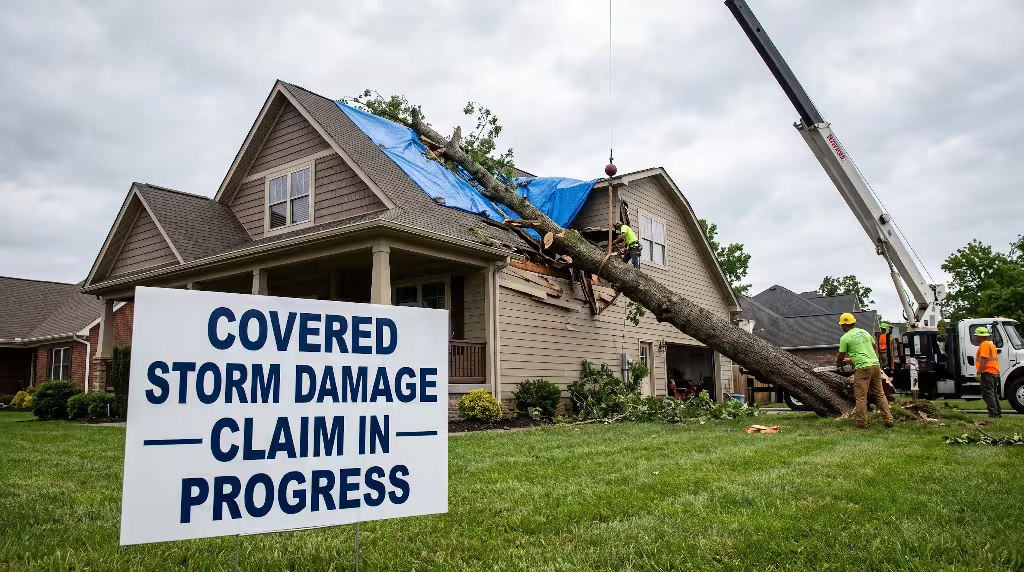
When a sudden windstorm blows across Holston Mountain and sends a massive oak crashing through your ceiling, you need immediate clarity without insurance jargon. The bottom-line answer is straightforward: yes, a standard Tennessee homeowners insurance policy (commonly called an HO-3 policy) covers physical damage to your home caused by a tree falling, provided the tree fell due to a covered peril.
In the world of insurance, a peril is a specific event that causes damage. Most homeowners policies in Tennessee operate on an open-peril basis for your primary dwelling. This means the policy covers any sudden and accidental cause unless the policy specifically excludes it. Common covered perils that lead to a tree falling include:
- Severe windstorms, straight-line winds, and tornadoes
- Winter storms with heavy snow and ice accumulation
- Lightning strikes that shatter a trunk
- Saturated soils on steep slopes during heavy rainstorms
The fundamental rule to remember is that homeowners insurance follows the damaged structure, not the property line where the tree originally stood. If your neighbor owns a massive white pine, but a windstorm causes a tree falling onto your roof, your own insurance policy steps in to pay for the repairs. Many homeowners believe the person who owns the trunk must pay for the damage. Under Tennessee law and insurance standards, that is not how it works. Your policy protects your building envelope, while your neighbor’s policy protects theirs.
There is, however, an important condition regarding a tree falling that catches many homeowners off guard. We call it the no-damage rule. If a sudden storm causes a tree falling into your open yard, across your grass, or onto a garden bed without hitting an insured building, your insurance company will usually pay nothing. Insurance is designed to repair damaged property like your home, garage, or fence. If a tree falling simply creates a mess on your lawn, you are responsible for paying the cleanup costs out of pocket.
Your policy deductible also applies directly to these claims. If repairs from a tree falling total $12,000 and your policy has a $1,500 deductible, your insurer will issue payments totaling $10,500, while you cover the initial $1,500. Some policies written along exposed mountain ridges feature separate percentage-based wind and hail deductibles, which we will analyze in detail later in this guide.
Tennessee Tree Law: The Act of God Principle Versus Property Owner Negligence
To understand who pays when you experience a tree falling event, you must understand how Tennessee courts handle fallen timber. Tennessee follows long-standing common law principles regarding natural hazards, property rights, and neighbor disputes.
The Act of God Legal Rule
Under Tennessee law, a healthy tree that blows over during a storm is classified as an Act of God. An Act of God is an event caused exclusively by natural forces that could not have been prevented by reasonable foresight, care, or human intervention. If high winds or heavy ice cause a healthy tree falling across a property boundary, the owner of the land where the tree stood is not legally liable for the damage.
The legal logic is simple: no property owner can control the wind, stop an ice storm, or prevent a healthy root system from failing under extreme weather. Therefore, when an Act of God causes a tree falling onto your roof, you cannot legally force your neighbor to pay your insurance deductible or cover your roof repairs. You must file the claim with your own insurance company.
The Negligence Exception
The Act of God rule only protects a neighbor if the tree was healthy and sound before the storm. If a neighbor knows their tree is dead, dying, or structurally decayed, the legal standard shifts entirely from an Act of God to personal negligence.
To hold a property owner liable for damage after a tree falling incident, you must establish three clear facts:
- The tree presented a visible hazard: The tree had obvious signs of rot, fungal growth at the base, dead limbs, hollow trunks, or a severe lean.
- The owner had notice: The property owner knew, or a reasonable person inspecting their property should have known, that the tree was hazardous and presented an imminent danger of a tree falling onto an adjacent home.
- Failure to take reasonable action: The owner failed to prune, cable, or cut down the dead timber within a reasonable timeframe.
If an insurer pays to fix your house after a rotten tree falling event, the company will likely exercise its right of subrogation. Subrogation is the legal process where your insurer goes after the negligent neighbor’s insurance carrier to recover the money paid for your claim, including your personal deductible.
Creating a Paper Trail Before Disaster Strikes
If you live next to a dead or leaning tree, hope is not a strategy. It is always advised homeowners to create a formal paper trail before an accident happens. If you simply mention the hazard to your neighbor while picking up the mail, you have no legal proof of notification.
If you are worried about a tree falling from next door, hire a certified arborist to inspect the tree from your property line. If the arborist produces a written report stating the tree is dead, structurally unsound, and poses a direct risk of a tree falling on your home, send that report to your neighbor. Mail it using USPS Certified Mail with a return receipt requested. Keep your tone friendly, professional, and neighborly. Explain that you want to protect both families and their properties. Once your neighbor signs for that certified letter, they can no longer claim the tree falling was an unexpected Act of God. If that tree later collapses, their insurance company will be on the hook for the entire repair bill.
Encroaching Limbs and Tennessee Precedent: Lane v. W.J. Curry and Sons
Many homeowners ask whether they can cut back branches before a tree falling disaster happens. Tennessee law is very clear on this topic, guided by the landmark Tennessee Supreme Court case Lane v. W.J. Curry and Sons.
Under this ruling, you have the legal right to trim away encroaching branches and roots that extend over your property line, right up to the boundary marker. This practice is known as self-help. However, you must follow three strict limitations:
- You may only trim branches up to the boundary line; you cannot cross onto your neighbor’s property without permission.
- You must pay for the trimming yourself; you cannot send the bill to your neighbor.
- You cannot trim the branches or roots in a way that destroys the structural balance of the tree or kills it. If your aggressive pruning leads to the tree falling later, you could be held liable for replacing the value of a mature tree, which can run into thousands of dollars.
Policy Anatomy: What Gets Repaired and Where Policy Limits Bite
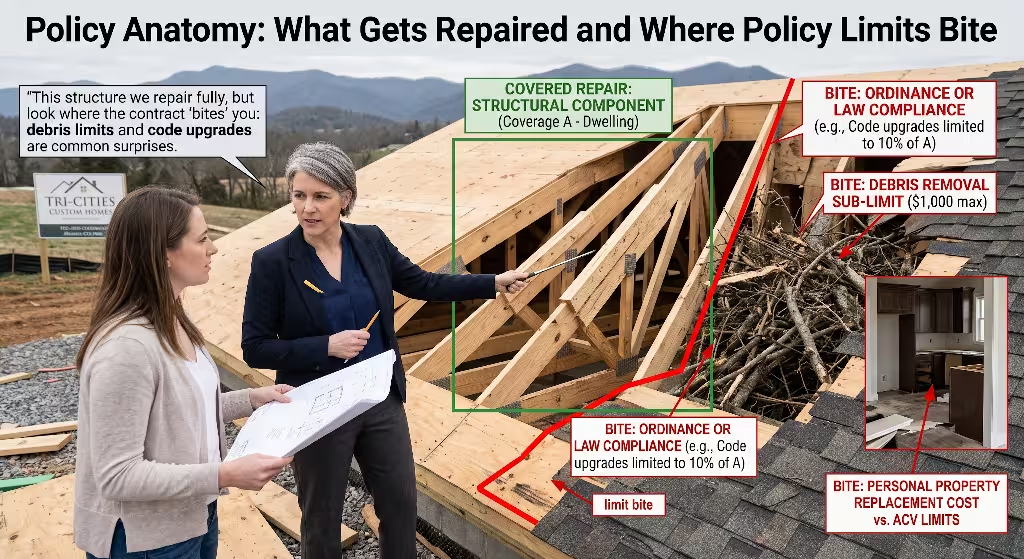
A standard homeowners policy is not a single bucket of money. It is divided into several specific coverage sections, each designed to pay for different types of damage after a tree falling incident. Understanding these sections helps you avoid unexpected out-of-pocket expenses.
+-----------------------------------------------------------------------+
|              STANDARD HOMEOWNERS POLICY STRUCTURE (HO-3)              |
+-----------------------------------------------------------------------+
| COVERAGE A: Dwelling                                                  |
|   * Roof framing, rafters, trusses, decking, shingles                 |
|   * Structural load-bearing walls and foundations                     |
|   * Permanent interior drywall, trim, ceilings, and built-in cabinets |
+-----------------------------------------------------------------------+
| COVERAGE B: Other Structures (Typically 10% of Coverage A)            |
|   * Detached garages and carports                                     |
|   * Equipment sheds and storage barns                                 |
|   * Perimeter fences, privacy gates, and retaining walls              |
+-----------------------------------------------------------------------+
| COVERAGE C: Personal Property (Typically 50% to 70% of Coverage A)    |
|   * Living room, bedroom, and dining furniture                        |
|   * Clothing, linens, and personal goods                              |
|   * Electronics, home office gear, and appliances                     |
+-----------------------------------------------------------------------+
| COVERAGE D: Loss of Use / Additional Living Expenses                  |
|   * Hotel stays or temporary rental home costs                        |
|   * Restaurant meals above normal food budgets                        |
|   * Pet boarding and temporary utility fees                           |
+-----------------------------------------------------------------------+
Coverage A: The Dwelling
Coverage A is the backbone of your policy. It pays to repair the physical structure of your primary house. When a tree falling crushes your roof shingles, cracks rafters, snaps engineered trusses, or punctures the exterior wall, Coverage A pays to restore the home to its previous condition. It also covers permanent interior components damaged during the impact, such as ceilings, hardwood floors, insulation, and built-in cabinetry.
Coverage B: Other Structures
Coverage B extends protection to detached structures on your land. If a sudden storm causes a tree falling onto your detached two-car garage, your garden potting shed, a pool house, or a wooden privacy fence, Coverage B covers the repair bill. On most standard policies, Coverage B is set at 10 percent of your Coverage A limit. For example, if your home is insured for $400,000 under Coverage A, your detached structures have $40,000 in available protection. If you have an expensive detached workshop or guest suite, you may need to increase this limit to ensure complete coverage against a tree falling.
Coverage C: Personal Property
When a heavy trunk breaks through a ceiling, it brings down plaster, sheetrock, insulation, and rainwater directly into your living spaces. Coverage C pays to repair or replace your personal belongings destroyed during a tree falling accident. This includes furniture, televisions, mattresses, clothing, and kitchenware.
You should check whether your policy provides Actual Cash Value (ACV) or Replacement Cost Value (RCV) for personal belongings:
- Actual Cash Value: The insurer pays what the item is worth today, subtracting depreciation for its age. A five-year-old couch might only yield a few hundred dollars.
- Replacement Cost Value: The insurer pays the actual retail cost to purchase a brand-new, comparable replacement. I always recommend that homeowners insist on Replacement Cost Value on their policy endorsements.
Coverage D: Loss of Use and Additional Living Expenses
If a massive tree falling punctures your roof trusses and causes an open roof collapse, your home may be declared structurally unsafe or uninhabitable. Coverage D pays for the extra living costs your family faces while contractors rebuild your home. It covers hotel bills, short-term apartment leases, storage units for undamaged furniture, pet boarding, and even the extra cost of eating meals at restaurants. For a busy household, having reliable Coverage D protection ensures that your daily routine remains stable while your home is under repair.
The Debris Removal Sub-Limit Trap
The biggest financial surprise after a tree falling incident involves tree removal and debris disposal. Homeowners often assume that because insurance covers the structural roof repairs, it also pays whatever it costs to cut up and haul away the entire fallen tree. That is rarely true.
Most standard policies carry a debris removal sub-limit, often capped at $500 to $1,000 per tree, with an overall cap of $1,000 to $2,000 per storm event. Here is the critical distinction you must understand:
- Extraction off the house: If a heavy trunk is resting directly on your roof, the crane service and rigging required to lift that trunk off the structure are covered under Coverage A as a necessary part of the structural building repair.
- Hauling away the timber: Once the tree is safely lifted off the house and placed on the ground, the insurer’s primary obligation under Coverage A is fulfilled. Cutting that trunk into firewood, chipping the brush, and hauling the logs away falls under the debris removal sub-limit.
In our region, hiring a specialized tree service with a crane and log truck to dismantle a mature, 80-foot red oak can easily cost $2,500 to $5,000. If your policy only provides a $500 debris removal limit, you could be left paying thousands of dollars out of your own pocket just to get the timber off your lawn. Review your policy declarations page and ask your insurance agent about adding an endorsement to increase your fallen tree debris removal limit to $2,500 or $5,000.
The Structural Perspective: Assessing Impact Damage Beyond the Surface
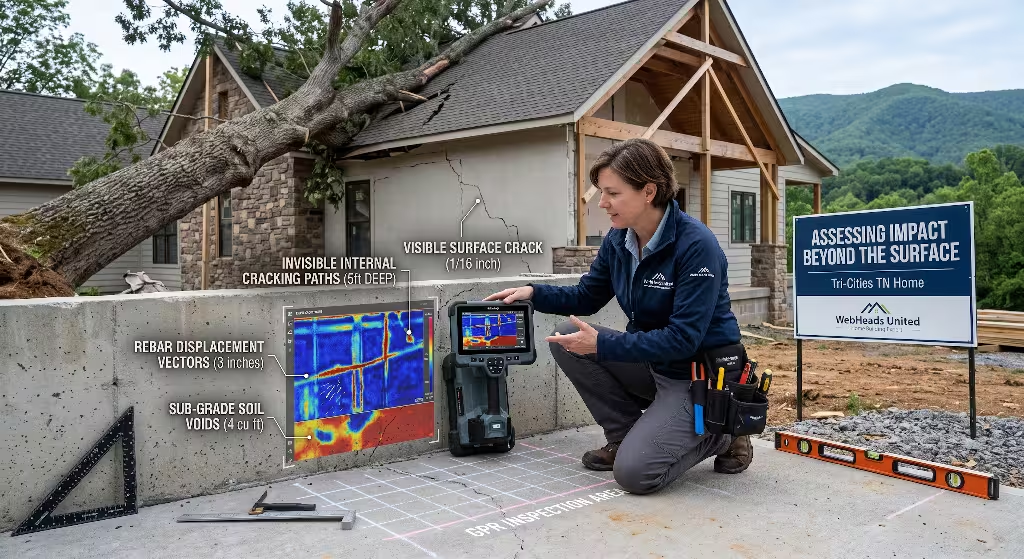
When a tree strikes a house, the structural forces involved are immense. Adjusters evaluate a tree fall impact by calculating kinetic energy and structural loads. A mature hardwood tree can weigh between 10,000 and 30,000 pounds. When that tremendous weight falls from fifty feet in the air, the impact shock wave travels throughout the entire building framework.
                           FALLEN TREE IMPACT
                                  │
                                  ▼
                   ┌──────────────────────────────┐
                   │ Roof Sheathing & Shingles    │ (Puncture & Moisture Barrier Failure)
                   └──────────────┬───────────────┘
                                  │
                                  ▼
                   ┌──────────────────────────────┐
                   │ Roof Trusses / Rafter Framing│ (Broken Chords, Snapped Web Members)
                   └──────────────┬───────────────┘
                                  │
                                  ▼
                   ┌──────────────────────────────┐
                   │ Exterior Load-Bearing Walls  │ (Stud Buckling, Top-Plate Deflection)
                   └──────────────┬───────────────┘
                                  │
                                  ▼
                   ┌──────────────────────────────┐
                   │ Foundation & Sill Plates     │ (Lateral Displacement, Masonry Cracks)
                   └──────────────────────────────┘
Engineered Roof Trusses Versus Traditional Rafters
Modern homes built throughout the Tri-Cities over the last thirty years almost always use pre-engineered light-frame wood roof trusses. Older historic homes in downtown Kingsport, Bristol, or Johnson City often feature stick-built roof systems with solid 2×6 or 2×8 rafters. Each system reacts differently to a tree falling.
Traditional rafters carry loads linearly from the ridge board down to the exterior walls. If a tree falling crushes two rafters, an experienced carpenter can often sister new dimensional lumber alongside the damaged boards, tie them into the ridge, and restore structural integrity.
Engineered roof trusses are completely different. A truss acts as a rigid, interconnected structural web held together by pressed metal gusset plates. Every chord and web member is engineered to handle specific tension and compression forces:
- Top chords resist downward snow and dead loads in compression.
- Bottom chords tie the exterior walls together in tension, preventing the walls from pushing outward.
- Web members transfer internal forces throughout the triangle.
If a tree falling bends, snaps, or pulls loose even one metal gusset plate or web member, the structural balance of the entire truss is destroyed. You cannot simply nail a 2×4 across a broken truss chord and call it a day. Doing so violates Tennessee residential building codes. When an engineered truss is damaged by a tree falling, a licensed structural engineer must inspect the damage and design an engineered truss repair drawing with an official engineer’s stamp, or the entire truss must be removed and replaced.
Shear Forces, Racking, and Wall Shifts
A vertical impact rarely travels straight down. When a tree falls at an angle, it imparts massive lateral shear forces against the roof plane. This racking motion can push the top wall plates sideways, causing several hidden structural problems:
- Exterior wall deflection: Studs can bow outward, breaking the bond between the drywall and framing.
- Drywall nail pops: You may notice drywall screws popping out of walls in rooms thirty feet away from the point of impact. This indicates the building frame racked during the tree falling collision.
- Out-of-square door openings: Interior doors may suddenly stick or refuse to latch, showing that the wall frames have shifted out of plumb.
- Sill plate shifting: In severe impacts, the force can shift the wooden sill plate where it anchors into the concrete foundation, cracking anchor bolts or damaging masonry blocks.
Hidden Building Envelope Failures
Even if a tree falling event leaves your ceiling intact, the exterior building envelope can suffer hidden punctures that invite severe moisture damage. An experienced inspector should check several critical areas:
- Punctured underlayment: Tree branch stubs act like spears, punching clean holes through architectural shingles, synthetic underlayment, and 7/16-inch OSB roof decking.
- Crushed ridge vents: Impact can flatten plastic and aluminum ridge vents, cutting off attic ventilation and letting wind-driven rain pour into the attic insulation.
- Damaged plumbing vent stacks: A branch striking a PVC plumbing vent pipe can crack the pipe below the roofline, allowing sewer gases and rainwater to leak inside wall cavities unseen.
- Pulled electrical weatherheads: If a tree falling catches the overhead electrical service line, it can yank the meter base and weatherhead off the exterior siding, creating an immediate fire hazard.
Step-by-Step Action Plan: What to Do the Hour a Tree Falls
Experiencing a sudden tree falling into your living room or bedroom is terrifying. In the chaotic moments following an impact, having an orderly, step-by-step checklist keeps your family safe and protects your insurance rights.
+---------------------------------------------------------------------------------------+
|                       POST-IMPACT EMERGENCY ACTION TIMELINE                           |
+---------------------------------------------------------------------------------------+
| HOUR 1: IMMEDIATE SAFETY                                                              |
|   1. Evacuate all occupants from the impact zone immediately.                         |
|   2. Watch for downed power lines; treat all metal and fences as energized.           |
|   3. Shut off the main electrical breaker if water is leaking near wiring.            |
+---------------------------------------------------------------------------------------+
| HOURS 2 TO 6: MITIGATION & NOTIFICATION                                               |
|   4. Take clear, well-lit photos of the tree, root base, roof, and interior damage.   |
|   5. Call your insurance carrier's emergency line to establish a claim number.        |
|   6. Hire an emergency tarping crew to prevent water intrusion (keep all receipts).   |
+---------------------------------------------------------------------------------------+
| DAYS 1 TO 7: RECOVERY & ADJUSTMENT                                                    |
|   7. Demand proof of license and worker's compensation insurance from tree crews.     |
|   8. Walk through the inspection with the insurance adjuster in person.               |
|   9. Hire a licensed Tennessee general contractor to verify all structural framing.   |
+---------------------------------------------------------------------------------------+
Step 1: Secure Family Safety and Evacuate the Impact Zone
The absolute priority is the physical safety of your family and pets. Immediately move everyone out of the impact zone. If a tree falling penetrates the roof, structural collapse can occur minutes or hours after the initial blow as framing lumber gives way under sustained weight.
Never walk under a ceiling that is sagging or cracking. If you hear popping sounds from the framing, evacuate the house entirely. Look outside for downed power lines. If branches tore down the electrical service drop, treat every fence, gutter, and downspout as electrically energized until the local power company cuts the power.
Step 2: Mitigate Secondary Water Damage
Every Tennessee homeowners policy contains a legal condition known as the homeowner’s duty to mitigate. This rule requires you to take reasonable steps to prevent further damage to your property after an accident. If a tree falling leaves an open hole in your roof and you allow three days of rain to soak your drywall without taking action, the insurance company can deny the resulting water damage claims.
Call an emergency board-up and tarping service immediately. Professional mitigation crews will secure heavy, reinforced polyethylene tarps over the roof breach and brace damaged walls. Keep every receipt and invoice. Emergency mitigation expenses are covered under your policy as part of your structural dwelling claim.
Step 3: Comprehensive Photographic Documentation
Before any tree service cuts away a single branch, take extensive photos and videos of the damage. You must capture clear evidence for the insurance adjuster:
- Photograph the tree where it stands, paying special attention to the root ball. Show whether the roots pulled out of healthy soil or broke off from rot.
- Take wide-angle photos showing where the trunk rests against the roof, gutters, and siding.
- Step inside and document every room with ceiling cracks, broken drywall, water leaks, or buckled flooring.
- Take close-up photographs of serial numbers on ruined televisions, computers, and appliances.
This visual evidence ensures that your adjuster sees the full severity of the tree falling disaster before the site is altered by cleanup crews.
Step 4: File the First Notice of Loss
Contact your insurance carrier’s twenty-four-hour claims center to file your First Notice of Loss (FNOL). Provide the exact time of the storm, describe the point of impact, and obtain a formal claim number. Request the name, phone number, and email address of the field adjuster assigned to your case.
Ask your carrier specifically whether they will send an emergency tree extraction crew or if you should hire your own local tree service. Getting this guidance early prevents disputes over hourly crane rates and debris fees.
Step 5: Vet Contractors and Watch Out for Storm Chasers
Following major storms across East Tennessee, out-of-state contractors and tree crews flood local neighborhoods looking for quick insurance payouts. Never hire a company that knocks on your door offering to cut down trees without proper credentials.
Before hiring any contractor to handle a tree falling cleanup or structural rebuild, verify three essential requirements:
- Tennessee Contractor License: Any structural repair work totaling $25,000 or more requires a licensed General Contractor (BC-b or BC-A classification) licensed by the State of Tennessee.
- Worker’s Compensation Insurance: Tree extraction is dangerous work. If an uninsured worker falls off your roof while clearing branches, you could face personal injury lawsuits on your own property. Demand a certificate of insurance sent directly from their insurance agency showing active worker’s compensation and general liability coverage.
- ISA Certified Arborist: For complex extractions involving cranes and rigging over an occupied house, work with an arborist certified by the International Society of Arboriculture.
Common Questions About a Tree Falling in Tennessee
Here are direct answers to the most common questions homeowners ask search engines regarding insurance coverage and tree disasters.
Does homeowners insurance cover fallen tree damage in Tennessee?
Yes, homeowners insurance covers fallen tree damage in Tennessee as long as the tree fell due to a covered peril such as wind, ice, snow, lightning, or a falling aircraft. Your policy covers the costs to repair the roof, siding, and interior living spaces, minus your policy deductible. The coverage applies whether the tree originated on your own property or fell from an adjacent property.
If my neighbor’s tree falls on my house in Tennessee, who pays?
Your own homeowners insurance company pays for the damage. Under Tennessee property law, a tree falling during a storm is categorized as an Act of God. Your neighbor is not legally liable for natural weather events, so you must file the claim under your own policy and pay your deductible.
The only exception occurs if you can prove your neighbor was legally negligent. If the tree was dead, visibly rotting, or hollow, and you have written proof that your neighbor was warned about the danger before the storm, their insurance company can be held liable for the full repair costs and your deductible.
Will insurance pay to remove a tree falling in the yard without structural damage?
Generally, no. If a tree falling results in timber lying harmlessly across your lawn, woods, or flower beds without striking an insured structure, standard homeowners insurance will not pay for removal or cleanup.
There are two rare exceptions found in standard policy forms:
- The fallen tree completely blocks a driveway, preventing you from driving your personal vehicle in or out of the property.
- The fallen tree blocks a handicap accessibility ramp or entrance designed for a disabled resident.
In these specific access situations, policies often provide a small debris removal benefit, typically capped at $500 to $1,000.
How much will insurance pay for tree falling removal from a roof?
Insurance coverage for tree removal depends on whether the work involves lifting the tree off the home or clearing the timber away afterward:
- Lifting the tree off the structure: If a heavy trunk is resting on your roof and must be lifted by a crane to allow carpenters to repair the framing, those crane and rigging costs are covered under your primary dwelling limits (Coverage A).
- Cutting, chipping, and hauling away debris: Once the timber is safely lowered to the ground, your policy’s debris removal sub-limit takes over. Most standard policies cap this coverage at $500 to $1,000 per tree, with a maximum of $1,000 to $2,000 per storm. Any disposal costs above those limits must be paid by the homeowner.
What happens when a tree falling event hits a car parked in the driveway?
Your homeowners insurance policy will not pay for damage to a motor vehicle, even if the tree fell from your own yard while the car was parked in your own driveway.
Damage to a car from a tree falling is covered exclusively by the Comprehensive (Other Than Collision) section of your personal auto insurance policy. You must file the claim through your auto insurer and pay your auto comprehensive deductible.
If the tree falling damaged both your car and your garage roof, you will deal with two separate claims: an auto claim for the vehicle and a homeowners claim for the building.
Can you trim branches to prevent a tree falling from next door?
Yes. Under Tennessee common law and the Lane v. W.J. Curry and Sons court ruling, you have the legal right to trim away branches and roots that grow over your boundary line.
You must pay for this trimming yourself, and you can only cut branches up to your property line. You are not allowed to cross the boundary onto your neighbor’s land without permission, and you must avoid trimming the tree so severely that it becomes unstable or dies.
Regional Nuance: Tree Falling Risks Across the Tri-Cities Landscape
Living in the Tri-Cities area of Northeast Tennessee provides breathtaking mountain scenery, but our unique geography, weather, and soil conditions create distinct structural risks. Understanding these local factors helps you safeguard your home.
+---------------------------------------------------------------------------------------+
|                      TRI-CITIES GEOLOGICAL & SPECIES RISK MATRIX                      |
+---------------------------------------------------------------------------------------+
| SPECIES          | ROOT CHARACTERISTIC  | PRIMARY FAILURE MODE    | LOCAL RISK LEVEL  |
+------------------+----------------------+-------------------------+-------------------+
| Tulip Poplar     | Shallow, broad plate | High-wind root shear    | Very High (Ridge) |
| White Pine       | Softwood, wide span  | Heavy ice limb snapping | High (Winter)     |
| Red / White Oak  | Deep taproot base    | Heart rot trunk failure | Moderate (Aged)   |
| Red Maple        | Surface root spread  | Soil saturation slip    | High (Slopes)     |
+------------------+----------------------+-------------------------+-------------------+
Shallow Soils and Ridge Wind Funnels
The topography of Washington, Sullivan, and Carter counties features rolling limestone valleys surrounded by steep mountain ridges. Throughout neighborhoods along Buffalo Mountain in Johnson City or the high ridges of Kingsport and Bristol, topsoil layers are often thin, resting directly on dense limestone bedrock.
Because taproots cannot penetrate solid limestone, native trees develop wide, shallow root plates. When spring storm systems stall over the Appalachian Mountains, soaking rains saturate our red clay soils. The saturated clay loses its grip on shallow root balls. When powerful mountain downdrafts funnel through valley gaps, mature trees can easily topple, leading to a sudden tree falling catastrophe.
Local Tree Species Vulnerabilities
Different tree species common to Northeast Tennessee present unique storm hazards:
- Tulip Poplar (Liriodendron tulipifera): As the state tree of Tennessee, the Tulip Poplar grows rapidly, often soaring past eighty feet. Because they grow tall so quickly, their wood is relatively soft and brittle. Their shallow root systems make them highly susceptible to windthrow during straight-line wind events, creating a frequent hazard for a tree falling across nearby power lines and rooflines.
- Eastern White Pine (Pinus strobus): White pines feature sweeping horizontal branches with dense evergreen needles. During winter storms, wet mountain snow and freezing rain accumulate on the needle canopy. The immense ice weight snaps massive boughs, often resulting in heavy limbs or the entire tree falling onto residential roofs below.
- Mature Oaks (Quercus species): While white and red oaks have strong, dense wood, mature specimens in older Tri-Cities subdivisions frequently suffer from hidden heart rot or root decay. A fungal infection can hollow out a four-foot trunk over several years, leaving the tree standing until a strong storm triggers a catastrophic trunk fracture.
Dealing with Tennessee General Contractors and Adjusters
When navigating structural repairs after a tree falling incident in the Tri-Cities, keep localized construction costs in mind. National insurance pricing software (such as Xactimate) often lags behind local market realities for skilled framing labor, engineered truss packages, and crane rentals in our region.
If your insurance adjuster issues an initial repair estimate that seems too low to complete the work, do not panic. That first estimate is simply an opening baseline. Partner with a licensed Tennessee General Contractor (holding a BC-b residential or BC-A commercial building classification).
A reputable local builder will review the adjuster’s line-item estimate, verify whether all damaged trusses, framing members, and insulation were accounted for, and submit a formal insurance supplement. The supplement includes detailed photos, structural engineering specifications, and local market labor rates to ensure that your insurer pays every dollar needed to restore your home safely.
Comparison Table: Common Scenarios Involving a Tree Falling
To help you navigate different situations quickly, here is a clear summary of how insurance policies, property laws, and financial responsibilities apply across various scenarios.
| Scenario Details | Responsible Insurance Policy | Who Pays the Deductible? | Is Tree Removal Covered? |
| Your healthy tree falls on your house during a windstorm | Your Homeowners Insurance (Coverage A) | You pay your standard homeowners deductible | Yes, extraction from roof is covered; yard debris capped at $500 to $1,000 |
| Neighbor’s healthy tree falls on your house during an ice storm | Your Homeowners Insurance (Coverage A) | You pay your standard homeowners deductible | Yes, your policy lifts tree from roof; neighbor has zero liability (Act of God) |
| Neighbor’s dead, rotting tree falls on your house after written warning | Your Insurer pays initially, then subrogates against neighbor | You pay initially, but insurer seeks full refund from neighbor | Yes, neighbor’s liability policy covers total extraction and repairs if negligence is proven |
| Your tree falls in your yard without hitting any buildings | None (Not a covered loss) | No deductible applies (All out-of-pocket) | No, standard policies pay nothing unless a driveway or disability ramp is blocked |
| Your tree falls on a neighbor’s detached garage | Neighbor’s Homeowners Insurance (Coverage B) | Neighbor pays their own deductible | Neighbor’s insurer covers garage repairs; you owe nothing under Act of God rule |
| A tree falls directly onto your car in the driveway | Auto Insurance (Comprehensive Coverage) | You pay your auto comprehensive deductible | Auto policy covers vehicle damage; tree cleanup on driveway is not covered |
| Tree branch crushes 50 feet of wooden privacy fencing | Your Homeowners Insurance (Coverage B) | You pay your standard homeowners deductible | Yes, covered under Coverage B up to your detached structures limit |
Final Thoughts from Tri-Cities TN Home: Building Confidence and Protecting Your Sanctuary
Dealing with a tree falling on your house is an emotional, overwhelming experience. In a single instant, the quiet comfort of your family sanctuary is broken by noise, wind, debris, and structural damage. But it bears repeating, houses can be repaired, framing can be reinforced, and your sense of peace can be fully restored.
By approaching the situation with a calm mind, an understanding of your policy coverage, and clear knowledge of Tennessee property laws, you take control of the recovery process. You do not have to accept unfair repair shortcuts, and you do not have to navigate the insurance adjustment alone.
Inspect your trees regularly, maintain a written paper trail with neighbors when hazards arise, review your policy sub-limits for debris removal, and partner with licensed, competent professionals who value craftsmanship and integrity. Your home is the backdrop of your family’s life, and taking these practical steps will keep it safe, secure, and resilient for years to come.