

When looking at land for building a home in Washington County, Tennessee there is one thing you should investigate before all else. That is the zoning. That journey often begins with a seemingly simple code: R-1.
You might have seen it on a real estate listing or heard it mentioned by a county official. You’ve found a beautiful piece of property in Washington County, and you’re told it has R-1 Zoning. What does that actually mean for your dream? Can you build the house you want? Can you add a workshop or run a small business from home? This code is more than just a label; it’s a set of rules that will shape your entire project.
The goal of this post is to explain in an easy way, R-1 Zoning for you. I want to translate the official language into practical, real world advice, giving you the clarity and confidence you need to move forward on your home building journey.
First, What is Zoning and Why Does It Matter?
Before we look at the specifics of R-1 Zoning, it’s important to understand the bigger picture. Imagine your local grocery store. Everything has its place. The produce is in one section, the dairy is in another, and the cleaning supplies are in their own aisle. You wouldn’t want to find a gallon of bleach sitting next to the fresh bread. This organization makes for a pleasant and predictable shopping experience.
Land use zoning works in a very similar way for a community. It’s a set of rules that divides a county or city into different areas, or “zones,” for different types of activities. The primary goal is to ensure orderly development and to keep incompatible land uses separate. It’s the reason you don’t have a noisy factory popping up in the middle of a quiet residential neighborhood or a busy retail store built right next to a peaceful farm. This separation protects public health, safety, and the overall quality of life for residents. It also helps protect property values by ensuring that the character of a neighborhood remains stable over time.1
In our area, the entity responsible for creating and enforcing these rules is the Washington County Planning Commission. They develop a comprehensive plan for how the county should grow and then create zoning ordinances, which are the specific laws that govern what can be built where. When you hear about R-1 Zoning, you are hearing about one of the most common and important of these local laws. Understanding the basics of R-1 Zoning is the first step in knowing if a piece of land is the right fit for you and your family.
The Post Question: What Does R-1 Zoning Mean in Washington County?

Now let’s get to the heart of the matter. You have a property, and its designation is R-1 Zoning. So, what does that mean for you? We can break it down into a few key parts that are easy to understand.
The Official Definition: Low-Density Residential District
At its most basic level, the “R” in R-1 stands for Residential.2 The number “1” signifies the density level. In this case, R-1 Zoning refers to a “Low-Density Residential District.” The core purpose of this classification is to create and preserve neighborhoods intended for traditional, single-family living.3
What does “low-density” mean in practice? It means more space. It means larger lots, bigger yards, and more distance between you and your neighbors compared to other residential zones. The vision behind R-1 Zoning is one of quiet, spacious, and family oriented communities. It’s designed to prevent the overcrowding that can come with smaller lots, duplexes, or apartment buildings. When you buy land with an R-1 Zoning designation, you are buying into this specific vision for a neighborhood’s character.4 This is the most fundamental concept of R-1 Zoning.
Primary Permitted Use: The Single-Family Detached Dwelling
The main, “by-right” use for any parcel of land with R-1 Zoning is a single-family detached dwelling.5 Let’s break that phrase down.
- Single-Family: The structure is designed to house one family or household.6 It cannot be a duplex, triplex, or apartment building.
- Detached: The home must be a standalone structure. It cannot share walls with another residence, like a townhouse or a condo might.
This means you have the right to build one primary home on your property, as long as you follow all the other rules laid out in the R-1 Zoning ordinance. This refers to a traditional, site-built home constructed on a permanent foundation. Other forms of housing, such as mobile homes, are typically not permitted in areas with R-1 Zoning unless specific exceptions are outlined in the county code. The very essence of R-1 Zoning is to promote the construction of these permanent, single-family homes.
The Critical Details: Key Restrictions and Requirements
This is where the specifics really matter. R-1 Zoning isn’t just a label; it’s a detailed rulebook for your property.7 These requirements ensure that every new home built in the zone fits the established neighborhood character. While you should always get the exact numbers from the Washington County Planning Office, here are the critical details you’ll encounter with R-1 Zoning.
- Minimum Lot Size: R-1 Zoning requires a certain amount of land to build on. You cannot take a small parcel and call it a lot. For example, the ordinance might state that a new lot created in an R-1 zone must be at least 15,000 square feet. This rule is what ensures the “low-density” feel of the neighborhood by preventing small, crowded lots.
- Setback Requirements: A setback is the required distance that a building must be from your property lines.8 Think of it as a mandatory, invisible buffer zone around your house. R-1 Zoning will specify these distances clearly.
- Front Setback: This is the distance from the road or the front property line. It ensures a consistent look along the street and provides space for a front yard and utility lines. A typical front setback might be 30 feet.
- Side Setback: This is the distance you must maintain from your neighbors on either side. It ensures privacy, allows for airflow and sunlight between houses, and provides access for maintenance. For instance, a side setback might be 10 feet from each side.
- Rear Setback: This is the distance from the back property line, creating a mandatory backyard space. A common rear setback might be 25 feet. These setback rules are a cornerstone of R-1 Zoning
- Maximum Building Height: To maintain the character of the neighborhood, R-1 Zoning places a limit on how tall your home can be.9 This prevents a new, massive three-story home from suddenly towering over its single-story neighbors, blocking sunlight and feeling out of place. A typical height limit might be 35 feet, or about two and a half stories.
- Minimum Lot Width: This rule dictates how wide a property must be at the front setback line. It works together with the minimum lot size requirement to prevent long, skinny lots that feel out of character with the spacious feel that R-1 Zoning is meant to create.
Understanding these specific requirements of R-1 Zoning is absolutely essential before you even begin designing your home. Your architect or builder must create plans that fit within these exact dimensions.
Beyond the Main House: What Else is Allowed in an R-1 Zone?

Life is more than just the main house. You might want a garage for your cars, a shed for your lawnmower, or even a small office for your work. The rules for R-1 Zoning address these situations as well.
Accessory Structures and Uses
An “accessory structure” is any building on your property that is secondary to the main house.10 In an R-1 Zoning district, you are generally permitted to build common accessory structures, provided they follow certain rules. These can include:
- Detached garages
- Storage sheds or garden sheds
- Workshops for hobbies
- Pool houses or gazebos
The rules typically require that these structures be located in the side or rear yard, not in front of the main house. They also have their own setback requirements, though they are often smaller than the setbacks for the primary home. There may also be limits on their size and height.
A topic of growing interest is the Accessory Dwelling Unit (ADU), sometimes called a granny flat or in-law suite. This is a smaller, secondary living unit on the same property as the main home. The rules for ADUs can be very specific and vary greatly. Some communities are embracing them, while others have strict limitations. If you are considering an ADU, it is critical to speak directly with the Washington County Planning Office to see what is allowed under the local R-1 Zoning ordinance.
Home Occupations
Another common question is, “Can I run a business from my home in an R-1 zone?” The answer is typically yes, but with significant limitations. R-1 Zoning is designed to protect the quiet, residential nature of the neighborhood.11 Therefore, it only allows for “home occupations” that have a very low impact.
This usually means:
- The business must be run entirely within the home.
- You cannot have non-resident employees coming to work at your house.
- The business cannot generate significant customer traffic or large delivery trucks.
- You cannot have exterior signage advertising the business.
- The business cannot create noise, fumes, or anything that would disturb your neighbors.
Good examples of permitted home occupations might include a writer, an accountant, a web designer, or someone who sells crafts online. A car repair shop, a retail store, or a beauty salon with a steady stream of clients would almost certainly not be allowed under R-1 Zoning rules.
What is Expressly Prohibited in R-1 Zones?
To fully understand what R-1 Zoning is, it helps to be clear about what it is not. The rules expressly prohibit any land use that would disrupt the single-family character of the neighborhood. This includes:
- Multi-family dwellings: Duplexes, townhouses, and apartment buildings are not allowed.
- Commercial uses: You cannot build a restaurant, a gas station, an office building, or a retail store.
- Industrial uses: Factories, warehouses, and manufacturing plants are strictly forbidden.
These prohibitions are the core function of R-1 Zoning. They provide homeowners with the assurance that their quiet neighborhood will remain that way for years to come.
How Does R-1 Compare to Other Zones (R-2, A-1)?
Seeing how R-1 Zoning fits in with other local zoning classifications can provide valuable context. When you are looking at property listings, you will likely see other codes, and knowing the difference is key.
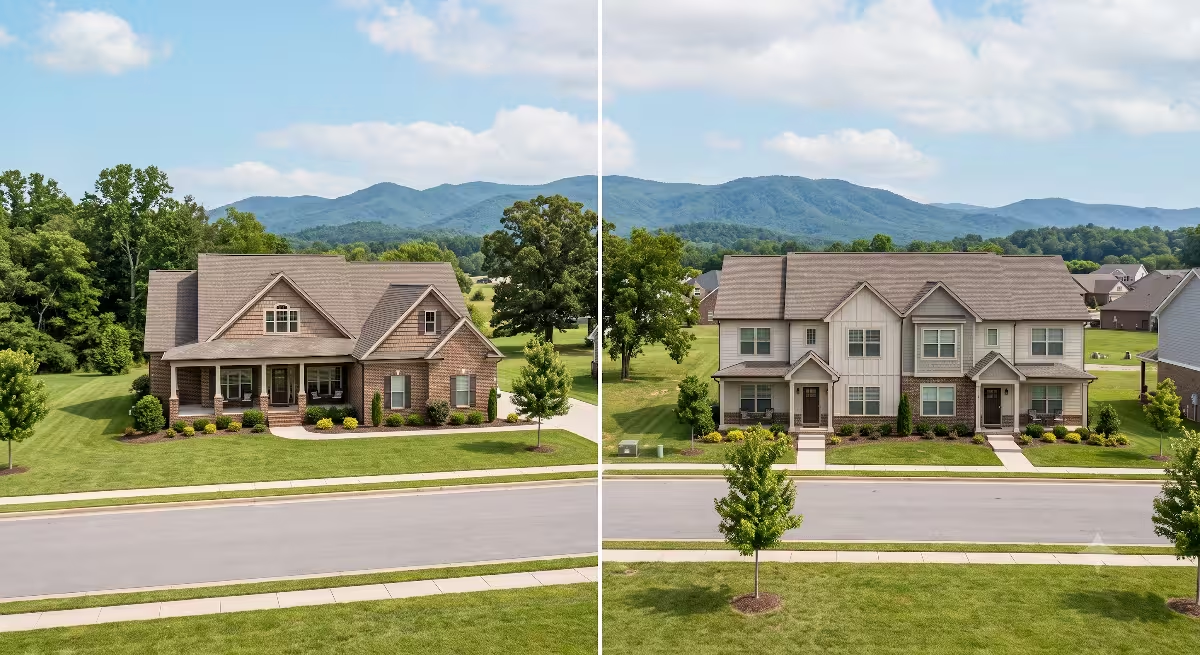
Let’s compare R-1 Zoning to R-2 Zoning, which stands for Medium-Density Residential. While both are for housing, R-2 allows for more homes to be built in a given area. This often means smaller minimum lot sizes and potentially allows for the construction of duplexes in addition to single-family homes. If you are in an R-2 neighborhood, you can expect to be a bit closer to your neighbors, and the overall feel might be less spacious than an area with R-1 Zoning.
Now let’s look at A-1 Zoning, which stands for Agricultural District. This zone is primarily intended for farming, forestry, and other rural activities. While you are usually permitted to build a single-family home in an A-1 zone, the surrounding land uses will be very different. You might have a cattle farm or a large agricultural operation as your neighbor. The lot sizes in A-1 are typically much larger, often measured in multiple acres, and the rules will be geared toward supporting agriculture rather than creating a residential subdivision feel. The regulations associated with A-1 are quite different from the strict residential focus of R-1 Zoning.
Practical Steps for Land Buyers and Future Homeowners
Knowledge is power, but you have to know where to find it and how to use it. If you are serious about a piece of property, here are the actionable steps you need to take regarding its R-1 Zoning status.
How to Verify a Property’s Zoning
Never take a seller’s or real estate agent’s word for the zoning as the final answer. You must verify it yourself with the official source. The easiest way to do this is to use the Washington County GIS map. “GIS” stands for Geographic Information System, which is a powerful online mapping tool.12 You can search for an address or parcel number, and the map will display a wealth of information about the property, including its official zoning designation.13
After you have checked the map, your next step should be a call or visit to the Washington County Planning and Zoning Office. They are the ultimate authority. You can confirm the R-1 Zoning, get a copy of the specific ordinance with all the setback and height requirements, and ask any questions you may have about your plans. This is the most important step you can take to avoid costly mistakes.
The Difference Between Zoning and Covenants/Restrictions
This is a critical distinction that trips up many new homeowners. County zoning laws, like R-1 Zoning, are public regulations that apply to a large area.14 However, a specific subdivision or development might have an additional layer of rules called covenants, conditions, and restrictions (CC&Rs). These are private rules created by the developer and enforced by a Homeowners Association (HOA).
These covenants can be much more restrictive than the underlying R-1 Zoning. For example, while the R-1 Zoning might allow you to build a shed or park a boat in your driveway, the HOA covenants for your specific neighborhood might forbid it. The covenants could dictate things like fence types, exterior paint colors, or even the type of mailbox you can have. You must investigate both the county’s R-1 Zoning rules and the neighborhood’s specific CC&Rs before you buy.
What if My Plans Don’t Fit? The Variance Process
What happens if your dream home design is just a few feet over the side setback line? In some very specific cases, you may be able to apply for a “zoning variance.” A variance is a minor exception to the zoning rule granted when a property has a unique hardship, like a strange shape or difficult topography, that makes it impossible to meet the standard requirements.15
It is important to understand that a variance is not a loophole. The process involves a formal application, fees, and a public hearing before a board.16 Your neighbors will be notified and will have the opportunity to speak for or against your request. Variances are not easy to get, and they are typically only granted for the minimum relief necessary to solve the hardship.17 You should never purchase a property assuming you will be able to get a variance. Always try to create a plan that works within the established rules of the R-1 Zoning.
Conclusion: Building with Confidence in Washington County
Navigating the world of home building can seem daunting, but it doesn’t have to be. Understanding regulations like R-1 Zoning is the first step toward taking control of your project and ensuring a smooth process. At its heart, the R-1 Zoning in Washington County is designed to create the kind of stable, spacious, and family-friendly neighborhoods that so many people are looking for. It provides a blueprint for communities where property values are protected and the quality of life is preserved.18
By knowing the rules about what you can build, where you can build it, and what other uses are allowed, you can plan effectively and avoid unexpected problems. The most important advice I can give you is to do your homework. Use the county’s online tools, but always follow up with a direct conversation with the Washington County Planning Office. Confirm every detail before you invest your time and money. With this knowledge in hand, you can move forward with confidence, ready to build the home you’ve always dreamed of.
Disclaimer: This article is for educational purposes and provides a general overview of concepts related to R-1 Zoning. Information is based on regulations as of the publication date, and zoning ordinances can be amended by Washington County at any time. You must consult the official Washington County Zoning Ordinance and speak directly with the Planning Office for the most current and accurate information pertaining to your specific property and project.