

Building a custom home in the Johnson City area is about more than just laying a foundation and raising walls. It’s about creating a space that feels like it belongs, a home that works in harmony with the beautiful landscape of Northeast Tennessee. When you look at a piece of land, the mature trees, the old oaks and maples, are not obstacles. They are anchors, living sculptures that bring character, shade, and value to your property. One of the most important first steps in any project is one that happens before a single shovel of dirt is moved: protecting the trees.
The construction process, by its nature, is tough on the land. Heavy equipment, stacks of materials, and constant foot traffic can wreak havoc on the delicate systems that keep a mature tree alive. The real danger isn’t a truck bumping the trunk; it’s the invisible damage happening underground. Soil compaction squeezes the life out of the ground, preventing water and air from reaching the roots. A carelessly dug trench can sever a root system that took decades to grow. This is where foresight and integrity come into play. A simple, properly installed barrier, the right kind of tree protection fencing, is the most critical tool you have to safeguard these priceless natural assets.
This guide will provide a clear, competent overview of how to choose and use the best tree protection fencing, ensuring the long term health of your trees and the lasting value of your new custom home.
Why Tree Preservation on a Construction Site is Non Negotiable
Before we discuss the types of tree protection fencing, it’s important to understand exactly why we go to the trouble. Some people might see it as just another box to check for a building permit, but it’s far more than that. Treating tree preservation as a priority is one of the smartest decisions you can make for your project, your finances, and your future enjoyment of the home.
First, let’s talk about property value. A home on a bare lot looks exposed and new. A home nestled among healthy, mature trees looks established, graceful, and inviting. Real estate experts consistently find that homes with mature trees on the property sell for more money, sometimes as much as 15% to 20% more than a comparable home without them. These trees provide immediate curb appeal, a sense of permanence, and a connection to the natural environment that buyers in the Tri Cities area deeply value. Protecting them is a direct investment in your property’s final market worth. Using the correct tree protection fencing ensures that this value is not accidentally destroyed during the build.
Beyond the financial benefits, there are practical environmental advantages. In the summer, the shade from a large deciduous tree can significantly reduce your home’s cooling costs. The root systems of established trees are fantastic at managing stormwater, absorbing thousands of gallons of rainwater that would otherwise run off your property. They improve air quality, produce oxygen, and create a welcoming habitat for local songbirds and wildlife, adding a layer of life and sound to your home that you can’t buy.
It’s also the law. Most organized municipalities, including Johnson City, Kingsport, and Bristol, have tree ordinances and land disturbance regulations. These rules are in place to preserve the character of our communities and protect the local environment. Failing to install or maintain proper tree protection fencing can result in a stop work order, which can delay your project for weeks or even months. It can also lead to significant fines. Adhering to local codes by using proper tree protection fencing is a simple way to avoid these costly and frustrating setbacks.
Finally, consider the cost of failure. Let’s say a critical tree is damaged during construction. The signs might not show up for a year or two, but eventually, the leaves will start to thin, and branches will die back. You would then have to hire a certified arborist to attempt expensive remediation, which may or may not work.
If the tree cannot be saved, you then face the massive expense of having a large, dead tree safely removed from near your brand new home. This process can easily cost thousands of dollars. Compare that to the one time, upfront cost of installing quality tree protection fencing. The choice is clear. It’s a small investment that prevents a huge potential liability.
Understanding the Tree Protection Zone (TPZ): The Critical First Measurement
To protect a tree, you have to understand what it needs. The most important part of a tree isn’t the trunk or the branches you see, but the sprawling, unseen network of roots beneath the ground. The Tree Protection Zone, or TPZ, is the area we designate to protect the majority of this critical root system. Think of it as a nature preserve for each individual tree on your property. Inside this zone, there should be no construction activity of any kind: no parking, no material storage, no digging, and no dumping. The tree protection fencing serves as the clear and absolute boundary of this vital area.
So, how do you figure out how big the TPZ needs to be? There is a simple, reliable rule of thumb that we use in the building industry. It’s based on the size of the tree’s trunk, measured at a specific height.
First, you need to find the tree’s Diameter at Breast Height (DBH). This is exactly what it sounds like: the diameter of the tree trunk measured at about 4.5 feet up from the ground. You can measure the circumference (the distance all the way around the trunk) with a flexible tape measure and then divide that number by pi (which is about 3.14) to get the diameter.
Once you have the DBH in inches, the standard formula is to allow for one foot of protected radius for every one inch of trunk diameter.
Let’s use a real world example. Imagine you have a beautiful, mature white oak on your lot in Kingsport. You measure its DBH and find that it’s 24 inches. According to our formula, you would need to protect a radius of 24 feet from the center of that trunk. This means your tree protection fencing would create a large circle around the tree, and the fence itself would be 24 feet away from the trunk in every single direction. This creates a TPZ that is 48 feet across. That might seem like a lot of space, but that’s what a tree of that size needs to thrive.
The vast majority of a tree’s feeder roots, the ones that absorb water and nutrients, are in the top 12 to 18 inches of soil and extend far out from the trunk. The TPZ is designed to protect this entire system.
While this formula is a fantastic starting point, it’s important to remember that it is a general rule. Different trees have different needs. Some species have very deep taproots, while others, like the maples common in our area, have very shallow, wide spreading root systems that are extra sensitive to disturbance. For very old or particularly valuable trees, the most competent and precise approach is to hire an ISA Certified Arborist. They can assess the specific species, age, and health of the tree and give you a definitive recommendation for the TPZ and the best type of tree protection fencing to use.
Comparing the Best Types of Tree Protection Fencing
Once you know the size of your Tree Protection Zone, the next step is to choose the physical barrier that will enforce it. Not all fences are created equal. The goal is to install a barrier that is not only a visual reminder but a true physical obstacle that cannot be easily ignored or moved. The type of tree protection fencing you choose says a lot about the quality of the job site. Let’s break down the most common options, from the best to the barely acceptable.
Option 1: Chain Link Fencing (The Gold Standard)
When you need absolute, unquestionable protection for a high value tree, chain link fence is the best option. This is typically a 4 foot or 6 foot tall fence made of galvanized steel mesh, supported by heavy steel posts that are driven firmly into the ground.
This type of tree protection fencing is the gold standard for several reasons. Its primary advantage is its strength and rigidity. It is a true physical barrier. No one is going to accidentally push it over, and equipment operators can see it clearly from a distance. It sends an unmistakable message to every single person on the job site: this area is off limits, period. Many municipalities with strict tree ordinances will specifically require this level of tree protection fencing because they know it works.
The installation is more involved than other options, which also means it’s more expensive. However, you should view this cost as an insurance policy on your property’s most valuable assets. For a long term project that will last many months, or for a site with a lot of heavy equipment traffic, the peace of mind that comes with a chain link tree protection fencing system is well worth the investment. It shows a professional commitment to doing the job right from the very beginning.
Option 2: Welded or Woven Wire Fencing on T Posts (The Practical Choice)
For most custom home building projects, a fence made of welded or woven wire stretched between steel T posts is the most practical and effective choice. This is the option I see used most often on well managed sites here in the Tri Cities.
This type of tree protection fencing provides an excellent balance of strength, visibility, and cost. The steel T posts are driven a foot or two into the ground, creating a sturdy frame. The wire mesh, whether it’s a heavy gauge welded wire or a more flexible woven wire (often called field fence), is then stretched tightly and attached to the posts. The result is a barrier that is still very strong and highly visible. It’s more than enough to stop people from wandering into the TPZ and provides a clear line for equipment operators.
While it’s not quite as rigid as a chain link fence, a well installed wire fence is no pushover. It is significantly more affordable than chain link and is faster to install and remove, which saves on labor costs. It meets the requirements of most local ordinances and provides a very high level of protection for the cost. For the vast majority of situations, this is an excellent and highly recommended tree protection fencing solution. It demonstrates competence and a serious commitment to tree preservation without being excessively expensive.
Option 3: High Visibility Plastic Mesh Fencing (The Minimum Standard)
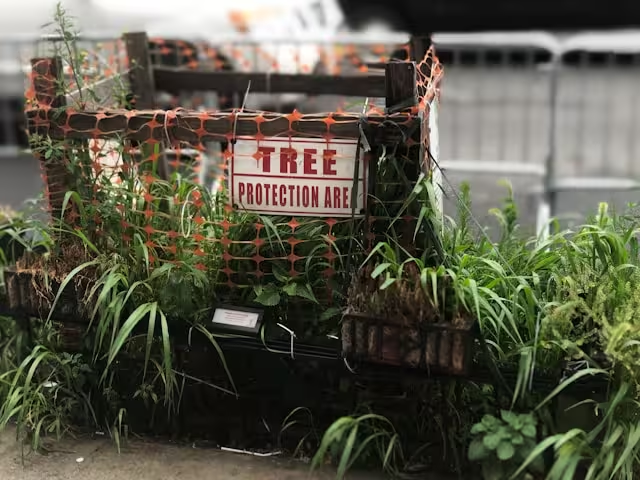
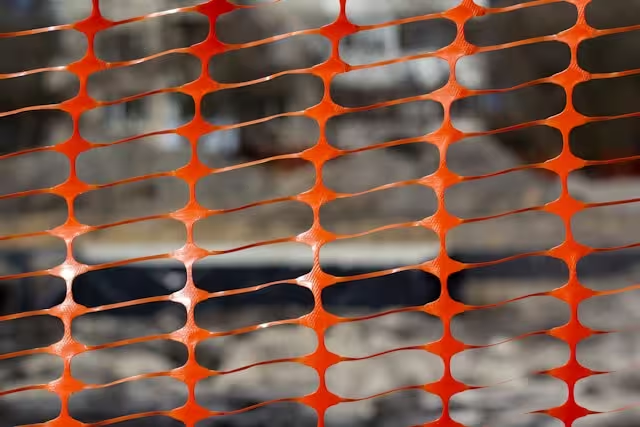
You have likely seen this type of bright orange or green plastic mesh fencing on construction sites. It is often called safety fence or snow fence, and it is held up by thin wooden stakes or small metal posts. While it is certainly better than nothing, I must be very direct here: this should not be your primary choice for a reliable tree protection fencing system.
The main problem with plastic mesh is that it is not a real barrier. It is only a visual suggestion. The plastic material can be easily torn. The stakes are often just pushed into the ground by hand and can be knocked over by a strong wind, let alone a piece of equipment. I have seen sites where workers simply lift up the bottom of the fence to cut through the TPZ for a shortcut. Because it is so flimsy, it fails to command the respect that a strong, steel tree protection fencing system does.
That being said, it does have its place. Its low cost and ease of installation make it useful for very short term projects or for marking off secondary areas that are not as critical as a primary root zone. For instance, you could use it inside a larger, properly fenced area to mark off a patch of sensitive ferns or wildflowers. But you should never rely on this flimsy mesh as the sole defense for a valuable tree. It may not even meet the legal requirements for “durable” tree protection fencing in your local area.
Option 4: Plywood Barriers and Other Root Protection Measures
Sometimes, a project’s layout makes it absolutely impossible to avoid having some traffic cross over a part of a tree’s root zone. In these rare cases, a simple tree protection fencing perimeter is not enough. We have to take extra steps to protect the soil itself from compaction.
Soil compaction is the silent killer of trees on construction sites. When heavy equipment repeatedly drives over the ground, it squeezes the soil particles together. This process pushes out the tiny pockets of air and water that roots need to survive. The ground becomes as hard as concrete, and the tree’s roots can no longer breathe, drink, or grow.
To prevent this, we can create a special ground barrier. The first step is to spread a thick layer, about 8 to 12 inches deep, of coarse wood chips or mulch over the entire area that needs to be crossed. This mulch layer acts like a cushion. Then, we lay large, thick sheets of plywood (at least 3/4 inch thick) or even heavy steel road plates on top of the mulch. This hard layer helps to distribute the weight of the equipment over a much wider area, preventing it from pressing down and compacting the soil underneath.
This is an advanced technique that shows a deep understanding of tree biology and is a hallmark of a truly expert building team. It is often used in combination with standard tree protection fencing to create a comprehensive preservation plan.
Best Practices for Installing Your Tree Protection Fence
Choosing the right material for your tree protection fencing is half the battle. The other half is installing it correctly and making sure it stays in place throughout the entire project. A great fence installed poorly is almost as bad as a weak fence. Following these best practices ensures your investment in tree protection pays off.
The most important rule is about timing. The tree protection fencing must be the very first thing installed on the job site. It should be in place before any clearing or grading begins, before the portable toilet is delivered, and certainly before any heavy equipment like a bulldozer or excavator arrives. I have personally seen a project where a concrete truck, arriving early, drove over the root zone of a massive oak tree to get to the foundation forms. The damage was done before the project had even really started. That tree eventually died, all because the tree protection fencing wasn’t put up first. Make it the absolute first item on your site prep checklist.
Placement requires precision. Using your TPZ calculation, mark the line where the tree protection fencing will go. When in doubt, always give the tree a little extra room. It is always better to make the protected area slightly larger than required than to crowd the tree. Ensure the fence creates a complete, unbroken enclosure around the tree or group of trees you are protecting. A gap in the fence is an open invitation for people and equipment to cut through.
Signage is a simple step that adds a huge amount of effectiveness. Attach large, easy to read, weatherproof signs to the tree protection fencing every 20 to 30 feet. These signs should clearly state the purpose of the fence. Something like, “TREE PROTECTION ZONE – DO NOT ENTER. NO STORAGE OF MATERIALS. NO PARKING.” is perfect. This communicates the rules to every subcontractor, delivery driver, and visitor who comes to the site. It removes any ambiguity and reinforces the seriousness of the protected area.
You must also be strategic about access. On a tight site, you might need to place a gate in your tree protection fencing to allow for necessary access. This should be carefully planned to minimize impact and the gate should be kept closed and secured at all times when not in use. It should not become a convenient parking spot or a shortcut.
Finally, a tree protection fencing system requires regular maintenance.9 It is not a “set it and forget it” installation. The project manager should make it part of their daily routine to walk the property and inspect every foot of the tree protection fencing. Check for damage, ensure posts are still sturdy, and make sure signs are still in place. Construction sites are dynamic environments, and a fence can be damaged. Diligent inspection ensures the barrier remains effective from the first day of the project to the very last.
Top Questions Answered
Clients often have similar questions about this process. Let’s address some of the most common ones directly to provide some extra clarity.
What is the main rule for protecting trees during construction?
The single most important rule is to establish a robust Tree Protection Zone (TPZ) with properly installed, durable tree protection fencing before any other work begins. This is the foundation of all other preservation efforts. Everything else, from careful excavation near the zone to proper watering, builds upon this first critical step of creating a clear, respected, and enforced “no go” area around the trees.
How do you truly protect a tree from construction damage?
The best protection comes from a multi layered plan. It starts with hiring a team that values tree preservation. Then, you accurately calculate the TPZ and install the right kind of tree protection fencing, like chain link or welded wire. For especially valuable trees, you should consult an ISA Certified Arborist to create a formal tree preservation plan. This plan might include extra steps like periodic deep root watering throughout a long project or light pruning of branches to prevent them from being broken by tall equipment.
Can tree roots actually recover from construction damage?
This is a tough question. While trees are resilient, recovery from major root damage is very difficult and often not successful. When more than a third of a tree’s root system is damaged or destroyed, the tree’s chances of long term survival are low. Soil compaction is even more insidious because the damage is invisible and starves the entire root system over time. This is why our entire focus is on prevention, not remediation. It is vastly more effective and cheaper to protect the roots with good tree protection fencing from the start than it is to try and save a dying tree later.
Conclusion: Building with Precision and Respect for Your Land
In the end, building a custom home is about hundreds of precise details coming together to create a unified whole. The way we treat the land is one of those details, and it reflects the overall quality and integrity of the project. Protecting your property’s mature trees is a foundational part of a well executed build. It’s a process that starts with a simple calculation, the TPZ, and is made real by a physical barrier, your tree protection fencing.
By understanding the importance of the root zone, choosing the right material for your tree protection fencing—whether it’s the gold standard of chain link or the practical choice of welded wire—and following the best practices for installation and maintenance, you are doing more than just following the rules. You are protecting your financial investment, preserving the natural beauty of your property, and starting your life in your new home with a landscape that is healthy and thriving. This commitment to foresight and precision is the mark of a truly high quality home builder.
Planning is the cornerstone of a successful project.