If you live in the Tri-Cities area of Tennessee, you already know that we do not live on flat ground. We build our lives and our homes on the ancient ridges and valleys of the Appalachian foothills. While this gives us incredible views of the mountains and beautiful wooded lots, it presents a significant engineering challenge when it comes to access. For instance, a steep driveway can turn from a convenience into a nightmare during one of our heavy summer thunderstorms.
When you ignore the physics of water, gravity takes over. On a steep slope, water is not just wet; it is heavy, fast, and destructive. It cuts channels into gravel, undermines expensive asphalt, and can even threaten the foundation of your home. Finding the right driveway drainage solutions is not just about digging a ditch. It is about understanding hydrology, soil mechanics, and the specific behavior of our local red clay. It requires a blend of precise engineering and practical construction knowledge.
It has been stated in a number of posts on this blog, that the systems you cannot see, like drainage, are just as important as the ones you can see, like your kitchen cabinets. If we do not manage the energy of the water coming down that hill, the water will manage us. In this guide, we are going to look at how to protect your investment with proven driveway drainage solutions that work for our unique terrain.
Video Version of this Article
Understanding the Terrain: Why East TN Driveways Fail
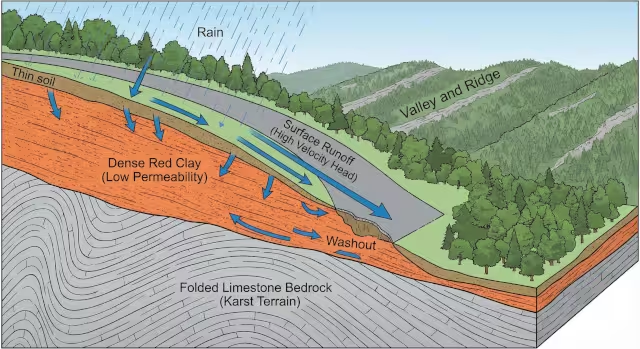
To fix a problem, you first have to understand the ground you are standing on. In the building industry, we look at the geology of a site before we ever pour a footer. Here in East Tennessee, we live in what geologists call the Valley and Ridge province. This means our land is made of long, parallel ridges separated by valleys. When we carve a driveway up the side of one of these ridges, we are fighting two main enemies: the slope and the soil.
The first enemy is the soil itself. If you have ever tried to garden in Kingsport or Bristol, you know about our red clay. From an engineering standpoint, red clay is difficult because it has very low permeability. Permeability is a fancy word for how fast water can soak into the ground. Sandy soil drinks water up quickly. Our dense, compacted red clay acts more like a plastic bowl. When it rains, the water cannot go down into the earth fast enough, so it stays on the surface. This creates immediate runoff.
The second enemy is what we call “velocity head.” This is an engineering term for the energy water gains as it speeds up. On a flat driveway, water moves slowly and lazily. On a steep driveway, gravity pulls that water down quickly. As the water moves faster, it gets stronger. Fast water can pick up rocks, rip apart asphalt edges, and carry away tons of gravel in a single storm. The combination of clay that won’t absorb water and a slope that speeds it up is why standard driveway drainage solutions often fail here. We have to be smarter than the water.
Steep Driveway Drainage Solutions
Trench Drains
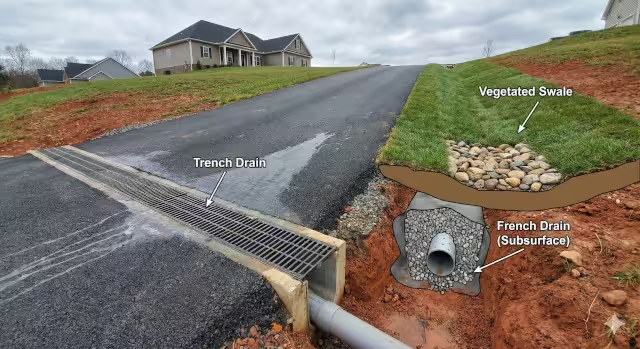
One of the most common and effective driveway drainage solutions for steep paved surfaces is the trench drain. You might also hear these called channel drains. These are long, narrow troughs that we install across the width of the driveway. You usually see a metal or heavy plastic grate on top of them.
The purpose of a trench drain is to act like a gatekeeper. They are usually installed at the very bottom of a slope, right before the driveway meets the garage or the house. The idea is to catch the sheet of water rushing down the pavement and drop it into a pipe before it can flood your garage. However, on very steep, long driveways, we might install two or three of these at different intervals to slow the water down before it reaches the bottom.
Installation is where a lot of people go wrong. You cannot just dig a slot in the dirt and drop a plastic channel in. That will fail within a year. A proper trench drain needs to be encased in concrete. We dig a trench that is wider and deeper than the drain itself. We pour concrete under and around the channel so that it is locked in place. This prevents the drain from shifting when a heavy delivery truck drives over it.
Speaking of trucks, you have to choose the right grate. If you ever plan on having a septic truck, moving van, or construction vehicle on your property, you need a grate with an H-20 load rating. This is an industry standard that means the grate can handle heavy axle loads without snapping. If you use a cheap plastic grate from a big box store, the first UPS truck that backs down your driveway might crush it.
French Drains and Curtain Drains
While trench drains handle the water on top of the driveway, French drains manage the water underneath it. This is one of the most misunderstood driveway drainage solutions in the industry. A true French drain is not just a ditch with gravel in it. It is a system designed to relieve hydrostatic pressure.
Hydrostatic pressure happens when the ground gets saturated. Remember that red clay we talked about? When the topsoil gets soaked, water moves sideways through the ground, looking for a place to go. If your driveway is cut into a hill, that water will hit the gravel base of your driveway and get stuck. This pressure can actually lift asphalt up or cause it to crack. In freezing weather, this trapped water turns to ice and destroys the road surface.
To build a proper French drain, we dig a trench alongside the driveway on the “uphill” side. We line the trench with a geotextile fabric. This fabric is crucial. It lets water pass through but stops dirt and clay from getting in. If you skip the fabric, the clay will clog up the rocks in a few years, and the drain will stop working. Inside the fabric, we place a perforated pipe and cover it with clean, washed gravel. We then wrap the fabric over the top like a burrito. This system intercepts the subsurface water moving down the hill and carries it away before it can get under your pavement.
Swales and Berms
Sometimes, the best engineering looks like nature. Swales and berms are what we call “soft engineering” driveway drainage solutions. Instead of using concrete and pipes, we use the shape of the land to control water. This is often a great choice for long, rural driveways in areas like Jonesborough or outskirts of Johnson City where you have more room to work.
A swale is a shallow, wide ditch with gently sloping sides. Unlike a deep, narrow ditch, a swale is easy to mow. Swales are often lined with grass or, if the water moves fast, with river rock. The goal of a swale is to catch water running off the side of the driveway and guide it safely down the hill to a designated outlet, like a creek or a storm drain. Because the swale is wide and lined with vegetation, it helps slow the water down.
A berm is the opposite of a swale. It is a raised mound of soil. Small berms are often built on the downhill side of a curved driveway. If water tries to run off the road, the berm acts like a bumper, keeping the water in the swale or channel where it belongs. Combining swales and berms gives you a highly effective system that blends in with your landscaping. It doesn’t look like a construction site; it looks like a yard.
Permeable Pavers
In recent years, permeable pavers have become popular driveway drainage solutions for high-end custom homes. The concept is brilliant: instead of sealing the surface with solid concrete or asphalt, you use a system of pavers that has gaps or porous material. This allows the rain to pass right through the driveway surface and into the ground below.
However, we have to give you a word of caution based on our local geography. Permeable pavers work best when the soil underneath can drain well. As we discussed, our red clay does not drain well. If you put permeable pavers directly on top of clay, the water will go through the pavers, hit the clay, and sit there. This turns your driveway base into a mud pit, and the pavers will start to sink and shift.
To make permeable pavers work in the Tri-Cities, we have to do some serious prep work. We have to dig out a much deeper base than usual, sometimes 12 to 18 inches deep. We fill this excavation with different sizes of open-graded stone. This deep rock layer acts as an underground storage tank. It holds the water while it slowly seeps into the clay over the course of a day or two. It works, but it is expensive. If you have the budget, it is a beautiful and effective option, but it must be engineered correctly for our soil conditions.
Crowning the Driveway
When we design a road or a driveway, the shape of the surface is just as important as the drains we install. One of the most fundamental driveway drainage solutions is “crowning.” If you look closely at a well-built highway, you will see that the center line is actually the highest point of the road. The pavement slopes down gently toward both shoulders. This is the crown.
For a long, straight steep driveway, crowning is essential. If a driveway is perfectly flat from left to right, water will pool in the middle. When water pools, it seeps into cracks. When it freezes, it expands and breaks the pavement. By crowning the driveway, we force the water to shed off to the sides immediately. It gets the water off the load-bearing surface and into the swales or ditches where we can manage it.
Achieving a proper crown takes a skilled operator on a grader or a paving machine. It requires precision. You generally want a slope of about 2% from the center to the edge. That means for every foot you go sideways, the surface drops about a quarter of an inch. It doesn’t sound like much, but it is enough to keep the surface dry and safe.
Engineered Solutions to Drainage
Advanced Engineering: Super-elevation (Banking)
If your steep driveway has curves, which most of them do in our mountains, crowning might not be the right answer. Instead, we use a technique called “super-elevation.” If you are a NASCAR fan and you have been to Bristol Motor Speedway, you know exactly what banking is. The track is tilted so that the cars can turn without flying off the edge.
We do a similar thing with water. On a curve, we want the water to drain to the inside of the turn. If we let water drain to the outside of a steep curve, it will wash away the edge of the driveway because the water is moving so fast. By banking the driveway toward the inside of the hill, we direct all the water into a stabilized ditch or a concrete gutter on the uphill side.
This protects the outer edge of the driveway, which is usually the most vulnerable part on a steep slope. It creates a predictable path for the runoff. Implementing these geometric driveway drainage solutions requires careful planning before the gravel or asphalt is ever laid down. It is much harder to fix the shape of a driveway after it is built than it is to grade it correctly from the start.
Advanced Engineering: Water Bars
For those of you with long gravel driveways, perhaps leading to a hunting cabin or a farmhouse, paving might not be in the budget. Gravel is practical, but it washes out easily on slopes. One of the most rugged driveway drainage solutions for gravel is the “water bar.” You see these a lot on logging roads or forestry service trails in the Cherokee National Forest.
A water bar is a diagonal ridge or hump built across the driveway.11 It is usually made of compacted soil, gravel, or sometimes a buried timber or rubber belt. The water bar runs diagonally at about a 30-degree angle to the road. Its job is to intercept the water running down the tire tracks and kick it off the side of the road into the woods.
The key is frequency. You cannot just put one water bar at the bottom. You need to space them out. On a very steep hill, you might need a water bar every 50 feet. This ensures that the water never builds up enough volume or speed to cut deep ruts into your gravel. It makes for a slightly bumpier ride, but it saves you thousands of dollars in gravel replacement every spring.
Material Selection: Asphalt on Slopes
Choosing the right paving material is a critical part of your drainage strategy. Asphalt is a popular choice in our area because it is generally cheaper than concrete and handles our freeze-thaw cycles fairly well due to its flexibility. However, standard asphalt has some weaknesses when it comes to steep slopes and water.
Asphalt is held together by a binder, basically a sticky, black oil. If water runs over asphalt constantly, especially fast-moving water, it can strip that binder away over time. This is called “raveling.” The stones start to come loose, and the surface becomes rough and pitted.
If you choose asphalt for a steep driveway, you must be aggressive with your driveway drainage solutions. You cannot allow water to run down the center of the lane. You must crown it or bank it effectively. Also, on very steep slopes, heavy vehicles can actually ripple the asphalt on hot days. We often use a stiffer mix design for steep slopes to prevent this shoving and rippling.
Selection of Materials for Driveways
Material Selection: Concrete Traction
Concrete is the gold standard for durability. It doesn’t ravel like asphalt, and it is rigid enough to bridge over small soft spots in the soil. However, concrete can be slippery when wet. On a steep driveway, a smooth concrete finish is dangerous. I have seen delivery trucks slide backwards down smooth concrete driveways in the rain.
When we pour concrete on a steep grade, we apply a special finish to aid with traction. A “heavy broom finish” is the most common. After the concrete is poured and leveled, we drag a stiff-bristled broom across it to create deep grooves. These grooves should run horizontally across the slope to give tires something to grip.
Another excellent option is “exposed aggregate.” We wash away the top thin layer of cement paste to reveal the stones inside the concrete.16 This creates a very rough, gritty surface that offers incredible traction. It also looks very high-end. While concrete acts as a surface for the car, it works in tandem with your driveway drainage solutions by moving water quickly without eroding.
Material Selection: Resin-Bound Gravel
I want to mention a newer technology that is gaining traction: resin-bound gravel. This is a hybrid material. We mix clean, decorative gravel with a clear, high-strength resin and trowel it down over a concrete or asphalt base. It hardens to look like loose gravel, but the stones are glued together.
The advantage here is that it is permeable and has high friction. It gives you the rustic look of a gravel driveway that fits a mountain home, but it doesn’t wash away in the rain. Because the surface has texture, it provides good grip. It is one of the more expensive options, but for a luxury custom home where aesthetics are as important as function, it is a strong contender among driveway drainage solutions.
Local Regulations and Legalities
Before you rent an excavator and start digging trenches, we need to talk about the rules. Even if you live outside the city limits of Kingsport or Johnson City, you are still subject to state laws regarding water runoff. The general legal principle is that you cannot change the natural flow of water in a way that damages your neighbor’s property.
If you install a massive system of driveway drainage solutions that collects all the water from your hill and shoots it out of a pipe directly at your neighbor’s garage, you are liable for the damage. You are creating a “point load” of water. You must disperse the water or direct it to a natural drainage path like a creek or an existing drainage easement.
Furthermore, both Kingsport and Johnson City have stormwater ordinances. If you are disturbing a large area of land, usually over an acre, but sometimes less, you might need a land disturbance permit. They want to ensure you have silt fences up to keep mud out of the public roads and creeks. Always check with the local building department or a civil engineer before starting a major regrading project.
Maintenance: The Clean-Out Schedule
Do not foget, that no system runs forever without maintenance. You can install the most expensive driveway drainage solutions in the world, but if you ignore them, they will fail. This is especially true in East Tennessee, where we have heavy leaf fall from oak, maple, and pine trees.
Trench drains are notorious for getting clogged with pine needles and oak leaves. When they clog, the water simply flows right over them and into your garage. You need to pop the grates off and clean out the channel at least twice a year—once in late fall after the leaves drop, and once in spring after the pollen and seed pods fall.
French drain outlets also need to be checked. The pipe usually pops out of the ground somewhere downhill. Grass can grow over this outlet, or critters can build nests inside it. If the water can’t get out, it can’t get in. Walk your property line and ensure all your pipe daylight points are clear and flowing freely.
Sealcoating and Crack Filling
Water is persistent. It will find any crack in your pavement. Once water gets into a crack, it starts to erode the base material underneath. This creates a pothole. On a steep driveway, a pothole can grow very quickly because the water scours it out with force.
Part of your strategy for driveway drainage solutions must include regular pavement maintenance. For asphalt, this means sealcoating every 3 to 5 years. This seals the surface and keeps water from penetrating the binder. For concrete, you should seal the control joints (the deliberate cracks we put in) with a flexible silicone or polyurethane caulk. This keeps water on top of the slab where it belongs, rather than letting it seep underneath.
Commonly Asked Questions about Driveway Drainage
Can I use gravel on a steep driveway?
A lot of people ask me if they can just use gravel because it is cheaper. You can use gravel on a steep driveway, but you have to use the right kind. Do not use round river rock or “pea gravel.” It acts like marbles and will roll right down the hill under your tires.
You must use “crusher run” or “pug mix.” This is angular gravel mixed with stone dust. When you wet it and compact it, it locks together almost like concrete. For very steep slopes, you might need to install a geocell grid. This is a plastic honeycomb structure that you lay on the ground and fill with gravel. The grid holds the stones in place so they cannot wash away. It is one of the most robust driveway drainage solutions for rural properties.
How much does a heated driveway cost?
While not strictly a drainage solution, heated driveways are often installed alongside drainage systems to manage snow and ice. In our area, a heated driveway system is a significant investment. You are looking at roughly $15 to $25 per square foot just for the installation, not including the cost of the new concrete or asphalt.
However, for a very steep driveway that is dangerous in the winter, it can be worth it. The system melts the snow as it falls, turning it into water. This water then runs into your trench drains. It eliminates the need for plowing and salting, which saves wear and tear on the driveway surface.
What is the maximum slope for a driveway?
Standard building codes and fire safety regulations usually prefer a driveway slope of less than 15%. Fire trucks and ambulances struggle to climb anything steeper than that, especially if it is wet. However, in the mountains, we sometimes have no choice but to go steeper.
I have seen driveways in our area exceed 20% or even 25%. If you have a driveway this steep, your driveway drainage solutions must be aggressive. You absolutely need high-traction concrete, and you must have water bars or trench drains at frequent intervals. If you are building a new home, try to design the driveway with switchbacks (curves) to reduce the steepness of the grade.
How do I stop water from entering my garage?
This is the most common panic call I get. If water is coming into your garage, you need a multi-layered defense. First, ensure the driveway slopes away from the garage door for at least the first few feet. This is called a “negative slope” or an “apron.”
Second, install a high-capacity trench drain across the entire width of the driveway, about two to three feet in front of the garage door. Pipe this drain to a downhill location. Finally, check the seal on the bottom of your garage door. While it won’t stop a flood, a good rubber seal helps keep wind-blown rain out. Combining these driveway drainage solutions offers the best protection.
Conclusion
Building and maintaining a home in the Tri-Cities offers wonderful rewards, but it demands respect for the environment. The combination of our steep ridges, red clay soil, and heavy rainfall creates a perfect storm for driveway issues. But with the right engineering and a proactive approach, these problems are solvable.
Remember that water always wins if you try to fight it with brute force. The key is to manage it, to guide it, slow it down, and give it a place to go. Whether you choose trench drains, swales, or advanced paving techniques, investing in proper driveway drainage solutions is an investment in the longevity and value of your property.
Don’t let the next big storm wash away your hard-earned money. Go outside next time it rains. Put on your boots and watch where the water goes. If you see it pooling, cutting ruts, or rushing toward your foundation, it is time to act. Evaluate your slope, consult with a professional, and put a plan in place. Your home is your castle; make sure the drawbridge is safe.