Smart Design for Small Homes
Building smaller is not just about saving money. It is an engineering challenge that requires precision and a shift in how we view space. Across Kingsport, Johnson City, and Bristol, there has been a distinct shift. Whether it is retirees downsizing in Jonesborough or young families looking for affordable new construction in Kingsport, the demand for efficiency is real.
We are seeing a change in the market for 2025 and onward into 2026. While inventory is rising and interest rates are stabilizing near six percent, buyers are smarter. They want value. They do not want wasted space. They want a home that performs.
“Small” does not mean “cramped.” It means “optimized.” It means using smart design to make sure every square inch serves a purpose. It is about how smart engineering can make 1,200 square feet feel like 2,000. It is about competence. It is about integrity in construction.
In this article, we will explain how smart design transforms smaller footprints into high-performance machines for living. We will look at the bones of the house, the technical systems, and the local rules here in Northeast Tennessee.
Video Version of this Article
Structural & Layout Engineering: The Bones of Smart Design
When we talk about smart design, most people think of paint colors or where the sofa goes. Being writers about home, we look at the bones. The bones are the studs, the beams, and the foundation. If the bones are weak, the house fails. If the bones are clumsy, the house feels small.
In a smaller home, we do not have the luxury of wasted space. We cannot hide bad design behind a long hallway. Every piece of wood must do a job. This is where we move from just “building” to actual engineering.
The Physics of Open Space
Everyone wants an “open concept.” You want to stand at your kitchen sink and see the TV in the living room. You want the sunlight from the back door to reach the front door.
In older homes in Kingsport or Bristol, walls were everywhere. They held up the ceiling. When you take those walls away to create space, gravity does not stop working. The weight of the roof, the snow, and the second floor still has to go somewhere.
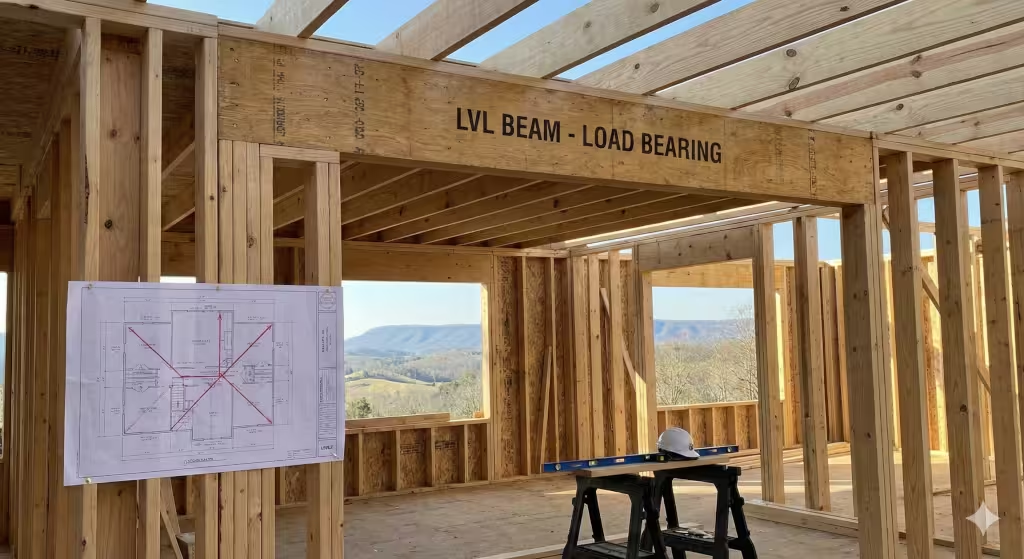
If we remove a wall that is holding up the roof (a load-bearing wall), we have to replace it with a beam. This beam acts like a bridge. It carries the weight over your head and sends it down to the posts on either side.
In smart design, we want that beam to be invisible. We want it tucked up inside the ceiling so you have a flat, smooth look. This requires calculation, not guessing.
The Muscle: LVL vs. Traditional Lumber
In the old days, carpenters would nail two or three 2 X10 boards together to make a header. That works for a normal door. But if you want a 20-foot open span in a compact home to make it feel huge, standard lumber will not work. It will sag.
This is where we use Laminated Veneer Lumber, or LVL.
Think of an LVL like a super-strong plywood. We take thin layers of wood, coat them in waterproof glue, and press them together under massive heat and pressure. The result is a beam that is twice as strong as regular wood. It is perfectly straight. It does not twist. It does not warp.
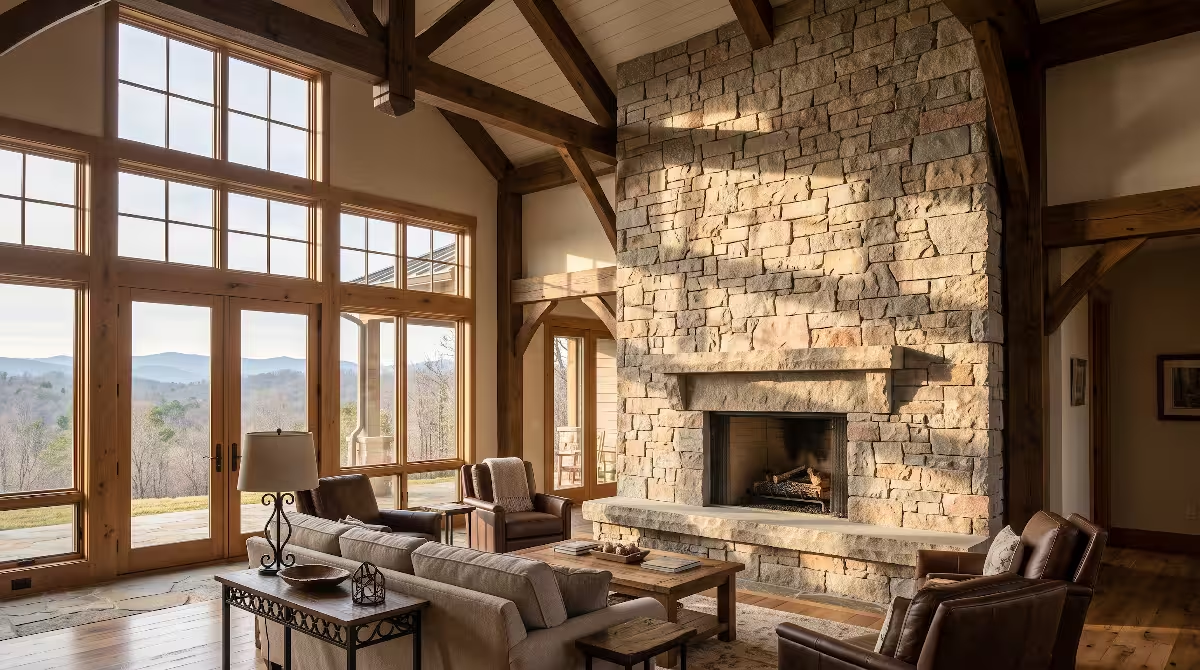
Using LVLs is a hallmark of smart design. It allows us to span 15, 18, or 20 feet without a column in the middle of the room. This makes a 1,200-square-foot house feel as open as a gymnasium, but warm and comfortable.
Calculating the Load (The Math)
How do we know how big the beam needs to be? We do not guess. We calculate. We look at two types of weight:
Dead Load: This is the weight of the house itself. The shingles, the plywood, the drywall, the insulation. This weight never changes.
Live Load: This is the weight of you, your furniture, your dog, and the weather. In East Tennessee, we have to account for snow. Even though we don’t get feet of snow often, the code says we must build as if we might.
To size a beam for smart design, we calculate the “Tributary Width.” Imagine the floor plan. Draw a line halfway between the beam and the next wall. That area is the “tributary.” All the weight in that area flows like water to that beam.
If the span is wide and the snow load is heavy, the beam gets taller. If we can’t make it taller because of ceiling height, we make it wider, or we switch to steel.
The Transfer of Weight (Point Loads)
This is the part that gets missed by amateur flippers, but never by a pro.
When you put a big beam across a room, you collect all that weight from the roof and dump it onto two spots at the ends of the beam. These are called “Point Loads.”
Imagine holding a heavy barbell. If you stand on soft mud, your feet will sink. The same thing happens to your house.
If we concentrate 5,000 pounds of roof weight onto a single $4\times4$ post, we have to follow that path all the way down to the dirt.
The post sits on the floor.
We need solid blocking under the floor to keep the subfloor from crushing.
We need a post in the crawlspace or basement directly under that block.
Finally, we need a concrete footing in the ground that is wide enough to spread that weight out so the house doesn’t sink.
Smart design isn’t just opening the room; it is tracing that load path all the way to the earth to ensure stability.
Headers and Window Openings
In a smaller home, windows are your best friend. They connect you to the outdoors. But a window is a hole in the wall. You cannot put a stud where the glass is.
Above every window, we need a “header.” This is a small beam that carries the weight around the glass.
In traditional framing, headers are often oversized and filled with wood spacers. This is bad for energy efficiency because wood conducts cold. In smart design, we use “insulated headers.”
We build the structural box, but we leave space in the middle for rigid foam insulation. This keeps the strength but stops the cold winter air from Kingsport from seeping through the frame above your window. It is a small detail, but it saves energy and makes the home more comfortable.
Truss Systems
To achieve those high ceilings we talked about, we often use engineered trusses. These are the triangular web of wood that supports the roof.
For a small home, we can order “scissor trusses.” These are trusses that slope up on the inside as well as the outside. They give you a vaulted ceiling without needing a ridge beam. They are factory-built, precise, and affordable.
Using trusses is smart design because it speeds up construction. We can set the roof in a day. It also allows us to run insulation properly right to the edge of the wall (the “heel”), which prevents ice dams in the winter.
Summary of the Bones
When we get the bones right, the rest is easy.
LVL Beams let us remove walls and open the view.
Load Calculations keep the roof from sagging.
Point Load Paths keep the foundation from cracking.
Insulated Headers keep your utility bills low.
This is the difference between a house that is just built, and a house that is engineered.
Multi-Functional Interiors (The Function)
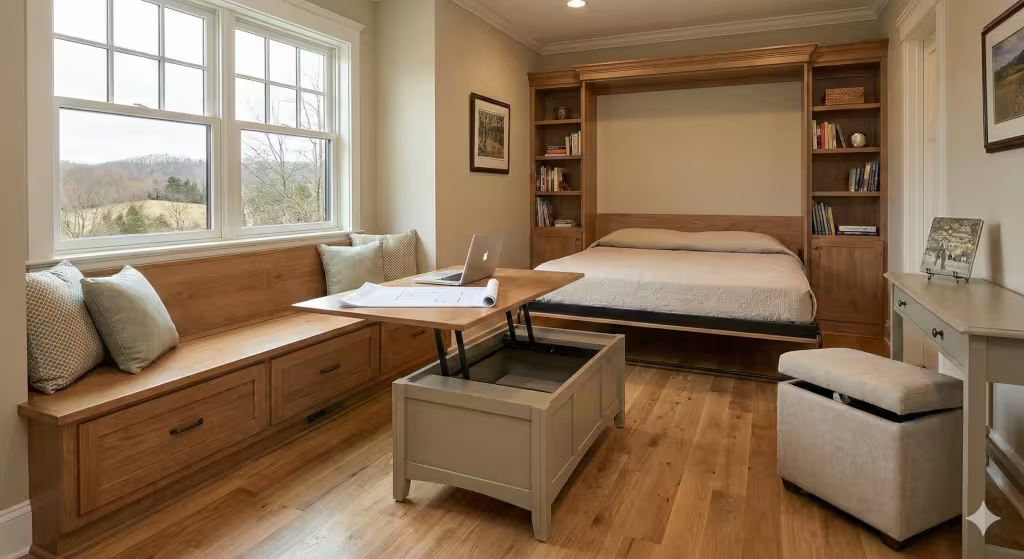
Once the frame is up, we look at how you live. A small home cannot have single-use rooms. A dining room that you only use at Thanksgiving is a waste of money. Smart design demands that every space works double duty.
Flex Rooms
The “spare bedroom” is a luxury small homes cannot afford. Instead, we design “flex rooms.” This is a space that changes based on the time of day.
During the day, it is a home office. At night, it is a guest room. We use Murphy beds that fold into the wall. We use daybeds that look like couches. This is smart design in action. You get the utility of two rooms for the price of one.
Smart Storage Solutions
Storage is the biggest worry for people downsizing. “Where will I put my stuff?” The answer is in the “dead space.”
In a traditional house, the space under the stairs is wasted. Maybe it is a small closet. In a home built with smart design, we turn that space into pull-out drawers. We can fit a pantry, a coat rack, or even a small desk under the stairs.
Another area is the dining nook. Chairs require two or three feet of clearance to slide back. That is empty space you cannot use. A built-in bench, or banquette, against the wall saves that space. Plus, we can build storage inside the bench seat. That is smart design.
Furniture with a Dual Purpose
When you choose furniture, you must think like an engineer. Does this object do more than one thing?
The Coffee Table: It should not just sit there. It should have a lift-top so you can work on your laptop. It should have drawers for remotes.
The Ottoman: It is a footrest, but it should also open up to store blankets.
The Bed: It should have drawers underneath.
If a piece of furniture only does one thing, it does not belong in a smart design home.
Technical Systems & Efficiency (The Engine)
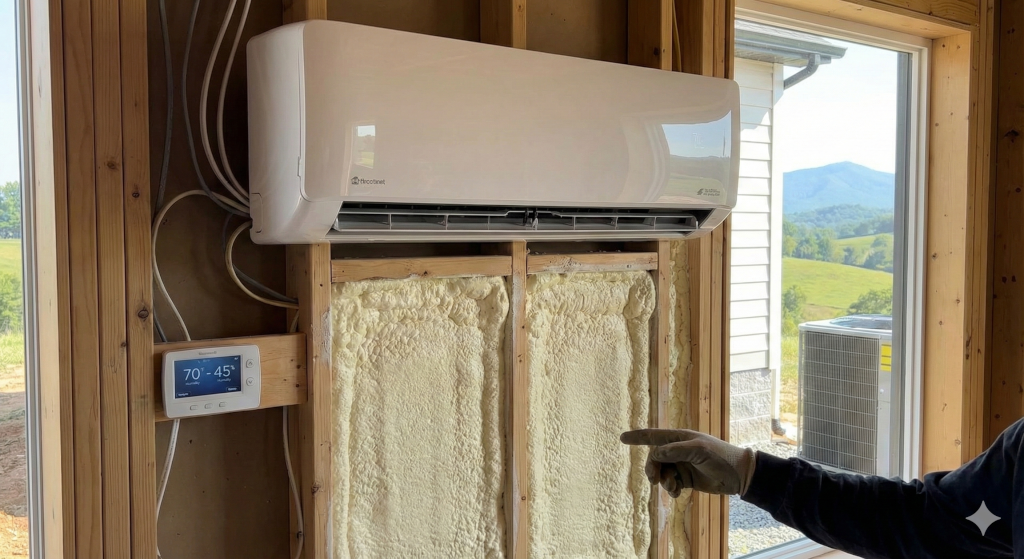
This is where my background in engineering comes in. People focus on the granite countertops, but the machine behind the walls matters more. In a small home, the technical systems must be precise.
HVAC in Smaller Footprints
Here in the Tri-Cities, we have humid summers. We all know how sticky it gets in July. This is where smart design prevents mold.
In a small house, you have less air to cool. If you put in a standard, big air conditioning unit, it will cool the house too fast. That sounds good, but it is bad. It turns on, cools the air in five minutes, and turns off. This is called “short-cycling.”
The problem is that it takes about 15 minutes for an AC unit to start removing humidity. If it only runs for five minutes, the house gets cold, but the walls stay wet. That leads to mold.
Smart design solves this with Mini-Splits or Variable Speed Heat Pumps. These units run at a low speed for a long time. They keep the temperature steady and pull the moisture out of the air. They are quiet, efficient, and perfect for small spaces.
Insulation & The Thermal Envelope
The “envelope” is the barrier between the inside and the outside. In a small home, you are always close to an outside wall. If that wall is cold, you will feel it.
We use spray foam insulation. It works like a cooler. It seals every crack and crevice. This is smart design because it stops air leaks. A tight house is a comfortable house. It also keeps your utility bills low. You spend less money heating the neighborhood and more money heating your home.
Local Context: Building in the Tri-Cities
Real estate is local. What works in California does not always work in Tennessee. We have specific rules and specific land.
Regulatory Landscape
You may have heard of “Tiny Homes.” Tennessee has adopted specific codes for these, called Appendix Q. This code allows for homes under 400 square feet. It has rules for lower ceiling heights in lofts and ladders instead of stairs.
However, most people want a “Compact Home,” which is 1,000 to 1,400 square feet. These must follow standard building codes.
You also need to know about ADUs, or Accessory Dwelling Units. These are small homes in the backyard of a big home. Johnson City and Kingsport have different zoning rules for this. Generally, the small home cannot be bigger than 50% of the main house. Smart design means checking these rules before you draw a single line.
Topography Challenges
We have hills. If you are building in East Tennessee, you are likely building on a slope. A flat slab foundation is cheap, but it requires a flat lot.
Smart design on a hill means using a walk-out basement. We cut into the hill. The basement becomes living space. It stays cool in the summer because it is underground. It is a cost-effective way to double your square footage without doubling your roof size.
Visual Tactics for Perceived Space
Engineering creates space. Design creates the feeling of space.
Color Theory
Colors change how we see distance. Dark colors come toward you. Light colors move away.
Smart design uses “receding colors.” These are soft grays, light blues, and sage greens. They make the walls feel like they are further away than they really are.
We also paint the trim the same color as the wall. When the trim creates a box, your eye stops at the edge. When the trim matches the wall, the boundary blurs. The room feels endless.
Reflective Surfaces
Mirrors are the oldest trick in the book, but they work. A large mirror opposite a window acts like a second window. It bounces light back into the room. It tricks the brain into thinking there is more space. This is a simple, low-cost application of smart design.
Common Questions about Smart Design
Below are some of the questions often asked about smart design.
What is the best floor plan for a small house?
The best floor plan is a rectangle. It is the cheapest to build and the easiest to heat. You want a central living area with bedrooms on opposite ends. This removes the need for long hallways. Hallways are wasted money. Smart design eliminates them.
How do you make a small house look expensive?
You invest in “touchpoints.” These are the things you touch every day. Solid core doors instead of hollow ones. Heavy door handles. Nice light switches. You also invest in custom trim. Good carpentry makes a small house feel like a jewel box rather than a shack.
Are tiny homes legal in Tennessee?
Yes, but they must meet safety standards. You cannot just build a shed and live in it. It must have proper egress windows for fire safety. It must have proper plumbing. Appendix Q of the building code covers this. Smart design is safe design.
Why This Matters to You
Why should you care about smart design?
Because a smaller, well-built home gives you freedom. It means lower utility costs. It means less time cleaning and maintaining the house. That means more time for you. You can spend your weekends fishing on the Holston River. You can go hunting. You can watch a basketball game.
A giant house with poor design is a burden. A small house with smart design is an asset.