For anyone looking to build a new home here in the Tri-Cities, a fundamental choice presents itself right at the start. Do you select a lot in a new, growing subdivision and choose from a builder’s attractive set of floor plans? Or do you purchase your own piece of land and begin the journey of creating a one-of-a-kind home from a blank sheet of paper? This decision goes far deeper than just picking out kitchen cabinets and paint colors. It is a choice between two entirely different processes, and it represents a major financial calculation with consequences that will play out for years to come.
This is a decision many buyers have to make, when choosing a home. Do you choose the system-built approach of large-scale production projects or do you bring their unique custom home visions to life. This article aims to provide a clear perspective on the materials, methods, and market forces that shape the final value of a new home.
Going further it will provide you with an unbiased, builder’s analysis of this crucial decision. We will move past the emotional appeal of a dream home and focus on the practical numbers. We will dissect the key differences between these homes and examine the critical factors that ultimately determine the custom vs. production home resale value Tri-Cities TN homeowners can realistically expect when it is time to sell.
Defining the Terms: What Are We Really Comparing?
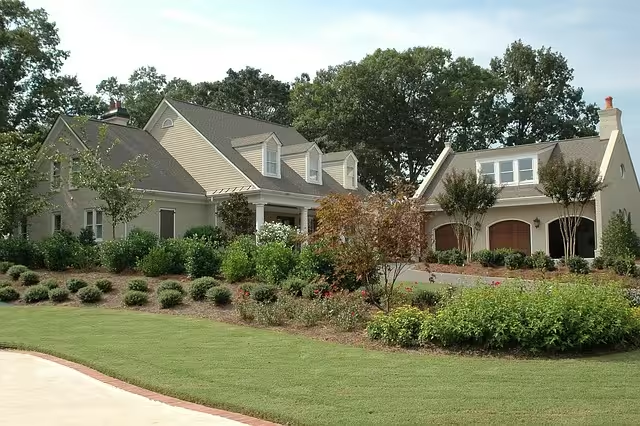
To have a meaningful discussion about resale value, we first need to be very precise about what we are comparing. The words “production” and “custom” are not about style. They are about the process of how a home is designed, planned, and constructed. That process has a direct impact on the cost, the timeline, the final product, and its value on the open market.
The Production (or Tract) Home
A production home, often called a tract home, is one that is built by a developer or large builder as part of a bigger community. Think of the new subdivisions you see rising in areas like Gray or Boones Creek. In this model, the builder owns a large tract of land and divides it into many lots. They then offer a limited selection of pre-designed floor plans that have been optimized for that specific land.
The process is all about efficiency and predictability. It is similar to buying a new car. You choose a model you like, then you select from a few different option packages for things like flooring, countertops, and light fixtures. Because the builder is constructing dozens or even hundreds of homes, they can buy materials like lumber, windows, and shingles in enormous quantities at a significant discount. They use the same teams of carpenters, plumbers, and electricians who become experts at building those specific floor plans over and over again. This system, known as economies of scale, is what allows production builders to offer a lower price per square foot and a faster, more predictable construction timeline. The result is a cost-effective, well-planned home in a community that often includes amenities like sidewalks, a neighborhood pool, or a playground.
The Custom Home
A custom home is the complete opposite. It is a one-of-a-kind home that is designed and built for a specific person on a piece of land that they own. The process is not about efficiency; it is about personalization. It begins not with a floor plan, but with a conversation. The homeowner works with an architect or a designer to create a home that is perfectly tailored to their lifestyle, their needs, and the unique features of their land.
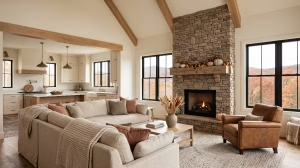
Every single detail is a decision. Where does the morning sun hit the best spot for the kitchen? How can we frame the view of the mountains from the master bedroom? What kind of unique Tennessee fieldstone should we use for the fireplace? The choices are virtually unlimited. This process allows for an unparalleled level of personalization and the use of high-end, unique materials. However, this freedom comes at a cost. The price per square foot is significantly higher because there are no economies of scale. The timeline is much longer, often taking a year or more from design to completion. The process can also be mentally taxing for the owner, who is responsible for making thousands of individual decisions along the way.
The Resale Value Equation: 4 Factors Tri-Cities Buyers Care About
Resale value is a simple concept. It is not what a home is worth to you and your family. It is what a future buyer is willing to pay for it. In my experience, there are four key factors that determine how a home, whether production or custom, will perform as a long-term investment in our local market.
Factor 1: Location & The Power of “Comps”
The oldest saying in real estate is “location, location, location,” and it holds true here. But it is more nuanced than just a good or bad spot. When it comes time to sell your home, your bank and the buyer’s bank will hire an appraiser to determine its official value. Appraisers do this by finding “comparable sales,” or “comps.” These are recent sales of homes that are very similar to yours in size, age, and location.
This is where production homes have a major advantage. In a subdivision with 100 houses of similar style and size, finding comps is easy. If three other four-bedroom homes on your street sold for around $450,000 in the last six months, the appraiser has a very clear and defensible value for your home. This makes the selling and financing process smooth and predictable.
Custom homes can be much trickier. A unique, custom-built modern farmhouse on 15 acres outside of Jonesborough might be a stunning property, but if no other similar homes on similar acreage have sold nearby in the past year, the appraiser has a very difficult job. They may have to use comps that are not a perfect match, which can sometimes lead to a lower appraisal value than what you think the home is worth. The unique location, like a property with a stunning view of Boone Lake, is a huge asset, but the uniqueness of the home itself can make its value harder to prove on paper.
Factor 2: Design & The “Over-Personalization” Trap
This is perhaps the single biggest risk to the resale value of a custom home. The very thing that makes a custom home special to you can make it unappealing to a future buyer.
Production home builders spend a great deal of money on market research to create floor plans and designs with the broadest possible appeal. They know that most families want an open concept kitchen and living area, a master suite on the main floor, and plenty of storage. By sticking to these popular, time-tested designs, they ensure their homes appeal to the largest possible pool of future buyers.
When you build a custom home, you have the freedom to do anything you want. But that freedom can be a double-edged sword. Your dream of a bright purple kitchen, an oversized garage with no backyard for your car collection, or a dedicated soundproofed room for your drum set might be perfect for your lifestyle. However, these features can severely limit the number of people who would ever consider buying your home. When a potential buyer has to mentally calculate the cost of a full kitchen remodel, it directly impacts the offer they are willing to make. The most successful custom homes, from an investment standpoint, are those that use their freedom to achieve timeless, elegant design, not just personal quirks.
Factor 3: Quality of Construction & Finishes
There is a common perception that production homes are “cheaply built” while custom homes are “quality built.” The reality is more complicated.
Production builders build homes efficiently, not necessarily cheaply. They use proven systems and materials, and because their crews build the same plans repeatedly, the construction process can be very consistent. Where they save money is often on the standard finishes. The base price of a production home typically includes “builder-grade” carpet, faucets, lighting, and appliances. These are functional but not luxurious.
A custom home provides the opportunity to use demonstrably superior materials. You can choose high-end architectural shingles, premium insulated windows, beautiful hardwood flooring, and commercial-grade kitchen appliances. This level of quality is a powerful selling point at resale, especially if you keep detailed records and receipts. A future buyer will be impressed by a portfolio showing the top-of-the-line materials used. However, “custom” does not automatically equal “quality.” The quality of a custom home is entirely at the mercy of the builder you choose and the budget you set. A poorly managed custom build can have more problems than a well-managed production home.
Factor 4: The Market & Buyer Pool
Finally, consider the typical home buyer in the Tri-Cities. Our region has a strong and stable economic base, with major employers like Ballad Health and East Tennessee State University. These organizations draw a steady stream of doctors, nurses, professors, and professionals to our area. Many of these buyers are families looking for a reliable, comfortable home in a safe neighborhood with good schools. They want a four-bedroom, two-and-a-half-bath home in a community setting. This description perfectly matches what production builders provide. They are serving the largest segment of the market.
The buyer for a high-end custom home is a much smaller, more specific demographic. They are looking for something unique, a home with architectural character, a special view, or luxury features that you cannot find in a subdivision. This market is strong in the Tri-Cities, especially in areas around the lakes or in exclusive communities like The Blackthorn Club. However, the pool of buyers who can afford and desire such a property is, by definition, smaller. This can sometimes mean a custom home takes longer to sell than its production counterpart.
The Verdict: Which Holds Its Value Better in the Tri-Cities?

After weighing all these factors, we can draw some clear conclusions. There is no single winner, but each path has a predictable investment outcome.
The Case for Predictable Appreciation: Production Homes
For the average homeowner, a production home often represents the safer and more predictable investment. Its value is tied to the health of the entire subdivision. As the neighborhood matures and landscaping grows in, all the homes tend to appreciate together at a steady rate. Because its design has mass appeal and its price is easy to verify with comps, it is generally easier and faster to sell. For someone who thinks they might be transferred for work in five to ten years, a production home is often the more financially prudent choice.
The Case for High-Ceiling Potential: Custom Homes
A custom home is a higher-risk, higher-reward investment. Because of the higher upfront cost and the risks of over-personalization, it is possible to spend more on a custom home than you can get back at resale, especially in the short term. However, a well-designed custom home with timeless appeal, built with high-quality materials in an excellent location, has the potential for much greater appreciation over the long run. It can become a landmark property, something that stands out from the crowd and commands a premium price that far exceeds what a production home could achieve.
The Tri-Cities Market Dynamic
Our local market supports both paths. The consistent job growth and desirability of our region create a constant demand for the family-friendly homes found in new production communities. At the same time, the incredible natural beauty of East Tennessee, from our mountains to our lakes, creates a vibrant market for those who want to build a unique custom home to take advantage of a special piece of property.
Answering Your Top Questions

Let’s address some of the most common questions that come up in this discussion.
Is a custom home a good investment?
It absolutely can be, but you have to approach it with the mindset of an investor, not just a dreamer. This means working with a good architect and builder to create a home with a functional, flowing floor plan. It means choosing high-quality, timeless finishes over trendy, personal ones. It means focusing on the elements that future buyers will value: a great kitchen, luxurious bathrooms, ample storage, and a strong connection to the outdoors.
What home features add the most resale value in our TN market?
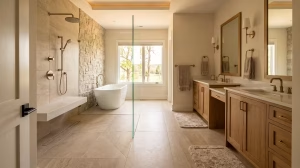
Year after year, the answer is consistent. Kitchens and bathrooms sell homes. A well-designed kitchen with quality appliances, solid-surface countertops, and plenty of storage provides the highest return on investment. Updated master bathrooms with large, walk-in showers and double vanities are also highly sought after. Here in East Tennessee, outdoor living spaces are another huge value-add. A comfortable screened-in porch, a large deck, or a well-designed patio significantly increases a home’s appeal.
Is it cheaper to buy a production home?
Yes, on a per-square-foot basis, the upfront cost of a production home is almost always less than building a custom home. The builder’s ability to buy materials in bulk and use labor efficiently creates savings that are passed on to the buyer. While you may spend more on upgrades in a production home, the starting base price is significantly lower than the starting point for a true custom build.
Can unique features hurt my resale value?
Yes, they certainly can. A feature is only worth what a buyer is willing to pay for it. A swimming pool can be a perfect example. For some buyers, it is a dream feature. For others, it is a dangerous and expensive maintenance headache. Highly specific rooms, like a dedicated home theater or a wine cellar, will only appeal to a small fraction of buyers. When it comes time to sell, you are better off having a flexible bonus room that a future owner can imagine as a playroom, office, or gym, rather than a room built for a single, niche purpose.
Conclusion
In the end, the question of custom vs. production home resale value in Tri-Cities, TN does not have a simple winner. The right answer depends entirely on your personal financial situation, your long-term plans, and your tolerance for risk.
A production home typically represents a safer, more liquid investment. It offers steady, predictable appreciation and appeals to the widest possible audience of buyers. A custom home is a more complex venture. It offers the potential for a greater financial reward and the deep satisfaction of living in a space created just for you, but it carries the risk of over-capitalizing and a longer, more difficult sales process.
My final piece of advice as a builder is this: the best investment is always a well-built, well-maintained home in a good location, regardless of whether it was born from a production portfolio or a custom blueprint. Quality, care, and thoughtful design are the true currencies of long-term value in real estate. Before you commit to either path, I encourage you to speak with experienced local real estate agents and builders who can give you an honest assessment of the current market and help you make a choice that is right for you.