
The Intersection of Thermal Physics and Biophilic Architecture
The Ritual of Immersion
Water shapes human biology. When you submerge your body in warm water, your heart rate slows, your blood vessels expand, and your nervous system shifts away from stress. For generations, modern home building treated the bathroom as a purely utilitarian room, built for quick hygiene rather than sustained wellness. In the Appalachian Highlands and across the Tri-Cities of East Tennessee, we are seeing a major shift. Homeowners want their living spaces to feel restorative, grounding, and tied directly to the earth.
True immersion is not about rushing through a ten-minute shower. It is an intentional ritual. When you settle into a bath after a long day, the material holding that water becomes your immediate environment. It forms your sensory horizon. If that material feels flimsy, synthetic, or artificially slick, your brain registers the space as manufactured and temporary. When that material is solid, heavy, and mineral-based, your body responds with a deeper sense of physical security. The ritual of the bath becomes an anchor for daily wellness, bridging the gap between indoor living and the restorative calm of the outdoors.
Defining the Scope
Choosing a tub comes down to two primary contenders: natural or composite stone, and polymethyl methacrylate, commonly known as acrylic. While both can look attractive in a showroom, they behave in fundamentally different ways once you install them in a home. The debate between a freestanding stone soaking tub vs acrylic heat retention biophilia involves real physics and biology. It comes down to how materials interact with heat, how they feel to the human touch, and how their physical weight affects the structure of your house.
Acrylic is an engineered polymer, essentially a lightweight plastic shell reinforced with fiberglass and resin. A stone soaking tub, on the other hand, is built either by carving raw mineral blocks such as granite, basalt, marble, or soapstone, or by casting crushed natural limestone bound with high-performance polymers. These two material paths demand very different engineering choices. Acrylic prioritizes quick manufacturing, low shipping weight, and ease of handling. Stone prioritizes structural permanence, high physical mass, and organic connection. To understand which one truly belongs in a restorative bath suite, we have to look closely at thermal dynamics, human sensory biology, and structural engineering.
+---------------------+-----------------------+-----------------------+
| Core Parameter      | Stone Soaking Tub     | Standard Acrylic Tub  |
+---------------------+-----------------------+-----------------------+
| Material Base       | Natural stone or      | Vacuum-formed plastic |
|                     | crushed limestone     | with fiberglass base  |
| Typical Empty Mass  | 300 to 800+ lbs       | 70 to 120 lbs         |
| Acoustic Profile    | Solid, dampens echoes | Hollow, reverberant   |
| Primary Heat Mode   | Radiant thermal mass  | Surface-layer barrier |
+---------------------+-----------------------+-----------------------+
The Core Trade-Off
Every architectural choice carries trade-offs. The divide between acrylic and stone represents a classic choice between convenience and long-term performance. Acrylic warms up quickly on its very surface, avoiding initial cold shock when your skin touches it. It is light enough for two people to carry up a narrow set of stairs without special equipment. Yet, that lightness comes from a thin, hollow wall structure that cannot store substantial thermal energy. Over a long soak, the water loses its warmth steadily into the surrounding room air.
A stone soaking tub demands respect during the planning phase. It is exceptionally heavy, requires deliberate subfloor preparation, and absorbs heat from the water during the first few minutes of filling. However, once that dense mineral wall absorbs that energy, it transforms from a cold vessel into a radiant thermal battery. It stores that heat, stabilizes the water temperature, and eliminates the rapid cooling curve seen in plastics. The trade-off is clear: acrylic offers easy installation, while a stone soaking tub offers geological grounding, superior thermal longevity, and genuine physical permanence.
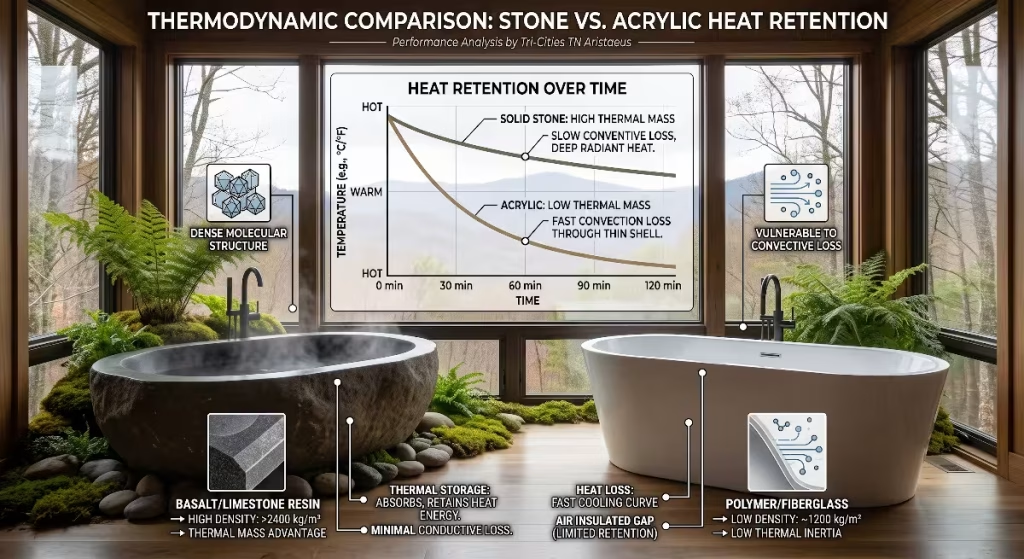
Thermodynamic Comparison: Stone vs. Acrylic Heat Retention
Heat Transfer Mechanics in Soaking Tubs
Heat moves out of a bath through three main paths: conduction, convection, and radiation, accompanied by evaporation at the water surface.
                       [ Evaporative Loss ]
                         ^   ^   ^   ^
                       ~~~~~~~~~~~~~~~~~  <- Open Water Surface
                      |                 |
  [ Conduction Into ] |   Warm Bath     | [ Conduction Into ]
  [  Tub Sidewalls  ] |     Water       | [  Tub Sidewalls  ]
                      |                 |
                       \_______________/
                               |
                       [ Heat Loss Down ]
Evaporation at the open water surface accounts for a massive portion of total energy loss, but the sidewalls of the tub dictate how the water feels against your body along the perimeter. When hot water touches a colder surface, energy transfers rapidly through conduction. How that surface responds depends on two primary scientific metrics: specific heat capacity and thermal conductivity.
Specific heat capacity measures how much energy an object must absorb before its temperature rises by one degree. Thermal conductivity measures the speed at which heat moves through that object. Acrylic has very low thermal conductivity. It acts as an insulator, which means heat moves through it slowly. However, because acrylic shells are thin and light, they have almost no volumetric heat storage. They act like a thin windbreaker jacket: they block immediate drafts, but they cannot store body heat.
A stone soaking tub has a much higher volumetric heat capacity. Because the tub walls are thick, dense, and heavy, they contain thousands of times more mass than an acrylic shell. When you fill a stone soaking tub, the dense mineral wall drinks in the warmth of the water. Once charged, that stone soaking tub acts like a heated masonry stove, holding that warmth and preventing sudden temperature drops along the boundary layer where your back, shoulders, and legs rest.
Engineered and Natural Stone Performance
When examining stone tubs, we divide the category into two main groups: quarried natural stone blocks and cast stone resin composites. Quarried stone, such as soapstone or river basalt, features tight mineral crystals that excel at storing energy. Soapstone, for instance, has been used in Appalachian woodstoves for centuries because it can absorb intense heat without cracking and radiate that warmth outward for hours. A stone soaking tub carved from solid stone behaves in the exact same manner.
Cast stone resin, often composed of roughly seventy to eighty percent crushed natural limestone blended with specialized bonding resins, matches or exceeds the thermal profile of quarried stone. The crushed limestone provides mineral density, while the resin matrix eliminates natural fissures and weak points.
When you run hot water into a stone soaking tub, the inner wall warms up over the first five to eight minutes. For the most comfortable experience, experienced bathers temper the vessel by running hot water along the inner rim as the tub fills. Once the stone soaking tub reaches equilibrium with the water, it ceases to draw energy inward. Instead, it forms a protective thermal barrier.
As the room air cools the surface of the water, the heated mass of the stone soaking tub gently radiates its stored thermal energy back into the water volume. This process significantly flattens the cooling curve, allowing bathers to enjoy extended forty-five to sixty-minute soaks without having to constantly run the hot water tap to refresh the temperature.
Acrylic Performance
Acrylic tubs are manufactured by heating a thin sheet of plastic, stretching it over a mold using a vacuum, and reinforcing the underside with chopped fiberglass strands and polyester resin. High-end models feature double-walled construction, which creates a hollow air space between the inner and outer shells.
This design creates an effective thermal barrier for short periods. Because the plastic wall has very little physical mass, it takes minimal heat to warm the microscopic layer of plastic touching your skin. When you step into an acrylic tub, the surface does not feel shockingly cold.
However, the laws of physics catch up quickly during longer baths. The thin plastic cannot store thermal energy. The air gap between the double walls provides some insulation, but air within that cavity circulates through natural convection, carrying warmth toward the cold exterior shell.
After fifteen to twenty minutes, the water temperature in an acrylic tub begins to decline at a steep, steady rate. Because the walls cannot push radiant heat back into the liquid, the water cools from both the open top and through the sidewalls. Bathers who enjoy long sessions find themselves regularly draining water and opening the hot water valve, disrupting their relaxation and consuming extra household energy.
Empirical Breakdown: Water Temperature Over Time
To see how this works in real life, consider a test comparing a double-walled acrylic tub and a cast stone soaking tub. Both tubs are placed in a room held at 68 degrees Fahrenheit, filled with 60 gallons of water heated to 104 degrees Fahrenheit, and left without an insulated surface cover.
Water Temperature Over Time (Degrees Fahrenheit)
105 F |  *
      |   * = Stone Soaking Tub
100 F |    *  *  *  *  *  *  *  *  *
      |   o  o
 95 F |        o  o
      |             o  o  o  o  o  o      o = Double-Walled Acrylic
 90 F +----------------------------------
      0 min      20 min      40 min      60 min
+---------------+-------------------+----------------------+
| Elapsed Time  | Stone Soaking Tub | Double-Walled Acrylic|
+---------------+-------------------+----------------------+
| Initial Fill  | 104.0 F           | 104.0 F              |
| 10 Minutes    | 102.8 F           | 101.5 F              |
| 20 Minutes    | 101.9 F           | 98.7 F               |
| 30 Minutes    | 100.8 F           | 96.2 F               |
| 45 Minutes    | 99.1 F            | 93.0 F               |
| 60 Minutes    | 97.4 F            | 90.1 F               |
+---------------+-------------------+----------------------+
During the first ten minutes, the stone soaking tub absorbs a small amount of heat as its thick mineral walls reach thermal equilibrium, dropping the water temperature by roughly 1.2 degrees. The acrylic tub drops by 2.5 degrees as heat escapes through its thin walls and the open surface.
Between the twenty-minute and forty-five-minute marks, the difference becomes dramatic. The stone soaking tub, now thoroughly warmed, stabilizes the water, losing only about 1.7 degrees over those twenty-five minutes.
The acrylic tub, lacking any stored thermal energy, loses heat rapidly, dropping below 95 degrees, which feels lukewarm to human skin. By the end of an hour, the bath in the stone soaking tub remains comfortable and restorative, while the acrylic bath has cooled to the point of discomfort.
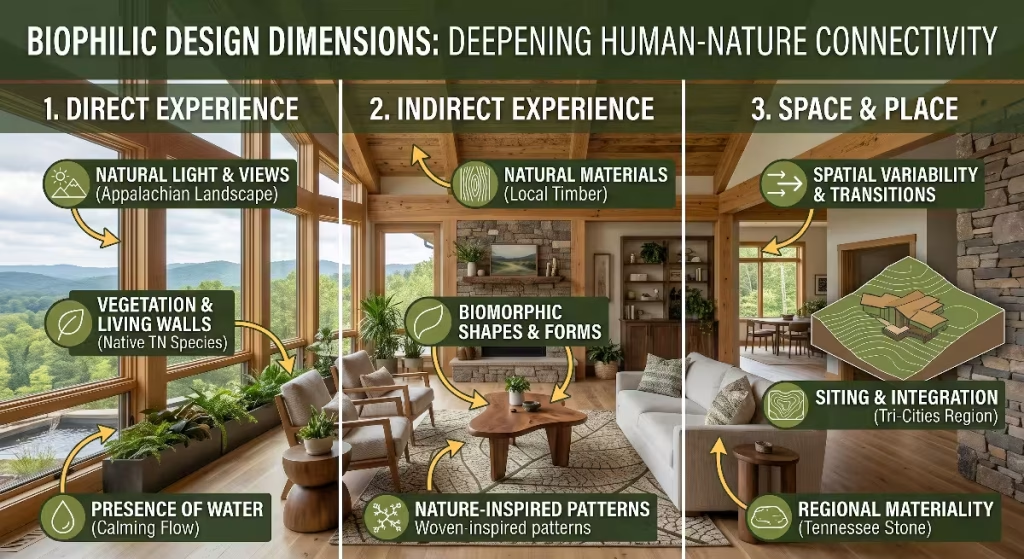
Biophilic Design Dimensions: Deepening Human-Nature Connectivity
Visual and Tactile Connection with Nature
Biophilic design is the practice of connecting people to nature inside built environments. Human beings evolved over millions of years outdoors, surrounded by living systems, geological formations, natural light, and varied textures. Our modern indoor lifestyle often places us in sterile boxes surrounded by processed, synthetic materials like vinyl, laminate, and plastic. This artificial environment can produce subtle, chronic sensory fatigue.
       [ Biophilic Design Elements ]
                     |
     +---------------+---------------+
     |                               |
[ Visual Connection ]      [ Tactile Connection ]
  - Organic forms            - Micro-textures
  - Mineral variations       - Solid mass
  - Matte light diffusion    - Grounded stability
When you step into a bathroom designed with natural materials, your visual and tactile systems relax. A natural stone soaking tub or a high-quality cast stone soaking tub provides a direct link to the earth. The surface of real stone is never truly uniform; it has microscopic variations in grain, subtle shifts in coloration, and a soft, matte finish that diffuses bathroom light rather than bouncing harsh glares into your eyes.
Acrylic, by contrast, is an uninterrupted synthetic plane. Its high-gloss surface looks reflective and plasticky. When your fingers move across acrylic, your brain recognizes the frictionless slide of petrochemical plastic.
Touching a stone soaking tub engages your mechanoreceptors, the nerve endings in your skin that detect real textures. The soft, velvet-like touch of honed limestone composite or the cool, solid strength of carved granite gives your hands and body an unmistakable feeling of authenticity. It roots you in the room, creating an immediate, physical connection to the natural world.
Material Honesty and Sensory Authenticity
In architectural theory, material honesty means using materials for what they truly are, rather than disguising them as something else. An acrylic tub molded and printed to look like marble violates this principle. Your eyes may see stone patterns from across the room, but the moment your bare skin touches the wall, or your foot steps onto the floor of the tub, the illusion collapses. Your mind registers the discrepancy immediately.
A stone soaking tub represents complete material honesty. When you rap your knuckles against the rim of a stone soaking tub, you hear a dull, deep, solid thud. The sound waves cannot bounce through the dense stone; they are absorbed by the mass of the rock. In an acrylic tub, knocking on the rim produces a hollow, drum-like echo.
This acoustic difference plays a major role during a bath. When water flows from a floor-mounted filler into an acrylic tub, the water strikes a flexible membrane, generating high-pitched, echoing splashes that reverberate off hard-tiled bathroom walls.
When water strikes a stone soaking tub, the heavy walls absorb those high frequencies. The sound changes from an echoing splash to a deep, soothing cascade, mirroring the acoustic tone of a mountain stream flowing over river stones. That acoustic dampening calms the nervous system, turning a simple bath into a deeply restorative experience.
+---------------------+-----------------------+-----------------------+
| Sensory Property    | Stone Soaking Tub     | Standard Acrylic Tub  |
+---------------------+-----------------------+-----------------------+
| Haptic Feedback     | Matte, micro-textured,| Glossy, slick,        |
|                     | mineral grounding     | synthetic polymer     |
| Acoustic Signature  | Deep, muffled, sound- | Hollow, echoing,      |
|                     | absorbing resonance   | drumming resonance    |
| Visual Reflection   | Soft light diffusion  | Specular, harsh glare |
| Structural Rigidity | Zero flex under load  | Noticeable wall flex  |
+---------------------+-----------------------+-----------------------+
Thermal Biophilia (Alliesthesia)
In environmental physiology, alliesthesia describes how our perception of pleasure changes depending on our physical state. When you are cold, touching something pleasantly warm feels deeply satisfying. When you are hot, a cool breeze feels wonderful. In biophilic architecture, thermal biophilia focuses on moving away from flat, static indoor temperatures and offering gentle, natural thermal variations that awaken our senses.
A stone soaking tub is a masterclass in thermal biophilia. When you first enter the room, the stone rim above the water line is cool to the touch, matching the ambient temperature of the bathroom. As you lower yourself into the hot water, your body experiences the deep warmth of the bath.
When you rest your arms or neck against the smooth, heated stone soaking tub rim that has been warmed by the water below, the slow transfer of heat through the stone mimics the feeling of sun-warmed rocks along a riverbank. This slow, radiant warmth penetrates deep into muscle tissue, easing tension in ways that thin plastic surfaces simply cannot replicate. The interplay between the cool ambient air, the steaming water, and the warm, grounded mass of the stone soaking tub engages your autonomic nervous system, encouraging rest and recovery.
Architectural and Structural Engineering Considerations
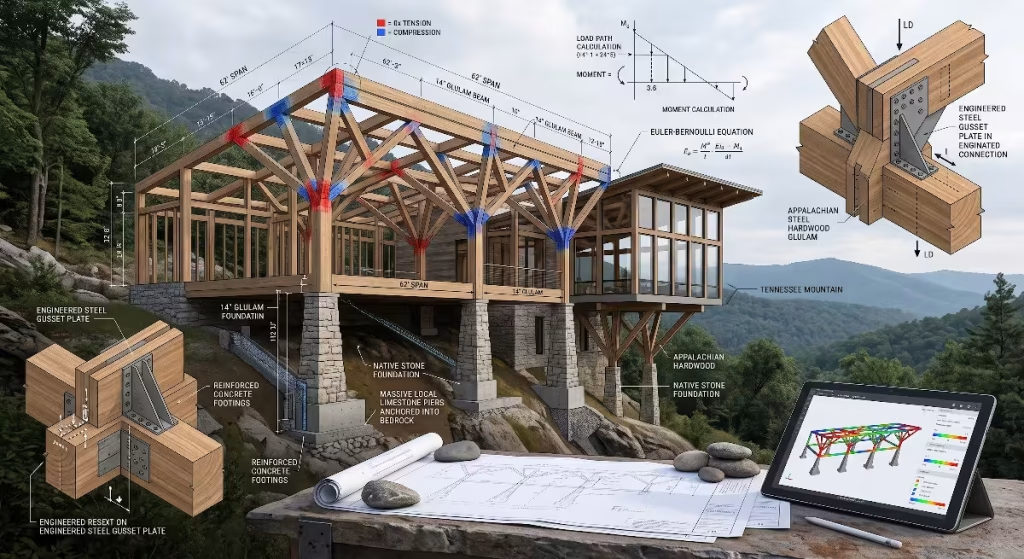
Dead Load Calculations and Subfloor Reinforcement
While the aesthetic and thermal benefits of a stone soaking tub are clear, you must also consider the structural realities of installing one. You cannot simply drop an 800-pound stone soaking tub into an existing bathroom without evaluating the framing below. The difference in dead weight between acrylic and stone requires careful architectural planning.
Total Weight on Subfloor = Empty Tub Weight + Water Weight (8.34 lbs/gal) + Bather Mass
An average freestanding acrylic tub weighs between 70 and 120 pounds empty. When filled with 60 gallons of water (roughly 500 pounds) and an adult bather (180 pounds), the total live and dead load sits around 750 to 800 pounds. Distributed across the tub footprint, this falls easily within the standard design loads of modern residential subfloors built to standard building codes.
A cast stone soaking tub easily weighs between 300 and 500 pounds empty, while a natural carved granite or basalt tub can reach 800 to 1,500 pounds dry. When you add 60 to 80 gallons of water and the weight of one or two bathers, the total working load of a stone soaking tub can easily surpass 1,200 to 2,000 pounds.
Working Load Comparison (60 Gallons of Water + 180 lb Bather)

Stone Soaking Tub (500 lb dry)
[ Tub: 500 lbs ] + [ Water: 500 lbs ] + [ Bather: 180 lbs ] = 1,180 lbs Total

Acrylic Tub (90 lb dry)
[ Tub: 90 lbs ] + [ Water: 500 lbs ] + [ Bather: 180 lbs ] = 770 lbs Total
Residential building codes typically mandate a minimum uniform live load capacity of 30 to 40 pounds per square foot (psf) for bedrooms and bathrooms. A filled stone soaking tub concentrates its heavy load onto a small, dedicated footprint, creating a concentrated point load that can exceed 100 to 150 pounds per square foot.
Standard Bathroom Framing (Requires Verification for Stone):
Joists: 2x10 or 2x12 Dimensional Lumber | Spacing: 16" on-center
Target Deflection for Tile/Stone Substrates: L/720 or L/1080 (No Sags)
To safely support a stone soaking tub, a structural engineer or professional builder must verify the joist system:
- Calculate the maximum bending moment and deflection limit of the floor framing.
- While typical floors allow a deflection rating of L/360 (where deflection equals joist span length divided by 360), rooms with natural stone floors and heavy tubs should be built to L/720 or L/1080 to prevent floor bounce and cracked tile mortar.
- If existing joists are insufficient, builders must sister the joists by bolting matching lumber alongside them, double up the perimeter framing, or install a structural beam or post directly beneath the tub location in the crawlspace or basement below.
       [ Subfloor Cross-Section: Sistered Joist Reinforcement ]

   =================== Subfloor & Tile Membrane ===================
        |  |                     |  |                     |  |
        |  |                     |  |                     |  |
        |  | [Sistered]          |  | [Sistered]          |  | [Sistered]
        |  | [ Joist  ]          |  | [ Joist  ]          |  | [ Joist  ]
        |  |                     |  |                     |  |
        +--+                     +--+                     +--+
Installation Feasibility and Logistics
The physical delivery and installation of a stone soaking tub requires its own plan. An acrylic tub can easily be carried through standard doorways, around tight hallway turns, and up second-story staircases by two workers. A stone soaking tub, however, demands dedicated rigging, careful route planning, and plenty of physical muscle.
In the mountain homes and ridge properties common to Johnson City, Kingsport, and Bristol, primary suites are often built on upper levels to take advantage of panoramic mountain views. Moving a 600-pound stone soaking tub up an open timber staircase requires heavy-duty furniture dollies, lifting straps, and sometimes a crew of four to six people.
In some custom homes, builders coordinate with crane operators to fly the stone soaking tub through an open second-story window or rough exterior balcony framing before final glass and drywall are installed.
Pre-Installation Checklist for a Stone Soaking Tub:
1. Verify clear path from exterior staging to final bathroom layout.
2. Measure all interior door openings, stairwell clearances, and turning radii.
3. Confirm rough plumbing drain centerlines precisely; stone cannot be easily notched.
4. Reinforce floor framing and install uncoupling membranes beneath tile.
5. Provide dedicated leveling compound to eliminate point stress on the tub base.
Plumbing rough-ins must be executed with millimeter precision. With an acrylic tub, there is often some flexibility under the hollow skirt to adjust drain lines or fit slip-joint connections. A stone soaking tub has zero tolerance for installation errors.
The drain hole is cast or cored directly through solid material that can be several inches thick. The rough drain pipe in the subfloor must align with the tub drain location.
Furthermore, the floor beneath a stone soaking tub must be level. Because stone does not flex, any high spot in the subfloor creates a pivot point that concentrates stresses, which can lead to stress fractures in composite materials or cracked floor tiles underneath.
Comprehensive Material Matrix
To help you compare these materials clearly, this matrix sets the technical properties of natural stone, stone composite, and acrylic side by side.
+-----------------------------------+--------------------+--------------------+--------------------+
| Evaluation Metric                 | Natural Stone      | Stone Resin        | Acrylic            |
|                                   | (Basalt/Soapstone) | (Limestone Blend)  | (Double-Walled)    |
+-----------------------------------+--------------------+--------------------+--------------------+
| Specific Heat Capacity            | Medium-High        | High               | Low-Medium         |
| Volumetric Thermal Mass           | Extremely High     | High               | Very Low           |
| Heat Retention (45+ min soak)     | Outstanding        | Excellent          | Poor to Fair       |
| Empty Weight (approximate)        | 800 - 1,500+ lbs   | 300 - 550 lbs      | 70 - 120 lbs       |
| Structural Framing Upgrades       | Mandatory          | Often Required     | Rarely Required    |
| Biophilic Tactile Connection      | Absolute / Raw     | High / Velvet-soft | Low / Synthetic    |
| Acoustic Sound Absorption         | Exceptional        | Exceptional        | Minimal (Echoing)  |
| Surface Repairability             | Challenging        | Easy (Buffable)    | Easy to Moderate   |
| Scratch and Chemical Resistance   | High               | High               | Vulnerable to Dents|
| Installation Labor Demands        | Very High          | Moderate to High   | Low to Moderate    |
| Relative Life Expectancy          | 100+ Years         | 50+ Years          | 10 - 15 Years      |
+-----------------------------------+--------------------+--------------------+--------------------+
Frequently Asked Questions about Stone Soaking Tubs vs. Acrylic
Does a stone resin tub hold heat longer than acrylic?
Yes, a cast stone resin soaking tub holds water heat significantly longer than a standard acrylic tub during extended bathing sessions. While acrylic feels warm the instant you touch it, that initial warmth comes from its low thermal conductivity, not real heat storage. Because an acrylic tub has thin, lightweight walls, it cannot store thermal energy.
A stone soaking tub, by contrast, features thick walls loaded with natural limestone powder and mineral binders. This substantial mass acts as a heat sink.
Once the stone soaking tub absorbs energy from the initial fill water, it reaches a steady temperature and steadily radiates that energy back into the water bath. While an acrylic tub loses heat quickly after twenty minutes, a stone soaking tub maintains comfortable soaking temperatures for forty-five minutes to an hour without needing more hot water.
                      Heat Loss Trajectory Over 60 Minutes
Warmest |
        | [ Stone Soaking Tub ]: Steady, gradual decline (retains thermal mass)
        |
        | [ Acrylic Tub ]: Rapid cooling curve after initial 15-20 min window
Coolest +-----------------------------------------------------------------------
        0 min                        30 min                            60 min
Is a stone freestanding tub cold to the touch?
When empty and sitting in an unheated room, a stone soaking tub will match the ambient air temperature of your home. Because natural stone and mineral composites have higher thermal conductivity than plastics, they draw heat away from bare skin quickly when cold, creating that initial feeling of chill.
However, this is easily avoided with simple bath habits. As you fill your stone soaking tub, use the hand shower or direct the incoming hot water across the interior walls and backrest for sixty seconds.
Because the stone soaking tub absorbs and holds heat, the walls warm quickly. Once warmed, the stone soaking tub stays warm for the rest of your soak, providing a gentle, radiant warmth along your shoulders and back that acrylic cannot duplicate.
Can upper-level subfloors support a freestanding stone tub?
Yes, but you should not install one without first checking the floor framing. An upper-level subfloor built to standard residential building codes is designed to support normal household furniture and standard acrylic bathtubs without modification.
However, a stone soaking tub filled with sixty to eighty gallons of water plus the weight of a bather can easily exceed 1,000 to 1,500 pounds. This concentrated weight can cause standard floor joists to sag over time, which can crack floor tile grout, damage drywall ceilings below, or cause structural issues.
Upper Floor Installation Path:
Check Joist Depth & Span -> Calculate Total Weight Load -> Sister Joists if Needed -> Seal Subfloor
Before placing a stone soaking tub on an upper floor, have a structural engineer, architect, or master builder review the framing. Strengthening the floor usually involves sistering existing joists with new lumber, adding structural blocking, or shortening spans with an engineered support beam below.
How do you clean and maintain matte stone resin compared to glossy acrylic?
Matte stone resin is non-porous and remarkably durable, but it requires different care than glossy plastic. Acrylic tubs feature an ultra-smooth, non-porous outer glaze that cleans easily with mild liquid dish soap and warm water. However, acrylic scratches easily if cleaned with abrasive pads, and chemical cleaners can dull or discolor the plastic over time.
A cast stone soaking tub features a solid, uniform material throughout its entire wall thickness. For routine maintenance, wash it using warm water and a neutral pH soap or a stone-safe daily bathroom cleaner. Avoid harsh acids, bleach, or ammonia, which can break down protective sealers.
The real maintenance benefit of a matte stone soaking tub is how easily it can be repaired. If you accidentally scratch or scuff the surface with a metal buckle or glass bottle, you do not need an expensive specialist. You can buff away surface marks using a light abrasive cleaning pad or fine-grit sandpaper, instantly restoring the original matte finish.
+---------------------+-----------------------+-----------------------+
| Maintenance Task    | Stone Soaking Tub     | Standard Acrylic Tub  |
+---------------------+-----------------------+-----------------------+
| Daily Surface Wash  | pH-neutral soap,      | Mild dish liquid,     |
|                     | micro-fiber cloth     | soft sponge           |
| Scratch Repair      | Lightly sand or buff  | Specialized polish or |
|                     | surface directly      | professional relining |
| Chemical Tolerance  | Sensitive to acids;   | Sensitive to solvents |
|                     | safe with gentle soap | and abrasive cleaners |
| Staining Resistance | High if kept clean;   | High, but vulnerable  |
|                     | can be re-sealed      | to surface fading     |
+---------------------+-----------------------+-----------------------+
Is stone resin worth the extra cost over acrylic for residential wellness?
For homeowners who prioritize daily self-care, quality construction, and timeless materials, a stone soaking tub is well worth the extra investment. Acrylic tubs carry lower purchase prices and lower installation costs, making them practical for guest rooms, rental properties, or quick renovations on strict budgets.
However, acrylic tubs have an average service life of ten to fifteen years before the plastic shows surface wear, dulls, or flexes enough to cause seam issues.
A stone soaking tub is a lifetime architectural fixture. It will not yellow, flex, or creak underfoot. Beyond longevity, its superior heat retention saves hot water, while its natural look and solid feel create a calming, biophilic environment.
In custom homes across the Appalachian region, a stone soaking tub serves as a stunning visual centerpiece, elevating the bathroom into a private spa retreat while adding lasting real estate value.
Synthesis and Specification Recommendations
The Archetype for Acrylic
Acrylic remains a practical, versatile option for specific home building scenarios. It works best when:
- Working with strict budget limits on fixtures and plumbing.
- Retrofitting an existing second-floor bathroom where opening ceilings to reinforce framing is not an option.
- Building a guest bathroom that will only be used occasionally.
- The homeowner prefers quick fifteen-minute baths over long soaking rituals.
In these situations, a well-built, double-walled acrylic tub provides clean looks and quick warmth at an accessible price.
       [ Project Decision Tree ]
                   |
   Is structural modification an option?
          /                \
        [No]               [Yes]
         |                   |
Use Acrylic Tub     Do you prefer long, restorative soaks?
                    and natural materials?
                           /         \
                         [Yes]       [No]
                           |           |
            Specify Stone Soaking Tub  Use Acrylic
The Archetype for Stone
A stone soaking tub is the clear choice for spaces designed around wellness, quiet luxury, and lasting design. It is ideal for:
- Primary suites designed as restorative personal retreats.
- Homes designed with biophilic elements, celebrating exposed timber, stone walls, and large windows that frame nature.
- Ground-level or slab-on-grade suites where weight is easily handled by the foundation.
- Custom mountain builds where the mass of the tub balances temperature swings and adds grounded permanence to the home.
In these spaces, the stone soaking tub becomes more than just a plumbing fixture. It anchors the room, turning daily hygiene into an intentional, grounding ritual.
                  Ideal Space Specification
+-----------------------------------------------------------+
| Primary Suite Retreat with Mountain Views                 |
| Subfloor: Engineered Framing (Deflection Rating L/720)    |
| Floor Finish: Large-format Slate or Honed Limestone       |
| Core Fixture: 67-inch Oval Cast Stone Soaking Tub         |
| Acoustic Profile: Quiet, Solid, Low Reverberation        |
| Lighting: Warm, Diffuse (2700K) to Complement Matte Finish|
+-----------------------------------------------------------+
Final Verdict
Choosing between an acrylic tub and a stone soaking tub is ultimately a choice between convenience and craftsmanship. Acrylic gives you an easy installation and a lightweight shell, but it lacks the thermal mass, solid acoustics, and grounding textures of natural materials. Over longer baths, its rapid heat loss works against true rest and relaxation.
A stone soaking tub demands careful planning, thoughtful structural engineering, and skilled installation. In return, it delivers an unmatched bathing experience.
By holding its warmth for extended soaks, dampening echoing water sounds, and offering an authentic, natural surface to the touch, the stone soaking tub unites the best of thermal physics and biophilic design. It transforms the bathroom into a restorative sanctuary, providing a lifetime of daily wellness and a quiet, beautiful connection to the earth.
Key Technical Takeaways for Your Project
- Plan for Mass: Check your structural floor loads early to ensure your joists comfortably support the tub when filled with water and bathers.
- Warm the Surface: Spend sixty seconds rinsing the tub walls with hot water when filling your stone soaking tub to start the thermal storage process.
- Prioritize Texture: Choose a honed or matte finish over high-gloss polish to maximize tactile comfort and natural light diffusion.
- Design the Surroundings: Pair your stone soaking tub with authentic regional materials like Appalachian white oak, mountain slate, and low-glare lighting to create a cohesive, nature-inspired retreat.