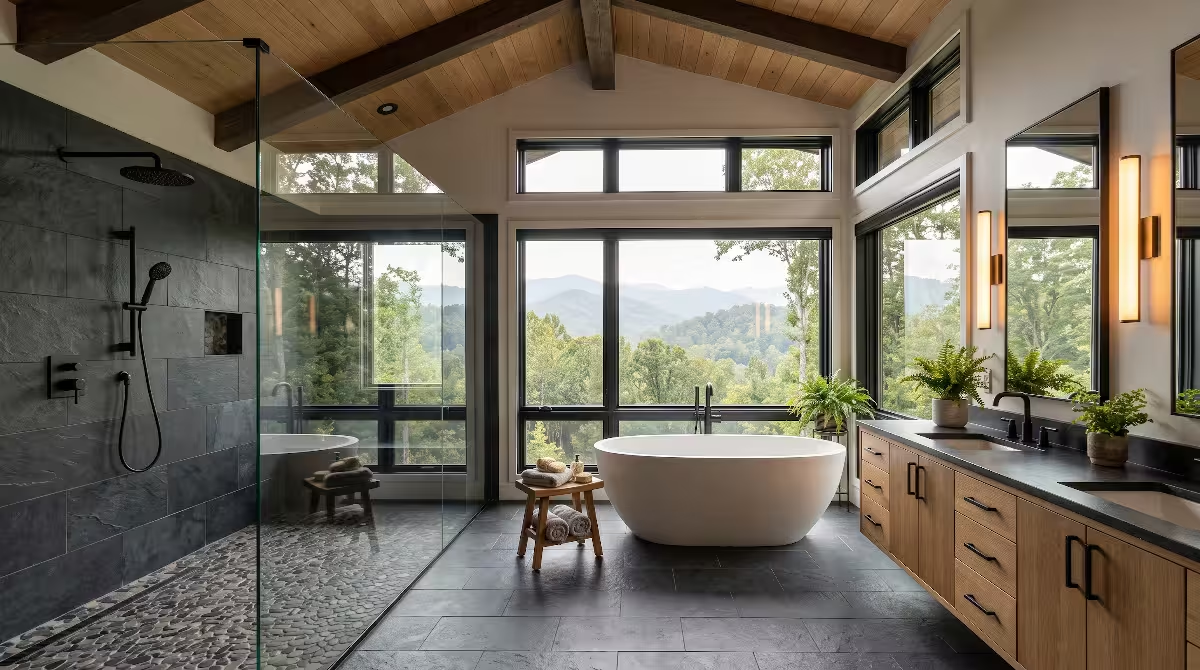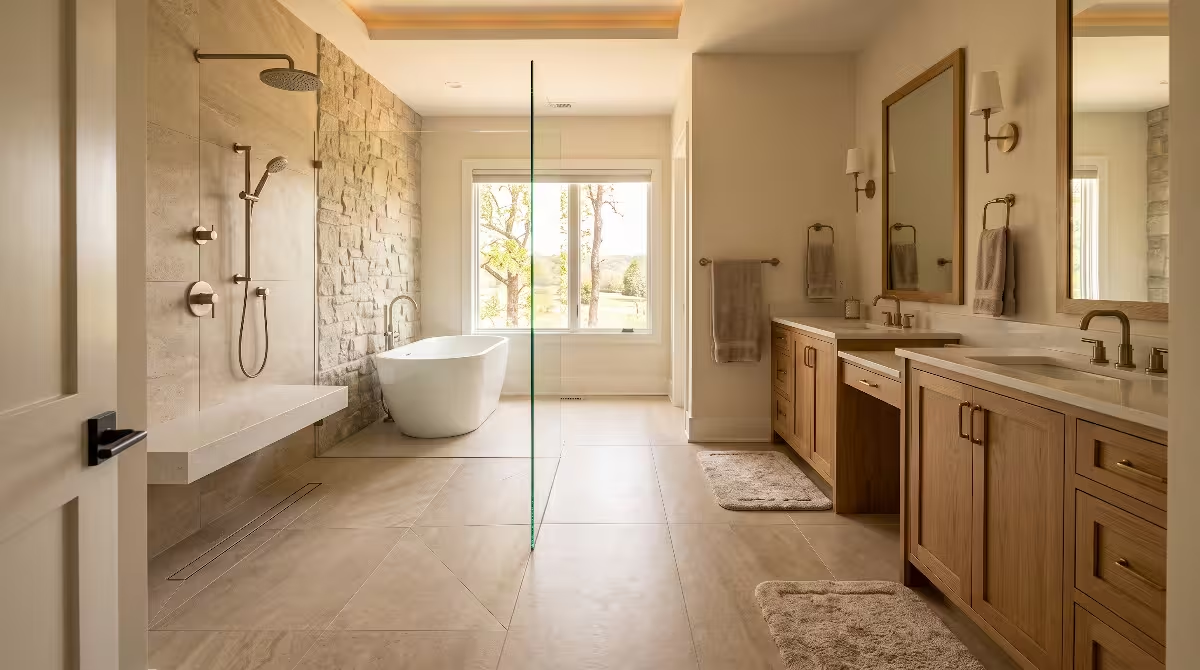


Imagine stepping into your primary bathroom just after sunrise. Mist curls off the calm water outside your oversized picture window, and warm morning light spills across your freestanding soaking tub. It feels like a private mountain or lakeside retreat until a pontoon boat glides past your shoreline, or a neighbor steps onto the dock next door.
Suddenly, that breathtaking wall of glass feels less like a spa sanctuary and more like a fishbowl. Building or remodeling a waterfront home means wrestling with this exact problem: you want to enjoy the water view you paid a premium for, yet you also deserve complete comfort and modesty while getting dressed or stepping out of the shower.
Most homeowners reach for traditional window coverings first, only to discover how poorly they perform in a damp lakeside bathroom. Heavy fabric drapes soak up steam from hot showers and quickly develop musty odors or mildew along the hems. Fabric Roman shades trap moisture against the cold windowpane during winter mornings, leaving water stains that ruin the material. Even faux-wood or slatted blinds collect dusty lint mixed with bathroom humidity, creating a chore nobody wants to clean every weekend. Worse yet, pulling shades or blinds shut blocks the sparkling water and natural daylight that make a lakefront bathroom feel spacious and uplifting.
Choosing the right privacy glass solves both problems at once by building seclusion directly into the window itself. Before you order custom windows or apply a retrofit film, you need to judge every option using four practical standards.
First is 24-hour opacity, which measures whether the glass hides shapes both in bright sunlight and at night when your vanity lights are glowing. Second is visible light transmission, which tells you how much natural daylight enters the room so you still get clean, accurate lighting for morning hair and makeup routines. Third is moisture durability, ensuring the surface will not peel, bubble, or trap hard-water spots in a steamy environment. Fourth is view preservation, which determines how much of the lake, sky, and shoreline greenery you can still enjoy throughout the day.
Permanent Privacy Glass Upgrades for New Builds and Window Replacements
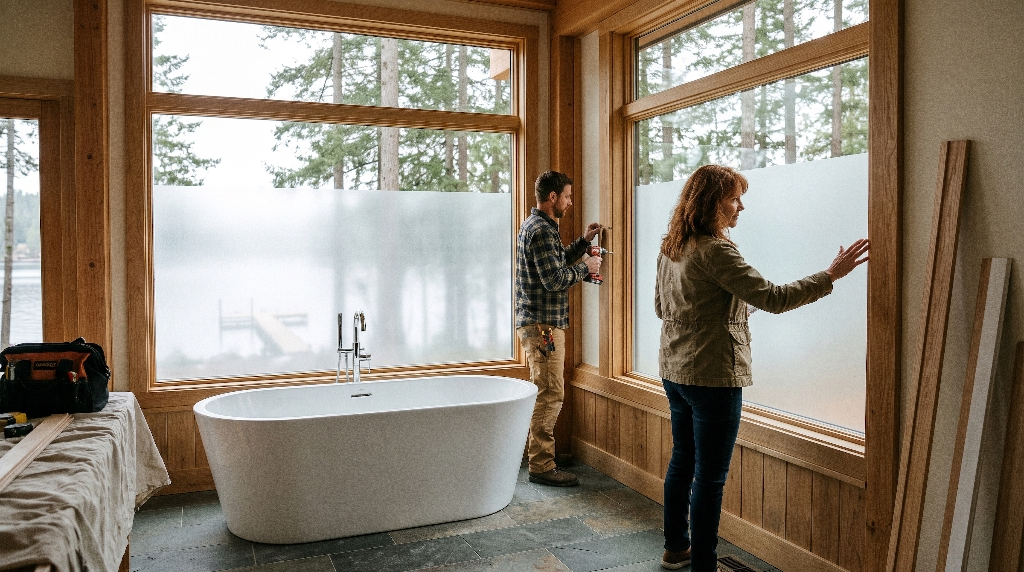
If you are building a custom waterfront home or replacing aging windows, ordering factory-built privacy glass gives you the cleanest look and longest lifespan. Permanent architectural glazing seals the privacy treatment inside or onto durable glass panes, so you never have to worry about peeling edges or humid air ruining your investment.
Switchable PDLC Smart Glass for Unobstructed Views on Demand
Switchable smart glass is the gold standard when you refuse to give up your lake view during the day. This advanced privacy glass uses a thin layer of Polymer Dispersed Liquid Crystal, often called PDLC, sealed safely between two panes of glass. When you flip a wall switch, tap a smartphone app, or use a voice command, a low-voltage electrical current lines up the microscopic crystals inside the panel. In less than a second, the window turns completely crystal clear, giving you a wide-open view of the water, boats, and trees outside.
When you are ready to step into the tub or get dressed, turning the power off scrambles those crystals and turns the window a soft, frosted white. Even in its frosted state, this privacy glass allows bright daylight to filter into the bathroom while completely blocking anyone outside from seeing shapes or movement. Because the active layer is laminated inside a sealed unit, steam and splashing water cannot reach it. Installed factory-laminated smart glass typically costs between $80 and $145 or more per square foot, plus electrical wiring for a small hidden transformer. While it carries the highest upfront price, it replaces the need for custom motorized shades and protects your view every single morning.
Acid-Etched and Satin Frosted Glass for Soft Spa Lighting
For homeowners who want serene, uninterrupted seclusion around the clock without wiring or switches, acid-etched satin glass is a timeless choice. Manufacturers create this privacy glass by treating one surface of the glass with a controlled chemical solution that dissolves a microscopic layer, leaving behind a silky, uniform matte finish. Unlike older sandblasted glass, which feels rough and grabs onto skin oils or soap residue, acid-etched satin glass feels smooth to the touch and resists fingerprints.
In a lakefront bathroom, satin privacy glass acts like a giant natural light diffuser. Harsh midday sunlight bouncing off the lake turns into a soft, even glow that flatters skin tones at the vanity mirror and eliminates harsh shadows. Better still, acid-etched privacy glass delivers true 24-hour protection. Whether a fishing boat passes twenty yards from your shore at noon or your chandelier is shining at midnight, people outside only see a gentle warm glow rather than recognizable silhouettes.
Fluted, Reeded, and Textured Obscure Glass for Architectural Character
If plain frosted panes feel too modern or minimal for your home, textured architectural glass brings tailored elegance to a waterfront bath. Fluted glass, also known as reeded glass, features parallel vertical grooves pressed into molten glass during manufacturing. Other popular options include rain glass, which mimics water droplets streaming down a pane, and hammered glass, which offers a subtle rippled surface inspired by hand-blown vintage windows.
Textured privacy glass breaks up light rays as they pass through the ridges, blurring people and interior details into soft, impressionistic shapes while keeping the room bright. Vertical fluted glass also draws the eye upward, making standard eight-foot or nine-foot bathroom ceilings feel taller and grander. When ordering textured privacy glass for a picture window, ask your window manufacturer to place the textured face toward the inside airspace of the double-pane unit. That simple specification keeps both the exterior glass and the interior bathroom face completely flat, so you can wipe away condensation with a quick swipe of a microfiber cloth instead of scrubbing inside tiny grooves.
Low-E Tinted and Reflective Insulated Glass for Sun Glare and Daytime Privacy
Lakefront homes face intense glare because sunlight reflects off the water and hits your windows at low angles. Low-emissivity tinted and reflective glass units help tame that brightness while offering daytime seclusion. Low-E coatings are microscopic, virtually invisible metallic layers applied to the glass surface to reflect infrared heat back outside during hot summers and keep indoor warmth inside during chilly winters. When paired with a subtle bronze, gray, or soft blue tint, this privacy glass cuts harsh eye strain and protects your bathroom vanity cabinetry, rugs, and artwork from ultraviolet fading.
During bright daylight hours, reflective and tinted glass acts much like mirrored sunglasses. Because the outside sunlight is much brighter than your bathroom interior, boaters and walkers along the shore mostly see the reflection of the sky and trees on your windowpane. However, every lakefront homeowner needs to understand one crucial rule about tinted and reflective privacy glass: it works based on light balance. The moment the sun goes down and you switch on your bathroom lights, the effect reverses. At night, anyone outside can see straight through tinted or reflective glass into your lit room, which means you must pair this option with a shade or secondary night covering.
Laminated Translucent and Custom Stained or Leaded Glass for Focal Points
Sometimes a picture window above a soaking tub serves as the main architectural centerpiece of the entire bathroom. Laminated translucent glass and custom decorative glass allow you to turn that window into functional art while protecting your modesty. Laminated privacy glass sandwiches a durable, milky-white polyvinyl butyral interlayer between two sheets of strong glass. Not only does that inner layer block sightlines day and night, it also dampens outside sound, hushing the hum of early-morning bass boats or noisy jet skis so your bath stays peaceful.
For traditional, craftsman, or coastal cottage lake homes, custom leaded or stained privacy glass adds unmistakable charm. Modern builders rarely install single-pane stained glass directly against the outdoors because it leaks heat and cold air. Instead, reputable window makers seal the decorative leaded panel inside an insulated double-pane unit between two sheets of clear tempered glass. You get the sparkle of beveled textures and muted seeded glass alongside modern energy efficiency and effortless cleaning.
Retrofit Privacy Options for Existing Lakefront Picture Windows
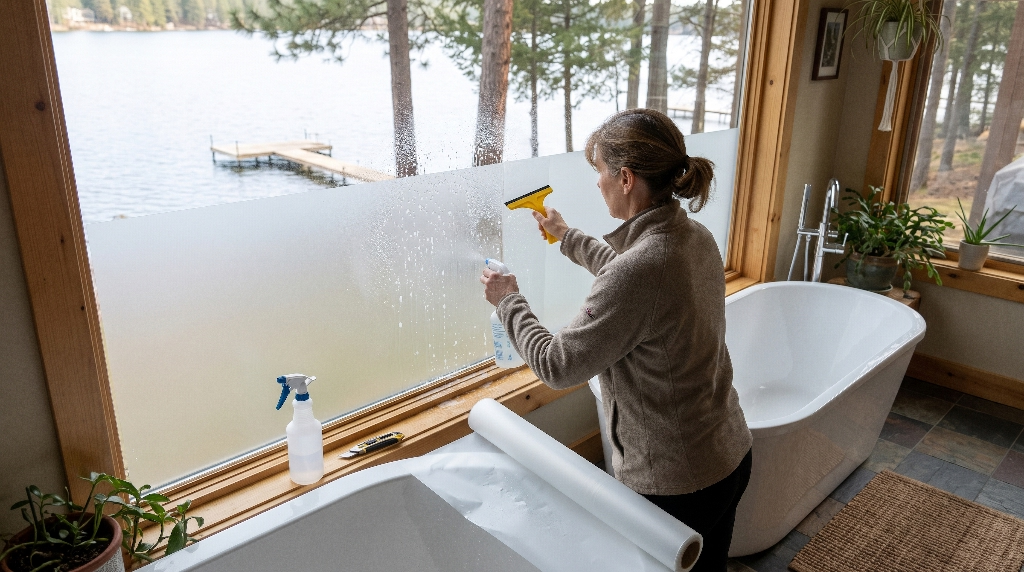
You do not always need to tear out walls or replace expensive custom windows to gain seclusion in an existing waterfront home. If your current picture windows are still airtight and in good structural shape, several smart retrofit options can upgrade your privacy over a single weekend.
Gradient and Ombre Privacy Window Films
Gradient window film is one of the smartest design solutions created for waterfront bathrooms. Instead of covering the entire window in solid frost, gradient film starts out densely opaque at the bottom and gradually fades into crystal-clear transparency near the top. When applied to a large picture window behind a freestanding tub or vanity, the frosted lower section blocks views from docks, boats, and neighboring yards at eye and body level. Meanwhile, the clear upper portion keeps your view of towering lakeside pines, rolling hills, and open sky completely untouched.
High-quality polyester gradient films adhere smoothly to the inside face of clean glass and block up to 98 or 99 percent of ultraviolet rays. Because the transition from frosted white to clear glass looks soft and intentional, it blends easily with modern, transitional, and spa-inspired bathroom designs without making the room feel boxed in.
Static-Cling vs. Adhesive Frosted and Prismatic Films
Homeowners shopping for retrofit window films generally choose between static-cling vinyl and permanent adhesive polyester films. Static-cling privacy films contain no glue at all. Instead, they grip smooth glass through static charge and surface tension after you mist the pane with soapy water and smooth out air bubbles with a plastic squeegee. Static-cling films are affordable, simple to install yourself, and easy to peel off without leaving sticky residue behind if you ever change your mind.
Adhesive architectural films cost a bit more and require careful trimming, but they bond much more tightly to the glass surface. In a steamy bathroom where temperature swings happen daily, cheaper static-cling films can sometimes curl or lift at the corners after a year or two. Professional-grade adhesive frosted or prismatic films resist moisture far better, lasting seven to ten years or longer. Prismatic films also feature tiny geometric micro-patterns that bend incoming sunlight into subtle rainbow sparkles while delivering strong day-and-night privacy.
Pairing Clear Picture Glass with Top-Down Bottom-Up Cellular Shades
If you love looking through completely unaltered clear glass and do not want any permanent frost or film on your window, a top-down, bottom-up cellular shade offers a clever mechanical compromise. Unlike standard blinds that only pull up from the bottom, top-down shades let you lower the top rail down to chest or shoulder height while keeping the lower half of the window covered. You stay completely hidden while soaking in the tub or standing at the sink, yet you still enjoy open blue sky and upper lake views above the shade line.
To make this setup survive bathroom humidity, skip delicate linen or cotton fabrics and choose moisture-resistant spun-lace polyester cellular shades. Look for cordless lift systems or motorized tracks tucked neatly inside deep window jambs so cords never dangle near wet tub decks.
What Your Builder Won’t Always Tell You About Code, Thermal Stress, and Ventilation

Beautiful glass only works well when it obeys building safety laws and handles the tough climate next to open water. Overlooking a few technical details during planning can lead to failed building inspections, cracked windowpanes, or peeling paint around your window trim.
Tempered Safety Glazing Rules Near Tubs and Showers
Before you order any privacy glass for a bathroom, check where the window sits in relation to your tub or shower. Under the International Residential Code, specifically Section R308.4.5, any glass installed in a wall next to a bathtub, shower, hot tub, or whirlpool is considered a hazardous location if its bottom edge sits less than 60 inches above the standing or walking surface and within 60 inches horizontally of the water’s edge. Because wet tile and acrylic tub floors are slippery, building codes require tempered or laminated safety glass in these zones.
Standard annealed glass breaks into large, jagged daggers if someone slips and falls against the window. Tempered privacy glass goes through extreme heating and rapid cooling during manufacturing, making it roughly four times stronger than standard glass. If it ever breaks, it crumbles into small, dull pebble-like cubes that rarely cause severe cuts. Building inspectors always look for a permanent etched safety stamp in the corner of the glass before signing off on your bathroom. Remember that tempered glass cannot be cut or trimmed after manufacturing, so accurate rough-opening measurements are critical before ordering.
Preventing Thermal Stress and Seal Failure on Double-Pane Windows
Modern picture windows are almost always built as Insulated Glass Units, or IGUs, meaning two or three panes of glass are sealed together with an airtight spacer and filled with insulating argon gas. Applying the wrong aftermarket window film onto an existing double-pane Low-E window can cause an expensive headache called thermal stress fracture.
Dark tinted films and heavy metallic reflective films absorb solar heat instead of letting it pass through. When hot lakefront sun hits that film, the inner pane of glass heats up rapidly while the shaded edges inside the window frame stay cool. That sharp temperature difference makes the glass expand unevenly, which can crack the pane or break the perimeter rubber seal. Once the seal fails, moisture creeps between the panes and creates permanent foggy condensation that cannot be wiped away. Always check your window manufacturer’s warranty rules before applying any retrofit film, and stick to light-colored, non-reflective frosted films approved for Low-E insulated glass.
Solving Airflow Without Operable Picture Windows
By definition, a picture window is fixed in place and does not open. While that fixed seal keeps cold lake winds and blowing rain out of your bathroom, it also means you cannot crack the picture window open to let hot shower steam escape. Without proper airflow, moist air condenses on cool privacy glass, runs down onto wooden sills, and encourages mold growth along caulk joints.
Smart builders solve this by designing a composite window unit. You can center a large fixed privacy glass picture window over your tub for an unbroken focal point, then flank it on the left and right sides with narrow, operable casement windows that crank open to catch fresh lake breezes. If wall space is tight, place a horizontal awning transom window directly above the picture window. Because warm, humid air naturally rises toward the ceiling, opening a high transom vents steam outdoors fast while keeping the lower viewing zone completely private. Pair your windows with a quiet, high-capacity exhaust fan rated at least 110 cubic feet per minute on a humidity-sensing wall switch so moisture clears automatically after every bath.
Common Questions Homeowners Ask About Lakefront Bathroom Privacy Glass
Homeowners planning a waterfront build or remodel often share the same practical worries when comparing glazing samples. Here are clear answers to the most common questions about using privacy glass in lakeside bathrooms.
What Type of Glass Gives Privacy in a Bathroom Without Blocking Natural Light?
Acid-etched satin glass, frosted laminated glass, and fine-textured obscure glass deliver the highest level of privacy while keeping your bathroom bright. Rather than blocking sunlight like a solid wall or dark blind, these glass finishes scatter incoming light rays in thousands of directions at once. You retain roughly 70 to 85 percent of natural daylight, which keeps small or north-facing bathrooms feeling airy and cheerful while completely hiding personal details from outside eyes.
Does Tinted or Reflective Privacy Glass Work at Night in a Bathroom?
No, tinted and reflective glass cannot protect your privacy after dark. Both options rely on bright outdoor sunlight bouncing off the exterior glass surface to hide what is inside. Once night falls over the lake and you turn on overhead recessed lights or vanity sconces, your bathroom becomes much brighter than the dark water outside. Anyone standing on a dock or idling in a boat can see clearly through tinted or reflective panes at night, so you must combine them with shades or choose frosted or switchable privacy glass instead.
Can You Put Switchable Smart Privacy Film on an Existing Bathroom Window?
Yes, retrofit PDLC smart film can be applied directly to the interior face of an existing smooth picture window. Retrofit smart film costs less than replacing the entire window unit, typically running between $25 and $80 per square foot installed, plus electrical setup. However, because smart film relies on thin copper busbars along the glass edge to carry low-voltage power, your installer must carefully seal the perimeter with neutral-cure silicone caulk. Keeping water and condensation away from those electrical edges is essential so the film does not short out or delaminate in a damp bathroom.
What Is the Best Window Style for Bathroom Privacy and Ventilation?
Combining a fixed privacy glass picture window with either flanking casement windows or an upper awning transom gives you the best balance of view, seclusion, and fresh air. Picture windows offer clean sightlines without bulky horizontal meeting rails cutting across your view of the water. Adding operable side casements or a high awning window lets cross-breezes flow through the room to dry damp towels and clear mirror fog without sacrificing privacy at tub or vanity height.
Is Frosted Glass or Fluted Glass Easier to Clean in a Humid Bathroom?
Acid-etched frosted glass is significantly easier to clean than exposed fluted glass. Because acid-etched satin glass has a smooth, micro-textured surface with no deep ridges, soap spray, dust, and hard-water droplets wipe away effortlessly with warm water and a soft cloth. Exposed fluted or reeded glass has vertical channels that trap damp dust and mineral deposits over time. If you love the tailored look of fluted privacy glass, always specify that the ribbed surface be sealed inside a double-pane insulated unit so the exposed glass surfaces stay flat and effortless to maintain.
Comparing Lakefront Bathroom Privacy Glass at a Glance
Use this side-by-side comparison to weigh how each privacy glass option performs across daily comfort, lake views, maintenance, and budget before speaking with your builder or window supplier.
| Privacy Glass Option | Daytime Privacy | Nighttime Privacy | Lake View Retention | Cleaning Effort | Installed Cost per Sq. Ft. |
| Switchable PDLC Smart Glass | Full when off, clear when on | Full when off, clear when on | 100% clear view on demand | Low (smooth glass surface) | $80 to $145+ |
| Acid-Etched Satin Frosted | High (soft silhouette blur) | High (blocks all detail) | Light and color only, no view | Low (smooth, resists smudges) | $25 to $55 |
| Fluted or Reeded Obscure Glass | Medium to high (distorts shapes) | Medium to high (distorts shapes) | Soft vertical motion and color | Low if sealed inside IGU, high if exposed | $30 to $65 |
| Low-E Tinted and Reflective | High in bright sunlight | Very low (see-through at night) | Clear tinted view outward | Low (standard glass cleaning) | $20 to $45 |
| Gradient Privacy Window Film | High at bottom, clear at top | High at bottom, clear at top | Preserves upper sky and tree view | Moderate (avoid harsh abrasives) | $10 to $25 |
Step-by-Step Checklist Before Ordering Your Windows
Choosing custom windows is a major investment that stays with your home for decades. Follow these three straightforward steps before signing off on your final window schedule so there are no surprises on installation day.
Step 1: Map True Shoreline Sightlines at Dusk
Before locking in your window specs, stand inside your framed bathroom space at dusk when interior work lights are on and the lake outside is dark. Have a partner walk down to your dock, stand near the shoreline, or look toward the house from the neighboring property line. Looking back toward the bathroom reveals the exact angles where outside eyes can see into your shower, vanity, or soaking tub. You may discover that only the lower two-thirds of a tall picture window needs privacy glass, allowing you to combine a frosted lower pane with a clear upper transom.
Step 2: Verify Tempered Safety Stamps and Low-E Compatibility
Review your window quote line by line with your builder or supplier to confirm that every picture window within 60 inches of a tub or shower floor is specified as tempered safety glass. Double-check that your chosen privacy glass treatment works alongside Low-E coatings and argon gas fills so your bathroom stays cozy during crisp lakefront winters and cool during humid summers. If you plan to use switchable smart glass, coordinate with your electrician during rough-in framing so low-voltage wires are hidden cleanly inside the wall cavity before drywall goes up.
Step 3: Test Physical Glass Samples in Morning Sun and Evening LED Light
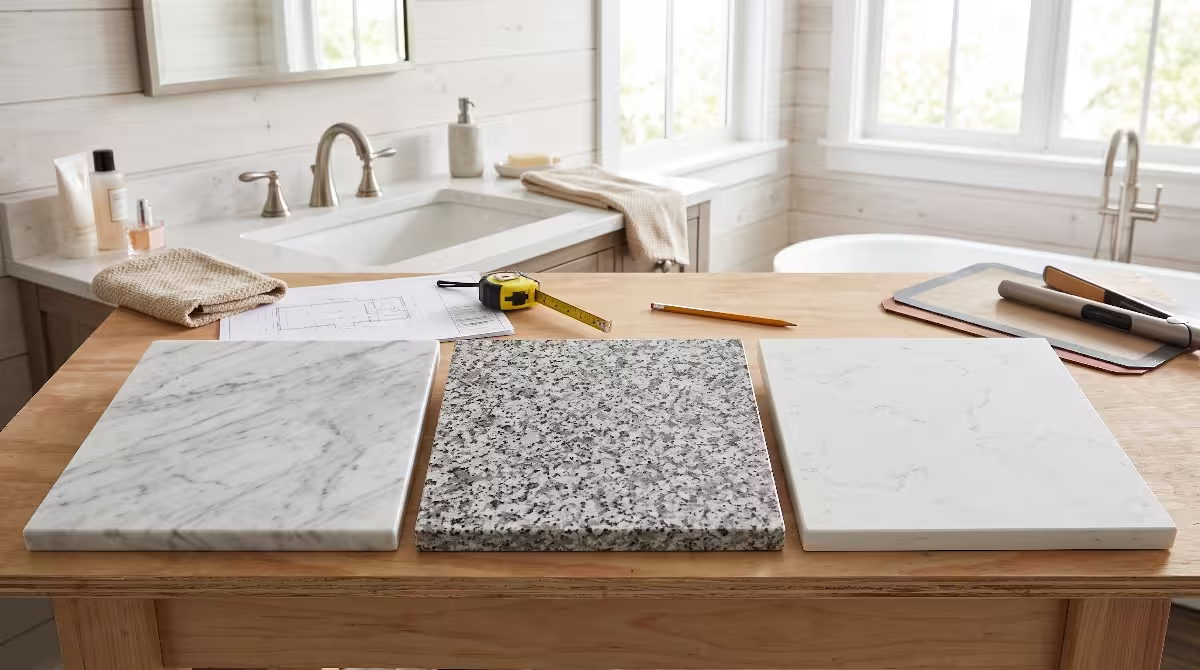
Never choose privacy glass from a tiny photo on a computer screen. Ask your window showroom for six-inch by six-inch physical glass samples of your top two or three favorites. Hold each sample up to your bathroom wall finishes, marble or quartz countertops, and warm LED vanity bulbs during both bright morning sun and evening darkness. Seeing how each sample softens daylight and pairs with your tile colors gives you total confidence that your lakefront bathroom will feel bright, serene, and completely private for years to come.