

When it comes to attached housing, the real estate world is full of specific terms that can sound alike but mean very different things. You might see listings for a duplex, a semi-detached home, and a townhome, and notice that they all seem to share walls with a neighbor. This often leads to the question: what’s the real difference? If you’re feeling a bit lost in this jargon, you’re not alone.
The purpose of this guide is to simply the terms so you can decide which is best for you. We are going to break down exactly what makes each of these home styles unique. While they all fall under the umbrella of attached living, the most important distinctions come down to three key areas: how you own the property, how many living units are in the structure, and the legal framework that governs the home.
Understanding these differences is paramount. It affects everything from your mortgage and maintenance duties to your potential for rental income and your overall lifestyle. Whether you’re looking to buy your first home, find a smart investment, or downsize here in the Tri-Cities area, this guide will give you the solid foundation you need to make a confident and informed decision.
Video Version of this Post
The Defining Factor: What Does “Attached Housing” Really Mean?
Before we dive into the specific types, let’s start with the basic concept they all share. “Attached housing” is a broad term for any residential building that contains separate homes or living units that share at least one common wall. Think of it as the opposite of a traditional single-family detached home, which stands alone on its own piece of land with open space on all four sides.
This style of building has become incredibly popular for several good reasons. From a construction standpoint, it’s a more efficient way to use land. By connecting homes, we can build more residences in a smaller area, which can help make housing more affordable. This is especially true in growing cities and suburbs where land is becoming more expensive. For homeowners, attached living can offer a great sense of community. You get to know your neighbors more easily, and in many cases, especially with townhomes, you share amenities and outdoor spaces. It can also mean a lower purchase price compared to a detached home of a similar size in the same neighborhood.
But this is where the similarities end and the important differences begin. The way those walls are shared, who owns the land underneath, and what you’re responsible for maintaining all change dramatically depending on whether you’re looking at a duplex, a semi-detached home, or a townhome. The devil, as they say, is in the details, and in real estate, those details are written into the legal deed.
Deep Dive: Defining Each Property Type
To truly understand your options, we need to look at each property type one by one. Their definitions are rooted in their legal structure and ownership model, which is far more important than their outward appearance.
What is a Duplex?
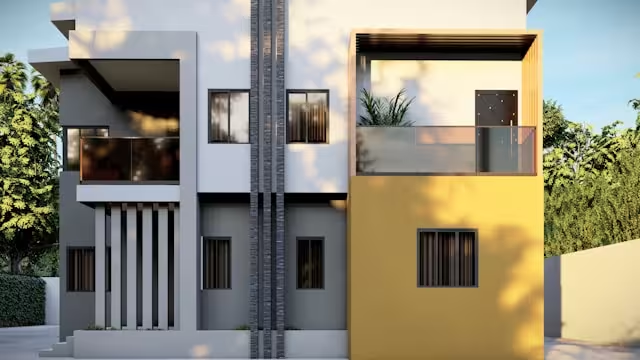
Let’s start with the duplex. A duplex is a single residential building that is divided into two separate living units, all on one single piece of land, known as a lot. The entire property, including the building and the land, is owned by one person or entity and is recorded on a single legal deed. This is the most important characteristic of a duplex. Even though there are two households living there, the property itself is not divided.
The two units within a duplex can be arranged in a couple of different ways. The most common style is a side-by-side duplex, where the two units are next to each other and share a central wall. From the street, it might look like two identical, connected houses. The other common style is a stacked or up-and-down duplex, where one unit is on the ground floor and the other is on the second floor.
Because the entire duplex is a single property, it’s most often treated as an investment. The owner typically lives in one of the units and rents out the second unit to a tenant. The rent from the tenant can then be used to help pay the mortgage on the entire property. This is a strategy often called “house hacking,” and it can be a fantastic way to get into real estate investing. In other cases, an investor will buy a duplex and rent out both units for a steady stream of income.
A duplex can also be a wonderful solution for multigenerational families who want to live close to one another while still maintaining their own private living spaces. For anyone considering buying a duplex, it’s essential to understand that you are not just a homeowner; you are also a landlord, with all the responsibilities that come with it. The duplex property requires a mindset geared toward both personal housing and business management.
What is a Semi-Detached Home?
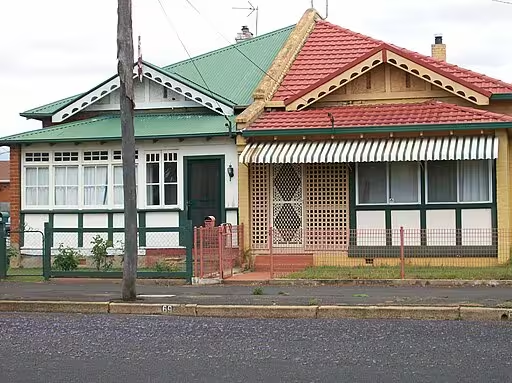
Next, we have the semi-detached home. On the surface, a side-by-side duplex and a semi-detached home can look nearly identical, and this is where a lot of confusion comes from. Both are single buildings that contain two residences sharing a common wall. However, the ownership structure is completely different.
A semi-detached home consists of two separate homes on two separate lots that just happen to be attached to each other. Each home is owned by a different person, and each owner has their own separate deed and their own mortgage. When you buy a semi-detached home, you are buying just your half of the building and the land your home sits on. Your property line runs right down the middle of that shared wall. Because of this, these homes are also sometimes called “twin homes.”
Unlike with a duplex, you are not a landlord. You are simply a homeowner, and the person living on the other side of the wall is your neighbor, not your tenant. This type of home is designed to provide a single-family living experience at a more accessible price point than a fully detached home. You still get your own front and back yard and the feeling of a traditional house, but with the cost savings that come from a shared foundation and central wall. The key takeaway is that a semi-detached home is legally two properties, whereas a duplex is legally one. This is a critical distinction, especially when it comes to financing, property taxes, and resale.
What is a Townhome?
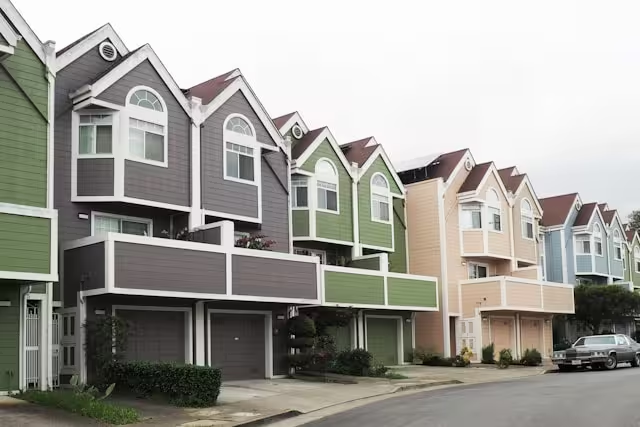
Finally, let’s look at the townhome, which is sometimes called a row house. A townhome is a single-family home that is part of a continuous row of three or more houses, sharing one or both of its side walls with its neighbors. Like a semi-detached home, when you buy a townhome, you own your individual unit as well as the land it sits on. This is known as “fee simple” ownership, and you receive a separate deed for your property.
The defining feature of nearly all modern townhome communities is the Homeowner’s Association, or HOA. Because all the homes are connected and share common spaces, an HOA is created to manage them. When you buy a townhome, you automatically become a member of the HOA and are required to pay monthly or yearly fees. These fees go toward maintaining all the shared elements, which can include landscaping, lawn care, snow removal, exterior building maintenance (like roofing and siding), and community amenities like a swimming pool, a clubhouse, or a playground.
Living in a townhome is about embracing a low-maintenance lifestyle. The HOA handles many of the chores that a traditional homeowner would have to do themselves. In exchange, you have to follow the rules and regulations set by the HOA, which can govern everything from the color you’re allowed to paint your front door to where you’re allowed to park. It offers a blend of ownership and convenience that many people find very appealing. Unlike a duplex, a townhome is purely a personal residence, not an investment property with a rental unit attached.
At a Glance: Duplex vs. Semi-Detached vs. Townhome Comparison
Sometimes the easiest way to see the differences is to lay them all out side by side. This table gives you a quick reference for the most important features of each home type.
| Feature | Duplex | Semi-Detached Home | Townhome |
| Ownership | Single owner for the whole building | Two separate owners | Individual owners for each unit |
| Legal Title | One deed for the entire property | Separate deed for each home & lot | Separate deed for each home & lot |
| Units | Two units in one building | Two individual homes sharing a wall | A row of three or more homes |
| Land Ownership | Owner owns the entire lot | Each owner owns their half of the lot | Owner owns the land under their unit |
| HOA | Unlikely | Unlikely | Very Common |
| Primary Goal | Investment / Rental Income | Affordable single-family living | Low-maintenance lifestyle |
Which Housing Style Fits Your Life? Pros and Cons
Now that we have the technical definitions down, let’s talk about what it’s actually like to live in or own each of these properties. Your lifestyle, budget, and long-term goals will be the biggest factors in deciding which is the right fit for you.
The Duplex Advantage
The decision to buy a duplex is often a financial one, and it comes with a unique set of benefits and challenges.
- Pros: The biggest advantage of owning a duplex is the potential for rental income. That monthly rent check from your tenant can cover a significant portion, if not all, of your mortgage payment. This can dramatically lower your housing costs or allow you to afford a property in a more desirable neighborhood. A duplex is also a flexible asset. You can use it for multigenerational living, or you can eventually rent out both units and turn it into a pure investment property that generates cash flow for years to come.
- Cons: The main drawback is that you are a landlord. This means you are responsible for all the maintenance and repairs for the entire building, including your tenant’s unit. When a faucet leaks or an appliance breaks in the middle of the night, you’re the one who gets the call. You also have to handle the business side of things, like finding and screening tenants, collecting rent, and dealing with potential vacancies. Owning a duplex is not a passive investment; it requires active management.
The Semi-Detached Balance
A semi-detached home offers a middle ground, blending some of the benefits of a detached home with the affordability of attached living.
- Pros: The primary benefit is affordability. You get the experience of a single-family home, often with a private yard and no HOA fees, but for a lower price than a comparable detached house. You have more freedom and privacy than in a townhome community since you don’t have to follow HOA rules.
- Cons: You only have one neighbor, but you are very close to them. Noise can sometimes travel through the shared wall. The biggest potential issue arises when it’s time for major repairs to shared structures, like the roof. Since there are two separate owners, you and your neighbor have to agree on the contractor, the cost, and the timeline. If you have a disagreement, it can become a difficult and legally complicated situation.
The Townhome Lifestyle
The townhome is designed for convenience and a community-oriented lifestyle.
- Pros: The biggest selling point is the low-maintenance living. The HOA takes care of most of the exterior upkeep, freeing up your weekends. Townhome communities also often provide access to great amenities that you might not be able to afford on your own, like a pool or fitness center. They are frequently built in prime locations, close to shopping, dining, and city centers.
- Cons: That convenience comes at a cost in the form of monthly HOA fees, which can increase over time. You also give up a degree of freedom. The HOA has rules that you must follow, which can limit your ability to personalize the exterior of your home. You will also have neighbors on one or both sides, which means less privacy than in a semi-detached or detached home.
Local Lens: Finding These Homes in the Tri-Cities, TN
Here in our local market of Johnson City, Kingsport, and Bristol, we see all three of these housing types, each serving a different purpose.
In Johnson City, for example, you’ll find many older duplex properties in the neighborhoods surrounding East Tennessee State University (ETSU). These serve as excellent investment properties for landlords renting to students. If you’re considering buying a duplex in this area, you’ll find a steady demand for rentals. There are also newer duplex communities being built, but they are less common than other housing types.
Semi-detached homes, or twin homes, can be found scattered throughout some of the region’s more established, older neighborhoods. They were a popular building style in the mid-20th century as a way to provide affordable family housing. You might find them in historic parts of Kingsport or Bristol, offering classic charm and character.
Townhomes, however, are where we’ve seen the most growth in new construction across the Tri-Cities. Developers are building new townhome communities in both Johnson City and Kingsport, often targeting young professionals and empty-nesters who want the benefits of homeownership without the hassle of extensive yard work. These new communities often feature modern designs and are built in convenient locations close to major employers and amenities.
Commonly Asked Questions
Let’s tackle some of the most common questions buyers have when comparing these homes.
Is a semi-detached home the same as a duplex?
No, and this is the most important distinction to remember. A duplex is one property with two units and one owner. A semi-detached home is two separate properties with two separate owners. The difference is entirely in the legal ownership structure.
Do you own the land with a townhome?
Yes, in almost all cases, when you buy a townhome, you own the land that your unit is built on. This is different from a condominium, where you only own the airspace inside your unit. With a townhome, your ownership extends from the interior of your home down to the ground beneath it. The HOA owns and manages the surrounding common land.
Which is a better investment?
This depends entirely on your investment goals. A duplex is a direct real-life investment vehicle. Its primary purpose is to generate rental income and cash flow. A townhome or a semi-detached home is typically purchased as a primary residence. While they can be a great financial investment in terms of building equity and appreciating in value over time, they are not designed to produce monthly income in the same way a duplex is.
Is it harder to get a mortgage for a duplex?
The process for getting a mortgage on a duplex can be slightly different from that for a single-family home. Because it’s considered an investment property (even if you plan to live in one unit), lenders may require a larger down payment, often around 20-25%. However, there’s a significant advantage: the lender will often allow you to use the projected rental income from the second unit to help you qualify for the loan. This can make a duplex an accessible entry point into real estate investing.
Your Final Decision: Making the Right Choice
Choosing between a duplex, a semi-detached home, and a townhome is a significant decision that goes beyond just the physical structure. It’s about choosing a lifestyle and a financial strategy.
Let’s recap the core ideas. The duplex is for the buyer with an entrepreneurial spirit. It’s for someone who wants to be a homeowner and a real estate investor at the same time and who is prepared for the responsibilities of being a landlord. The semi-detached home is for the buyer seeking the feel and freedom of a traditional single-family house but at a more manageable price. It offers a balance of affordability and autonomy. The townhome is for the buyer who values convenience, community, and a low-maintenance lifestyle, and is comfortable with the structure and fees of an HOA.
Our advice is to carefully assess your own priorities. Think about your budget, how much time you want to spend on home maintenance, and whether the idea of managing a rental property excites you or sounds like a headache. Once you have a clear picture of your personal and financial goals, you’ll be in a much better position to recognize the right property when you see it. Before you make a final decision, always talk to a trusted local real estate professional and a home builder. We can help you understand the specific market conditions and the quality of construction, ensuring you make a choice you’ll be happy with for years to come.