What’s the Real Tri-Cities TN Modular Home Cost? An Insider’s Breakdown
In the home building industry here in East Tennessee, you hear a lot of talk about different construction methods. The conversation often turns to modular homes, and with good reason. The process has an appeal—building a home in a controlled, indoor environment, protected from the unpredictable weather we get in the Appalachian Highlands, seems efficient. Many people immediately jump to the conclusion that this efficiency must translate into significant cost savings. While there can be value in building modular, the belief that it’s automatically the “cheaper” option is a common misconception that can lead to serious budgeting problems down the road.
As someone who has managed home building projects across the Tri-Cities for decades, from the rolling hills of Washington County to the cityscapes of Kingsport and Bristol, I’ve seen firsthand how these projects come together. The most frequent and critical question I encounter revolves around the real final cost. It’s one thing to see an advertised price for a beautiful three-bedroom home; it’s another thing entirely to understand the total investment required to take that home from a factory floor to a finished, move-in-ready reality on your piece of land.
This guide is designed to provide a precise, comprehensive breakdown of what you can expect to pay for a modular home in the Tri-Cities area in 2025, covering every line item from the manufacturer to your finished foundation.
First, Let’s Be Precise: Modular vs. Manufactured Homes
Before we can talk about cost, we need to be perfectly clear about what we’re discussing. The terms “modular” and “manufactured” are often used as if they mean the same thing, but in the eyes of builders, lenders, and local building inspectors, they are fundamentally different. Understanding this distinction is the first step in any successful building journey.
Modular Homes
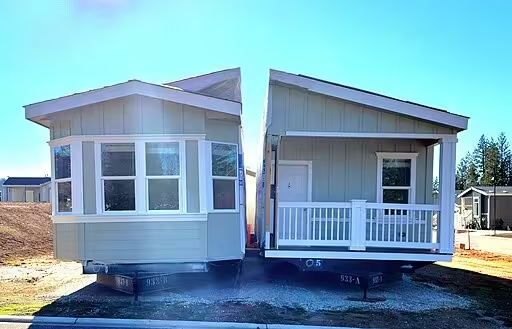
Think of a modular home as a house built in large, three-dimensional pieces, almost like a highly advanced set of LEGOs. These large sections, or “modules,” are constructed inside a climate-controlled factory. They build the floors, walls, and even the roof, and often install the wiring, plumbing, insulation, drywall, and cabinets right there on the assembly line.
Once these modules are complete, they are covered to protect them from the elements, loaded onto special carriers, and trucked to your property. A large crane then lifts each module and places it onto a permanent foundation that has been built on your land ahead of time. A specialized crew then joins the modules together, a process called “setting the house.”
The most important thing to remember is this: A modular home must be built to the exact same state and local building codes as a traditional, site-built home. Here in Tennessee, that means it follows the International Residential Code (IRC). An inspector from your city or county (like the Johnson City Planning Department or the Sullivan County Building Codes office) will inspect the work done on-site. Once it’s assembled on its permanent foundation, a modular home is legally and structurally the same as a stick-built home. It is taxed as real estate and generally appreciates in value the same way.
Manufactured Homes
A manufactured home, which many people grew up calling a “mobile home,” is different. It is built entirely in a factory, but on a permanent steel frame, or chassis, that is part of its structure. This chassis has wheels and axles for transportation, which are typically removed once the home is delivered.
Instead of adhering to local building codes, manufactured homes are built to a single, national code set by the U.S. Department of Housing and Urban Development (HUD). You’ll often hear them called “HUD homes.” They are not placed on a permanent foundation in the same way a modular home is; they are typically set on piers or blocks and anchored to the ground.
Because they are built on a chassis and governed by a different set of rules, they are often treated more like a vehicle than a piece of real estate, though they can sometimes be converted to real property. This can affect financing options and how they hold their value over time.
Why This Matters in the Tri-Cities
This isn’t just a technical detail. Local zoning laws in places like Washington County or Sullivan County can have specific rules about where different types of homes can be placed. Some neighborhoods or city limits may not permit manufactured housing, but they almost always permit modular homes because they are, for all intents and purposes, the same as any other house on the block once they are finished. Getting this right from the start will save you a world of headaches and potential financial loss.
The Base Cost: Modular Home Price Per Square Foot in Tennessee
Now, let’s get to the number everyone wants to know. When you walk into a modular home sales center or browse a manufacturer’s website, you will see prices advertised based on the square footage of the home.
For 2025, a realistic starting range for a new modular home in the Tri-Cities area is between $90 and $150 per square foot.
So, for a 1,800-square-foot home, the base price would likely fall somewhere between $162,000 and $270,000. That’s a wide range, and the final number depends on the quality of the materials, the complexity of the design, and the manufacturer you choose.
It’s tempting to take that number and immediately compare it to the cost of a traditional site-built home, which often starts at a higher price per square foot. However, this is the single most critical point of the entire article: the base price is just the beginning. It’s only one part of a much larger financial picture.
What the Base Price Usually Includes:
- The Home’s Structure: This is the cost of the modules themselves, built at the factory.
- Standard Finishes: This includes builder-grade materials like vinyl flooring, basic carpeting, laminate countertops, standard light fixtures, and basic plumbing fixtures (sinks, toilets, showers).
- Basic Siding and Roofing: Typically includes standard vinyl siding and architectural shingles installed at the factory.
- Transportation: The cost to deliver the modules from the factory to the edge of your property.
- The “Set” Crew: The specialized team that works with the crane operator to place the modules on your foundation and bolt them together.
What the Base Price Almost NEVER Includes:
- The land to build on.
- The cost of designing or building the foundation.
- Any site work (clearing trees, grading the land).
- The cost of a driveway.
- Drilling a well or connecting to city water.
- Installing a septic system or connecting to a city sewer line.
- Connecting to the electrical grid.
- The rental cost of the crane itself (this can be thousands of dollars).
- Any finishing work required after the house is set.
- Building permits and associated fees.
- Garages, decks, porches, or sidewalks.
- Landscaping.
The advertised price gets the house to your land. The rest of the expenses are what it takes to turn it into a home you can actually live in.
The “All-In” Cost: Unpacking the Expenses Beyond the Factory
The final cost of a project is the sum of all its parts, and for a modular home, the “site costs” can easily add up to 50% to 100% of the home’s base price. Let’s break down these costs one by one.
1. Land
If you don’t already own property, this is your first major expense. The cost of land varies dramatically across our region. A quarter-acre lot in a developed Johnson City subdivision could cost $50,000 or more, while a few acres of raw, undeveloped land out in rural Carter County might be less, but will require more work to get it ready for building. Don’t forget to budget for closing costs and real estate commissions as well.
2. Site Preparation
You can’t just place a house on a piece of land. It needs to be properly prepared.
- Surveying and Testing: You’ll need a survey to mark your property lines and a soil engineer to test the ground to ensure it can support a foundation. If you’re not on city sewer, you’ll need a “perk test” to see if the ground is suitable for a septic system.
- Clearing and Excavation: Do you have trees that need to be removed? Is the land on a slope? A crew will need to come in with heavy equipment to clear the homesite, level a pad for the house, and dig for the foundation. Building on a sloped lot overlooking Boone Lake will cost significantly more to prepare than a flat, clear lot in Kingsport.
- Driveway: You need a way for construction vehicles, and eventually your car, to get to the house. The cost of a simple gravel driveway versus a long, paved asphalt one can differ by thousands of dollars.
3. Foundation
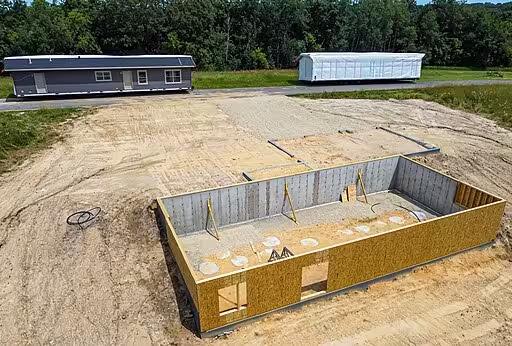
This is a major expense. Your home’s modules need a solid, permanent foundation to sit on. In our area, you generally have three choices:
- Crawl Space: This is very common in Tennessee. It raises the house off the ground, giving you easy access to plumbing and wiring underneath. This is often the mid-range cost option.
- Basement: A full basement can nearly double your home’s usable square footage, but it is the most expensive option due to the extensive excavation and concrete work required.
- Slab: This is a thick concrete pad poured directly on the ground. It’s often the most affordable option but offers no access from underneath and can be less suitable for sloped lots.
For a 1,800-square-foot home, the foundation alone could cost anywhere from $15,000 to $50,000+, depending on the type and your site conditions.
4. Utilities
Getting water, power, and sewer to your home is a significant cost.
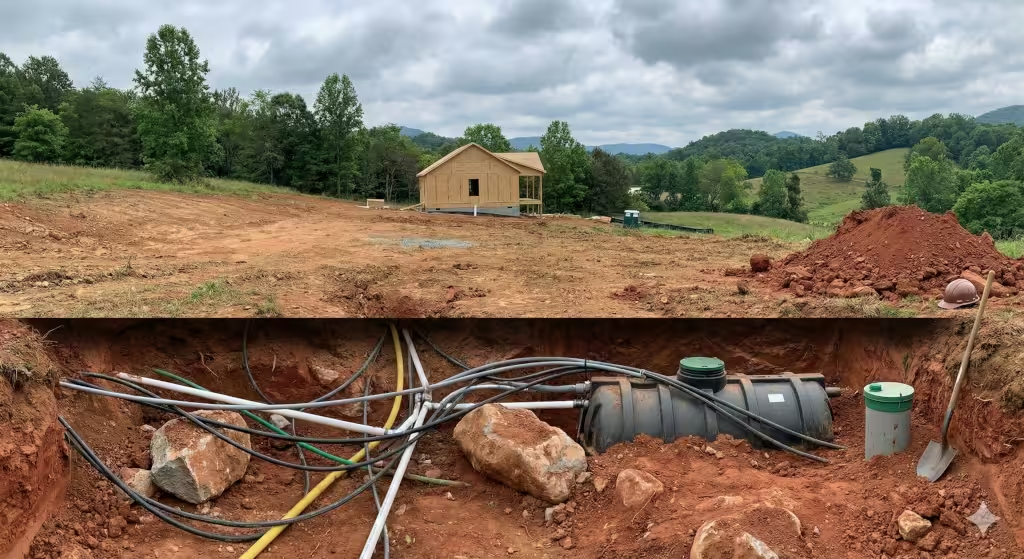
- City vs. Rural: If you’re building in town, you’ll have to pay “tap fees” to connect to the city’s water and sewer lines. These fees can be several thousand dollars. If you’re in a rural area, you’ll need to budget for drilling a well ($5,000 – $15,000+) and installing a complete septic system ($5,000 – $12,000+).
- Electricity: You’ll also have to pay your local utility company, like BrightRidge or Bristol Tennessee Essential Services (BTES), to run power from the main road to your house. If the distance is long, this can be surprisingly expensive.
5. Crane and Set-Up
While the set crew’s labor is often in the base price, the massive crane needed to lift the modules is usually a separate rental. Depending on the size of your home and the difficulty of access to your site, crane rental can cost between $2,000 and $10,000 for the day.
6. “Button-Up” or Finishing Work
Once the house is set on the foundation, it’s not finished. A local general contractor and their crew need to do the “button-up” work. This includes:
- Connecting the Modules: Bolting them to the foundation and to each other.
- Interior Finishing: Patching, taping, and painting the drywall along the “marriage lines” where the modules meet.
- Exterior Finishing: Installing the final pieces of siding and roofing to cover the seams between modules.
- Utility Connections: A plumber and electrician will connect your home’s systems to the exterior utility lines.
7. Garages, Decks, and Porches
These structures are not built in the factory. They are built on-site using traditional methods. A two-car garage, a nice back deck, and a welcoming front porch can easily add $40,000 or more to your total project cost.
8. Permits and Fees
You will need to pay for a building permit from your local government office. This involves submitting your plans for review and paying a fee, which is often based on the estimated value of your home.
Factors That Influence Your Final Tri-Cities Modular Home Cost
Beyond the big-ticket items above, several other choices will affect your budget.
- Customization and Upgrades: Think of it like buying a car. The base model has a certain price, but if you want granite countertops instead of laminate, hardwood floors instead of vinyl, or a tiled walk-in shower instead of a fiberglass insert, the price will go up. Every upgrade you choose at the factory adds to the final cost.
- Home Design: A simple, rectangular home is the most affordable to build, ship, and set. The more complex your design—with multiple rooflines, dormers, or unique angles—the higher the cost will be.
- Manufacturer Choice: Different manufacturers have different reputations for quality and service. A builder known for using premium materials and offering more customization will naturally cost more per square foot than a builder focused on basic, affordable homes.
- Your General Contractor (GC): It is extremely wise to hire a local general contractor to oversee all the site work. They are the “quarterback” of your project, coordinating the excavators, foundation crew, plumbers, and electricians. They ensure everything is done correctly and to code. A good GC will charge a fee, typically 10-20% of the cost of the site work they manage, but their expertise can save you from costly mistakes and delays.
Finding a Reputable Modular Home Builder in East Tennessee

Choosing the right partner for this process is essential. You’re not just buying a product; you’re entering a long-term construction project. Instead of just searching online, you need to vet potential builders and dealers thoroughly.
Here are the questions you MUST ask:
- “Can I see your Tennessee state contractor’s license and proof of insurance?” Never work with an unlicensed or uninsured contractor.
- “Can you provide references from three homeowners you’ve built for in the Tri-Cities area in the last two years?” Talk to these people. Ask them what went well and what didn’t.
- “Is your price quote ‘turnkey’ or does it only cover the home itself? Please provide a detailed, itemized list of what is and is not included.” This is where you avoid surprises.
- “Who will be my single point of contact throughout the entire process?” You need one person you can call who is responsible for your project.
- “Can I visit your factory or tour a home that is currently under construction?” Seeing their work firsthand is invaluable.
Focus on finding a builder or dealer with a strong, positive track record right here in East Tennessee. They will understand the local landscape, have relationships with the best local subcontractors, and know how to navigate the permitting process with the city and county offices.
Conclusion: Building Smart in the Tri-Cities
A modular home can be a fantastic, efficient, and high-quality way to build a new life in our beautiful corner of Tennessee. The controlled factory environment often leads to a stronger, more tightly built structure. However, the key to a successful and satisfying project is not just speed, but precision in your planning and your budgeting.
As a rule of thumb, you can estimate that your total “all-in” cost will be roughly 1.5 to 2 times the advertised base price of the modular home itself. If a home is listed at $200,000, you should be prepared for a final project cost in the neighborhood of $300,000 to $400,000 once you have bought land and completed all the necessary site work.
In this line of work, integrity isn’t just about honesty—it’s about building something that lasts. That process begins with a solid, realistic budget built on facts, not assumptions. Account for every variable I’ve outlined here, partner with reputable local professionals, and you will be well on your way to building a home with integrity.
If you have more specific questions about the building process in the Tri-Cities, please feel free to leave a comment below. I’ll do my best to provide a clear answer.