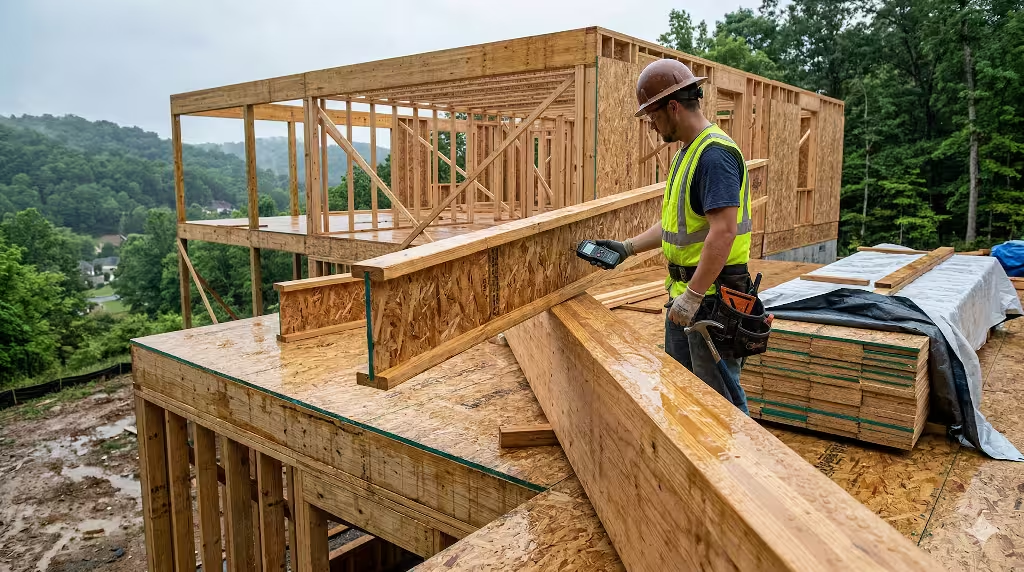

Managing Unforeseen Risk in Custom Home Construction
Building a custom home in the Tri-Cities area of Tennessee is one of the most exciting milestones a family can undertake. Whether you are setting foundation walls on a rolling pasture in Jonesborough, tucking a mountain modern retreat into the hills of Johnson City, or clearing a parcel near South Holston Lake in Bristol, the journey requires both vision and technical discipline. When you invest significant resources into building a home from the ground up, you need total clarity about how your money and your timeline are protected. A successful build is never just about selecting granite countertops, engineered hardwoods, or framing packages. It is fundamentally about risk management, contract precision, and honest communication between the owner and the general contractor.
Every custom home site faces potential disruptions that nobody can predict with absolute certainty. Volatile commodity markets can alter material bills overnight, and regional disruptions can halt progress without warning. In East Tennessee, weather can change quickly across our ridges and valleys, causing deep ground saturation that stalls excavation and concrete placement. At the same time, national and global supply bottlenecks can leave custom windows, electrical panels, or specialized HVAC equipment sitting on backorder for months. When these external disruptions collide with real-world building schedules, standard construction agreements face serious pressure. Two clauses often cause confusion for custom home buyers: the force majeure clause and the material price escalation clause. Many property owners assume these two contract terms do the same thing, but they address entirely different operational risks.
The main distinction between these two provisions comes down to time relief versus monetary relief. Understanding this fundamental boundary prevents costly disputes before site grading even starts. A general contractor must balance trade scheduling, supplier commitments, and cash flow, while a homeowner must protect their construction loan, interest reserves, and personal family schedule. When an external emergency stops work, the parties must know which legal safeguard governs the situation so that no one makes assumptions.
To state the answer directly: a force majeure clause shields parties from breach penalties and contract defaults by granting schedule extensions due to severe, uncontrollable, external events. On the other hand, a material price escalation clause sets a transparent financial formula to adjust the contract price when hard construction materials surge beyond predictable baselines. A force majeure clause gives you time, while a material price escalation clause deals with money. The following comprehensive breakdown explains how both mechanisms function, how they interact, and how custom home buyers can protect their budgets and timelines throughout the building process.
Understanding Force Majeure in Residential Building
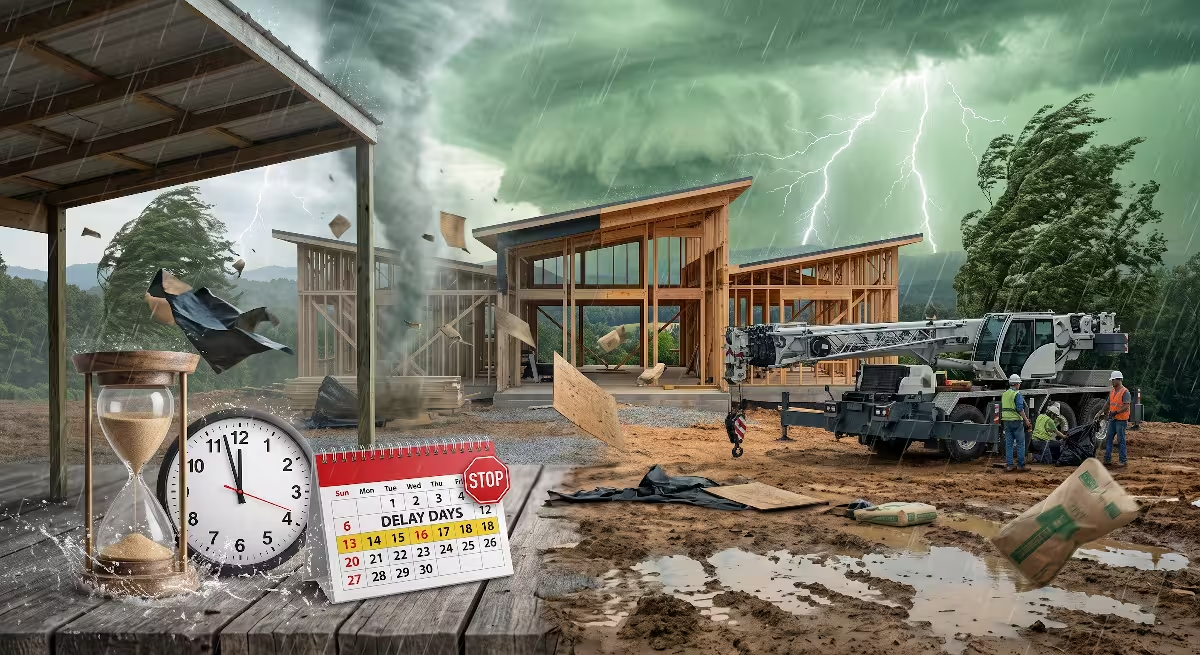
The legal term force majeure comes from French law and translates literally as superior force. In residential building agreements, force majeure operates as an agreed rulebook for what happens when extraordinary, unavoidable events prevent either party from fulfilling their promises on time. Under normal circumstances, if a general contractor promises to complete your home by a certain completion date and fails to do so, they may face financial damages or be declared in default of the contract. However, when an unforeseeable disaster occurs that makes performance practically impossible, the force majeure clause steps in to excuse the delay.
A well drafted force majeure clause lists the types of catastrophic events that qualify under the contract. These events typically fall into two categories: natural events and human caused events. Natural events are often called Acts of God in older contracts. These include tornadoes, direct lightning strikes, severe regional floods, earthquakes, and freak winter blizzards that bring municipal services to a complete standstill. Human caused events under force majeure include declared wars, riots, government embargos, sudden changes in local building laws, labor union strikes, or formal public health shutdowns.
For an event to trigger force majeure protection, it must meet three strict legal criteria. First, the event must be truly unforeseeable at the time the contract was signed. Second, the event must be outside the reasonable control of both the contractor and the owner. Third, the event must make it impossible, or at least unreasonably difficult, to carry on with construction. If any of these three elements is missing, the force majeure defense usually fails.
The primary remedy granted by a force majeure clause is an extension of the contract schedule. When an authorized event stops job site activity, the contract completion deadline is extended by an amount of time equal to the operational stoppage. For example, if a severe storm causes catastrophic washouts across local access roads and heavy equipment cannot reach the job site for twelve days, the force majeure clause adds twelve working days to the final delivery date. This schedule extension prevents the homeowner from charging delay penalties and prevents the builder from facing default claims.
It is equally important to understand what force majeure rarely does. A standard force majeure clause does not award extra money to the builder simply because an event occurred. Unless the written agreement explicitly specifies financial compensation for downtime, force majeure provides only time relief. The builder does not have to pay penalties for missing milestones, but the owner is not automatically required to pay higher labor or material sums just because an emergency took place.
Homeowners must also watch out for common pitfalls regarding force majeure in residential contracts. One major trap is overly vague boilerplate language. In many standard form contracts, force majeure is buried in fine print with sweeping statements like any cause beyond the control of the contractor. This vague phrasing can lead to bitter disagreements. For instance, builders operating in the Tri-Cities know that heavy rains are normal during early spring. Ordinary seasonal rain is not an Act of God; it is typical East Tennessee weather that should be anticipated in any competent construction schedule. If a contractor tries to invoke force majeure for every routine summer thunderstorm, the intent of the clause is being abused. An effective force majeure provision must clearly separate routine seasonal weather from true record-breaking disasters.
Another frequent pitfall is the failure to include clear written notice requirements inside the force majeure clause. If an emergency occurs, the affected party must be required to provide formal written notice within a set period, such as five to ten business days. If a builder suffers a qualifying disruption but never mentions force majeure until six months later when the home is behind schedule, proving the actual delay becomes nearly impossible. Clear timelines and formal documentation keep the force majeure process fair and measurable for both parties.
Material Price Escalation Clauses: Protecting Budget Certainty
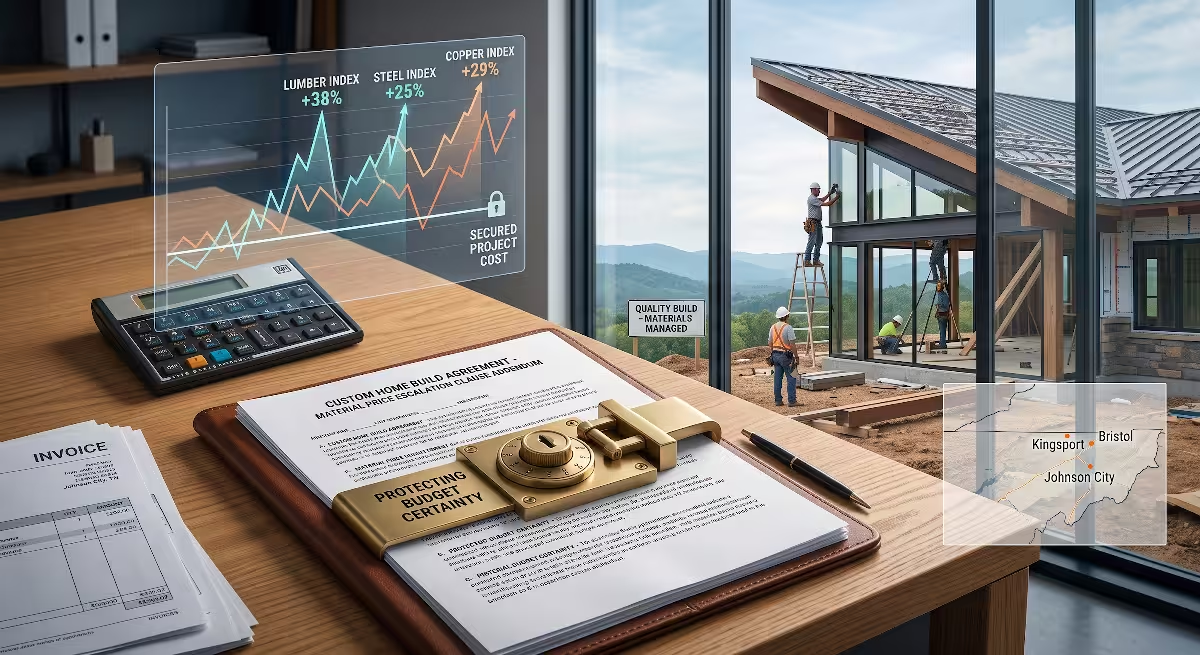
While force majeure manages delays and project timing, the material price escalation clause focuses entirely on managing fluctuating dollars. Over the past several years, custom home construction has seen unprecedented swings in the cost of basic building materials. The prices of framing lumber, PVC piping, copper wiring, concrete, roofing shingles, and structural steel have experienced sharp spikes due to manufacturing shifts, international trade tariffs, and freight costs. When a builder provides a firm quote on a custom home that takes ten to fourteen months to complete, they cannot absorb sudden fifty percent cost surges without risking company insolvency. At the same time, a home buyer cannot write open-ended checks that bust their personal budget and upset their construction lender.
A material price escalation clause creates an agreed method to share or adjust contract costs when specific building materials surge in price after the contract is signed. Without an escalation clause in a fixed-price agreement, a builder facing extreme cost surges might be tempted to cut corners, substitute lower quality finishes, or walk away from the project entirely. Conversely, without an escalation clause in a cost-plus agreement, the homeowner carries all the financial risk without any ceiling or cost protection. A well constructed escalation clause brings structure and predictability to these market shifts.
There are three major ways to structure a material price escalation clause in a custom home agreement:
First, a threshold escalation clause sets a minimum percentage increase that must occur before any extra cost can be passed along to the homeowner. For example, the contract might state that the builder absorbs all price increases up to five percent on framing lumber. If the market price goes up by seven percent, only the two percent that exceeds the five percent baseline threshold is billed to the buyer. This approach encourages the contractor to bid accurately while protecting them against devastating surges.
Second, a fair contract includes a two-way or de-escalation clause. If a contract allows the builder to raise prices when wholesale commodity costs climb, it must also require the builder to lower the contract price if commodity prices drop. If the price of structural lumber plummets by twenty percent between contract signing and the day the framing package is delivered, that savings should flow back to the homeowner. A one-way clause that only moves prices upward is inherently unbalanced. Insisting on a two-way escalation and de-escalation clause aligns the interests of both parties.
Third, a capped escalation clause places an absolute maximum financial ceiling on how much the homeowner can be charged for price increases. For instance, the contract may establish that total material price adjustments cannot exceed five percent of the total project contract sum. Once that cap is reached, any additional price surges must be absorbed by the builder, or the parties must sit down to evaluate alternative materials. A cap gives banks and construction lenders confidence that the loan amount will remain adequate to finish the home.
To make an escalation clause work properly, the contract must establish verified baseline prices for every material covered by the clause. The baseline cannot be an arbitrary guess. It must be supported by date-stamped quotes from local lumberyards, concrete batch plants, and trade distributors. When an increase occurs, the builder must present the original baseline quote alongside the actual invoice showing the higher cost. Transparent records ensure that the escalation clause reflects true market dynamics rather than general markups.
Force Majeure vs. Material Price Escalation Clause: The Direct Comparison
To see the practical differences between a force majeure clause and a material price escalation clause, we must examine how they operate during a live construction project. While they may appear near each other in the general conditions section of a building contract, their legal triggers, daily operations, and financial consequences follow different paths.
| Operational Dimension | Force Majeure Clause | Material Price Escalation Clause |
| Primary Operational Trigger | External catastrophic events, Acts of God, severe disasters, public orders | Economic shifts, market volatility, commodity price spikes |
| Primary Contract Remedy | Extension of construction schedule, relief from default penalties | Adjustment of overall contract price or material allowance line items |
| Burden of Proof Required | Proof that external event made timely work physically impossible | Itemized supplier invoices and date-stamped baseline quotes |
| Direct Impact on Budget | Generally neutral unless special mobilization costs are specified | Directly alters the final purchase price or construction loan balance |
| Direct Impact on Schedule | Directly extends completion date and trade arrival milestones | Typically zero schedule impact unless alternate materials are sourced |
| Resolution of Market Drop | No legal mechanism; once the emergency passes, work simply resumes | De-escalation reduces total cost to owner if prices decline |
The fundamental separation shown above highlights why every custom home contract requires both provisions. If your contract has an escalation clause but lacks a force majeure clause, an unexpected hurricane or severe winter freeze could shut down the job site, leaving your builder exposed to breach-of-contract claims because the schedule failed to adjust. On the other hand, if your agreement includes a force majeure clause but leaves out an escalation clause, a dramatic spike in lumber prices cannot be handled under the force majeure rule. Courts across the nation have consistently ruled that high prices and economic difficulty do not constitute a force majeure event. The builder remains legally bound to deliver the materials at the agreed price unless a separate escalation clause exists.
There are, however, moments where the two concepts intersect on a job site. Consider an extraordinary scenario where a major regional catastrophe disrupts the manufacturing base. A severe hurricane hits the Gulf Coast, destroying oil refineries that produce raw resins used for PVC piping and moisture barriers. The storm is clearly an Act of God that triggers the force majeure clause for regional manufacturers, leading to delayed shipments. As supplies dwindle, the spot market price for available PVC pipe doubles within two weeks.
In this compound scenario, both clauses become active, but each performs its distinct duty. The contractor invokes the force majeure clause to document that the piping cannot be obtained through standard commercial channels, thereby securing an extension on the plumbing rough-in deadline without facing delay penalties.
Simultaneously, when the replacement plumbing materials finally arrive at a much higher price point, the builder activates the material price escalation clause to verify the cost difference against the baseline quote and calculate the budget adjustment. Using both clauses in harmony ensures that time delays are handled through force majeure while financial changes are governed by the escalation terms.
Common Asked Questions about Force Majeure
Custom home buyers frequently encounter complex questions when reviewing their builder agreements. Below are detailed explanations of the most common issues that arise during contract negotiations.
Can a builder invoke force majeure for rising lumber or fuel costs?
No. Under standard American contract law, a builder cannot legally invoke force majeure simply because lumber, steel, concrete, or fuel costs have risen significantly. Economic hardship, changing profit margins, and commodity inflation do not count as a force majeure occurrence. A force majeure clause is designed to address physical impossibility or severe regulatory prohibition, not financial unprofitability.
When a contractor signs a fixed-price agreement without an escalation clause, they assume the market risk of material price changes. If a lumber supplier raises stud prices by thirty percent, the contractor is still physically capable of buying the studs and nailing them together. The task has simply become more expensive. Unless the contract explicitly contains a material price escalation clause that links market cost spikes to contract adjustments, the builder must absorb those increases. Attempting to use force majeure as a backdoor price increase violates the clear purpose of the clause and will not hold up in formal dispute proceedings.
What happens if a custom home buyer refuses to pay an escalation increase?
If a homeowner refuses to pay an escalation charge submitted by the builder, the outcome depends on the exact terms of the agreement. If the contract contains a valid escalation clause and the builder has followed all verification rules, the buyer is contractually required to pay the verified overage. Refusing to pay constitutes a breach of contract, which may give the builder the legal right to stop work, record a mechanic’s lien against the real estate, or terminate the contract.
However, modern custom contracts often include compromise protocols. When a price escalation reaches a certain point, the contract may give the homeowner three distinct choices:
- Pay the verified cost difference and continue with the original specification.
- Direct the builder to value engineer the assembly by selecting an approved alternate material that fits the original budget.
- Mutually terminate the contract without penalty if the cost surge makes the overall project financially impossible.
If the builder submitted an escalation charge without proper baseline documentation, the homeowner has every right to challenge the invoice. In that situation, the dispute is typically routed through the mediation or arbitration provisions outlined in the contract, during which time work outside the disputed trade usually continues.
How are baseline prices established in a custom home contract?
Baseline prices must be clearly defined in writing before the contract is executed. Professional home builders establish baselines by attaching an itemized schedule of values or a bill of materials to the contract. Each primary material subject to escalation is listed alongside its unit cost, its total estimated volume, and a date-stamped quote from an actual commercial supplier.
For example, the baseline document might state that framing lumber is priced at eight hundred dollars per thousand board feet, based on a written quote provided by an area lumber dealer on a specific date. Similarly, ready-mix concrete might be baselined at one hundred forty-five dollars per cubic yard. By attaching these written supplier bids directly to the contract, both the buyer and the builder share an identical starting point. When invoices arrive months later during construction, calculating an escalation or de-escalation adjustment is a straightforward mathematical task rather than an emotional argument.
Is a price escalation clause standard in fixed-price custom home builds?
Yes, price escalation clauses have become standard practice in fixed-price custom home building. Prior to recent supply chain disruptions, many general contractors were comfortable offering rigid fixed-price contracts with no escalation language, absorbing minor cost variations within their standard contingency funds. However, modern market conditions have made fixed-price bidding without escalation protection exceptionally risky for custom builders.
Today, if a builder offers a pure fixed-price contract without any escalation language, they usually add a very large contingency margin, often ten to twenty percent, to the total contract sum to protect themselves against worst-case price swings. Homeowners end up paying that inflated price even if material costs stay flat. Including a transparent, two-way escalation clause allows the builder to provide a tighter, more competitive base price, knowing that unexpected market shocks will be managed fairly if they arise.
Contract Best Practices for Custom Home Buyers and Builders
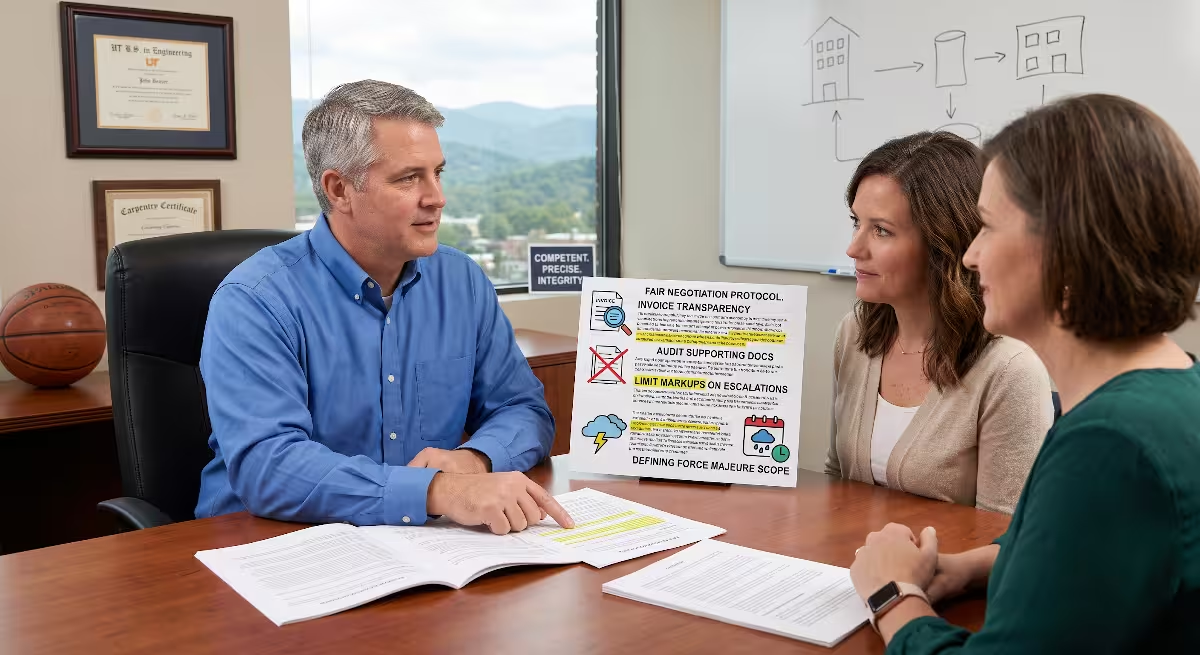
Protecting your custom home investment requires an intentional approach to contract negotiation. By taking practical steps before work begins, both parties can avoid misinterpretations of force majeure and escalation terms.
Auditing Transparency
The single most effective way to manage price escalation is to demand complete invoice transparency. The contract must state that no price adjustment will be paid without full supporting documentation. This means the builder must provide:
- The original baseline quote from the initial contract package.
- The supplier’s written notice explaining the market wide price increase.
- The actual paid invoice showing the date, quantity, unit price, and delivery address.
Homeowners should ensure that markups on price escalations are strictly controlled. An escalation clause should only pass through the actual net cost increase of the raw material. The builder should not add additional general overhead and profit percentages on top of an emergency price escalation unless the contract explicitly permits a modest administrative handling fee.
Defining Force Majeure Scope
Do not accept standard boilerplate language that leaves force majeure open to wild interpretation. Work with your attorney to build an explicit definition that fits your specific geographic region. The force majeure clause should:
- Explicitly exclude normal seasonal weather conditions, such as ordinary spring rains, routine summer heat, or standard winter frosts.
- Require that an Act of God be measured against formal government standards, such as weather data recorded by the National Weather Service exceeding a fifty-year return period.
- Exclude ordinary subcontractor delays, late material orders, or routine vendor cancellations, as these are normal operational challenges that fall under the general contractor’s management duties.
- Clarify that economic changes, rising wages, and spot material shortages do not constitute force majeure events.
By setting precise legal parameters, the homeowner ensures that the force majeure clause serves only as a shield against true catastrophic disasters rather than a catch-all excuse for poor project management.
Early Procurement Protocols
A practical strategy to avoid both price escalation disputes and force majeure shipping delays is early procurement. As soon as architectural plans are finalized and the construction loan is closed, the builder can purchase long-lead materials and store them safely.
Items such as framing lumber packages, exterior windows, architectural doors, plumbing rough-in valves, and electrical switchgear can often be ordered and paid for months ahead of time. Securing these goods early locks in baseline prices, neutralizing the risk of a material price escalation clause. Furthermore, having materials stored locally in a secure warehouse takes your project off the vulnerable interstate supply line, reducing the risk that a distant shipping delay will trigger an unexpected force majeure claim.
Clear Notice Windows
Every clause that alters time or money must include strict notice windows. A fair contract requires that when a qualifying event occurs, the party seeking relief must provide formal written notice within a set timeframe, typically five to ten business days.
For a force majeure event, the contractor must detail the nature of the disruption, the physical trades impacted, and an initial estimate of the schedule delay. Once the event ends, a final notice confirming the exact number of delay days requested must be delivered. For a material price escalation, notice must be given before the material is ordered, giving the homeowner an opportunity to review the cost difference, approve the charge, or explore alternative materials. Enforcing tight notice periods prevents surprises at the end of the job when work has already been completed.
Aligning Precision, Contracts, and Trust
Building a custom home is an extraordinary partnership. For nearly a year or more, you will work closely with your general contractor to translate two-dimensional blueprints into a permanent, high-performance home. That relationship thrives on mutual trust, but genuine trust is always built upon contract precision. Clear contracts protect friendships, preserve family budgets, and ensure that custom builders are compensated fairly for their skill and hard work.
A force majeure clause provides an indispensable safety valve when nature or global events create conditions beyond human control. It ensures that when true catastrophes strike, your project pauses with dignity, schedules adjust reasonably, and neither party is unfairly punished for circumstances outside their power. Simultaneously, a balanced material price escalation clause protects the economic health of the build, establishing a transparent system to manage market volatility without compromising construction quality.
Before signing your custom home construction agreement, review the entire document alongside an experienced residential construction attorney. Make certain that every force majeure provision contains sensible definitions and realistic notice periods. Verify that any material price escalation clause includes verified baselines, two-way adjustments, and clear caps. When your contract establishes exact boundaries for both time delays and financial shifts, you can break ground on your new custom home with total confidence, knowing that your project is built on solid legal and operational footings from day one.