If you have ever walked through the historic neighborhoods of Kingsport or looked at the new custom builds going up in the hills of Johnson City, you know that our land is a beautiful but difficult place to build. Our red clay is like a sponge, and the rolling hills of East Tennessee can put a lot of weight on a house. Today, we are going to examine a choice that every home buyer faces: poured concrete vs. block foundation.
When you build a home, the foundation is the most important part and you have to choose between a poured concrete vs. block foundation. It is the root system for your house. If the roots are weak, the tree will fall. In our area, we deal with a lot of lateral pressure, that is the sideways push of the dirt and water against your walls.
Understanding the difference in poured concrete vs. block foundation lateral strength is the key to a dry, safe home that lasts for a hundred years. Let us get into the details of how these two systems work, what they cost in 2026, and whether a poured concrete vs. block foundation is the right choice for your Tennessee dream home.
What Is a Poured Concrete vs. Block Foundation?
When we talk about the choice between a poured concrete vs. block foundation, we aren’t just talking about different materials; we are talking about two completely different ways of managing the physics of your home.
In our part of the country, from the steep ridges in Bristol down to the flatter lots in parts of Gray, the “how” of your foundation construction changes your home’s lifespan. Let’s break down exactly what goes into these two methods so you can see the precision required for each.
To really understand a poured concrete vs. block foundation, you have to look at how they are put together on the job site. One is built like a puzzle, and the other is created like a sculpture. Both have been used in the Tri-Cities for decades, but the way they handle the weight of a Tennessee hill is very different.
The Anatomy of a Block Foundation
A block foundation is often called a “built” foundation. We start with a concrete footing, which is a wide base buried deep in the ground. Once that footing is hard, a mason begins laying Concrete Masonry Units (CMUs). These are the standard 8x8x16-inch blocks you see at the local hardware store.
The mason uses mortar, a mix of cement, lime, and sand, to “glue” the blocks together. They lay them in a running bond pattern, which means the joints are offset, sort of like how bricks look on a chimney. This is a very manual process. A skilled mason in Johnson City might lay hundreds of blocks a day, ensuring each one is perfectly level and “plumb” (straight up and down).
When looking at a poured concrete vs. block foundation, the block version is essentially a giant grid of seams. Even with the best mortar, those seams are points where the wall can theoretically move. To make these stronger, we often place steel rebar vertically through the hollow “cells” or holes in the blocks and then pour thin concrete, called grout, into those holes. This ties the blocks together, but at the end of the day, it is still an assembly of thousands of individual parts.
The Anatomy of a Poured Concrete Foundation
A poured foundation is what we call “monolithic,” which is just a fancy word for “one single stone.” We don’t use individual blocks here. Instead, after the footing is ready, a crew brings in large panels called “forms.” These forms are made of wood, aluminum, or steel, and they act like a mold for the house.
The crew sets these forms up to create the exact shape and thickness of your basement walls. Before the concrete arrives, we secure a web of steel rebar inside the empty space between the forms. This is where the precision comes in. We can space that steel exactly where the engineering report says it needs to be to fight the red clay’s pressure.
Then, the concrete trucks arrive. We pour wet, liquid concrete into the top of the forms until they are full. We use vibrating tools to make sure there are no air bubbles trapped inside. Once the concrete cures and becomes rock-hard, usually after a day or two, we “strip” the forms away. What is left is a solid, seamless wall of stone. When you compare a poured concrete vs. block foundation, the poured wall has no mortar joints to leak or crack. It is one continuous shield against the earth.
The Key Differences in Construction
A block job is quiet, just a few guys with trowels and a mortar mixer. It takes time, and it’s very rhythmic. A poured job is a massive event. It involves heavy machinery, huge pump trucks with long reaching arms, and a lot of coordination to get the concrete there before it starts to set.
In the poured concrete vs. block foundation debate, the “poured” side is much faster but requires more heavy equipment. If your lot is tucked away on a narrow mountain road where a 30-ton concrete truck can’t go, you might be forced to choose block. But if we can get the trucks in, the poured wall gives us a density and a lack of seams that a block wall just cannot match.
The Science of Lateral Strength
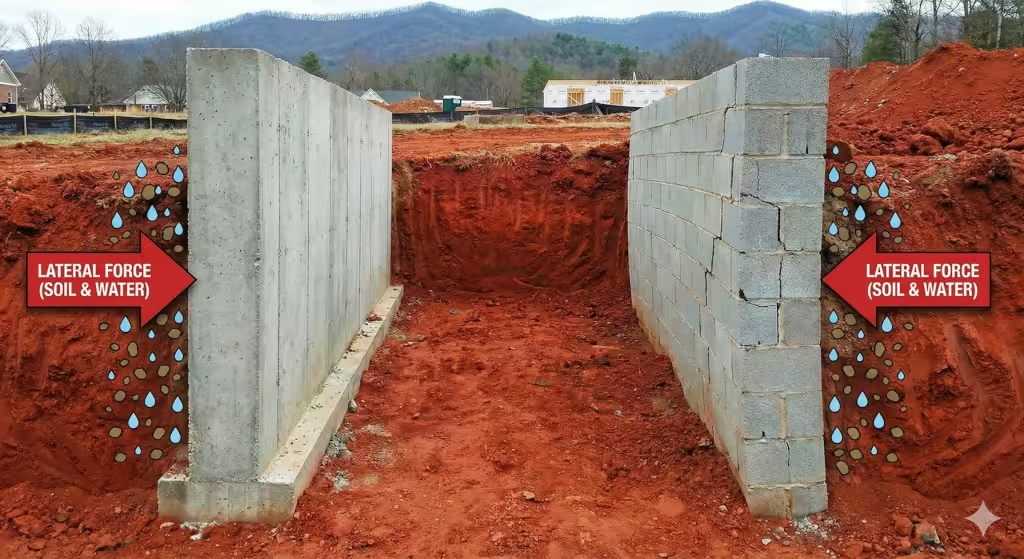
Lateral strength is the ability of a wall to stand up against a sideways push. Think about a retaining wall on a steep hill in Bristol. The dirt is trying to push that wall over. This is very different from vertical strength, which is the ability to hold up the weight of the roof and the floors.
Both a poured concrete vs. block foundation can hold up a house just fine. They are both great at vertical weight. But when it comes to lateral pressure, the poured wall wins. Because a poured wall is one single piece of stone, it does not have weak spots. A block wall is only as strong as the mortar holding the blocks together. If the dirt pushes too hard, the mortar can crack, and the blocks can start to bow inward.
Understanding Hydrostatic Pressure in East Tennessee
In places like Johnson City and Kingsport, we get a lot of rain. Our soil is mostly heavy clay. When it rains, that clay sucks up water and gets very heavy. It expands like a sponge. This creates something called hydrostatic pressure.
Imagine you are underwater in a pool. The deeper you go, the more the water presses against your ears. That is hydrostatic pressure. The same thing happens to your basement. The water in the soil presses against the walls. In a poured concrete vs. block foundation, the poured wall is better at resisting this. It is denser and has no holes. Block walls are hollow in the middle, and water can actually get trapped inside the blocks.
Why Soil Type Matters for Your Foundation
The dirt under your feet changes everything. In East Tennessee, we have a lot of “expansive” clay. This means the soil grows when it is wet and shrinks when it is dry. This constant moving back and forth is hard on a house.
When you look at poured concrete vs. block foundation options, you have to think about this movement. A poured wall is more rigid. It does not want to move. A block wall has a little bit of “give” because of the mortar, but that give can lead to cracks. If you are building on a flat lot with sandy soil, a block wall is great. But on our Tennessee hills, the poured wall is usually the safer bet.
The “Joint” Problem in Block Walls
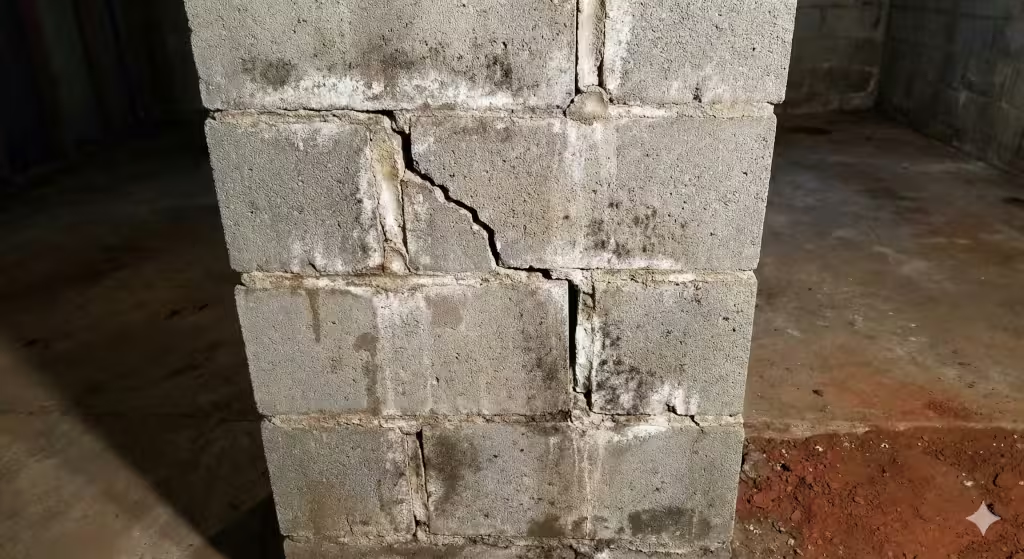
Every line of mortar in a block wall is a potential leak or a potential crack. Over time, as the house settles, those joints can open up. This is where the debate of poured concrete vs. block foundation gets serious. Once a block wall starts to crack in a “stair-step” pattern, it means the lateral pressure is too much.
To fix this, we have to use steel rebar and fill the blocks with concrete. This makes the block wall much stronger, but it also makes it more expensive. At that point, you might as well have poured a solid wall from the start.
The Monolithic Advantage of Poured Concrete
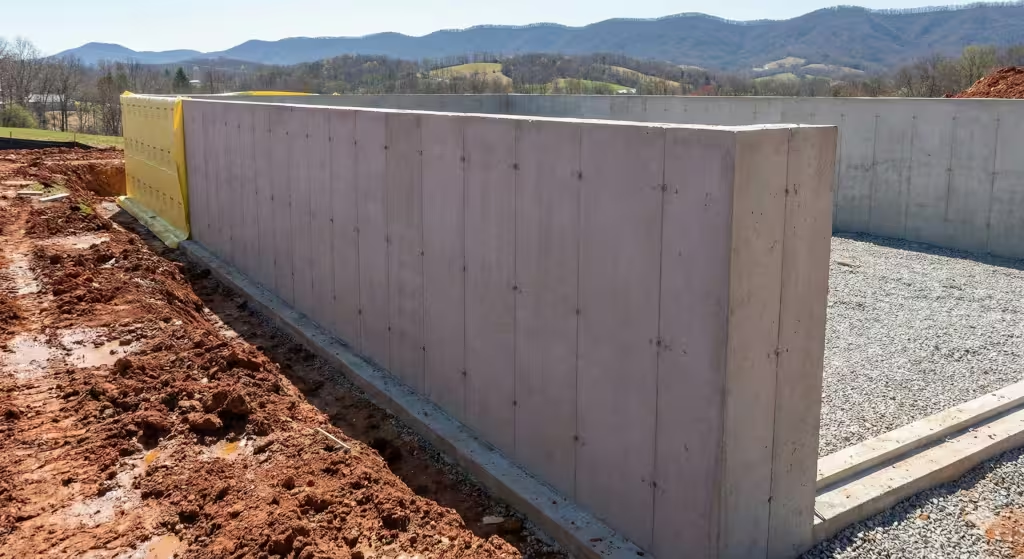
In the building industry, we use the word “monolithic” a lot. It just means “one stone.” A poured wall is a monolith. Because there are no seams, there is nowhere for water to hide and nowhere for a crack to start easily.
When comparing poured concrete vs. block foundation for a basement, the poured wall is almost always more waterproof. It is a denser material. It is harder for water to seep through solid concrete than it is to seep through a porous cinder block.
Cost Comparison in 2026
Money is always a big factor. In 2026, the price of materials has gone up, but the labor for masons has gone up even more. Stacking blocks takes a lot of time and a lot of skill.
Usually, a poured concrete vs. block foundation will cost about the same if you are just doing a simple crawl space. But for a full basement, poured walls can actually be cheaper. This is because a crew can set up the forms and pour the whole house in just a couple of days. A block basement might take a week or more of manual labor.
Block Foundation: $15 to $30 per square foot.
Poured Foundation: $15 to $35 per square foot.
The price is close, but the poured wall gives you more “bang for your buck” when it comes to strength.
Is Poured Concrete Better?
A common question is, “If poured is better, why do people still use block?” The answer is often about access. If you are building a house in a tight spot where a big concrete truck cannot reach, you have to use blocks. You can carry blocks in the back of a small truck. You cannot do that with a load of wet concrete.
Another reason is the “crawl space” tradition in Tennessee. Many local builders have used blocks for fifty years and they are very good at it. For a short wall that isn’t holding back a hill, a block foundation is a perfectly fine, competent choice.
Waterproofing Your Investment
No matter which way you go in the poured concrete vs. block foundation choice, you must waterproof it. We use special rubber coatings and plastic membranes to keep the water out.
In a block wall, the water can get inside the hollow cores. This can lead to a musty smell in your basement. In a poured wall, the water stays on the outside. We also use “French drains” which are pipes buried in gravel at the bottom of the wall. These pipes carry the water away before it can press against the house.
The Role of Steel Reinforcement
Both foundations use steel “rebar” to get stronger. Concrete is very strong when you push on it, but it can snap if you try to bend it. Steel is the opposite. It is great at being bent and pulled.
When we put steel inside a poured concrete vs. block foundation, we create a “composite” material. The concrete handles the weight of the house, and the steel handles the push of the dirt. In a poured wall, we can place the steel exactly where the engineers say it needs to be. In a block wall, we have to put the steel inside the holes of the blocks.
Maintenance and Long-Term Value
When you go to sell your home in twenty years, the home inspector is going to look at the foundation first. They are looking for bows and cracks.
A poured concrete vs. block foundation will affect your home’s value. Generally, a poured basement is seen as a higher-quality feature. It stays drier and looks cleaner. If a block wall has been repaired with “wall anchors” or “carbon fiber straps,” it can scare away buyers. Starting with a strong poured wall is like buying insurance for your home’s future value.
Regional Trends: Why Tri-Cities is Changing
Ten years ago, almost every house in Johnson City was built with blocks. Today, more and more custom builders are switching to poured walls. Why? Because the equipment has gotten better. We have bigger pumps that can reach over trees and fences, which can affect your choice of a poured concrete vs. block foundation.
Also, people want bigger basements with taller ceilings. A 10-foot tall block wall is very hard to build safely. A 10-foot tall poured wall is easy. As we move through 2026, the poured concrete vs. block foundation shift is leaning heavily toward poured concrete for all custom homes.
How to Choose the Right Builder
When you interview a builder, ask them which foundation they prefer. If they say “we always use block because that’s what we’ve always done,” that might be a red flag. A good builder should look at your specific lot and your specific plans.
They should explain the poured concrete vs. block foundation choice based on the slope of your land and the type of dirt you have. A precise builder will even have a soil test done. This tells us exactly how much pressure the walls will have to fight.
The Importance of the Footing
Underneath every wall, whether it is a poured concrete vs. block foundation, is the footing. This is a wide base of concrete that sits on the “virgin” soil (soil that has never been dug up).
If the footing is too small, the wall will sink. If the footing is not level, the wall will crack. The footing is the foundation of the foundation. It must be poured concrete, even if the walls are made of block. It has to be thick and wide enough to spread the weight of the house out, just like a snowshoe spreads your weight out so you don’t sink in the snow.
Common Problems: Bowing and Cracking
If you see a wall that looks like it is leaning inward, that is bowing. This is a sign that the lateral pressure has won.
In the poured concrete vs. block foundation battle, block walls bow more often. This is because the joints give way. A poured wall is much harder to bow. If a poured wall fails, it usually cracks all the way through first. Both are bad, but bowing is often a sign of a slow, steady failure over many years.
Fire Resistance and Safety
One thing people forget is fire. Both concrete and brick are great at stopping fire. However, a poured wall is a solid barrier. It can act as a “firewall” between different parts of a building.
When comparing poured concrete vs. block foundation safety, both are very safe for your family. They won’t burn, and bugs like termites cannot eat them. This is one of the reasons we use masonry for foundations instead of wood.
The Curing Process: Patience is a Virtue
Concrete does not “dry.” It “cures.” It is a chemical reaction between the water and the cement. This takes time.
A poured concrete vs. block foundation has different needs here. A block wall can be built quickly, and you can start framing the house almost immediately. A poured wall needs a few days to get strong before you take the forms off. Then, it needs a few more days before you can push dirt back against it. If you rush a poured wall, it can crack.
Final Thoughts from a Tri-Cities Expert
Building a home is the biggest investment you will ever make. Don’t let the part you can’t see be the part that fails. In our beautiful East Tennessee mountains, the lateral strength of your foundation is the key to your peace of mind.
When you look at poured concrete vs. block foundation options, think about the future. Think about the heavy rains in April and the freezing ground in January. For most buyers in the Tri-Cities, We recommend a poured concrete wall. It is precise, it is competent, and it has the integrity to stand up to our rugged landscape.