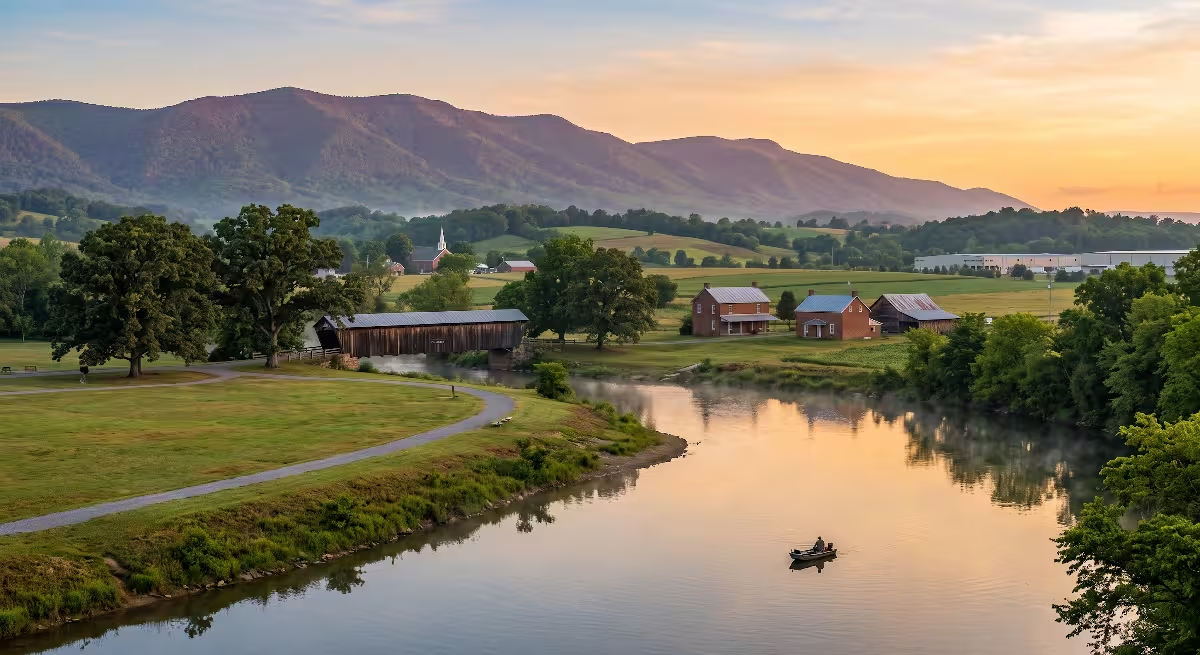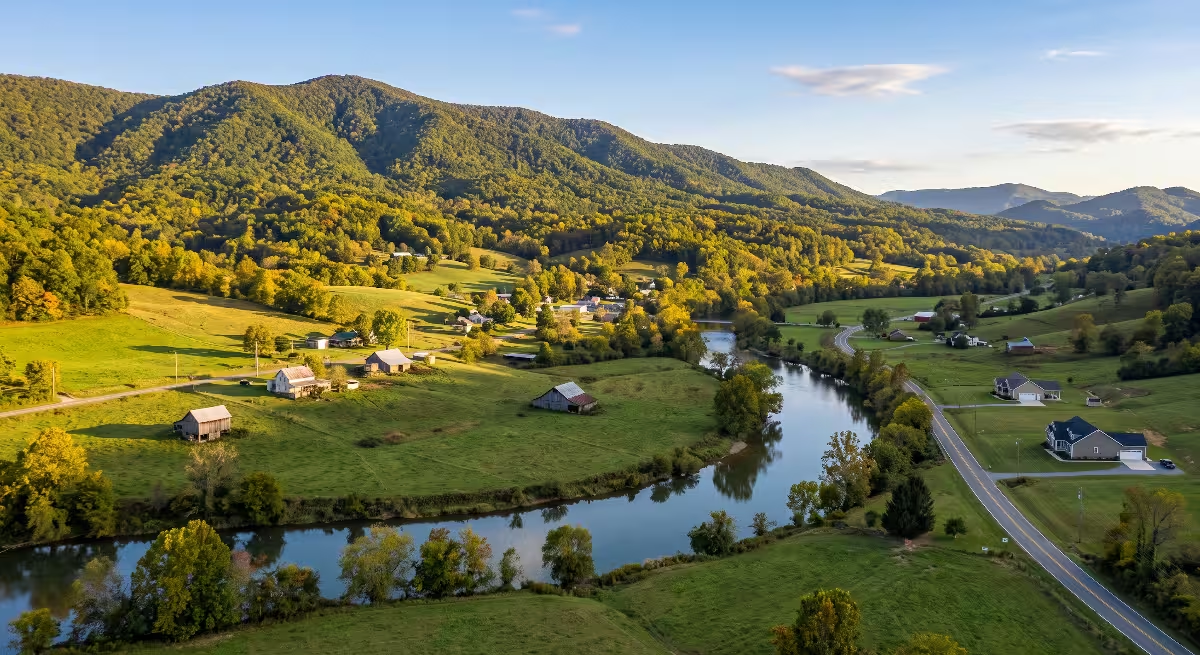


As a builder, you spend your life walking job sites, studying topography, and looking at the way buildings sit on the earth. As a result, you start to view towns differently than most folks. A lot of people see old streets, brick storefronts, and bronze plaques. In Greeneville, TN, you see something much deeper. You see generations of skilled hands, smart builders, and tough settlers who understood how to work with the rocky land, the dense timber, and the rolling valleys of Upper East Tennessee.
Greeneville, TN has a unique story. It is not just another dot on the map in our region. It is a town built on hard work, deep conviction, and solid foundations. In this comprehensive guide, we will walk through each chapter of this town’s rich past. We will look at how its land was settled, how it served as the capital of an independent frontier state, and how its people built homes and institutions that still stand strong today.
The Ridge-and-Valley Frontier
To understand Greeneville, TN, you have to start with the land beneath your boots. Greeneville, TN sits right in the heart of the Ridge-and-Valley province of the Appalachian region. To the south and east rise the rugged peaks of the Blue Ridge and the Unaka Mountains. To the west and north lie the rolling hills and limestone ridges that define East Tennessee. Flowing nearby is the Nolichucky River, a powerful waterway that provided early settlers with fresh water, transportation, and fertile bottomland for crops.
The soil here is often rich in red clay and loaded with dense limestone rock. It takes patience to grade, care to drain, and skill to build upon. The early pioneers who arrived in Greeneville, TN did not have hydraulic excavators or laser levels. They had iron picks, broadaxes, draft horses, and an eye for stable ground.
The primary story of Greeneville, TN is one of resilience. It began as a tiny, isolated frontier outpost. It grew to become the capital of the short-lived State of Franklin. It endured fierce divisions during the American Civil War. Later, it became a center for farming, burley tobacco, and manufacturing. Through every shift, Greeneville, TN kept its identity intact.
Today, Greeneville, TN holds an honored place as the second-oldest town in the state of Tennessee. Only Jonesborough, located just up the road, is older. If you look closely at road signs, you will notice another detail: it is spelled with an extra “e” in the middle. That spelling is a direct nod to the Revolutionary War general for whom it was named, a detail the locals have defended with pride for more than two centuries.
Early Settlements & Founding (1772–1783)
Indigenous Crossroads
Long before European settlers set foot in what is now Greeneville, TN, this land was part of an ancient network of human travel and culture. Paleo-Indian hunters tracked game through these river valleys thousands of years ago. By the Woodland and Mississippian periods, Native American communities built farming settlements along waterways like Big Limestone Creek and the Nolichucky River.
The broader region surrounding Greeneville, TN was also crossed by the Great Indian Warpath. This major overland route ran from the northern territories down into Georgia, passing directly through the Great Valley of East Tennessee. The Cherokee held deep ties to this area as a prime hunting ground and travel corridor. When you walk the fields near Greeneville, TN after a spring plowing, it is not uncommon to find stone arrowheads, flint scrapers, and ancient pottery shards. These artifacts remind us that people were choosing this land for its resources, shelter, and water long before the first cabin was raised.
The Nolichucky Settlement
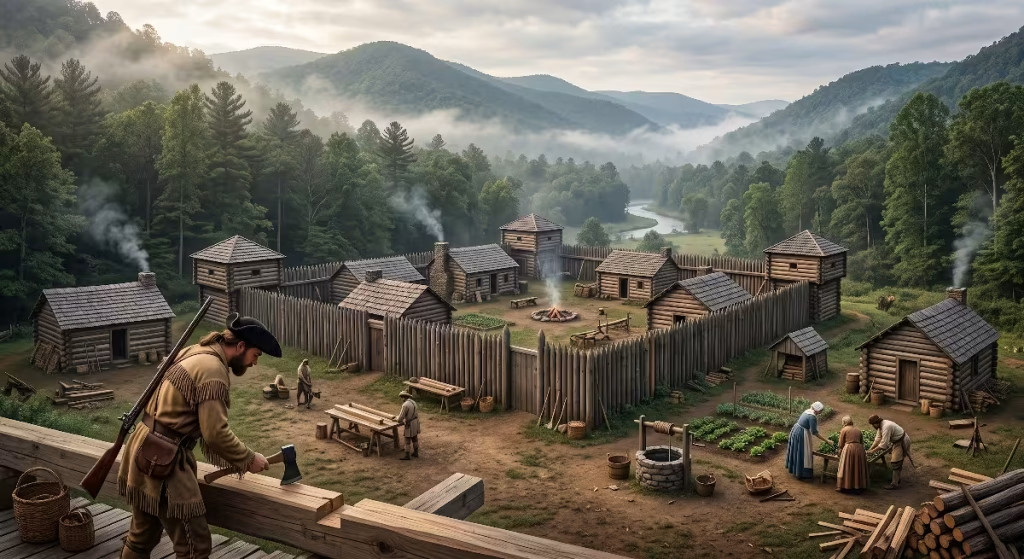
In the early 1770s, white settlers began moving past the borders permitted by the British Proclamation of 1763. They crossed the high ridges of North Carolina and Virginia into the Nolichucky River valley. Among the first prominent leaders was Jacob Brown, an enterprising trader and blacksmith. In 1772, Brown negotiated private leases with the Cherokee for two large tracts of land along the Nolichucky River.
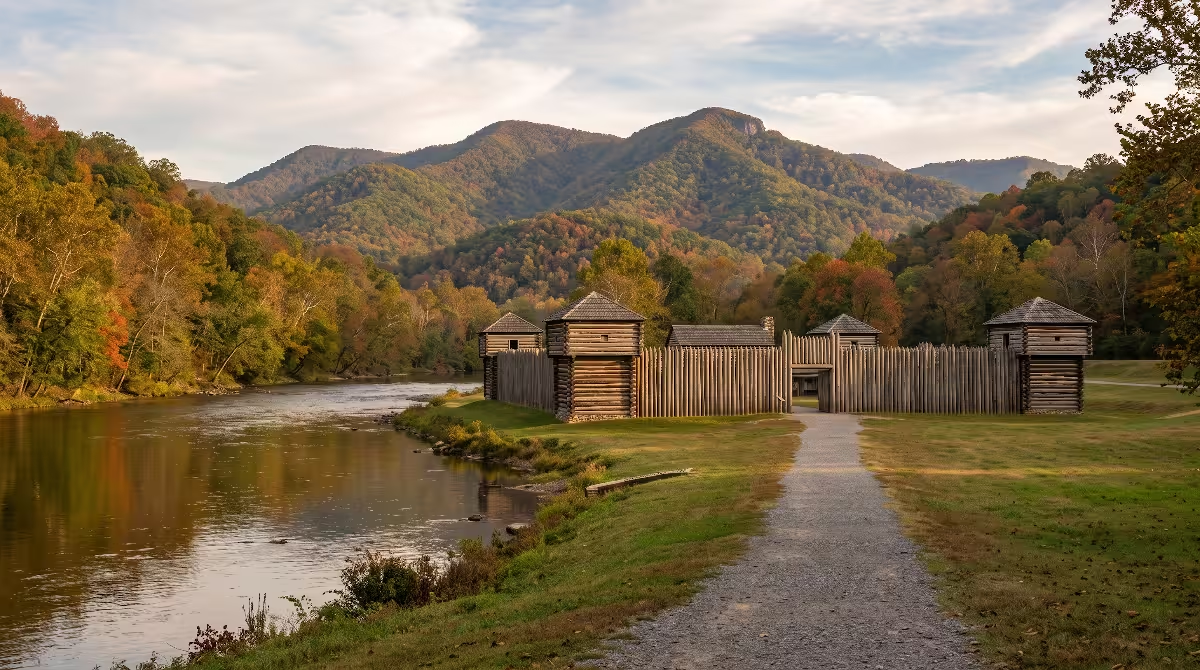
Brown’s settlement operated closely with the neighboring Watauga Association, one of the earliest self-governing compacts formed by American pioneers. These men and women were not waiting on colonial governors to protect them. They felled trees, built stockades, laid out farmsteads, and developed basic community laws. Life near the Nolichucky was physically demanding. Every family had to clear forest, pull stumps, and build shelter before winter set in. It was this self-reliant mindset that laid the groundwork for Greeneville, TN.
Founding Greene County
During the Revolutionary War, the men of the Nolichucky and Watauga valleys joined the famous Overmountain Men. They marched over the steep peaks to fight British loyalists at the Battle of Kings Mountain in 1780, securing a crucial victory for the American cause. One of the key frontier leaders was Daniel Kennedy, a soldier and surveyor who saw the need for formal local government.
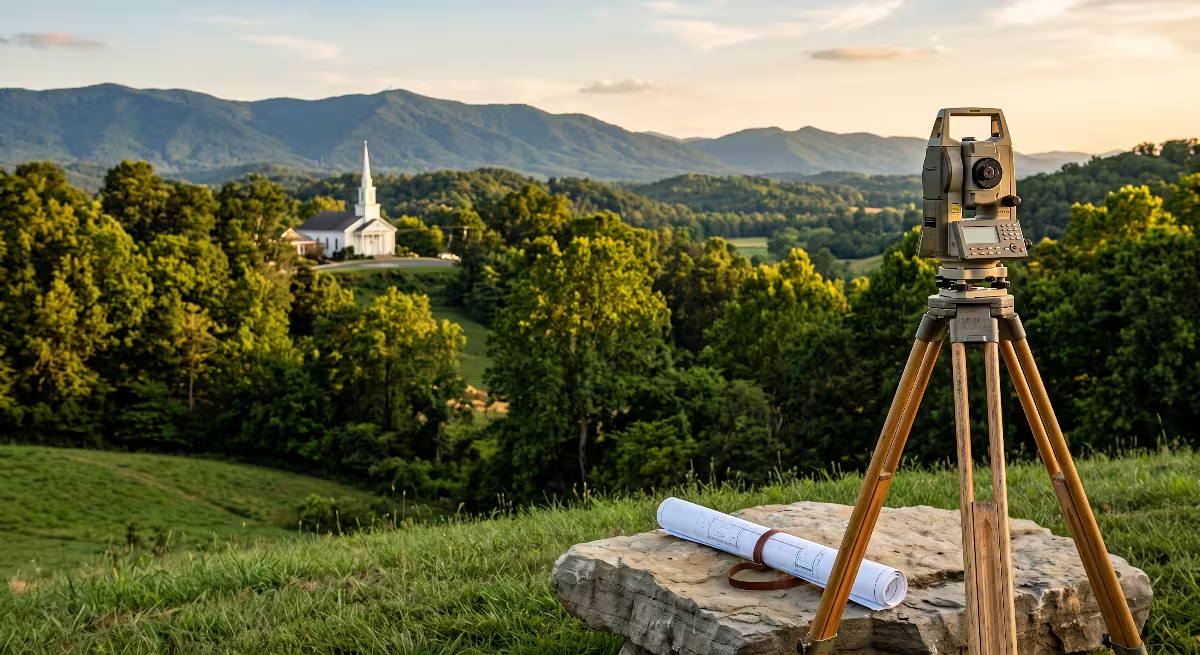
In April 1783, the North Carolina General Assembly officially created Greene County. The county took its name from General Nathanael Greene, the brilliant commander of the Continental Army’s southern campaign. General Greene was known for his steady, tactical mind, wearing down British forces through strategic movement and stubborn defense. Settlers admired his gritty leadership, making his name a natural fit for both the county and the new settlement. Kennedy helped organize the county courts and oversaw early surveys, ensuring that property lines and civic plans were properly recorded in the young community of Greeneville, TN.
Robert Kerr & The “Big Spring”
Every successful frontier settlement needed one essential feature: clean, reliable water. In 1783, a settler named Robert Kerr stepped forward and donated fifty acres of his land to establish a permanent county seat. That land centered on a natural limestone spring known as the Big Spring.
From a builder’s perspective, Kerr’s choice of land was brilliant. Big Spring bubbled up out of the limestone rock, delivering an endless supply of cold, clean water that never dried up, even in hot summers. Having a central water source meant that families could gather, livestock could drink, and early mills could operate. The original courthouse, jail, and first cluster of homes in Greeneville, TN were mapped out directly around this spring. Even today, if you visit downtown Greeneville, TN, you can walk down to the spring basin behind the library and see where the town’s civic life first took root.
Capital of the “Lost State of Franklin” (1785–1788)
The Push for Sovereignty
Following the American Revolution, the young United States faced massive war debts and a weak central government under the Articles of Confederation. North Carolina held the vast territory west of the Appalachian Mountains, which included what is now Tennessee. In 1784, North Carolina offered to cede this western land to the federal government to offset its national debt.
The settlers living around Greeneville, TN felt completely abandoned. North Carolina had rarely provided military protection against border raids, nor had it built adequate roads or established courts to settle land disputes. Now, the state was giving them away without asking their permission. The settlers worried that Congress might sell their land to foreign powers or ignore their safety altogether. Even though North Carolina quickly repealed its cession offer, the frontier leaders decided they had waited long enough. They resolved to form their own independent fourteenth state, naming it the State of Franklin in honor of Benjamin Franklin.
Greeneville as the Seat of Government
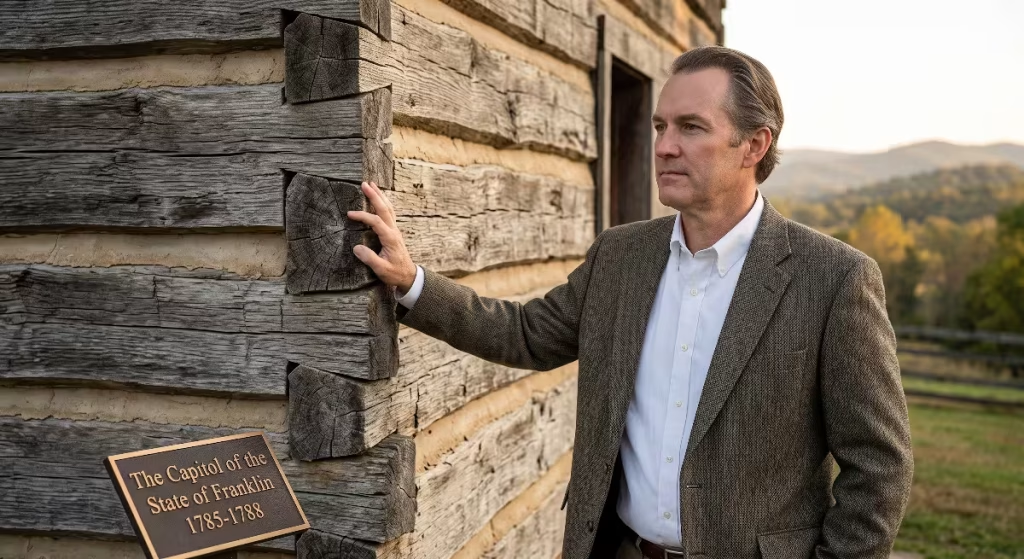
In 1785, the leaders of Franklin selected Greeneville, TN to serve as their permanent capital. John Sevier, the celebrated frontier fighter and hero of Kings Mountain, was elected as the first and only governor. Delegates met in a small, rustic log building located on what is now College Street in Greeneville, TN.
Running a frontier government required practical thinking. The State of Franklin had no gold or silver coins to use as currency. Instead, the assembly passed laws allowing taxes and public salaries to be paid in everyday goods. The governor’s salary was paid in deer skins, while clerk fees and court costs could be settled with bacon, rye whiskey, beeswax, or otter pelts. Greeneville, TN was the bustling center of this bold experiment. The leaders wrote a state constitution, established militia units, and petitioned the Continental Congress for formal recognition.
Dissolution & Legacy
Despite their passion, the State of Franklin faced severe roadblocks. Only seven of the thirteen states voted to admit Franklin to the union, falling short of the two-thirds majority required. Back in North Carolina, Governor Alexander Martin declared the movement an open rebellion.
Before long, internal divisions tore through the region. Some residents remained loyal to North Carolina, while others stood firmly with John Sevier and Franklin. Parallel court systems operated in the same valleys, and rival sheriffs attempted to collect taxes from the same citizens. By 1788, armed clashes broke out, and the Franklin government collapsed under pressure. John Sevier was briefly arrested, though he was never convicted of treason.
North Carolina regained temporary control, but the momentum could not be stopped. In 1790, the region became part of the Southwest Territory, and in 1796, Tennessee was admitted to the Union as the sixteenth state, with John Sevier as its first governor. Although Franklin lasted only four short years, Greeneville, TN will forever hold the title of the capital of the lost State of Franklin, proving how determined these early mountain people were to shape their own destiny.
Andrew Johnson: The Tailor Who Reached the White House
Arrival & Trade (1826)
In September 1826, an eighteen-year-old runaway tailor’s apprentice from Raleigh, North Carolina, walked into Greeneville, TN leading a cart that held his mother and step-father. His name was Andrew Johnson. He had no formal schooling, no money, and few possessions, but he had two hands that knew how to measure cloth, cut patterns, and sew sturdy garments.
Johnson set up a small tailor shop on Depot Street in Greeneville, TN. Shortly after arriving, he met Eliza McCardle, the daughter of a local shoemaker. They married in 1827. Eliza was patient, educated, and kind. As Andrew sat cross-legged on his tailor workbench sewing coats and trousers, Eliza sat beside him, reading aloud from history books, legal treatises, and volumes of classic speeches. She taught him how to write properly and helped him sharpen his math skills.
The tailor shop quickly became the unofficial town hall of Greeneville, TN. Working men, farmers, and laborers would drop by to talk about land taxes, crop prices, and national politics while Johnson worked his needle. Johnson had a deep, commanding voice and a natural gift for debate. He spoke directly to the everyday working class, earning their loyalty and trust.
Political Rise
Johnson’s career in public office started at the absolute bottom of local government right in Greeneville, TN. In 1829, local voters elected him town alderman. Five years later, in 1834, he was elected mayor of Greeneville, TN. From there, his rise was steady:
- State Representative in Nashville (1835)
- State Senator (1841)
- United States Congressman (1843 to 1853)
- Governor of Tennessee (1853 to 1857)
- United States Senator (1857 to 1862)
When the Civil War erupted in 1861 and Tennessee voted to secede, Andrew Johnson took a stand that shocked the South: he was the only sitting senator from a Confederate state who refused to leave his post in the United States Senate. For this, he was praised in the North and branded a traitor across much of the South. President Abraham Lincoln appointed him military governor of Tennessee in 1862, and in 1864, Lincoln selected Johnson as his vice-presidential running mate on the National Union ticket. Following Lincoln’s tragic assassination in April 1865, the former tailor from Greeneville, TN became the seventeenth President of the United States.
Johnson’s presidency was turbulent. He clashed violently with the Radical Republicans in Congress over how to handle Reconstruction in the defeated South, leading to his impeachment in 1868. He was acquitted in the Senate by a single vote. After finishing his term in 1869, he returned home to Greeneville, TN. Showing his trademark stubbornness, he ran for office again and was re-elected to the U.S. Senate in 1875, the only former president ever to return to the Senate.
Preserved Landmarks
Today, the legacy of Andrew Johnson is preserved throughout Greeneville, TN by the National Park Service:
- The Andrew Johnson National Historic Site: This site includes his original tailor shop, enclosed within a brick memorial building to protect the historic wood frame from weather damage. You can also tour his two-story brick home on Main Street, which displays original family furnishings and personal belongings.
- The Andrew Johnson National Cemetery: Situated on Monument Hill in Greeneville, TN, this cemetery is where Johnson was buried in 1875. Per his personal request, his body was wrapped in a United States flag, and his head was rested upon his well-worn copy of the U.S. Constitution. A tall marble obelisk crowned by an American eagle marks his grave, looking out over the rolling ridges of Greeneville, TN.
Frontiersmen & Higher Education

Davy Crockett Birthplace
When people think of legendary frontier heroes, the name Davy Crockett stands at the very top. What many do not realize is that Crockett began his life right here along the waterways of Greene County, near Greeneville, TN.
David Crockett was born on August 17, 1786, along the banks of the Nolichucky River near the community of Limestone, just a short drive from downtown Greeneville, TN. His father, John Crockett, was a veteran of Kings Mountain who built a modest log cabin close to the river mouth. Davy spent his childhood roaming the dense hardwoods, hunting wild game, and learning the tracking skills that later made him a national legend.
Today, the Davy Crockett Birthplace State Historic Park commemorates this site. Visitors can see a replica 1780s log cabin, examine period farm tools, and walk the very soil where Tennessee’s most famous frontiersman learned to survive. Crockett’s early years in the Greeneville, TN area shaped his independent spirit, his plainspoken humor, and his legendary marksmanship.
Tusculum University (Founded 1794)
Pioneers did not just bring axes and plows to Greeneville, TN; they also brought a hunger for learning and faith. In 1794, two years before Tennessee became a state, Presbyterian ministers Reverend Hezekiah Balch and Reverend Samuel Doak received a charter to establish Greeneville College. Nearby, Doak also founded Tusculum Academy in 1818. The two institutions eventually merged to become Tusculum College, known today as Tusculum University.
Tusculum University holds the proud title of the oldest institution of higher learning in Tennessee and the twenty-eighth oldest in the entire United States. Located just east of downtown Greeneville, TN, the historic campus is an architectural wonder:
- Historic Academic Buildings: Structures like Virginia Hall and McCormick Hall showcase early American brickwork, large double-hung wood windows, and heavy timber roof framing built to last generations.
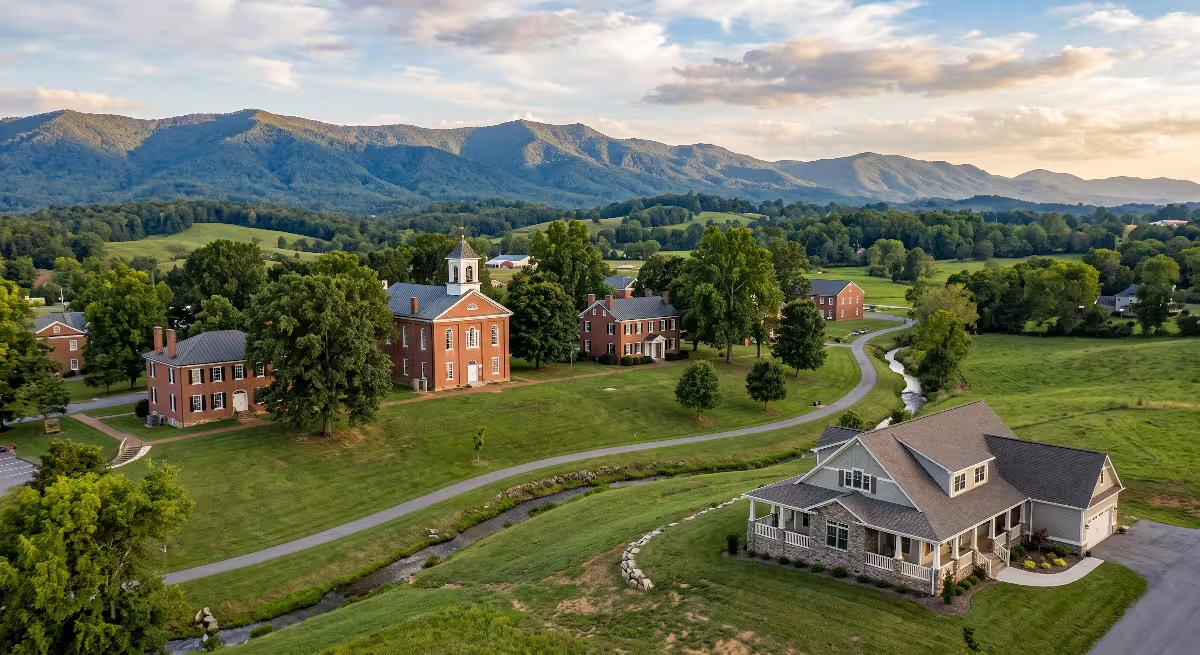
- The Doak House Museum: Built around 1830 by Samuel Doak, this preserved two-story brick home demonstrates early regional masonry. Notice the Flemish bond brick pattern, which locks the wall together using alternating rows of stretchers and headers, providing structural strength before modern rebar existed.
- Cultural Impact: For over two centuries, Tusculum has educated teachers, ministers, civic leaders, and business owners who helped build Greeneville, TN and the broader Tri-Cities region.
A House Divided: The Civil War in Greeneville

Union Sentiment vs. Confederate Encirclement
The Civil War was a painful, brother-against-brother conflict across America, but few places suffered deeper divisions than Greeneville, TN. In the plantation areas of West and Middle Tennessee, the economy depended on cotton and slave labor, leading to overwhelming support for secession. East Tennessee was different. The rocky landscape and smaller family farms were poorly suited for large plantations. Most people in Greeneville, TN were independent farmers who felt a fierce loyalty to the federal Union.
In June 1861, representatives from across the region met in Greeneville, TN for the second session of the East Tennessee Convention. They drafted a brave petition asking the state legislature to allow East Tennessee to break away from the rest of the state and remain a loyal Union territory. Their request was flatly rejected by Confederate leaders in Nashville. Confederate troops moved quickly into East Tennessee to secure the railroad, placing Greeneville, TN under military occupation.
Neighbor turned on neighbor. Sons from the same family enlisted on opposite sides. Union loyalists formed underground networks to guide escaped prisoners and recruits through the mountains to Kentucky, while Confederate home guards carried out raids to suppress dissent.
Strategic Shifting Ground
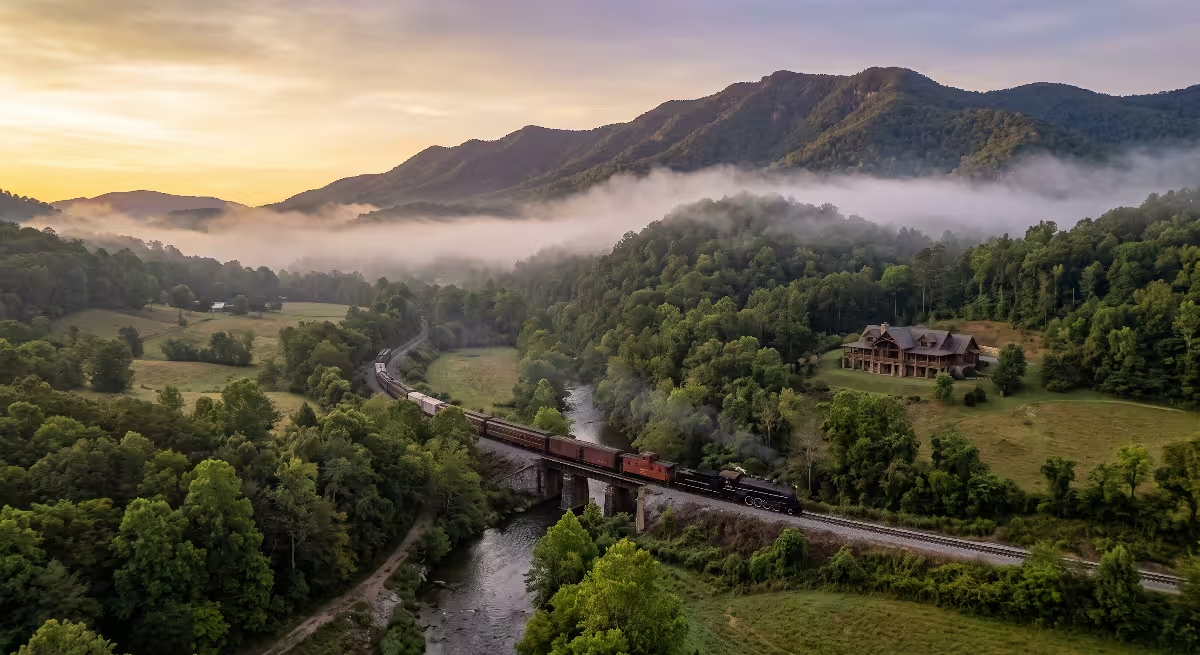
The primary reason armies fought so hard over Greeneville, TN was the East Tennessee and Virginia Railroad. This rail line ran straight through the center of town. It served as a vital lifeline, moving troops, ammunition, beef, grain, and salt between Virginia and the deep South.
Because of this rail line, control of Greeneville, TN changed hands dozens of times throughout the four years of war. When Confederate forces held the town, they guarded the bridges and depots. When Federal cavalry swept through, they tore up track, burned supply sheds, and cut telegraph wires. Local families had their barns raided for corn, their smokehouses emptied of hams, and their horses taken by passing armies from both sides.
The Death of General John Hunt Morgan (1864)
One of the most famous events of the Civil War took place in downtown Greeneville, TN on the rainy morning of September 4, 1864. Confederate Brigadier General John Hunt Morgan, celebrated as the “Thunderbolt of the Confederacy” for his daring cavalry raids into Kentucky, Indiana, and Ohio, arrived in town with his staff.
Morgan made his headquarters at the grand Dickson-Williams Mansion, the finest home in Greeneville, TN. His troops were camped on the outskirts of town, but a Union force under General Alvan C. Gillem launched a surprise dawn attack. Federal cavalry rode through the morning downpour, surrounding the mansion gardens.
Morgan realized his danger and fled through the basement into the garden, hoping to reach his horse in the stables. Before he could escape, he was spotted by Union soldiers and shot through the heart. His death sent shockwaves through the Confederacy. The room where Morgan stayed and the cellar path he ran through are still carefully preserved inside the mansion in Greeneville, TN today.
A Unique Civic Memory
After the war ended in 1865, the people of Greeneville, TN had to find a way to live together again. The wounds ran deep, but the community gradually chose reconciliation over bitterness.
You can see this healing displayed in concrete and stone on the lawn of the Greene County Courthouse in Greeneville, TN. Standing on the grounds are two separate monuments:
- A monument dedicated to the Union soldiers of Greene County who fought to save the republic.
- A monument dedicated to the Confederate soldiers of Greene County who fought for their southern cause.
Very few towns in the United States honor both sides of the Civil War on the exact same civic square. It stands as a powerful testament to the maturity, grace, and resilience of Greeneville, TN.
Structural Heritage & Built Environment
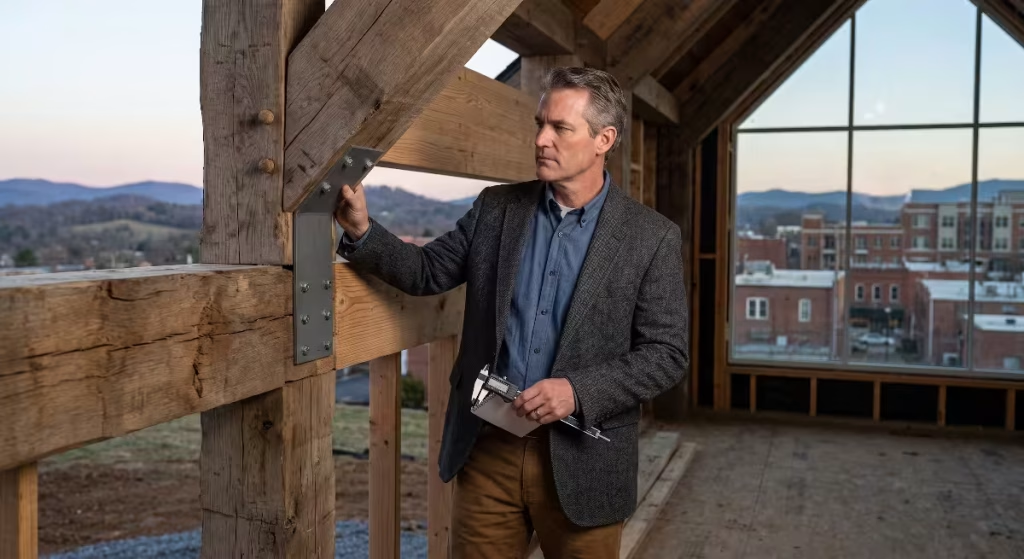
As a builder who inspects wood framing, footings, and structural masonry, I have an immense appreciation for how historic structures in Greeneville, TN were put together. Long before manufactured lumber, gypsum board, or modern Portland cement were invented, local craftsmen used raw, local materials to build homes that have survived for more than two hundred years.
Pioneer Craftsmanship & Framing Techniques
The earliest surviving buildings in Greeneville, TN are hewn-log structures and timber-frame homes. Early settlers did not have ready access to sawmills, so they shaped logs using a felling axe and a broadaxe.
- The Log Notch: Look at the corners of early cabins around Greeneville, TN. Builders used half-dovetail or full-dovetail notches. These joints fit together with angled faces that naturally drained water away from the log ends while pulling the timbers tighter together as the structure settled.
- Timber Framing: For larger homes, master carpenters used post-and-beam construction. They squared massive oak or tulip poplar timbers and joined them using mortise-and-tenon joints, locked securely in place with hard wooden pegs called trunnels. No metal nails were needed in the structural frame.
- Limestone Foundations: The earth beneath Greeneville, TN is filled with solid limestone. Early builders quarried this rock, split it with hammer and chisel, and laid dry-stack or lime-mortar foundations. These stone foundations kept the wood sills off the damp earth, preventing termite damage and rot.
Federal & Greek Revival Architecture
As Greeneville, TN grew from a frontier village into an established county seat, its architecture became more refined. Wealthy merchants built homes reflecting the popular Federal and Greek Revival styles.
The finest example of this era is the Dickson-Williams Mansion, built between 1815 and 1821 for William Dickson and his wife. Building this mansion was a major engineering feat for early Greeneville, TN:
- Brickwork: The bricks were not shipped in by rail; they were hand-pressed from local red clay and fired in temporary kilns on the property. The front facade features a Flemish bond pattern that creates a beautiful, formal look.
- Interior Craftsmanship: The home features wide center hallways designed to draw cool summer air up from the shaded yard. Skilled woodworkers hand-carved intricate fireplace mantels, delicate door casings, and a dramatic, unsupported curved staircase that remains an engineering marvel.
- Roof & Windows: The roof structure was built with heavy, clear-span timber trusses, and the home features ninety-paned windows with blown glass that still casts subtle waves in the sunlight.
Industrial Shift & Burley Tobacco
In the late nineteenth and early twentieth centuries, the economy of Greeneville, TN shifted toward commerce and industry. The arrival of modern steam-powered equipment and expanded rail connections allowed the town to become one of the premier burley tobacco markets in the entire world.
This economic boom completely transformed the built environment of Greeneville, TN:
- Commercial Storefronts: Main Street and Depot Street filled with two- and three-story commercial brick buildings. These featured cast-iron structural columns on the ground floor, which allowed for massive glass display windows to attract shoppers. Decorative corbeled brick cornices ran along the rooflines.
- Tobacco Warehouses: Massive brick and timber-truss warehouses sprang up along the rail corridors in Greeneville, TN. These buildings required vast, open floor plans without interior columns so that large wagons and carts could maneuver heavy tobacco baskets. Builders used heavy timber Howe or Pratt trusses to span fifty to eighty feet of clear space.
- Residential Neighborhoods: Wealthy warehouse owners and merchants built Queen Anne, Craftsman, and Colonial Revival homes along Main and Church Streets, featuring wrap-around porches, complex rooflines, and leaded glass windows.
Frequently Asked Questions about Greeneville, TN
Why is Greeneville spelled with an “e” in the middle?
Many towns across the United States are named Greenville, but Greeneville, TN includes an extra “e” in the middle. The town was named in honor of General Nathanael Greene, the famous Revolutionary War commander. When the town was founded in 1783, the county court clerk and early leaders made sure to include the exact spelling of General Greene’s family name to honor him properly. The spelling has been protected by community tradition ever since.
What is Greeneville, TN famous for?
Greeneville, TN is famous for several major historical claims to fame:
- It served as the capital of the independent State of Franklin from 1785 to 1788.
- It is the hometown of Andrew Johnson, the seventeenth President of the United States.
- It is the birthplace region of folk hero Davy Crockett, who was born nearby along the Nolichucky River.
- It is the home of Tusculum University, founded in 1794 as the oldest college in Tennessee.
- It is known for its historic role as one of the largest burley tobacco markets in the United States.
Is Greeneville the oldest town in Tennessee?
No, Greeneville, TN is the second-oldest town in Tennessee. Nearby Jonesborough was founded in 1779 and holds the title of the oldest town. Greeneville, TN was officially established by the North Carolina legislature in 1783, making it four years younger than Jonesborough.
Who was killed at the Dickson-Williams Mansion?
Confederate Brigadier General John Hunt Morgan, known as the “Thunderbolt of the Confederacy,” was killed at the Dickson-Williams Mansion in Greeneville, TN. On the morning of September 4, 1864, Union troops launched a surprise raid on the town. Morgan was staying at the mansion, and while attempting to escape through the backyard garden to the stables, he was shot and killed by Union cavalry.
Modern Greeneville: Preserving Historic Character
Downtown Revitalization & Preservation
When you walk down Main Street in Greeneville, TN today, you are looking at a town that values its roots. In many American towns, older buildings were torn down in the 1960s and 1970s to build strip malls and asphalt parking lots. Greeneville, TN took a different path. Civic leaders, local historians, and property owners recognized that their historic brick storefronts and homes were irreplaceable assets.
Through smart historic zoning, adaptive reuse programs, and main street revitalization, older buildings in Greeneville, TN have found new life. A former tobacco warehouse now serves as an event venue or small-business office. Old dry-goods stores are now bustling local restaurants, bakeries, and boutique shops. New electrical systems, modern HVAC units, and commercial roof coatings have been installed inside historic structures without stripping away the exposed brick, heart-pine floors, and hand-cut timber beams that give them character.
Living with History: A Builder’s Perspective
For those of us working in the home building and real estate industry across Upper East Tennessee, Greeneville, TN offers something truly special. When buyers come to me asking about building or buying in Greene County, they are often drawn to the open rolling farmland, the views of the Bald Mountains, and the small-town feel.
The history of Greeneville, TN shapes how we design and build modern homes in the area today:
- Honoring Heritage: Modern custom homes frequently incorporate exterior details inspired by the region’s past, such as natural stone foundations, wide covered front porches, and timber-framed accents.
- Topography and Drainage: The same rolling topography and limestone terrain that early settlers encountered near Big Spring require modern builders to perform thorough soil testing, careful foundation engineering, and smart site grading to ensure proper water runoff.
- Community Pride: People who choose to live in Greeneville, TN appreciate that their town has real roots. It is not an overnight suburb; it is a community that fought for its independence, weathered the storm of the Civil War, and contributed a president to the United States.
Historic Architecture in Greeneville, TN
To give you an idea of how building practices evolved in this area, here is a quick overview of how construction techniques changed in Greeneville, TN across different eras:
| Era | Common Building Type | Primary Foundation | Structural Framing | Key Characteristic |
| 1770s–1790s | Frontier Log Cabins | Dry-stacked field limestone | Hand-hewn logs with dovetail corner notches | Built from cleared clearing timber; tight joints shed rainwater |
| 1800s–1830s | Federal & Greek Revival Homes | Mortared quarried limestone blocks | Heavy post-and-beam timber with mortise-and-tenon joints | Hand-pressed local red brick; Flemish bond; balanced symmetry |
| 1850s–1880s | Civil War & Victorian Structures | Cut stone or rough-laid stone piers | Early balloon framing and sawn lumber | Multi-story homes, larger window spans, decorative trim |
| 1890s–1930s | Commercial Facades & Tobacco Sheds | Poured concrete or heavy ashlar stone | Heavy timber truss systems (Howe/Pratt) and load-bearing brick | Cast-iron support columns; wide clear-span storage floors |
| Modern Era | Custom Craftsman & Modern Farmhouse | Reinforced poured concrete footings and block | Engineered floor trusses, I-joists, and 2×6 exterior framing | Blends rustic stone and board-and-batten siding with modern energy efficiency |
A Town Built to Stand the Test of Time
A home, an institution, or a town is only as good as the foundation upon which it rests. If you build on shifting sand or use shortcuts, time and weather will eventually tear your work down. But when you lay deep footings on solid limestone, use the best materials available, and take pride in your craft, your work can endure through centuries of challenge.
Greeneville, TN is proof of that principle. From the initial spark of independence that ignited the State of Franklin to the tough determination of Andrew Johnson, the bold frontier spirit of Davy Crockett, and the quiet dignity of the brick homes on Main Street, Greeneville, TN has earned its place in the history of Tennessee and the United States.
Whether you are walking through the historic district, touring the national park sites, or planning to build your dream home in the surrounding countryside, you are participating in a living story. Greeneville, TN remains an inspiring example of American resilience, timeless craftsmanship, and mountain pride.