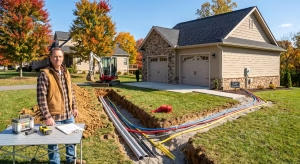
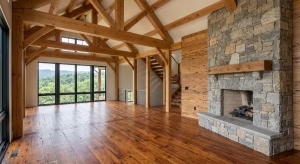
The decision to build a custom home in the rolling hills of the Appalachian Highlands is an exciting one. It’s a chance to translate a vision into a physical reality, a place for family, and a cornerstone for the future. Yet, before the scent of fresh-cut lumber fills the air and long before the first shovel breaks ground, a different kind of foundation must be laid. This foundation isn’t made of concrete and rebar, but of careful financial planning. The critical tool for this job is the construction loan.
Having the right financing at the start can set a project on a course for success, making the entire process feel seamless and controlled. A lack of understanding in this area can lead to friction, delays, and unnecessary stress for homeowners. The purpose of this post is not to sell you on a particular bank or product, but to provide a direct, competent overview of the landscape. In other words, consider this a blueprint.
This guide will walk you through every important aspect of securing a construction loan right here in the Johnson City, Kingsport, and Bristol area. When you’re finished reading, you will be equipped with the knowledge to move forward with clarity and confidence, ready to build not just a house, but a home.
What Exactly is a Construction Loan? (And How It Differs from a Mortgage)
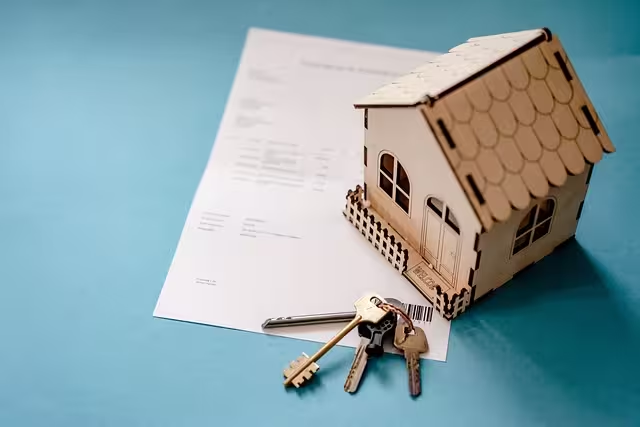
Most of us are familiar with a traditional mortgage. You find a house you like, you agree on a price, and the bank gives you a large, one-time loan to buy it. You then spend the next 15 or 30 years paying it back. It’s a straightforward process because the bank is lending against a finished product—a house that already exists and has a clear market value.
A construction loan is a different animal altogether. Its core purpose is to finance the creation of a home, not the purchase of an existing one. Because the house doesn’t exist yet, the process and the risks are fundamentally different for both you and the lender.
Think of it this way: a mortgage is like buying a car that’s already sitting on the dealership lot. A construction loan is like financing the parts and labor to have a custom car built for you piece by piece in a workshop.
Let’s break down the key differences:
- Purpose and Term Length: The primary goal of a construction loan is to cover the costs of building, from paying the excavator to clear the land to buying the final light fixtures. It’s a short-term loan, typically lasting only as long as the construction process—usually between 12 and 18 months. A mortgage, on the other hand, is a long-term loan designed to be paid back over decades.
- How the Money is Paid Out: With a mortgage, the seller gets a lump-sum check at closing, and the deal is done. A construction loan works in stages. The total approved loan amount sits with the bank, and the funds are released in periodic payments known as “draws.” Your builder receives these funds only after completing specific, pre-agreed-upon phases of the project. This protects the bank from giving out money for work that hasn’t been done, and it protects you by ensuring the project is progressing as planned.
- How You Make Payments: During the construction phase, you aren’t required to pay back the principal of the loan. Instead, you typically make interest-only payments. A crucial point is that you only pay interest on the money that has actually been drawn or paid out to the builder so far. For example, if your total loan is for $400,000 but only $50,000 has been paid out for the foundation and framing, your monthly payment is calculated based only on that $50,000, not the full amount. This keeps your payments lower during the build when you might also be paying rent or a mortgage on your current home.
- Risk and Requirements: From a lender’s perspective, a construction loan is riskier. They are lending money on a home that is essentially a detailed set of plans and a pile of dirt. There’s no existing house to use as collateral if the project goes wrong or the borrower defaults. Because of this higher risk, lenders have stricter qualification requirements. They will scrutinize not only your finances but also the qualifications and reputation of your builder, the quality of your architectural plans, and the details of your budget.
Understanding these distinctions is the first and most important step. A construction loan is not a mortgage; it is a specialized financial tool designed for a specific, complex job.
Types of Construction Loans Available in Our Area
When you start talking to lenders in Johnson City or Kingsport, you will likely hear them discuss two primary types of construction loan packages. The one you choose will have long-term implications for your closing costs and interest rates, so it’s vital to understand the difference.
A. Construction-to-Permanent Loan (Single-Close Loan)
This is, by far, the most popular option for homebuyers in the Tri-Cities, and for good reason. A construction-to-permanent loan, often called a “one-time close” loan, is exactly what it sounds like: it’s two loans wrapped into one convenient package with a single closing process.
Here’s how it works: You go through the underwriting and approval process once. At the closing, you sign the paperwork for a loan that starts as a construction line of credit. For the next 12-18 months while your home is being built, it functions as a construction loan with interest-only payments on the drawn funds. Once the home is finished and the county issues a Certificate of Occupancy, the loan automatically converts into a standard, permanent mortgage with principal and interest payments.
Pros of a Single-Close Loan:
- One Set of Closing Costs: This is the biggest advantage. Closing on a loan involves various fees for attorneys, appraisals, title searches, and more. With a single-close loan, you only pay these once, which can save you thousands of dollars.
- Rate Security: You typically lock in the interest rate for your permanent mortgage at the very beginning of the process. If interest rates happen to rise during the year your home is being built, you are protected because your rate is already secured. Some lenders even offer a “float-down” option, where if rates drop by the time construction is complete, you can get the lower rate.
- Simplicity and Peace of Mind: There’s no need to go through the stress of reapplying for a mortgage when your home is finished. You won’t have to worry about your credit score changing, losing your job, or other life events that could put your final mortgage approval in jeopardy.
Cons of a Single-Close Loan:
- Less Flexibility on the Final Mortgage: Since your permanent mortgage lender is the same as your construction lender, you don’t have the opportunity to shop around for a better mortgage rate once the house is built. You are committed to the terms you agreed to at the initial closing.
B. Stand-Alone Construction Loan (Two-Close Loan)
The less common option is the stand-alone construction loan, which requires two separate transactions and two closings.
First, you apply for and close on a loan that is only for the construction phase. This loan covers the building costs and must be paid off in full when the house is completed. To pay it off, you must then apply for a completely separate, standard mortgage. This means you go through the entire underwriting process—credit checks, income verification, appraisal—a second time.
Pros of a Two-Close Loan:
- Opportunity to Shop for Rates: The main benefit is that once your home is built, you are a free agent. You can shop around with dozens of lenders to find the absolute best interest rate and terms for your permanent mortgage. If interest rates have fallen since you started the project, this could result in significant savings over the life of the loan.
Cons of a Two-Close Loan:
- Two Sets of Closing Costs: You have to pay all the associated fees twice—once for the construction loan and again for the permanent mortgage. This can easily add an extra $3,000 to $6,000 or more to your total costs.
- Risk of Non-Qualification: This is the most significant drawback. A lot can happen in a year. If your financial situation changes for the worse during construction (e.g., a job change, a drop in your credit score, or even a change in lending regulations), you could fail to qualify for the permanent mortgage. This would leave you with a finished house and a construction loan that is due in full, a very precarious position.
- Interest Rate Risk: If mortgage rates go up during the build, you will be forced to accept a higher rate on your permanent loan than you might have gotten with a single-close loan a year earlier.
For most families building their primary residence, the security and cost savings of the construction-to-permanent, single-close loan make it the more prudent and logical choice.
The Mechanics: How Funds Are Disbursed via a “Draw Schedule”
One of the most frequently asked questions I get from clients is, “So, does the builder just get all the money at once?” The answer is a firm no. The financial engine of a construction loan is the draw schedule, a carefully controlled process that ensures money is paid out incrementally as work is verifiably completed.
A draw schedule is a detailed payment plan that you, your builder, and your lender all agree on before the project even begins. It breaks the entire construction process down into distinct stages. As the builder completes each stage, they can request a “draw” from the bank to cover the costs of the work they just finished and to get funds for the next phase.
Before the bank releases the money for a draw, however, a critical step must occur: an inspection. The lender will send out an independent inspector to your job site. This inspector’s only job is to confirm that the work for that particular stage has been completed according to the plans and building codes. For example, they won’t approve the “framing” draw until they can physically see that all the walls are up and the roof structure is in place. This system of checks and balances protects everyone involved.
A typical draw schedule for a home in our area might look something like this:
- Closing & Site Work: The first draw is often released at the loan closing to pay for the land (if it’s part of the loan), permits, and initial site preparation like excavation and pouring the foundation.
- Framing and “Dry-In”: This is a major milestone. Once the wooden skeleton of the house is up, the roof is on, and the windows and exterior doors are installed, the house is considered “dried in.” This means the interior is protected from the elements. The builder will request a significant draw at this point.
- Rough-in Mechanicals (MEP): This draw covers the installation of all the systems inside the walls: plumbing pipes, electrical wiring, and HVAC (Heating, Ventilation, and Air Conditioning) ductwork. The inspector will verify that this work is done before any drywall goes up.
- Drywall and Interior Finishes: Once the walls are closed up with drywall, the project starts to look like a real home. This draw covers hanging and finishing drywall, installing interior doors, trim, and cabinets, and sometimes initial painting.
- Final Draw and Certificate of Occupancy: The last draw is released after the home is 100% complete. This includes flooring, countertops, light fixtures, plumbing fixtures, appliances, final paint, and landscaping. The lender will require a copy of the official Certificate of Occupancy from the county building inspector, which legally certifies the home is safe and ready to be lived in.
This methodical process ensures that work is completed satisfactorily before payments are made, keeping the project on track and providing accountability for your builder.
Qualifying for a Construction Loan in the Tri-Cities: What Lenders Look For

As we’ve established, lenders view construction loans as higher risk. To offset that risk, they have a more rigorous set of requirements than you’d find for a standard mortgage. Being prepared for this is key to a smooth approval process. Lenders are essentially vetting a three-part package: you (the borrower), your builder (the professional), and your project (the plan).
A. A Solid Credit Profile
Your personal financial health is the first hurdle. Lenders will be looking for:
- Strong Credit Score: While you might find some programs that go lower, most lenders in our area will want to see a FICO score of at least 680. To secure the most favorable interest rates and terms, a score of 720 or higher is the target.
- Low Debt-to-Income (DTI) Ratio: Your DTI is the percentage of your gross monthly income that goes toward paying all of your monthly debts (car loans, credit cards, student loans, etc.). Lenders want to see that you can comfortably handle your current debts plus the interest-only payments on the construction loan and the eventual full mortgage payment. A DTI below 43% is the standard goal.
- Cash Reserves: Lenders want to see that you have savings on hand beyond your down payment. This shows you can handle unexpected expenses during the build or a financial emergency without defaulting on the loan. Having 2-6 months’ worth of your future mortgage payment in savings is a common requirement.
B. A Significant Down Payment
This is a major difference from the 3.5% down FHA loans or 0% down VA loans available for existing homes. For a construction loan, you need to bring more skin to the game.
- The 20% Rule: The industry standard is a down payment of at least 20% of the total project cost. The total project cost is the sum of the land price (if you’re buying it) plus the total cost to build the house. For a $500,000 project, that means a $100,000 down payment.
- Using Land Equity as Your Down Payment: Here is a fantastic advantage for many people in our region. If you already own your building lot free and clear, you can often use the equity in that land to satisfy the down payment requirement. For example, if your land is appraised at $80,000 and your total project cost is $400,000, that $80,000 of land equity represents a 20% down payment, and you may not need to bring any additional cash to the closing.
C. A Vetted and Approved General Contractor
The bank is not just lending to you; they are investing in your builder’s ability to complete the project on time and on budget. They will conduct a thorough review of your chosen contractor, and if the builder doesn’t pass their inspection, you will not get the loan. They will require:
- A copy of their state contractor’s license and proof of liability insurance and workers’ compensation coverage.
- A detailed resume or portfolio of similar homes they have built in the area.
- Financial documents, such as a business bank statement or balance sheet, to prove they are financially stable.
- References from past clients, suppliers, and subcontractors.
This is a good thing for you. The bank’s vetting process provides a second layer of protection, ensuring you’ve hired a reputable professional.
D. Detailed Plans and a Rock-Solid Budget
You cannot walk into a bank with a sketch on a napkin and ask for a construction loan. You need a complete, professional, and highly detailed plan. This package, which I sometimes call the “Blue Book,” must include:
- Full Architectural Plans: Complete blueprints that show floor plans, elevations, foundation plans, and structural details.
- A “Spec Sheet” or Specifications List: This is a document that details every single material to be used in the home, from the brand of windows and type of shingles to the model of the kitchen faucet and the grade of the hardwood flooring.
- A Sworn Construction Cost Breakdown: This is a detailed, line-item budget from your builder that shows exactly where every dollar of the loan is going. It will list costs for foundation, lumber, plumbing, electrical, etc.
- A Signed Construction Contract: This legal document outlines the responsibilities of both you and the builder, the total cost, and the projected timeline for completion.
The bank will use these documents to order an appraisal. The appraiser will then determine the “as-completed” value of the home—what it will be worth once it is finished according to your plans. The loan amount will be based on this future value. Precision and professionalism in this package are non-negotiable.
Local Lenders & Entities: Who to Talk to in Johnson City, Kingsport, and Bristol
When it comes to financing a home build, local knowledge is invaluable. While large national mortgage companies may advertise low rates, their underwriters in another state often don’t understand the nuances of the Tri-Cities housing market, our local builders, or our property values. Working with a local lender who drives past your future neighborhood on their way to work can make a world of difference.
These institutions are deeply invested in the community’s success and have established relationships with local builders, appraisers, and inspectors, which can significantly streamline the draw and inspection process.
Here are some of the specific entities and types of institutions you should consider when seeking a construction loan in our area:
- Local and Regional Banks: Banks that have a strong physical presence here are your best bet. Consider institutions like Bank of Tennessee, First Horizon Bank, and Citizens Bank. Their loan officers are experienced in construction lending and are accessible for face-to-face meetings. They understand the difference in land values between, for example, Washington County and Sullivan County.
- Community Credit Unions: Credit unions are member-owned and often have excellent customer service and competitive rates. In the Tri-Cities, Eastman Credit Union (ECU) is a major financial institution with a very well-regarded and robust construction lending department. They have a long history of financing projects for families throughout Northeast Tennessee.
- Experienced Mortgage Brokers: A good independent mortgage broker who is located in the Tri-Cities can also be a great resource. They don’t lend money themselves, but they act as an intermediary, using their network to connect you with multiple lenders—including local banks and larger wholesale lenders—to find the best program and rate for your specific situation.
Remember, your lender is a key part of your home-building team. This team should also include:
- Your General Contractor: The most important member.
- A Realtor: Especially if you still need to find and purchase your lot. An agent connected with the Northeast Tennessee Association of Realtors (NETAR) will have insight into available land.
- An Architect or Designer: To create the plans that form the basis of your loan application.
Choose a lender you feel comfortable with, who communicates clearly, and who has a proven track record of financing custom homes right here in our community.
Frequently Asked Questions (FAQ)

When navigating this process, the same questions tend to come up. Here are direct answers to some of the most common queries I hear from prospective homeowners.
- Q: How hard is it to get a construction loan in Tennessee?
- A: It is certainly more challenging and requires more documentation than getting a standard mortgage. However, it is not “hard” in the sense of being impossible. For a well-prepared borrower with good credit, a solid down payment, and a reputable builder, the process is very manageable. Lenders in the Tri-Cities are experienced and actively seek to make these loans; it is a standard part of their business. The key is to be organized and meet their requirements.
- Q: Can I act as my own general contractor to save money?
- A: This is a common ambition, but from a lending perspective, it is extremely difficult. Most banks will not approve a construction loan for an “owner-builder” unless that person is already a licensed, full-time contractor with a proven track record. Lenders see an inexperienced individual managing a complex, half-million-dollar project as an enormous risk. They need the assurance that a seasoned professional is at the helm to ensure the project is completed correctly, on time, and on budget. While you might save money on a contractor’s fee, you may find it impossible to get the necessary financing.
- Q: What is the typical down payment for a construction loan in TN?
- A: As mentioned earlier, the standard is 20-25% of the total project cost. Again, if you own your land, its appraised value can often be used to meet this requirement. For example, on a $400,000 total project, a 20% down payment is $80,000. If your land is valued at $80,000 or more, you may not need any additional cash for the down payment itself (though you’ll still need funds for closing costs and reserves).
- Q: Does the construction loan cover the cost of the land?
- A: Yes, in many cases it can. If you have found the perfect lot but don’t own it yet, you can apply for a loan that bundles the land purchase and the construction costs together. The land purchase would be funded at the initial closing, becoming the first “draw” on your construction line of credit. This is a very common scenario and streamlines the process into a single transaction.
Conclusion: Building with Competence and Confidence
Securing a construction loan is undoubtedly a detailed process. It demands more from you than a typical home purchase. It requires meticulous planning, a strong financial footing, and the assembly of a trustworthy professional team. However, it is a process that thousands of your neighbors in the Tri-Cities have successfully navigated.
Your choice of a lender and a builder will be the two most impactful decisions you make on this entire journey. They are the twin pillars that will support your project from concept to completion. Take your time, do your research, and ask direct questions. Never be afraid to say you don’t understand something. A true professional will be happy to explain it until you do.
By understanding the blueprint I’ve laid out here—the types of loans, the draw process, the qualification standards—you are no longer an uninformed observer. You are an educated, prepared participant in the creation of your own home, fully capable of building your vision with competence and with confidence.