

The Intersection of High-Performance Cooking and Appalachian Humidity
When we design a custom kitchen in East Tennessee, we spend months selecting quartz countertops, custom cabinet profiles, and statement pendant lighting. The kitchen is where our families gather after long school days, where we roll out biscuits on Saturday mornings, and where we host holiday dinners. Yet, there is one silent factor that disrupts more dream kitchens than anything else: unmanaged kitchen humidity.
Cooking is an active process that introduces massive amounts of water vapor directly into the home. When you combine that water vapor with the natural weather patterns of our mountains and valleys, you get an environment that challenges building materials and indoor comfort. If you want a kitchen that looks brand new ten years from today and feels fresh every single evening, managing kitchen humidity must be at the very top of your building plan.
The East Tennessee Reality
Living here in the Tri-Cities means enjoying beautiful green ridges, rolling rivers, and distinct seasons. But from an engineering standpoint, our home region sits square in Climate Zone 4A. That designation represents a mixed-humid climate. What does that mean for our day to day lives? It means our summers are warm and heavily saturated with moisture.
From late May through September, outdoor dew points in Johnson City, Kingsport, and Bristol routinely climb into the high sixties and low seventies. The outside air is thick with moisture. When you step outside in July, you can feel that weight immediately. Your home envelope works constantly to keep that outdoor moisture outside.
When you cook indoors during an East Tennessee summer, you are producing internal kitchen humidity inside a structure that is already surrounded by tropical levels of outside moisture. If your home cannot exhaust that kitchen humidity effectively, that wet air remains trapped inside your living space.
The Living Problem
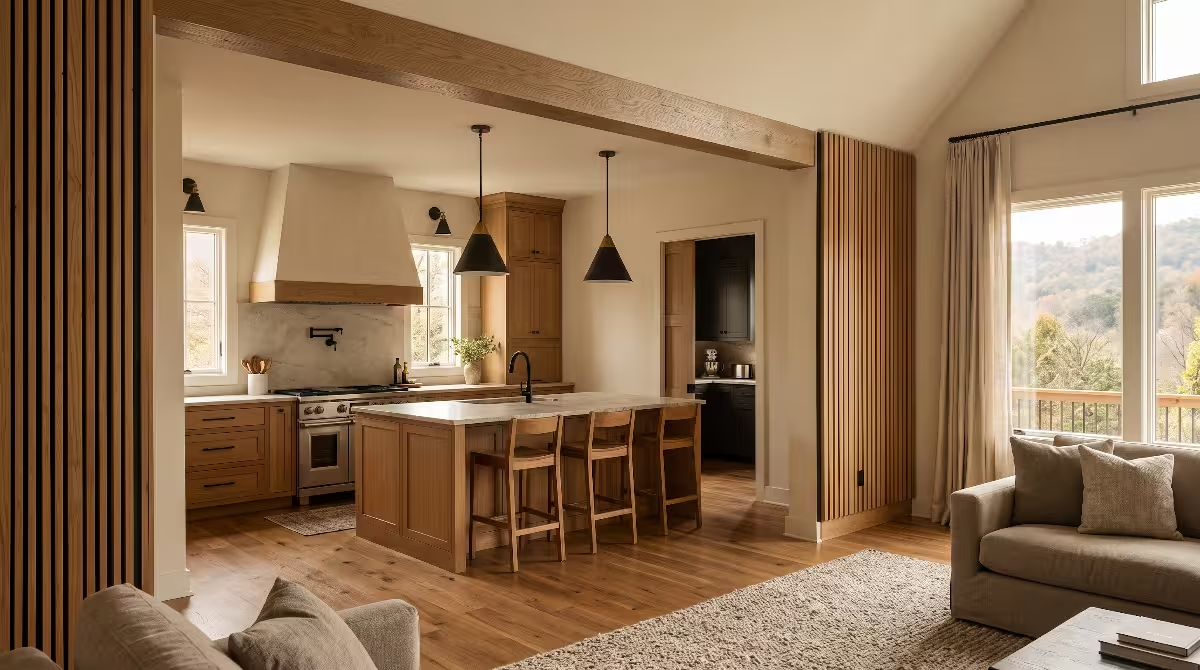
Modern architectural design celebrates the open-concept living space. We love seeing our children do their homework at the kitchen island while we simmer marinara sauce on the cooktop. We love entertaining guests who sit in the living room while we prep appetizers.
However, open layouts mean there are no walls or pocket doors to stop the spread of kitchen humidity. The steam rising from a pasta pot does not stay neatly over your stove. It billows upward, catches ceiling drafts, and drifts straight across your
Within minutes, elevated kitchen humidity settles onto your great room sofa, your family room windows, and your high-end hardwood floors. Without an engineered approach to kitchen humidity, the very openness that makes your floor plan so lovely becomes the highway that carries sticky, stale air through your entire main floor.
The Stakes
Elevated kitchen humidity is not just a temporary comfort issue. As a carpenter and former project manager, I look at homes through the lens of structural integrity and material durability. Wood is a natural hygroscopic material. That means wood acts like a sponge, swelling as kitchen humidity rises and shrinking as the air dries out.
When persistent kitchen humidity coats your custom painted cabinets, the moisture works into the fine wood joints. Over time, that kitchen humidity causes hairline cracks in the enamel finish, causes inset cabinet doors to bind against their frames, and can even cause solid wood drawer fronts to warp.
Beyond fine woodwork, uncontrolled kitchen humidity creates the exact conditions mold spores need to thrive behind wall cavities and on cooler surface trims. If you let kitchen humidity linger day after day, you are quietly degrading your indoor air quality and putting unnecessary strain on your air conditioning equipment.
The Main Thesis
Controlling kitchen humidity in our East Tennessee climate requires a complete, engineered system rather than an afterthought fan. You cannot solve kitchen humidity by simply turning on a builder-grade vent hood that sounds like a lawnmower and does little actual work.
A successful defense against kitchen humidity combines properly calculated exhaust volume, capture area design, smooth duct engineering, and intentional make-up air pathways. When we address kitchen humidity with technical precision, we protect our investments, safeguard our family health, and keep our kitchens smelling clean and feeling calm.
Understanding Kitchen Moisture Loads in Climate Zone 4A

To solve the challenge of kitchen humidity, we first have to understand where all this water vapor comes from. Moisture does not appear out of thin air; it is generated by our daily cooking routines and our regional environment.
Internal Moisture Generation
Every meal you prepare adds to the total volume of kitchen humidity in your home. Consider what happens when you boil a large stockpot of water for family pasta night. A standard rolling boil can release anywhere from one to two pints of pure water vapor into your kitchen air in under thirty minutes.
If you are cooking soup, steaming vegetables, or boiling sweet corn from our local farmers markets, that process continually releases water vapor into the air. When hot oil and steam mix during high-heat searing, grease droplets latch onto airborne moisture, creating a sticky aerosol that settles onto countertops and walls.
The heat source you choose also plays a major role in your baseline kitchen humidity. If you cook with a standard natural gas or propane range, water vapor is a direct chemical byproduct of burning fuel. For every gallon of fuel burned, your gas burners produce equal amounts of water vapor into the room, driving up kitchen humidity before you even place a pan on the fire.
By contrast, modern induction cooktops produce zero combustion moisture. Induction heats the metal pan directly using magnetic fields, which cuts your total baseline kitchen humidity significantly and makes controlling kitchen humidity far easier.
The Appalachian Outdoor Pressure
A common mistake many homeowners make when dealing with kitchen humidity is opening a kitchen window. In dry western climates like Colorado or Arizona, cracking a window can help clear steam quickly. But here in East Tennessee, opening a window during the warm months only makes your kitchen humidity far worse.
When the outdoor relative humidity in our valleys sits at 80% on an August evening, opening your kitchen window allows outdoor moisture to rush inside toward your cooler, air-conditioned rooms. That warm outdoor air collides with cool indoor surfaces, increasing your total kitchen humidity load and forcing your cooling system to run twice as hard.
Managing kitchen humidity in our mountains requires mechanical discipline. We must keep the outdoor moisture out while mechanically collecting and ejecting indoor kitchen humidity directly to the outdoors.
Target Metrics
What is our actual goal when measuring kitchen humidity? It is best to keep indoor relative humidity between 35% and 50% year-round.
When your kitchen humidity climbs above 55%, the air begins to feel muggy and heavy. Cooking odors hang in the air for hours rather than dissipating, and moisture lingers on window glass and cool quartz surfaces. If kitchen humidity stays above 60% for extended periods, you cross into the danger zone where dust mites reproduce rapidly and mold spores find fertile ground on drywall and wood trim.
Conversely, during cold Appalachian winters when your heat is running, kitchen humidity can help counteract dry skin, but unvented cooking moisture still risks condensing on cold exterior wall framing. Keeping your kitchen humidity within that stable 35% to 50% band protects both your health and your home finishes.
Specifying the Right Range Hood: Sizing, Sones, and Capture Area
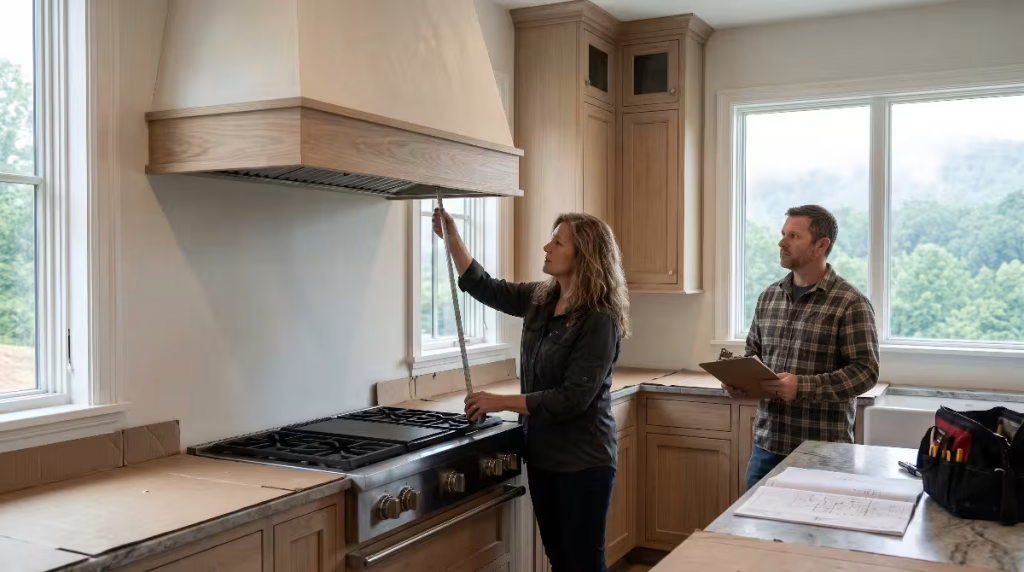
Your primary tool for eliminating kitchen humidity at the source is your range hood. However, choosing a hood from a catalog based solely on how pretty the stainless steel or custom plaster looks will lead to major frustration. You need a hood engineered to remove kitchen humidity effectively every time you turn on a burner.
CFM Calculation Beyond the Rule of Thumb
The power of a kitchen vent hood is measured in
A standard builder rule of thumb is to put in a 300 CFM fan and call it a day. In a custom home with high-performance cooking appliances, a 300 CFM fan will fail to capture the kitchen humidity generated during heavy cooking.
For electric and induction cooktops, calculate your needed CFM by taking the width of your cooktop in feet and multiplying by 100. If you have a standard 36-inch (three-foot) induction cooktop, your baseline hood should move at least 300 to 400 CFM to stay ahead of rising kitchen humidity.
If you choose a professional gas range, the math changes completely. Gas ranges generate substantial heat and combustion moisture alongside regular kitchen humidity. For gas, you need at least 1 CFM of exhaust power for every 100 British Thermal Units (BTU) of total burner output.
If your 36-inch luxury gas range produces 60,000 BTUs across all burners, your range hood must be rated for at least 600 CFM. If you have an 80,000 BTU setup, you need an 800 CFM system. If your hood is undersized, kitchen humidity escapes past the hood canopy and spreads through the house before the fan can pull it outside.
Cooktop placement also dictates your CFM needs. A wall-mounted cooktop has a natural backsplash wall that helps channel rising steam and kitchen humidity upward toward the hood. An island cooktop, however, is exposed to air currents from all four sides.
A walking child, an overhead ceiling fan, or an open doorway creates cross-drafts that pull steam away from the hood. Because of this, island cooktops need at least 25% to 30% more CFM capacity to capture the same amount of kitchen humidity as a wall-mounted setup.
The Sones Factor (The Living Experience)
Here is a practical truth that every homeowner understands: if your range hood sounds like an airplane taking off, you will never turn it on. When a hood is loud and intrusive, people leave it off during routine cooking, allowing kitchen humidity to build up unchecked.
Fan noise is measured in units called sones. One sone is roughly equal to the quiet hum of a modern refrigerator. A standard, builder-grade microwave vent fan runs at six to eight sones, which is loud enough to drown out normal conversation and make you feel stressed while preparing dinner.
When designing a kitchen to manage kitchen humidity, prioritize low-sone performance. Look for range hoods that run at 2.0 to 3.0 sones at normal cooking speeds.
For the ultimate peaceful cooking experience, ask your builder about remote inline blowers. Instead of placing the noisy fan motor directly inside the metal hood right in front of your face, an inline blower mounts inside your attic space or on the exterior wall of your home.
The hood canopy over your stove remains nearly silent, quietly drawing away kitchen humidity while the motor runs dozens of feet away. When your ventilation system is whisper-quiet, you will happily run it every time you cook, keeping your kitchen humidity perfectly managed.
Ducting Engineering (Zero Compromise)
You can purchase the most expensive range hood on the market, but if the ductwork behind your walls is installed incorrectly, your defense against kitchen humidity will fail.
First and foremost: never install a recirculating ductless range hood in an East Tennessee custom home. Recirculating hoods pull air through a metal mesh to catch grease and a thin carbon filter to catch odors, and then they blow that exact same air right back into your face.
A recirculating hood removes zero percent of your kitchen humidity. Every drop of boiling water vapor pulled into a recirculating hood gets dumped straight back into your room, leaving your kitchen humidity completely untouched. Your range hood must vent directly to the outdoors.
Second, the duct material matters immensely. Building codes require smooth, rigid galvanized steel ducting for kitchen exhaust. Never allow a contractor to use flexible, ribbed foil ducting. Flexible duct creates heavy air turbulence, cuts your fan CFM in half, catches grease deposits, and restricts the exit of kitchen humidity.
Your duct runs should be as straight and short as possible. Every 90-degree elbow in your duct run adds the equivalent of ten feet of pipe resistance. If a duct has to weave around ceiling joists and make several turns, the fan loses its ability to push kitchen humidity out of the home.
Finally, ensure your builder insulates any kitchen exhaust duct that passes through an unconditioned attic space. In winter, warm, moist air from your cooking travels through that duct.
If the metal pipe is freezing cold from attic air, that kitchen humidity will instantly condense inside the pipe. That condensation will pool in the joints and can run backward, dripping dirty, rusty water onto your ceiling or back down onto your clean cooktop. Insulating the duct keeps the pipe warm and lets the kitchen humidity exit cleanly into the outside air.
The Critical 400 CFM Threshold and Make-Up Air Systems
As homes have become more energy-efficient and tightly built over the past two decades, managing kitchen humidity has crossed paths with basic home physics. When you extract air to remove kitchen humidity, you have to consider where the replacement air comes from.
The Building Code Requirement
In the International Residential Code (IRC), Section M1503.6 states a clear rule: any kitchen exhaust hood system capable of exhausting in excess of 400 CFM must be provided with a make-up air system. This make-up air system must supply replacement air at a rate roughly equal to the exhaust rate, and it must be equipped with a means of automatic closure.
Why does this 400 CFM rule exist? It exists because of basic physics: a house cannot give away air it does not have. If your range hood pulls 600 CFM of kitchen humidity and air out of your kitchen, exactly 600 CFM of new air must enter the home to take its place.
In old, drafty homes built fifty years ago, air leaked in easily through loose windows, unsealed doors, and wall cracks. But in modern custom homes with spray-foam insulation, advanced house wraps, and high-performance windows, the house envelope is nearly airtight. Without an intentional opening, your high-powered hood cannot pull enough air to exhaust kitchen humidity effectively.
The Hidden Danger in Tight Custom Homes
When an exhaust hood tries to remove kitchen humidity in a tightly sealed house without make-up air, it creates strong negative pressure inside your home. Think of your house acting like a sealed plastic bottle when you suck the air out of it.
This negative indoor pressure fights against your range hood fan, drastically cutting its actual airflow and leaving kitchen humidity trapped in your rooms. Even worse, strong negative pressure creates a severe safety hazard called backdrafting.
If your home has a gas water heater, a gas furnace, or a wood-burning fireplace, negative pressure can overpower the natural draft of those chimneys. Instead of smoke and poisonous carbon monoxide traveling safely up the flue, the negative pressure pulls those deadly combustion gases backward down the chimney and into your living areas. Trying to solve kitchen humidity with an unbuffered high-powered fan can compromise your family safety.
Engineered Make-Up Air Solutions for East TN
The solution to this challenge is a dedicated, motorized make-up air system. When you turn on your range hood to clear out kitchen humidity, an electronic sensor senses the current draw or air movement. This signal automatically triggers a motorized damper on a dedicated fresh-air intake duct, opening a clean path for outside air to enter the home.
However, in our East Tennessee climate, you cannot simply dump raw outside air straight into the home. If you bring in 600 CFM of unfiltered outdoor air during a July afternoon, you are dumping gallons of raw atmospheric moisture directly into your house, replacing your cooking moisture with outdoor humidity.
An engineered make-up air setup for our region introduces replacement air through a tempering system. The incoming air should be filtered, lightly tempered, and introduced either into your central heating and cooling return plenum or through dedicated diffusers located outside the kitchen cooking zone.
By designing the make-up air pathway thoughtfully, your home maintains balanced pressure, your range hood works at full efficiency to remove kitchen humidity, and your living environment stays cool and dry.
Protecting High-End Cabinetry and Finishes
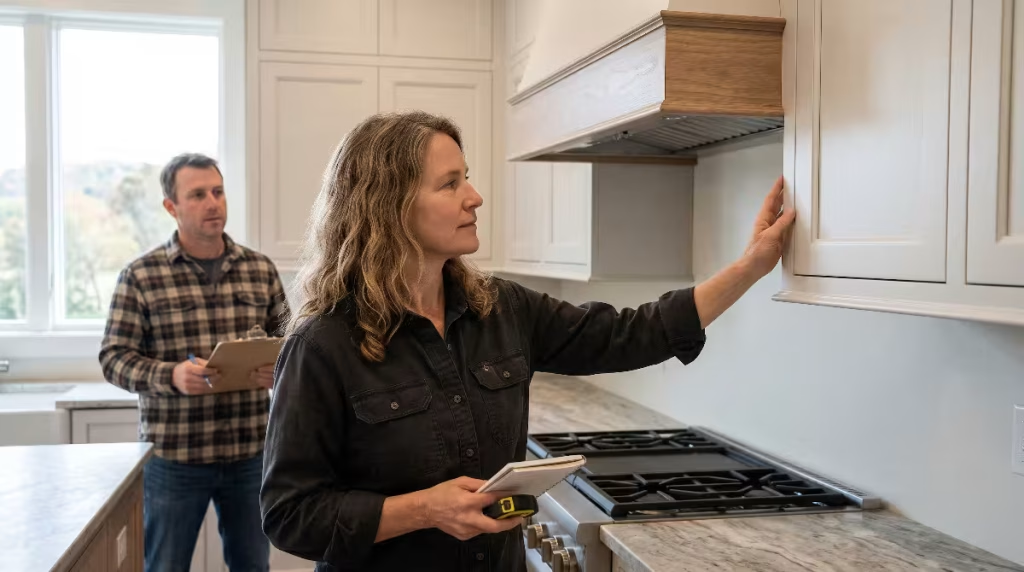
For many homeowners, the kitchen cabinetry represents the single largest material investment in the entire home. Custom inset cabinets, hand-applied paint, and detailed crown molding give a kitchen timeless beauty. But without proactive management of kitchen humidity, that investment can suffer visible wear.
The Carpentry Perspective
During my years working with residential carpentry and managing custom construction projects, I spent countless hours inspecting millwork. Wood breathes and moves. Even the finest kiln-dried maple or cherry retains microscopic cellular pores that respond to surrounding kitchen humidity.
When you cook, a concentrated plume of hot steam and kitchen humidity rises directly toward your upper cabinetry. If your hood capture area is too small, that concentrated kitchen humidity curls around the hood canopy and hits the edges of your cabinet doors.
The wood fibers along the door edges absorb that kitchen humidity, causing localized expansion. The wood swells, pressing the cabinet doors tightly against their face frames.
When winter arrives and indoor air dries out, the wood contracts again. This continuous cycle of swelling and shrinking from seasonal changes and repeated kitchen humidity creates visible seam separation at the five-piece cabinet door joints, often called spiderweb cracking. Protecting your cabinetry requires keeping that kitchen humidity from ever touching the cabinet face.
Design Clearances
Preventing moisture damage to cabinetry comes down to smart kitchen spatial design. Many homeowners try to squeeze cabinets as close as possible to the cooktop to maximize storage. In doing so, they put those cabinets directly in harm’s way.
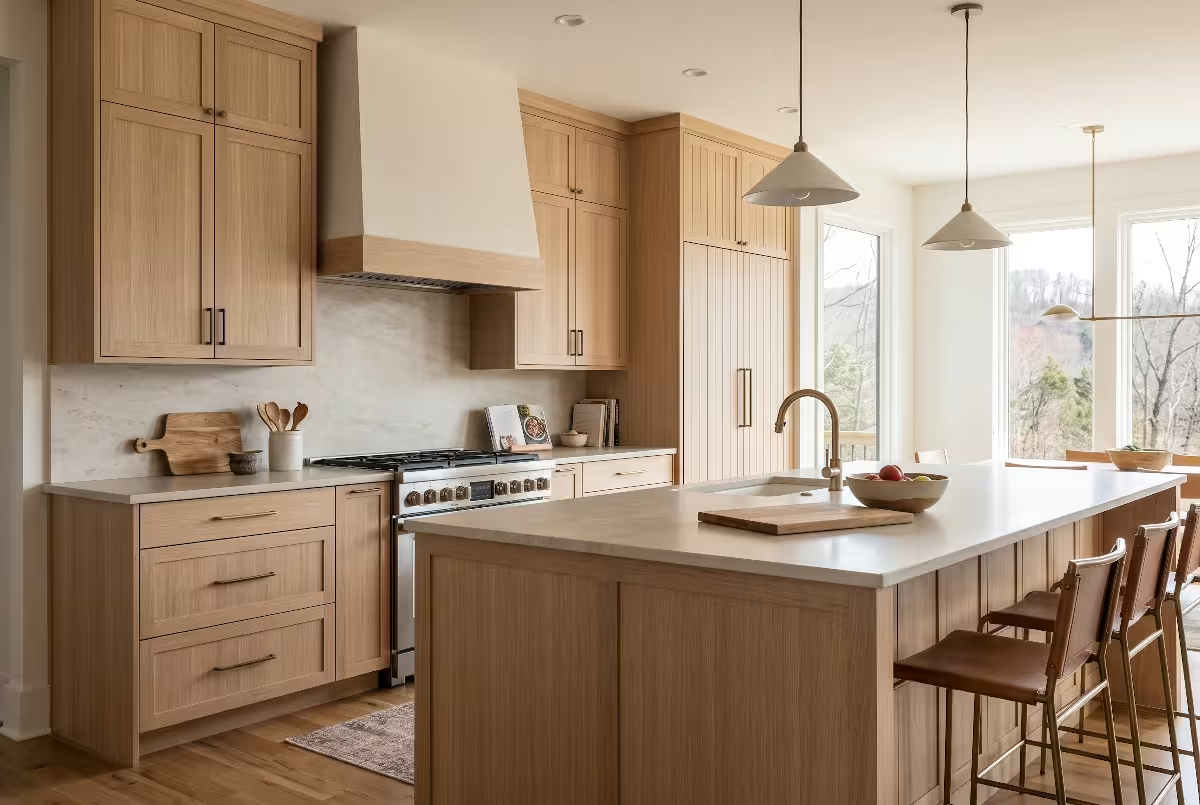
First, consider hood width. If you have a 36-inch cooktop, your range hood should ideally be 42 inches wide. Providing a three-inch overhang on each side creates a wider capture envelope.
As steam and kitchen humidity expand outward in a cone shape as they rise, that wider hood catches the edges of the moisture plume before the vapor can curl under your upper cabinets. If you cannot do a wider hood due to space constraints, ensure your upper cabinets flanking the stove are spaced at least three to six inches away from the hood edge.
Second, respect vertical mounting height. Your hood should typically sit between 30 and 36 inches above the surface of your cooktop.
If you mount the hood lower than 30 inches, you create a cramped, dark cooking space where you bump your head, and the intense heat can scorch the hood finish. If you mount it higher than 36 inches, ambient room air currents will blow your kitchen humidity out into the room before the fan can pull it in. Staying within that 30 to 36-inch sweet spot ensures optimal capture of rising kitchen humidity.
Finish Resilience
The type of finish applied to your kitchen cabinets makes a profound difference in how well they withstand ambient kitchen humidity.
Standard consumer furniture often uses simple nitrocellulose lacquer. In a kitchen environment, lacquer breaks down quickly when exposed to heat and kitchen humidity, leading to yellowing, peeling, and water spotting around the range.
For a custom home build, specify post-catalyzed conversion varnish or two-part polyurethane finishes. These industrial-grade coatings cure through a chemical reaction rather than simple air-drying.
Once cured, they form a dense, cross-linked protective barrier that resists moisture penetration. A conversion varnish shields the underlying wood from periodic spikes in kitchen humidity, ensuring your cabinet paint stays smooth and flawless through years of family cooking.
Holistic Whole-House Moisture Strategy
Your range hood acts as a localized emergency team, removing intense bursts of kitchen humidity right at the stove. But what happens to the moisture generated when you run the dishwasher, rinse dishes in the sink, or brew morning coffee? Managing kitchen humidity requires looking at your whole house as a connected ecosystem.
The Limitation of Spot Ventilation
Spot ventilation handles point sources of moisture. Your range hood handles cooktop kitchen humidity, and your bathroom exhaust fans handle shower steam.
However, spot ventilation fans only run for brief periods. They do not address the steady background moisture that enters your home through door openings, foundation slabs, or everyday family activities.
Furthermore, running your kitchen hood extracts air from the house, but it does not remove the kitchen humidity that has already escaped into your great room ceiling. To maintain ideal air quality and comfort, you need secondary systems designed to handle background kitchen humidity twenty-four hours a day.
Whole-House Dehumidifiers
In East Tennessee, a standard heat pump or central air conditioner is not enough to manage moisture during our spring and fall swing seasons. Air conditioners only remove humidity when they are actively cooling the house.
In May or October, our outdoor temperatures might sit at a comfortable 68 degrees, meaning your thermostat never calls for cooling. Yet, the outdoor humidity might sit at 85%, and your indoor kitchen humidity can easily climb past 60%. Because the air conditioner does not turn on, the moisture stays trapped inside.
This is why every high-performance custom home in our area should include a dedicated, whole-house dehumidifier, such as units built by Santa Fe or AprilAire. These systems are tied directly into your central ductwork.
They feature their own digital humidistat that constantly monitors your indoor air. If your kitchen humidity or general house moisture rises above 50%, the dehumidifier quietly turns on, extracts pints of water directly from the air stream, drains the water safely outside, and circulates dry, comfortable air back into your home.
A dedicated dehumidifier handles the background kitchen humidity effortlessly, allowing your air conditioner to focus solely on cooling the home.
The Role of Energy Recovery Ventilators (ERVs)
Modern homes need continuous fresh air to stay healthy, and an Energy Recovery Ventilator (ERV) is the best way to achieve that in Climate Zone 4A. An ERV pulls stale indoor air out of the house and brings fresh outdoor air inside, passing both streams through an enthalpy core.
In our humid summer climate, the ERV takes the heat and moisture out of the incoming fresh air and transfers it to the outgoing exhaust stream. This means you get fresh, oxygen-rich air without overloading your home with outdoor humidity.
However, it is critical to understand the separation of systems: an ERV is never a replacement for a kitchen range hood. Never connect your kitchen exhaust directly into an ERV duct.
Cooking vapors carry airborne grease, oils, and intense kitchen humidity that will coat and ruin the delicate membrane core of an ERV. Your range hood must remain a dedicated, separate exhaust line, while the ERV works quietly in the background to keep the overall air fresh and balanced.
Everyday Best Practices for East Tennessee Homeowners
Even the most advanced engineering requires smart daily habits. You can have an exceptional ventilation setup, but using it correctly ensures you get the absolute best control over your kitchen humidity.
The Pre-Ventilation Habit
Most people walk up to their stove, turn on the burner, start cooking, and only think about turning on the range hood ten minutes later when the room is already filled with steam. By that time, kitchen humidity has already escaped into the surrounding rooms.
Get into the habit of turning your range hood on low two to three minutes before you strike a match or heat a pan. Turning the fan on early establishes a continuous, upward-moving thermal column of air.
When you place your food in the pan and steam begins to rise, that established draft immediately catches the kitchen humidity and pulls it straight up the duct before it has a chance to drift across your island or settle onto your cabinets.
The “Lid on the Pot” Rule
This sounds like simple common sense, but the physical impact on kitchen humidity is enormous. When you boil potatoes, cook pasta, or simmer stocks, keep a fitted lid on your pot whenever possible.
Covering your cookware traps the water vapor inside the pot, condensing it back into the liquid where it belongs rather than releasing it into your room. Keeping a lid on your cookware can reduce the total volume of kitchen humidity released into your living space by up to 80%.
As an added bonus, keeping the lid on traps heat, which brings water to a boil much faster and saves energy.
Post-Cooking Run Time
When you finish cooking, your pans and burners remain scorching hot for several minutes, continuing to release radiant heat, lingering odors, and small amounts of kitchen humidity into the air. If you shut your hood off the second you plate your food, that lingering moisture stays in the room.
Leave your range hood running on its lowest, quietest speed for ten minutes after cooking has finished. This post-cooking cycle ensures that all residual kitchen humidity and microscopic grease particles are fully purged from the ductwork and the kitchen space. Many modern high-end hoods feature a built-in timer button that automatically shuts the fan off after ten minutes, making this habit effortless.
Switching to Induction
If you are currently in the planning stages of building a custom home in the Tri-Cities, I strongly encourage you to look closely at modern induction cooking. Many homeowners love the traditional look of gas flames, but from a building science and indoor air perspective, induction is vastly superior.
Gas burners dump substantial heat and moisture directly into your home envelope. That excess heat forces your air conditioner to work harder, and the combustion process adds to your overall kitchen humidity.
Induction cooktops use electromagnetic energy to heat the iron molecules in your cookware directly. The glass surface stays relatively cool, no combustion moisture is created, and your cooking efficiency jumps from roughly 40% with gas to over 85% with induction.
Less ambient heat means your kitchen stays comfortable, your air conditioner rests easy, and managing your daily kitchen humidity becomes a simple, stress-free task.
Frequently Asked Questions about Kitchen Humidity and Ventilation
Does a kitchen range hood actually remove humidity?
Yes, a kitchen range hood removes substantial kitchen humidity, but only if it is ducted directly to the outdoors. A ducted range hood captures steam, airborne moisture, and cooking vapors at the stove and ejects them through metal piping outside your home envelope.
However, if your hood is a ductless or recirculating model, it does not remove any kitchen humidity at all. Ductless hoods simply pull air through a metal screen and a charcoal pad before blowing that exact same moist air back into the room. If controlling kitchen humidity is your goal, your range hood must vent to the outside world.
What is the ideal indoor humidity level for an East Tennessee home?
The ideal indoor relative humidity for a home in the Tri-Cities area sits between 35% and 50%. During our humid summers, keeping your indoor moisture below 50% prevents the growth of mold spores, stops dust mite proliferation, and protects custom woodwork from moisture damage.
During our colder winters, maintaining indoor humidity around 35% to 40% prevents dry skin, reduces static electricity, and stops condensation from forming on interior window panes. Monitoring your kitchen humidity with a simple digital hygrometer helps you ensure your home stays in that healthy, comfortable range.
Why does moisture condense on my kitchen cabinets or windows while cooking?
Moisture condenses on your kitchen cabinets or window glass because warm, moisture-laden air from your cooking has come into contact with a surface that is at or below the ambient dew point temperature.
When you boil water or cook on the stove, you generate high levels of localized kitchen humidity. If your range hood is undersized, unvented, or turned off, that warm steam drifts upward until it hits cooler surfaces like glass window panes or painted wood cabinet doors.
The air immediately cools upon contact, loses its ability to hold water vapor, and deposits liquid water droplets onto the surface. Improving your range hood capture area and running your fan early prevents kitchen humidity from condensing on your fine finishes.
Do I really need a make-up air system in my Tennessee home?
If your range hood is rated to move more than 400 CFM, modern building codes require you to install a make-up air system. In a well-built, energy-efficient modern custom home, the building envelope is tightly sealed to save energy.
When a powerful exhaust fan extracts large volumes of air to remove kitchen humidity, it creates negative air pressure inside the house if replacement air cannot enter. This negative pressure chokes your fan, leaves kitchen humidity trapped in your living space, and risks pulling deadly carbon monoxide back down water heater vents or fireplace flues.
A dedicated make-up air system balances indoor air pressure, keeps your family safe, and lets your range hood clear out kitchen humidity at peak efficiency.
Can I run an ERV instead of a kitchen range hood?
No, you should never attempt to use an Energy Recovery Ventilator (ERV) in place of a dedicated kitchen range hood. An ERV is designed for continuous, low-speed whole-house ventilation, moving small amounts of air to keep fresh oxygen circulating through the home.
A kitchen range hood is a high-volume spot exhaust system designed to handle high heat, heavy steam, and airborne cooking grease. If you vent cooking air into an ERV, the grease and heavy kitchen humidity will quickly coat and permanently ruin the delicate heat-exchange core inside the unit.
Your home needs a dedicated range hood to expel kitchen humidity directly outdoors, while your ERV works separately to maintain whole-house air balance.