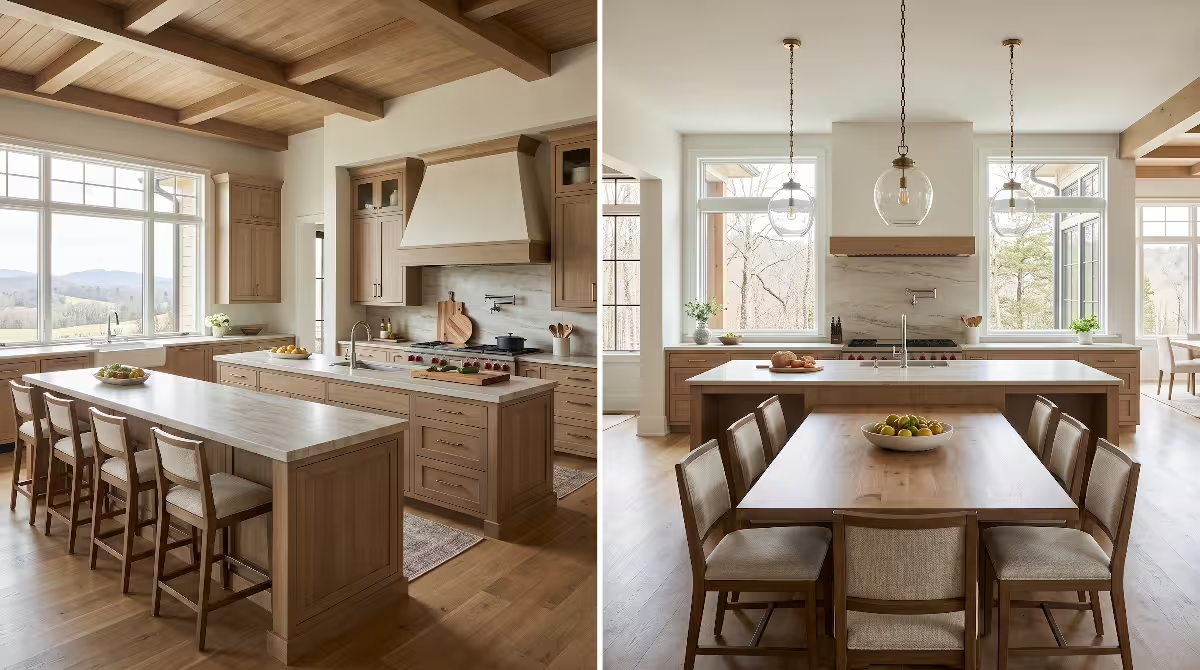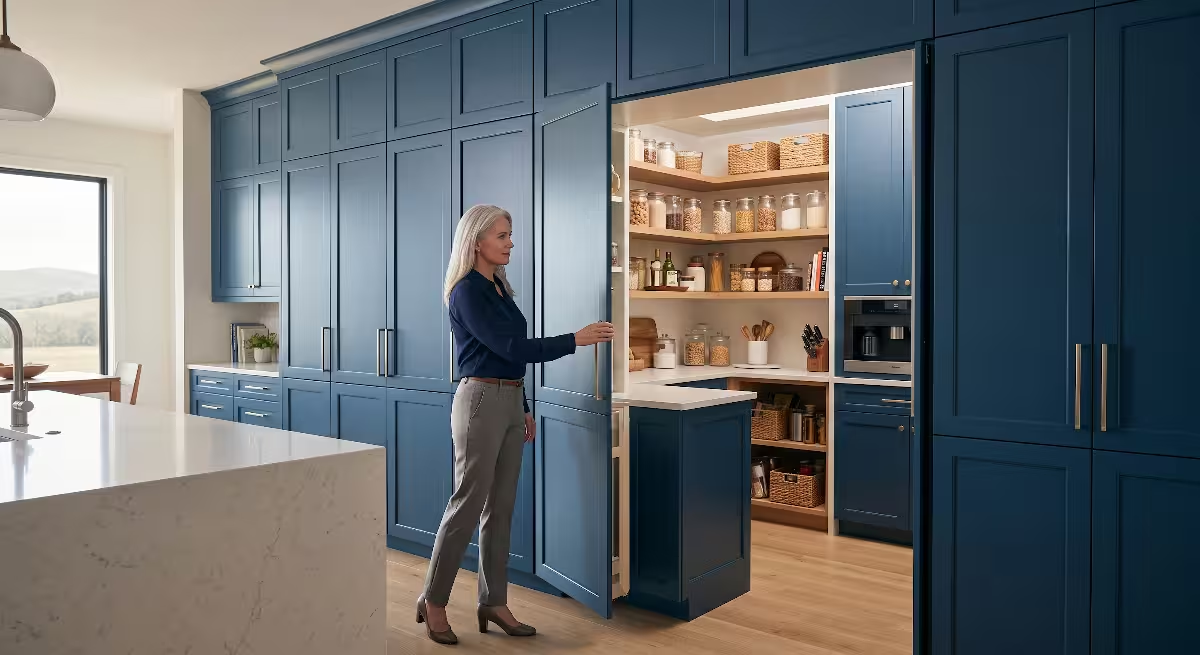

When you walk into a custom home, the kitchen commands your attention before any other room. Over the years, many design styles have evolved. While painted finishes had their run, natural wood has taken center stage. Homeowners want warmth, character, and permanence. That desire has placed white oak kitchen cabinets at the very top of most custom building wish lists.
White oak provides a calm, grounded presence that works equally well in a modern farmhouse, a mountain retreat, or a clean transitional home. However, when homeowners begin exploring rift sawn lumber for their cabinetry, they often experience sticker shock. The cost per linear foot for these cabinets is significantly higher than standard builder-grade units.
To make smart financial choices during a build or remodel, you need to understand what you are paying for. A high price tag should reflect genuine craftsmanship, durable materials, and engineering stability. In this guide, we will break down the true cost of white oak kitchen cabinets per linear foot, examining every element from log milling to final jobsite installation.
The Linear Foot Benchmark: Pricing Breakdown by Cabinet Tier
To evaluate cabinetry costs, builders and cabinet makers rely on a measurement called the linear foot. One linear foot equals twelve inches of horizontal cabinet run along a wall. When pricing white oak kitchen cabinets, it is important to remember that a linear foot price can refer to standard lower base cabinets, upper wall cabinets, or a combined package. In most custom cabinet estimates, a linear foot quote assumes a standard layout of base cabinets with matching upper cabinets directly above them.
The market for white oak
Semi-Custom Production Lines ($450 to $750 per Linear Foot)
Semi-custom white oak kitchen cabinets are manufactured in large regional facilities using standardized box sizes. These cabinets are built in three-inch width increments, such as 24, 27, 30, or 36 inches. Modifications are limited. In this tier, the door and drawer fronts may feature genuine rift sawn white oak veneer, but the interior boxes are usually made from particleboard or basic import plywood. The hardware is reliable, yet simple. Homeowners choosing semi-custom white oak kitchen cabinets can achieve a clean look, but the overall design must conform to the factory’s preset sizing rules.
Regional Custom Cabinet Shops ($800 to $1,200 per Linear Foot)
At this middle tier, you work directly with a local cabinet maker or custom millwork shop. Every cabinet is constructed specifically for your floor plan, allowing for exact fractions of an inch without awkward filler strips. These custom white oak kitchen cabinets feature hand-selected lumber, premium domestic plywood box carcasses, and high-end undermount soft-close glides. The cabinet maker carefully matches wood grain patterns across adjoining doors and drawer fronts. For most custom homes in our region, this tier represents the sweet spot of structural longevity and architectural beauty.
Architectural Grade and Inset Custom ($1,200 to $1,600+ per Linear Foot)
This top tier represents the peak of cabinetry craftsmanship. Architectural grade white oak kitchen cabinets frequently feature flush inset construction, where doors and drawers sit perfectly inside a solid wood face frame with tight, consistent gaps. This tier often incorporates continuous grain matching, where the wood grain flows unbroken across multiple cabinet runs or full-height appliance walls. Tall storage pantries, integrated panel-ready refrigeration, and bespoke interior drawer accessories push these white oak kitchen cabinets past $1,400 to $1,600 per linear foot.
Where does that money actually go? In a reputable custom shop, roughly 35 percent of your investment covers raw hardwood lumber and structural sheet goods. Another 45 percent pays for skilled bench labor, precise machine calibration, and shop assembly. The remaining 20 percent accounts for industrial finishing and careful site installation.
Timber Milling and Yield: Why Rift Sawn Carries a Lumber Premium
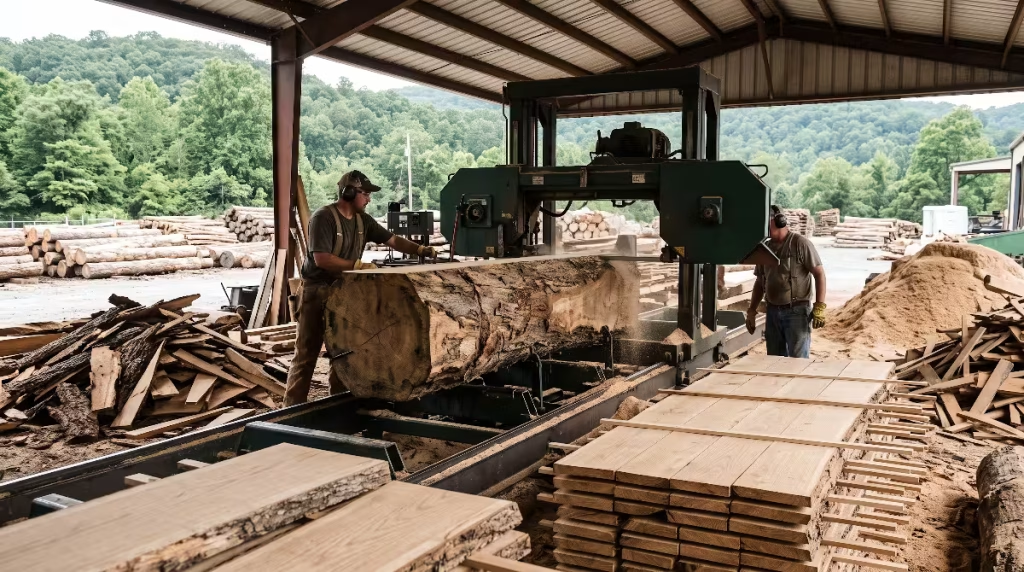
Homeowners often ask why
Hardwood logs can be cut into lumber using three primary milling methods:
- Plain Sawn (Flat Sawn): The sawyer makes parallel cuts straight through the log. This is the fastest, least wasteful method, utilizing 75 to 80 percent of the log volume. However, it produces a wide, arched grain pattern called cathedral grain. It also makes the wood more prone to seasonal cupping and twisting.
- Quarter Sawn: The log is cut into quarters, and each quarter is sawn at an angle. This exposes medullary rays, creating prominent reflective flecks or ribbon patterns across the boards. While structurally stable, these visual flecks do not always fit modern interior designs.
- Rift Sawn: The log is milled so that the growth rings sit at a strict 30 to 60 degree angle to the face of the board, with 45 degrees being the ideal target. This orientation creates a tight, straight, pencil-stripe grain pattern across the entire board face without ray flecks or arches.
Because the sawyer must repeatedly rotate the log to maintain this specific growth-ring angle, rift sawing creates substantial waste. Up to 55 to 60 percent of the original log is lost as unusable wedge offcuts and sawdust. Because the usable lumber yield is so low, sawmills charge a major premium for rift sawn raw stock.
In the lumber market, high-grade plain sawn white oak lumber might sell for $7 to $9 per board foot. True rift sawn white oak in the same grade routinely commands $14 to $19 or more per board foot. When building white oak kitchen cabinets, a custom shop must buy significantly more raw footage than what ends up in your home to cull out boards with knot holes, sapwood streaks, or mineral discoloration. You are paying for both the timber in the cabinet and the timber that fell to the sawmill floor to ensure a pristine, uniform appearance.
Engineered Veneer Core vs. Solid Stave Construction
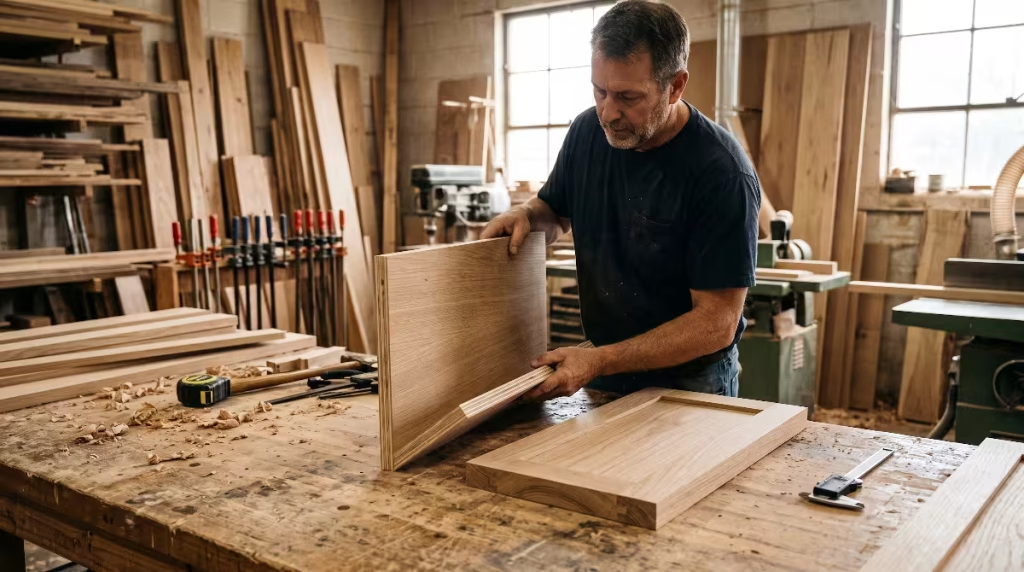
When planning white oak kitchen cabinets, many buyers assume that every single component should be made of solid planks of wood. In home building, solid wood is not always the best engineering choice. Wood is a hygroscopic material, meaning it constantly absorbs and releases airborne moisture, expanding across its grain during humid summers and contracting during dry winters.
In a kitchen, where boiling pots, dishwashers, and sinks create localized humidity swings, wood movement must be managed carefully. This structural reality determines how different components of white oak kitchen cabinets are manufactured:
Slab Style Cabinet Doors
Modern slab cabinet doors feature flat, smooth faces without decorative frame moldings. If you construct a wide, flat slab door out of solid planks of rift sawn white oak, those planks will eventually warp, twist, or cup as ambient indoor humidity changes. To prevent this failure, high-end white oak kitchen cabinets utilize premium architectural wood veneers pressed over a balanced, dimensionally stable core.
These cores are typically made of high-density fiberboard (HDF) or multi-ply hardwood plywood. The outer face receives an A-grade rift sawn white oak veneer, while the inner face receives a balancing sheet of the exact same species and thickness. Because the core material cannot expand or contract, the door remains dead flat for decades.
Do not mistake this for cheap construction. Sourcing sequence-matched, architectural-grade rift sawn veneer sheets and edging them with thick solid wood edge banding requires exceptional precision. Top-quality veneer slab white oak kitchen cabinets often cost just as much as solid five-piece doors.
Five-Piece Shaker and Slim-Shaker Doors
If your kitchen design calls for classic Shaker doors or contemporary slim-shaker profiles, solid lumber is used for the outer vertical stiles and horizontal rails. Because rift sawn lumber expands primarily along its thickness rather than its face width, solid rift sawn stiles and rails remain straight and true over time.
The center panel of a five-piece door is typically engineered with rift sawn white oak veneer over a stable core. This ensures the center panel does not shrink and pull away from the outer frame, preventing unsightly raw wood lines or cracked finish joints. Knowing where to use solid lumber and where to use engineered cores ensures that your white oak kitchen cabinets retain their structural integrity through every season.
Cabinet Box and Joinery Architecture
The visible front of a cabinet draws the eye, but the interior box carcass provides the structural foundation. When evaluating white oak kitchen cabinets, you must look closely at how the cabinet boxes are constructed. A sagging shelf, a bowed back panel, or a loose face frame can ruin a kitchen within five years.
Carcass Material Specifications
Quality white oak kitchen cabinets should feature cabinet box carcasses constructed from 3/4-inch furniture-grade plywood. Lower-cost production cabinets frequently cut corners by using 1/2-inch particleboard or low-density fiberboard. Particleboard degrades rapidly if exposed to plumbing leaks, and it holds mechanical fasteners poorly under heavy loads.
For the interior finish of your cabinet boxes, you generally have two choices:
- Pre-Finished Birch or Maple Plywood: This is the industry standard for custom cabinetry. It features a factory-applied, UV-cured clear topcoat that resists water stains, resists scratches, and wipes clean easily. It pairs cleanly with white oak kitchen cabinets while keeping fabrication costs reasonable.
- Matching White Oak Veneer Interior: For the ultimate luxury look, the interior of the cabinet boxes can be lined with real white oak veneer. While visually striking when doors are opened, this option adds $50 to $85 per linear foot to your cabinet package due to sheet material costs and the labor required to seal every interior corner.
Joinery and Structural Backing
Look for cabinet boxes that utilize pocket-hole joinery, blind dadoes, or precision dowel construction. The back of the cabinet box should be a solid 1/2-inch or 3/4-inch structural panel captured inside grooves, rather than a thin 1/8-inch hardboard panel tacked onto the back with staples. A heavy structural back allows the installer to drive cabinet mounting screws securely through the back panel directly into the wall studs, ensuring that heavy white oak kitchen cabinets loaded with cast-iron cookware will never pull away from the wall.
Framed vs. Frameless Construction
You must also decide between American face-frame construction and European frameless construction:
- Face-Frame: A 3/4-inch solid wood frame is mounted to the front of the box. This frame adds structural rigidity and provides a classic appearance. Inset white oak kitchen cabinets require a face frame so the doors can sit flush inside the openings.
- Frameless (Full Access): In frameless cabinetry, there is no front face frame. The cabinet doors attach directly to the interior box walls using specialized hinges. This style maximizes interior storage space and delivers the sleek, minimalist reveals required for contemporary white oak kitchen cabinets.
Hardware and Functional Storage Allocations
The mechanical hardware you select will dictate how your kitchen performs during daily meal preparation. Cabinet hardware represents a notable portion of your total investment, and high-performance moving parts add value to your white oak kitchen cabinets.
Drawer Boxes and Undermount Glides
The standard for quality drawer construction is a five-eighths-inch solid hardwood box joined with tight dovetail corners. While hard maple is the traditional choice for drawer sides, many homeowners building white oak kitchen cabinets upgrade to matching rift sawn oak drawer boxes for a cohesive aesthetic.
Underneath the drawer, you should specify heavy-duty, soft-closing, undermount drawer slides such as those made by Blum or Salice. Unlike cheap side-mounted epoxy slides, undermount slides remain hidden from view, support up to 100 or 150 pounds of static load, and allow smooth, full-extension travel. You never have to reach into a dark drawer corner to find a lost utensil. Premium undermount glides add roughly $35 to $65 per drawer to your white oak kitchen cabinets, but the performance upgrade is well worth the cost.
Functional Storage Accessories
A modern kitchen should be organized to streamline daily workflow. Incorporating specialized mechanical pullouts directly into your cabinet order eliminates countertop clutter and keeps cooking tools within easy reach.
Common interior upgrades for white oak kitchen cabinets include:
- Double Trash and Recycling Pullouts: A heavy-duty pullout drawer behind a single cabinet door, complete with removable plastic bins and soft-close action ($250 to $450 installed).
- Blind Corner Pullout Units: Rather than losing pots in a dark lazy Susan, multi-tiered articulating steel shelving trays slide out into the room ($600 to $1,200 installed).
- Vertical Spice and Oil Pullouts: Slim, three-tier pullouts placed next to the cooktop keep cooking oils upright and accessible ($200 to $400 installed).
- Deep Drawer Dividers: Custom wooden pegs and slots designed to organize plates and bowls securely inside deep lower drawers ($150 to $300 per drawer).
When you add four or five specialized organizers to your kitchen order, these mechanical units can add $1,500 to $3,500 to the total cost of your white oak kitchen cabinets. However, the resulting functional efficiency elevates the entire space.
Finishing Chemistry and Moisture Sealing
The natural color of raw rift sawn white oak is an understated wheat tone with soft gray and beige undertones. Protecting that organic color is one of the most critical challenges when fabricating white oak kitchen cabinets.
The Tannic Acid Factor
White oak contains a high concentration of natural tannic acid. While tannins make white oak rot-resistant and rot-tolerant, they react aggressively with improper finishes. If a woodworker applies standard oil-based polyurethane or cheap solvent lacquer to white oak, the oil reacts with the tannins, turning the wood a brassy, yellow-orange color. Furthermore, oil finishes continue to amber over time as they are exposed to sunlight, destroying the clean, modern look homeowners want from white oak kitchen cabinets.
Professional Cabinet Finishing Systems
To protect the wood without causing it to turn yellow, professional custom shops use advanced industrial finishes:
- Post-Catalyzed Conversion Varnish: This two-part chemical finish cures to form a hard, water-resistant barrier. Formulated with non-yellowing acrylic resins and UV inhibitors, conversion varnish protects white oak kitchen cabinets against water splashes, cooking grease, and household cleaning chemicals.
- Two-Component (2K) Polyurethane: Originating in European millwork shops, 2K polyurethane finishes offer exceptional scratch resistance and chemical durability while remaining completely water-clear. They cure without off-gassing long term and provide an elastic coating that moves with the wood through seasonal temperature changes.
Specialty Finishing Techniques
Achieving the desired look often involves specialized finishing steps:
- Natural Raw Look: Clear sealers containing a tiny percentage of white pigment (often called a 2% white wash or raw wood tone) are applied first. This counteracts the wet look that wood takes on when sealed, preserving the dry, pale appearance of raw timber on your white oak kitchen cabinets.
- Cerused Finish (Limed Oak): The cabinet doors are gently wire-brushed to open up the softer grain pores. A contrasting white glaze is wiped across the wood and buffed away, leaving crisp white pigment settled inside the grain lines while highlighting the natural oak tone.
- Ultra-Matte Topcoats: High-gloss finishes can make natural oak look dated. Specifying a dead-flat or ultra-matte sheen (5 to 10 percent luster) keeps white oak kitchen cabinets looking organic while offering full wipe-down protection.
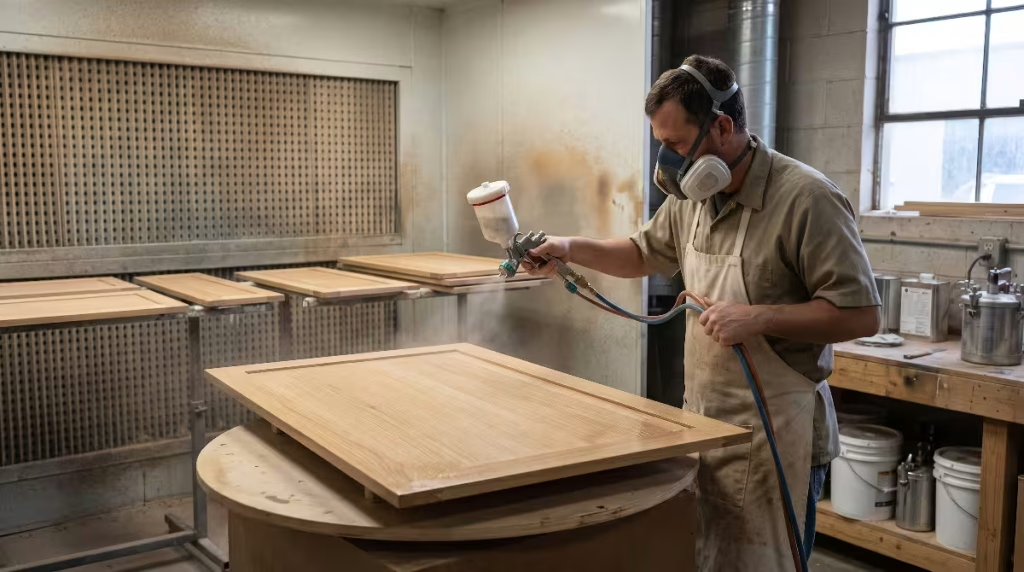
Applying these specialized finishes requires a climate-controlled spray booth, clean air filtration, and skilled technicians. A professional finish schedule adds $75 to $130 per linear foot over unfinished cabinets, but it guarantees that your white oak kitchen cabinets will look as fresh in ten years as they do on installation day.
Site Labor, Scribing, and Professional Installation
Even the most beautifully built cabinets will look flawed if they are improperly installed. Cabinet installation is a skilled trade that requires acute attention to detail, deep patience, and an understanding of residential framing tolerances.
Dealing with Framing Realities
In custom home construction, walls are rarely perfectly flat, corners are rarely exact 90-degree angles, and subfloors are rarely dead level across a room. A concrete slab or wood subfloor can easily dip or crown by a half-inch across twenty feet. Drywall tape joints frequently create bulges along framing studs.
Professional cabinet installers must bridge the gap between irregular drywall framing and rigid, square white oak kitchen cabinets. This requires:
- Establishing high spots on the subfloor with rotating laser levels and setting solid shims beneath base cabinets so that all perimeter countertops sit perfectly flat.
- Plumb-lining vertical walls and scribing face frames or finished filler panels to match the exact wavy profile of the drywall.
- Clamping face frames tightly together and driving hidden cabinet-to-cabinet connector screws so that visible face joints disappear completely.
Frameless Scribing Demands
If you select modern frameless European-style white oak kitchen cabinets, installation tolerances become even tighter. Because frameless doors sit edge-to-edge with reveal gaps of only 1/8-inch, there is no wide face frame to absorb wall variations. Installers must cut custom scribe moldings and side skin panels with micro-bevel saws to fit every sheetrock irregularity.
Standard cabinet installation labor typically ranges from $75 to $150 per linear foot. If your kitchen design includes tall ceiling-height storage with integrated multi-piece crown moldings, custom refrigerator door panel installations, or complex waterfall island gables, installation labor for your white oak kitchen cabinets can climb to $175 or $200 per linear foot. Never cut corners on installation labor; an inexperienced installer can ruin an expensive custom cabinet package in a single afternoon.
Regional Pricing Variances and Supply Chain Mechanics
When researching the cost of white oak kitchen cabinets, regional location plays a significant role in final quotes. The cost of materials, freight, and skilled labor varies noticeably across different parts of the country.
The Appalachian Hardwood Advantage
Here in the Tri-Cities region of East Tennessee and throughout the greater Southern Appalachian mountain region, we have a clear geographical advantage. The Appalachian mountains produce some of the finest white oak timber in North America. The moderate climate, rich soil, and slow tree growth create tight, uniform ring spacing that is prized by sawyers.
Because regional millwork shops are located near primary sawmills and timber suppliers, shipping fees for raw lumber are considerably lower than they are for cabinet builders located on the West Coast or in the desert Southwest. A custom cabinet maker in Johnson City or Bristol can source raw materials directly without paying cross-country freight markups.
Local Shop Labor Rates
Labor rates also create regional cost differences. In major metropolitan markets such as New York, San Francisco, or Chicago, custom millwork shop rates often exceed $120 to $160 per shop hour. In East Tennessee and surrounding areas, high-caliber custom millwright labor typically ranges between $65 and $95 per shop hour.
This difference allows regional homeowners to purchase high-end, bench-made white oak kitchen cabinets at a price point that might only buy standard production cabinets in an expensive coastal market. When seeking bids, supporting established regional cabinet makers keeps your project dollars local while giving you direct access to the craftsmen building your kitchen.
Real-World Kitchen Scope Budget Scenarios
To help you visualize how linear foot calculations translate into actual project budgets, let us review three practical kitchen layouts reflecting typical custom home construction.
Scenario A: The Compact L-Shaped Kitchen (16 Linear Feet)
This layout suits a secondary residence, a mountain guest cottage, or a smaller footprint home. It features a straightforward run of base and upper cabinets along two walls without an island.
- Linear Footage: 16 combined linear feet.
- Cabinet Style: Semi-custom, rift sawn white oak veneer slab doors on 3/4-inch plywood boxes with pre-finished maple interiors.
- Hardware: Blum soft-close hinges, basic full-extension drawer glides, one pullout trash bin.
- Finishing: Natural clear conversion varnish topcoat.
- Cabinet Materials and Fabrication: $9,600 ($600 per linear foot average).
- Delivery and Installation: $1,400.
- Total Investment: $11,000.
This budget delivers clean, durable white oak kitchen cabinets without costly architectural flourishes or complex interior mechanics.
Scenario B: The Open-Concept Kitchen with Work Island (28 Linear Feet)
This scenario represents the typical custom home built in our region. It includes a primary perimeter cabinet wall, a dedicated coffee station, and a substantial eight-foot by four-foot central working island.
- Linear Footage: 28 combined linear feet (20 feet along perimeter walls plus 8 feet on the island base).
- Cabinet Style: Custom shop, five-piece slim-shaker rift sawn white oak kitchen cabinets with solid wood stiles and rails.
- Hardware: Undermount soft-close glides, dove-tailed drawer boxes, double waste pullout, two blind corner organizers, vertical tray dividers.
- Finishing: Industrial 2K ultra-matte polyurethane with a 2% white balance wash to prevent yellowing.
- Cabinet Materials and Fabrication: $25,200 ($900 per linear foot average).
- Delivery and Precision Installation: $3,100.
- Total Investment: $28,300.
This configuration gives the family an open, functional, and visually balanced kitchen designed for daily cooking and easy entertaining.
Scenario C: The Architectural Luxury Chef’s Kitchen (44 Linear Feet)
This expansive kitchen is built for a high-end custom home. It features ceiling-height stacked cabinets, an oversized ten-foot entertaining island, an integrated walk-in pantry portal, and fully paneled, hidden appliances.
- Linear Footage: 44 combined linear feet (perimeter cabinetry, full-height appliance walls, and island).
- Cabinet Style: Fully custom, flush inset rift sawn white oak kitchen cabinets with continuous grain sequencing across all drawer fronts and matching tall paneled doors.
- Hardware: Heavy-duty Blum Movento drawer runners, solid white oak dovetailed drawer boxes, integrated pantry pullouts, powered touch-to-open upper doors, interior LED lighting channels.
- Finishing: Custom cerused rift oak finish with wire-brushed texture and dead-flat clear topcoat.
- Cabinet Materials and Fabrication: $59,400 ($1,350 per linear foot average).
- Delivery, Custom Scribing, and Appliance Panel Fitting: $6,200.
- Total Investment: $65,600.
This tier represents heirloom-quality cabinet building, where every face grain is hand-matched and every joint is calibrated to exacting tolerances.
Value Engineering and The Builder’s Specification Checklist
If you love the natural look of rift sawn white oak kitchen cabinets but find that your preliminary estimates exceed your construction budget, you do not have to abandon the look entirely. Smart value engineering allows you to preserve the character of the wood while trimming unnecessary shop labor.
Smart Strategies to Reduce Cabinet Costs
- Combine Finishes Strategically: You do not have to build every cabinet box from rift sawn oak. A proven approach is to specify white oak kitchen cabinets for the high-impact focal points, such as the central island and the lower perimeter base run, while using painted cabinetry for the upper wall cabinets. Painted cabinets can be made from less expensive materials like hard maple or paint-grade HDF, saving up to 25 to 30 percent on upper cabinet linear foot costs.
- Standardize Cabinet Widths: Work with your home designer or architect to plan cabinet openings around standard 30, 36, or 42-inch increments whenever possible. When a cabinet shop can build repeating box dimensions rather than twenty unique individual sizes, their CNC cutting and bench assembly time drops, which lowers your total quote.
- Choose Full-Overlay Over Flush Inset: While flush inset cabinets are traditional and visually refined, they require significantly more shop labor to fit doors within tight 3/32-inch perimeter clearances. Selecting full-overlay doors gives you a clean, seamless look while reducing fabrication labor by $150 to $250 per linear foot.
- Evaluate Quarter and Rift Mix Grades: If your budget is tight, ask your cabinet maker about utilizing a quarter and rift mixed grade rather than strict 100 percent rift sawn lumber. A mixed grade includes straight grain boards alongside mild fleck patterns, cutting raw lumber purchase costs by 15 to 20 percent while maintaining a clean look.
The Homeowner’s Verification Checklist
Before signing a contract or sending a deposit to a cabinet shop, use this pre-purchase checklist to verify your specifications:
- Lumber Verification: Does the contract specifically state “Rift Sawn White Oak” rather than generic “White Oak” or “Oak”?
- Box Material: Are the cabinet carcasses specified as 3/4-inch hardwood-core plywood, or has the builder substituted particleboard?
- Backing Construction: Does the cabinet box feature a minimum 1/2-inch structural back panel that can be securely anchored to framing studs?
- Drawer Architecture: Are drawer boxes specified as 5/8-inch solid hardwood with four-corner English dovetail joints?
- Hardware Standards: Are drawer slides and door hinges brand-name, full-extension, undermount soft-close mechanisms?
- Finishing Formulation: Is the shop using a certified non-yellowing industrial conversion varnish or 2K polyurethane with UV blockers?
- Installation Inclusions: Does the quote include complete on-site delivery, laser leveling, scribing to wall drywall, and hardware adjustment, or is installation billed separately as an extra cost?
Building with Confidence in the Tri-Cities
Building or remodeling a custom home should be an exciting and rewarding journey. When you understand the engineering, milling, and joinery that go into high-grade cabinetry, cost estimates transform from abstract numbers into transparent choices.
Investing in rift sawn white oak kitchen cabinets means investing in stable materials, expert milling, and timeless aesthetics. By holding your specifications to high standards and working with skilled local trade professionals, you will create a kitchen that serves your family reliably and remains visually compelling for decades to come.