Right now, many people are looking at the map and asking a big question. They want to compare home prices in East Tennessee vs Florida. As we move into 2026, the answer is more complex than a simple sticker price on a website. The true cost of a home is about much more than the mortgage. It is about the taxes, the insurance, and the way the house holds its value over time. In this guide, we will use our technical experience to help you understand why so many people are moving “halfway back” from Florida to our beautiful mountains.
The 2026 Shift in Regional Real Estate
The year 2026 has brought a major change to how we look at moving. For a long time, everyone wanted to move to Florida. It was the land of sun and no state income tax. But things have changed. We are seeing a “Halfback” trend. People moved from the North to Florida, found it was too hot or too expensive, and moved halfway back to Tennessee. They are finding that home prices in our area offer a much better deal for their money.
In the Tri-Cities, we have a mix of historic charm and new construction. We are in a “value-hub.” That means you get more house for every dollar you spend. In Florida, the market has become very crowded. In places like Tampa or Orlando, home prices have stayed high, but the quality of life has changed due to traffic and rising costs. Here in East Tennessee, we offer a calm life with four beautiful seasons.
Our goal today is to give you a clear, honest look at these two markets. We won’t just look at the listing price. We will look at the total cost of owning a home. This includes things like insurance and power bills. By the end of this article, you will see why the Tri-Cities area is one of the best places to build or buy a home right now.
The Core Comparison: Home Prices and Market Trends
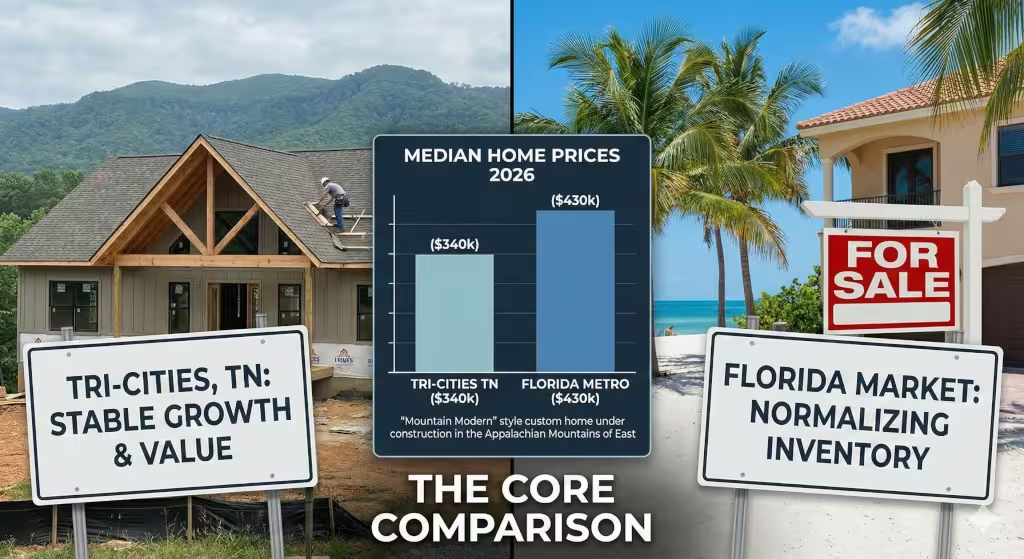
As we move through 2026, the gap between East Tennessee and Florida has become more defined. It is no longer just about which state is cheaper. It is about which state offers a more stable “foundation” for your investment. Below, I will expand on the key pillars of this comparison so you can see the precise math behind the move.
Median Price Points and Regional Value
To truly compare home prices, we have to look at the median data. In the real estate industry, the “median” is the middle point—half the homes cost more, and half cost less. This gives us a much clearer picture than an “average,” which can be skewed by a few multi-million dollar mansions on the coast.
In early 2026, the median home prices in Florida hover around $430,000. In many popular areas like Orlando or Tampa, you will find that entry-level homes often start much higher. Conversely, in the Tri-Cities—Johnson City, Kingsport, and Bristol—our median home prices sit closer to $330,000 to $340,000.
This $100,000 difference is a “technical gap” that changes everything. For a buyer, that $100,000 could be the difference between a cramped townhouse in a high-traffic Florida suburb and a custom four-bedroom home on an acre of land in Tennessee. From a builder’s perspective, my dollar goes much further here in terms of materials and local labor, which helps keep our new construction home prices more reachable for the average family.
Appreciation vs. Volatility
When you look at home prices, you aren’t just looking at what you pay today; you are looking at what the house will be worth in five years. This is where the comparison gets very interesting.
Florida’s Volatility: Florida has seen “explosive” growth, but in 2026, that growth is showing signs of fatigue. Because so many investors bought up Florida property for rentals or “flips,” the market there can be sensitive. If those investors decide to sell at once, home prices can dip quickly.
Tennessee’s Stability: In East Tennessee, our home prices tend to follow a “steady climb” model. We don’t see the massive 20% jumps that Florida saw, but we also don’t see the sudden drops. Our market is fueled by people who actually want to live here. This creates a “low-volatility” environment.
When home prices grow steadily at 3% to 5% a year, it creates a healthy equity build. It is like a well-engineered bridge, it’s designed to handle the weight of the market without swaying or snapping.
Inventory Levels: The “Months of Supply” Metric
Inventory is measured by “months of supply.” This tells us how long it would take to sell every home currently on the market if no new ones were added. A “balanced” market usually has about 6 months of supply.
In 2026, Florida is seeing an increase in inventory. In some parts of the state, supply has climbed toward 5 or 6 months. While this sounds good for buyers, it is often caused by the high cost of carry (taxes and insurance) forcing people to sell.
In the Tri-Cities, our inventory remains tighter, often around 3 to 4 months. Because our home prices are more affordable, the demand stays high. As a builder, this is a sign of a healthy region. It means there is still a “functional floor” under our home prices. People are moving here for jobs in healthcare and education, which provides a reliable stream of buyers that keeps our inventory from sitting stale on the shelf.
The Investor Exodus and Its Impact
One major factor in 2026 is what I call the “Investor Exodus.” During the boom years, Florida became a playground for big investment firms. They bought thousands of homes to use as short-term rentals. Now, as regulations tighten and insurance costs skyrocket, those investors are leaving. This puts downward pressure on home prices in those specific neighborhoods.
In East Tennessee, we have a different story. While we certainly have rentals, our “primary residence” rate is much higher. When the people who own the homes are also the people living in them, the community is stronger. Our home prices aren’t at the mercy of a corporate board in another state. They are rooted in the local economy. Integrity in the market matters just as much as integrity in the structure of a house.
New Construction and “Value Per Square Foot”
Finally, we have to talk about the physical reality of the build. In 2026, the home prices for new construction are heavily influenced by local building codes.
In Florida, a new house must be a “fortress” against hurricanes. This adds $30,000 to $50,000 to the build cost before you even pick out your cabinets. In Tennessee, while we build to high standards for energy and safety, we don’t have those extreme coastal requirements. This means our “value per square foot” is much higher. When you compare home prices for new builds, you’ll find that a Tennessee home offers more finished space and higher-end finishes for the same investment.
Comparison Summary Table
| Metric | Tri-Cities, TN (2026) | Central Florida (2026) |
| Typical Listing Price | $330,000 – $360,000 | $415,000 – $450,000 |
| Market Velocity | Steady / Balanced | Normalizing / Slower |
| Primary Buyer Type | Owner-Occupant | Mix of Owner & Investor |
| Build Complexity | Standard / Efficient | High (Hurricane Rated) |
The Hidden Multipliers: Insurance and Utilities
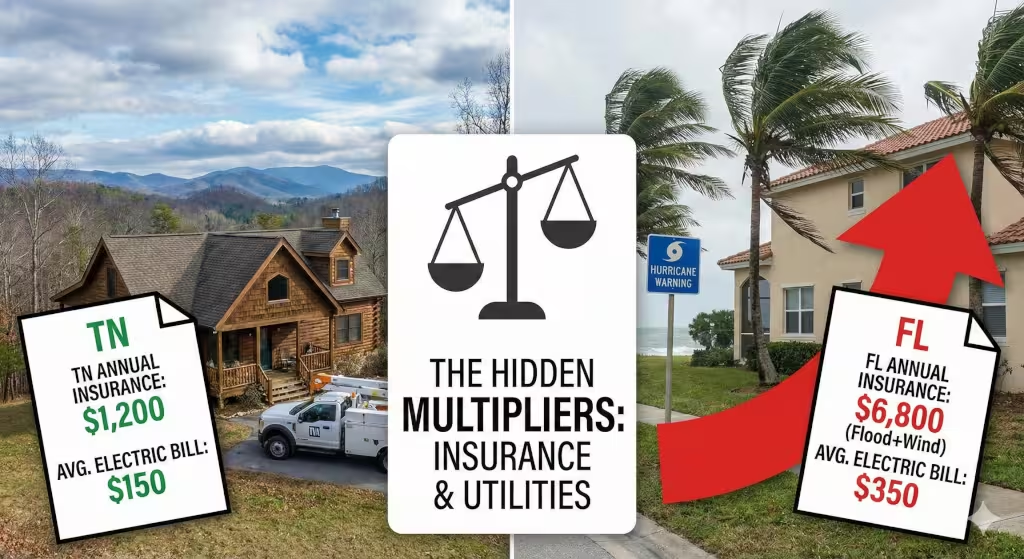
Many buyers forget that the monthly payment is not just the loan. It is also the “carry cost.” One of the biggest reasons people are looking at home prices in East Tennessee is the insurance crisis in Florida. By 2026, property insurance in Florida has become a massive burden. Some homeowners there are paying $5,000 or even $10,000 a year just to insure a standard house. This is because of the high risk of hurricanes and floods.
In the Tri-Cities, our insurance costs are much lower. We don’t have hurricanes, at least not most of the time. We are high above sea level, so large-scale flooding is rare. When you look at home prices, you must add that insurance cost back into your budget. A cheaper house in Florida might actually cost you more every month than a more expensive house in Tennessee because of those insurance premiums.
Then there is the power bill. In Florida, you have to run your air conditioner almost all year. In 2026, energy prices are a big concern for everyone. In East Tennessee, we have the Tennessee Valley Authority (TVA). Because of the TVA, we have some of the most competitive power rates in the country. Our winters are mild, and our summers are not as intense as the Florida heat. This means your “utility load” is much lower. When you look at home prices in East Tennessee, remember that the house is also cheaper to keep running every day.
Tax Implications: Looking Beyond the “Zero Income Tax”
Both Tennessee and Florida are famous for having no state income tax. That is a great benefit for everyone, especially retirees. But the government has to get its money from somewhere. When you compare home prices in East Tennessee vs Florida, you have to look at how they tax property.
Florida has property tax rates that are often much higher than ours. In many Florida counties, the effective tax rate is around 0.80% or higher. In Tennessee, our effective property tax rate is often closer to 0.46%. That might sound like a small number, but on a $400,000 house, that is a difference of thousands of dollars every single year.
Tennessee does have a higher sales tax. We pay more for things like clothes or electronics. But for many people, especially those who own a valuable home, the savings on property tax more than make up for it. When people talk about home prices, they often forget that the tax bill is part of that price. In the Tri-Cities, we work hard to keep our local taxes fair so that our residents can keep more of what they earn.
Building Your Dream: New Construction Costs
If you want to build a custom home, you will see a big difference in how your money is used. In Florida, building a house in 2026 is very technical. You have to use hurricane-rated glass, reinforced roofing, and sometimes you have to build the house on stilts if you are in a flood zone. These “hidden” structural costs drive up home prices for new builds.
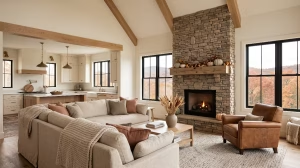
In East Tennessee, we don’t need those specific hurricane protections. Our building codes are strict, but they focus on things like snow loads and energy efficiency. The cost per square foot to build a home here is often much lower. You can spend your money on things you can actually see and enjoy, like granite countertops, hardwood floors, or a massive stone fireplace.
In the Tri-Cities, “Mountain Modern” is the big style for 2026. People want large windows to see the views, but they want the home to be cozy. In Florida, you often get a stucco-and-tile house that looks like every other house on the block. When you build here, you are getting a custom experience for a price that is often much lower than the home prices for new builds in the South.
Common Questions about Home Prices
Is it cheaper to live in TN or FL?
In general, yes. When you look at the total cost of living, Tennessee is usually about 6% to 10% cheaper. This includes groceries, healthcare, and especially the cost of housing. While Florida has great beaches, the “cost of entry” to live near them has pushed many people toward the more affordable mountains of East Tennessee.
Why are people leaving Florida for Tennessee?
The main reasons are the rising home prices in Florida and the extreme weather. People are tired of the heat and the worry of hurricane season. They want a place where they can see the leaves change in the fall and enjoy a slower pace of life. The Tri-Cities area offers a sense of community that is hard to find in the busy tourist zones of Florida.
What is the average home price in Johnson City, TN?
As of 2026, our median home prices are very competitive. While they vary by neighborhood, you can often find a high-quality home for well under the national average. This makes it a great spot for young families and retirees who want to get the most value for their money.
Lifestyle and Long-Term Value
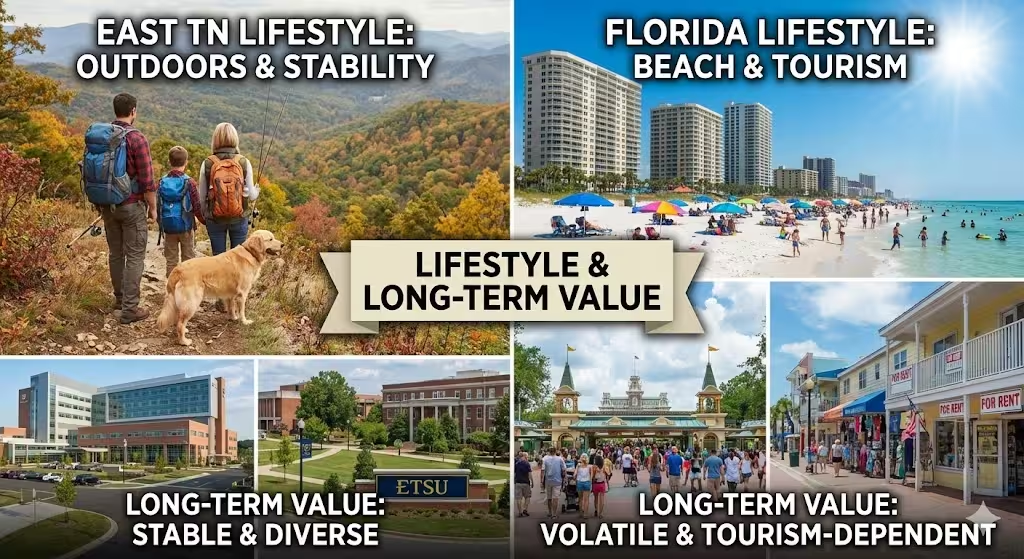
A home is not just an investment; it is where you live your life. As someone who loves hunting, fishing, and basketball, I can tell you that East Tennessee is a paradise for outdoor lovers. Florida has the ocean, but we have the lakes and the mountains. Our lifestyle is focused on the outdoors, but it is much more relaxed.
The long-term value of our region is also very strong. We have a diverse economy. We have world-class healthcare with the Ballad Health system and great schools like East Tennessee State University. This means that home prices in our area are supported by real jobs and a real community. We aren’t just a place for vacationers. We are a place where people build lives.
In Florida, much of the economy is tied to tourism. When the economy slows down, Florida can feel it very hard. But the Tri-Cities area has a history of staying steady. My experience as a general manager taught me that building in a stable area is the best way to protect your wealth. When you look at home prices, think about where that house will be in ten or twenty years. I believe our mountains offer a safety and a stability that is hard to match.
Precision in Your Decision
Choosing where to live is one of the biggest decisions you will ever make. It takes precision and honesty to look at the numbers correctly. When you compare home prices in East Tennessee vs Florida, the winner is clear for those who value long-term stability and a high quality of life.
Whether you are looking to buy an existing house in Kingsport or build a new custom home in Johnson City, you are making a choice for competence and integrity. Our home prices reflect the true value of the land and the labor that goes into every structure.
We want to thank you for taking the time to look at these details with us. We know that the technical side of home building can be a lot to take in, but it is the most important part of the process. If you want a home that will last, in a place that will feel like home from day one, you can’t go wrong with East Tennessee.
Bonus: Carry Cost Comparison Table of Florida vs. Tennessee
Our goal is to show you exactly how home prices translate into a monthly budget.
When you compare home prices across different states, you have to look at the “hidden” costs. Many people see a house and think the price on the tag is all they need to know. But in my experience, the carry cost is what truly defines your quality of life. Below is a detailed look at how a $450,000 house in our beautiful Tri-Cities area stacks up against a similar house in the Orlando, Florida area.
The Monthly Carry Cost: $450,000 Home Comparison
| Cost Category | Tri-Cities, TN (Johnson City/Kingsport) | Orlando, FL (Metro Area) | Difference (Monthly) |
| Mortgage (6.3% on $360k) | $2,228 | $2,228 | $0 |
| Property Tax (Est. 2026) | $188 | $338 | +$150 |
| Home Insurance (Est. 2026) | $150 | $595 | +$445 |
| Average Monthly Utilities | $250 | $350 | +$100 |
| Total Monthly Carry Cost | $2,816 | $3,511 | +$695 |
Note: Estimates based on a 20% down payment and standard 30-year fixed rates forecasted for early 2026.
As you can see, even when home prices are identical, the house in Tennessee saves you nearly $700 every single month. That is $8,400 a year that stays in your pocket for hunting, fishing, or saving for your children’s college.