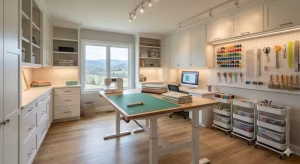
The Real Cost to Add a Finished Room in an Unfinished Basement in Tri-Cities, TN
If you live in the Tri-Cities, there is a good chance you are sitting on buried treasure. It is right beneath your feet. I am talking about that cool, dark, concrete space under your main floor. For many folks in Johnson City, Kingsport, and Bristol, the unfinished basement is just a place to store holiday decorations or hunting gear. But if you are looking for more space, that basement is the most logical place to look.
In the Tri-Cities of Tennessee one thing always stays the same. People always need more room. Maybe you need a home office, a bedroom for a teenager, or just a place to watch the Vols game without waking up the whole house.
The big question is always the price. You want to know the cost to add a finished room in an unfinished basement. You want the real numbers for our area, not some national average from a website that has never seen our red clay soil. The truth is that the price varies. It depends on if you want to swing the hammer yourself or hire a pro. It depends on whether you are dealing with simple drywall or cutting through concrete for a new bathroom.
In this guide, we will walk you through the costs, the risks of moisture, and the building codes you need to know in Washington and Sullivan counties. We will look at why a finished room in your basement might be the
you make this year. Let’s dig into the details so you can build with confidence.
2025 Cost Estimates for the Tri-Cities Area

When you start planning a finished room in your basement, the first thing you need is a budget. In 2025, prices have stabilized a bit compared to the last few years, but they are still higher than they were a decade ago. In the Tri-Cities area, we have a unique market. Our labor rates are generally lower than big cities like Nashville or Atlanta, but our material costs are about the same.
The “Per Square Foot” Breakdown
The most common way to estimate the price of a finished room is by square footage. This gives you a rough idea of what to expect.
Basic Finish: $35 to $50 per square foot
If you are handy and willing to do some work yourself, you can keep costs down. A basic finished room includes simple framing, standard drywall, budget-friendly flooring like carpet or basic vinyl, and standard electrical outlets. This price range assumes you are doing a lot of the painting and trim work yourself. It also assumes you are not moving any plumbing or adding walls that support the house structure. This is a great option for a simple playroom or a basic home office.
Mid-Range Finish: $55 to $90 per square foot
This is where most homeowners in Johnson City and Kingsport land. At this price point, you are hiring a professional general contractor to handle the heavy lifting. You get better materials, like luxury vinyl plank flooring that resists moisture. You get upgraded lighting, perhaps some recessed can lights instead of a single bulb. This budget allows for a truly comfortable finished room that feels like the rest of your house. It covers professional framing, insulation that meets modern codes, and a professional drywall finish that looks smooth and clean.
High-End Finish: $100+ per square foot
If you want a finished room that looks like a magazine cover, this is your category. This includes structural changes, like removing a steel column and replacing it with a beam to open up the room. It includes adding a wet bar with granite countertops or a custom bathroom with a tiled shower. If you are building a high-end home theater with soundproofing and specialized wiring, you will easily cross the $100 per square foot mark. In our area, we see this often in the larger custom homes in Jonesborough or the ridges around Bristol.
Cost by Room Type
The function of your finished room changes the price dramatically. Not all rooms are created equal.
Standard Bedroom or Office
This is the cheapest type of finished room to build. You mainly need walls, a ceiling, a floor, and electricity. There is no plumbing involved. The biggest expense here might be the egress window, which we will discuss later. If you just need a quiet place to work or sleep, this is the most affordable path.
Bathroom Addition
Adding a bathroom drives the cost up fast. You have to deal with plumbing waste lines. In a basement, those lines are often under the concrete slab. To add a bathroom, we have to cut through the concrete floor, dig out the dirt, and lay new pipe. Then we pour concrete back over it. That process alone can add $3,000 to $5,000 to your budget before you even buy a toilet or sink. If you use an up-flush system like a Saniflo, you can save some money on labor, but the unit itself is pricey. A bathroom can easily add $15,000 or more to the total project cost.
Home Theater or Entertainment Space
A dedicated entertainment space is a popular choice for a basement finished room. The costs here come from electrical and finish work. You might want dimmable lights, surround sound wiring, and extra outlets for gaming systems. Soundproofing is also a factor. Putting insulation in the ceiling to stop noise from traveling upstairs costs money. If you want a built-in entertainment center, that is custom carpentry, which adds to the labor bill.
Tri-Cities Cost Comparison Table
To help you see where the money goes, here is a simple comparison. This shows the difference between buying materials yourself versus hiring a pro for your new finished room.
| Task | DIY Material Cost (Est.) | Pro Labor & Material Cost (Est.) |
| Framing | $1,000 – $1,500 | $2,500 – $4,000 |
| Electrical | $500 – $800 | $1,500 – $3,000 |
| Plumbing (if needed) | $600 – $1,000 | $3,000 – $6,000 |
| Drywall & Paint | $800 – $1,200 | $3,500 – $6,000 |
| Flooring | $1,000 – $2,000 | $2,500 – $5,000 |
| HVAC | $500 – $1,000 | $2,000 – $5,000 |
Critical Factors That Inflate Your Budget
The numbers above are just estimates. Real life is messy. In the Tri-Cities, we have specific challenges that can make a finished room more expensive. You need to know these upfront so you do not get shocked later.
Moisture Management: The Tri-Cities Factor
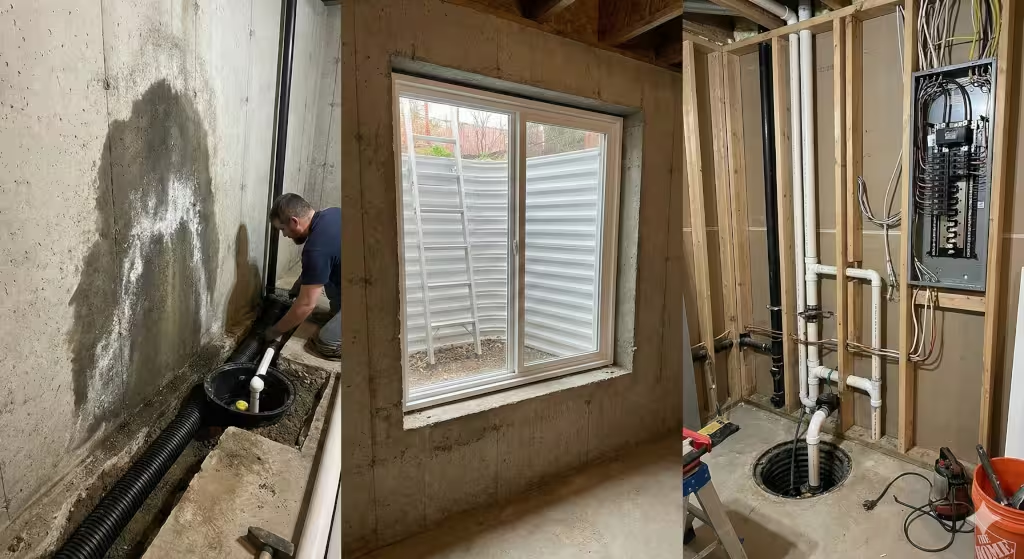
If you live here, you know we have clay soil. Red clay holds water. When it rains, that water pushes against your basement walls. Before you build a finished room, you must manage moisture. You cannot put drywall up against a damp wall. It will grow mold.
You might need to install a French drain system around the inside perimeter of the basement. This involves jackhammering the floor edge, putting in a pipe, and covering it with gravel and concrete. This catches water before it hits your floor. You also likely need a sump pump to push that water out and away from the house. A good waterproofing system can cost $5,000 to $10,000, but it is mandatory if you want your finished room to last.
Egress Windows
This is a big one for safety and legality. If your finished room is going to be a bedroom, the International Residential Code (IRC) says it must have an emergency exit. This is called an egress window. It has to be large enough for a firefighter to get in and for you to get out.
Most standard basement windows are too small. To fix this, we have to dig a large hole outside the foundation, cut a hole in the concrete wall, and install a large window and a window well. This is not a small job. It involves specialized concrete cutting equipment. In the Tri-Cities, installing an egress window typically costs between $3,000 and $5,000 per window. But without it, you cannot legally call that finished room a bedroom.
Plumbing and Electrical
We touched on plumbing, but electrical capacity is also key. Your main electrical panel might be full. If you add a finished room with lots of lights and outlets, you might need to upgrade your main service panel. Moving from a 100-amp box to a 200-amp box can cost $2,000 or more.
For plumbing, deeper drain lines are better. If your sewer line leaves the house halfway up the basement wall, you cannot use gravity to drain a toilet. You have to pump the waste up. Sewage ejector pumps are reliable, but they require a pit to be dug in the floor. This adds complexity and cost to your finished room project.
HVAC Extension
Your basement is naturally cooler, but it still needs airflow. You need to heat the space in winter and reduce humidity in summer. You might think you can just cut a hole in the existing ductwork. Be careful. Your current furnace creates a specific amount of air pressure. If you steal air for the basement, the upstairs might get too hot or too cold.
Often, the best solution for a finished room in the basement is a mini-split system. This is a small unit that mounts on the wall. It provides both heat and air conditioning just for that room. It is efficient and quiet. Installing a mini-split costs around $3,000 to $5,000, but it guarantees your finished room is comfortable year-round.
Step-by-Step Guide to Finishing Your Basement Room
Now that we have talked about money, let’s talk about the process. Building a finished room is like any other construction project. It has an order of operations. If you skip a step, you will have problems later.
Step 1: The Dry Test
Do not buy a single stud until you are sure the basement is dry. Tape a piece of plastic sheeting to the concrete wall and leave it for two days. If you peel it off and the concrete is dark or wet, you have moisture coming through. If there are water droplets on the front of the plastic, you have high humidity. You must fix these water issues first. Your finished room will be ruined by mold if you ignore this.
Step 2: Framing and Insulation
Once the space is dry, you frame the walls. We use pressure-treated lumber for the bottom plate. That is the piece of wood that touches the concrete floor. Regular wood will rot if it touches concrete.
For insulation, standard pink fiberglass bats are okay, but foam board is better for basements. I like to glue rigid foam insulation boards directly to the concrete wall before framing. This creates a thermal break. It keeps the cold concrete away from your warm finished room. It also acts as a vapor barrier.
Step 3: Rough-Ins
This is the messy phase. The electrician comes in and runs wires through the studs. The plumber runs pipes for the bathroom or wet bar. The HVAC technician runs ductwork or lines for the mini-split.
This is the best time to run low-voltage cables too. Think about internet cables (Cat6) or speaker wires. It is cheap to run these wires now while the walls are open. Once the drywall is up in your finished room, adding wires becomes a nightmare.
Step 4: Drywall and Ceiling
After the inspectors approve the rough-ins, you can close up the walls. We hang drywall boards and screw them to the studs. Then comes the taping and mudding. This takes skill. A bad drywall job looks terrible with certain lighting.
For the ceiling, you have two main choices. You can use drywall for a clean, hard ceiling that looks like the upstairs. Or you can use a drop ceiling with acoustic tiles. In a finished room in the basement, I often recommend a drop ceiling. It allows you to access pipes and wires later. If a pipe leaks upstairs, you just replace a tile instead of cutting a hole in the ceiling.
Step 5: Flooring Choices
Basement floors are cold and hard. You need the right flooring for your finished room. Avoid solid hardwood. It expands and contracts too much with humidity and will buckle. Carpet is warm, but if the basement floods, it is ruined.
My top recommendation for any finished room in a basement is Luxury Vinyl Plank (LVP). It looks like wood or stone, but it is waterproof. It floats on top of the concrete, so it can expand slightly without breaking. It is durable and easy to clean. If you want warmth, you can put area rugs down.
Navigating Legalities: Permits and Codes in Tennessee
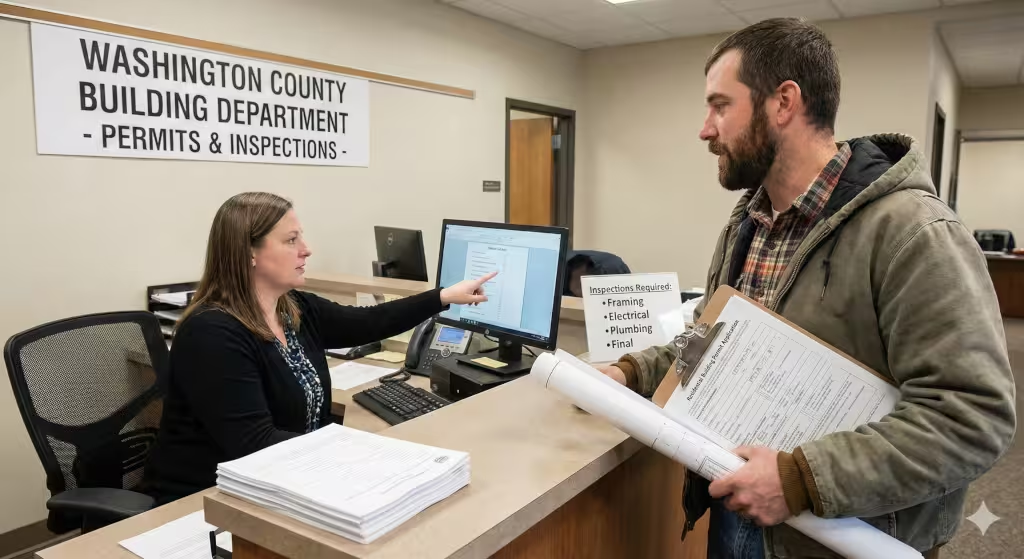
I know nobody likes dealing with the government. Standing in line at the permit office is not my idea of a fun Tuesday. But if you are building a finished room, you need to follow the rules.
Do You Need a Permit?
Yes, you usually do. If you are adding walls, electricity, or plumbing, the county requires a permit. This is true for Washington County, Sullivan County, and the city limits of Johnson City, Kingsport, and Bristol.
Why bother? First, safety. The electrical inspector ensures your finished room won’t burn down. Second, insurance. If you have a fire or flood and the insurance company finds out you did unpermitted work, they can deny your claim. Third, resale. When you sell your home, the buyer’s inspector will look for permits. If you cannot prove the finished room was built to code, you might have to tear it out or pay a fine.
The Inspection Process
The process is straightforward. You submit a simple drawing of your finished room plan. You pay a small fee. They issue a permit card. You call for inspections at specific milestones:
Framing/Rough-in: Before you put up drywall.
Insulation: Before you cover the walls.
Final: When everything is done.
Specific Codes to Watch
There are a few codes that trip people up.
Ceiling Height: The code usually requires a minimum of 7 feet for a finished room. If you have ducts hanging lower, they can sometimes go down to 6 feet 4 inches, but you need to check the local rules.
Outlet Spacing: You generally need an outlet every 12 feet along the wall. You also need one on any wall wider than 2 feet.
Smoke Detectors: You must have a hardwired smoke detector in the basement finished room, linked to the ones upstairs.
ROI: Is It Worth the Investment?
You are spending thousands of dollars on this finished room. Will you get it back?
Market Value
In the real estate world, basements are tricky. Appraisers look at “above-grade” square footage and “below-grade” square footage differently. Even if your finished room is nicer than your living room upstairs, it is worth less on paper.
Typically, in the Tri-Cities market, a finished room in the basement appraises for about 50% to 70% of the value of the main floor space. So, if your upstairs is worth $200 per square foot, your basement might be valued at $100 to $140 per square foot.
However, that does not mean it is a bad investment. A house with a finished basement sells faster. It appeals to more buyers. A family with teenagers needs that extra space. A buyer who works from home needs that office. The ROI is usually around 70%. You get 70 cents back for every dollar you spend when you sell.
Lifestyle Value
The real value of a finished room is not just in dollars. It is in how you live. It is the movie nights in the new theater. It is the quiet Zoom calls in the new office. It is having a private suite for your in-laws when they visit. You cannot put a price tag on peace of mind and comfort. If you plan to stay in your home for five years or more, the lifestyle value far outweighs the construction cost.
Common Questions about Basements
Can I finish my basement for $10,000?
It is very difficult to build a quality finished room for $10,000 in 2025. Maybe if the room is very small, say 10×12 feet, and you do every bit of labor yourself, use the cheapest materials, and already have electrical nearby. But for a standard size room, you should budget more realistically. Cutting corners to hit $10,000 often leads to moisture problems later.
Does a finished basement count as square footage in TN?
This is a common point of confusion. When a real estate agent lists your house, they can list the “Total Living Area.” This includes the finished room in the basement. However, for the official tax appraisal and reliable bank appraisals, the basement is often separated out. It counts, but it counts differently than the upstairs. It is “GLA” (Gross Living Area) nuance.
How long does it take to finish a basement room?
If you hire a professional crew, they can usually complete a finished room in 4 to 8 weeks. This accounts for inspections and scheduling subcontractors. If you do it yourself on weekends and evenings, it will likely take 3 to 6 months. Be realistic about your free time. A half-finished basement can sit there for years if you burn out.
Is it better to do an open layout or separate rooms?
Trends change, but currently, flexibility is key. A massive open space is great, but defining zones helps. Maybe use a partial wall or a change in flooring to separate a play area from a TV area. However, if you need a bedroom, it must be a separate enclosed finished room for privacy and fire safety reasons.
What is the best way to heat a basement room?
As mentioned earlier, the mini-split heat pump is the gold standard for a finished room. It is efficient and gives you total control. Electric baseboard heaters are cheap to install but expensive to run. Tying into your existing furnace is the cheapest upfront but often leads to uneven temperatures.
Conclusion
Adding a finished room to your unfinished basement is a journey. It requires planning, a budget, and a bit of patience. But the result is worth it. You are taking a dark, dusty storage area and turning it into a vibrant part of your home. You are adding value to your property and space to your life.
Remember the key takeaways. Manage the moisture first. Do not skip the permits. Be realistic about the costs in our Tri-Cities market. Whether you want a cozy den, a bright office, or a guest suite, this project is doable.
If you are sitting in your living room right now, thinking about that space downstairs, take the first step. Look at the foundation walls. Check for water. Dream a little bit. That finished room is closer than you think.