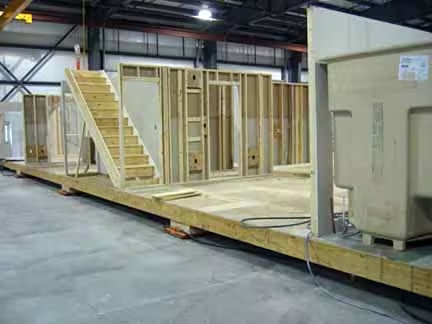

The Volatile Reality of Building Material Costs
Building a custom home is one of the most exciting journeys you will ever take. Whether you are breaking ground on a wooded hillside in East Tennessee or building in a quiet suburban neighborhood, watching your house take shape is deeply rewarding. But if you have paid attention to the home building market over the last several years, you know that the financial side of building can feel like riding a roller coaster.
These sudden jumps in material prices can cause serious trouble if you are not prepared. When supply chain pinches hit the market, suppliers pass those price hikes directly to your general contractor. If your building budget has no room to absorb those extra expenses, the entire project can come to a sudden halt.
Price Spike at Procurement
         │
         ▼
Does the build have a contingency fund?
         │
    ┌────┴────┐
    │         │
   YES        NO
    │         │
    ▼         ▼
Bank draws    Out-of-pocket cash call
cover gap     or project stalls
This is where a construction loan contingency fund for material price escalation becomes your most important financial tool. A contingency fund is a dedicated line item built right into your construction loan. Its only job is to cover unexpected price increases and surprise job site costs without forcing you to empty your personal savings.
When you build a home without a proper contingency fund, you are gambling on market stability. If material costs rise and you do not have a contingency fund in place, the bank will not simply give you extra money. You will face what the industry calls a cash call. That means you must write a check out of your own pocket before the contractor can order the next load of materials. If you do not have that cash ready, work stops. A well planned contingency fund keeps the hammers swinging, protects your relationship with your builder, and ensures your dream home gets finished on time and on budget.
Anatomy of a Construction Loan Contingency Fund

To understand how a contingency fund protects your build, you need to understand how banks and builders look at the money. A construction loan is not a single lump sum check handed to you at closing. It is a structured line of credit that pays out in stages as work is completed. Inside that loan structure, your contingency fund serves as a protective cushion.
Total Construction Loan
├── Hard Costs (Framing, Concrete, Roofing, Plumbing)
├── Soft Costs (Permits, Architectural Plans, Engineering)
└── Contingency Fund (Reserve for Escalation and Surprises)
    ├── Bank-Mandated Contingency Reserve
    └── Owner Discretionary Contingency
Hard Cost vs. Soft Cost Allocations
When a lender puts together your construction loan package, they divide your budget into two main categories: hard costs and soft costs.
Hard costs are the physical elements of the building. This includes the concrete in the footings, the two-by-fours in the walls, the shingles on the roof, the copper pipes in the crawlspace, and the labor required to install them. Soft costs cover everything else, such as architectural design fees, civil engineering stamps, building permits, survey charges, and construction loan closing fees.
A material price escalation contingency fund belongs almost entirely to the hard cost side of your budget. If the price of framing packages or oriented strand board shoots up after you close your loan, your hard cost line items will exceed their initial estimates. Your contingency fund sits right beside those hard cost line items to absorb the difference.
Bank-Mandated Reserves vs. Owner Discretionary Reserves
Not all contingency money works the same way. In most
- Bank-Mandated Contingency Reserve: Lenders want to make sure the house gets completely finished. If a home is only ninety percent complete and the money runs out, the bank is left holding collateral that is hard to sell. Because of this, most banks require a mandatory contingency fund of five to ten percent of the total hard construction costs. This money is locked in the loan. You cannot access this contingency fund simply because you want a nicer kitchen countertop later in the build. The bank only releases funds from this contingency fund when there is a documented cost increase or an unforeseen site condition.
- Owner Discretionary Contingency: This is an additional cushion that smart homeowners set aside. Sometimes this is rolled into the total loan amount if your appraisal allows it, or it is kept in a separate personal savings account. An owner contingency fund gives you flexibility. If you want to absorb a material increase without going through formal bank reviews, or if you decide during framing that you want to add extra recessed lights, your owner contingency fund covers it.
Contractor Contingency vs. Owner Contingency in Builder Contracts
It is also important not to confuse your loan contingency fund with the contractor contingency listed in your builder’s estimate.
A contractor contingency is money built into the builder’s internal budget to cover normal job site waste, minor estimating mistakes, or small tool and supply variances. The contractor controls that money to deliver the home at their agreed price.
An owner contingency fund, on the other hand, is your safety net. It is controlled by you and your lender. When a massive material price escalation occurs that exceeds the builder’s standard pricing allowance, your owner contingency fund is what pays the supplier so your project moves forward smoothly.
| Feature | Bank-Mandated Contingency Fund | Owner Discretionary Contingency | Contractor Contingency |
| Who Controls It? | Lender and Title Agent | Homeowner | General Contractor |
| Primary Goal | Guarantee home completion | Flexibility and upgrades | Covering waste and job site variance |
| Release Method | Formal draw and inspection | Direct owner payment | Internal contractor accounting |
| Eligible Uses | Verified material spikes and structural needs | Design changes and cost jumps | Minor job errors and material scrap |
How Material Price Escalation Triggers Contingency Funds
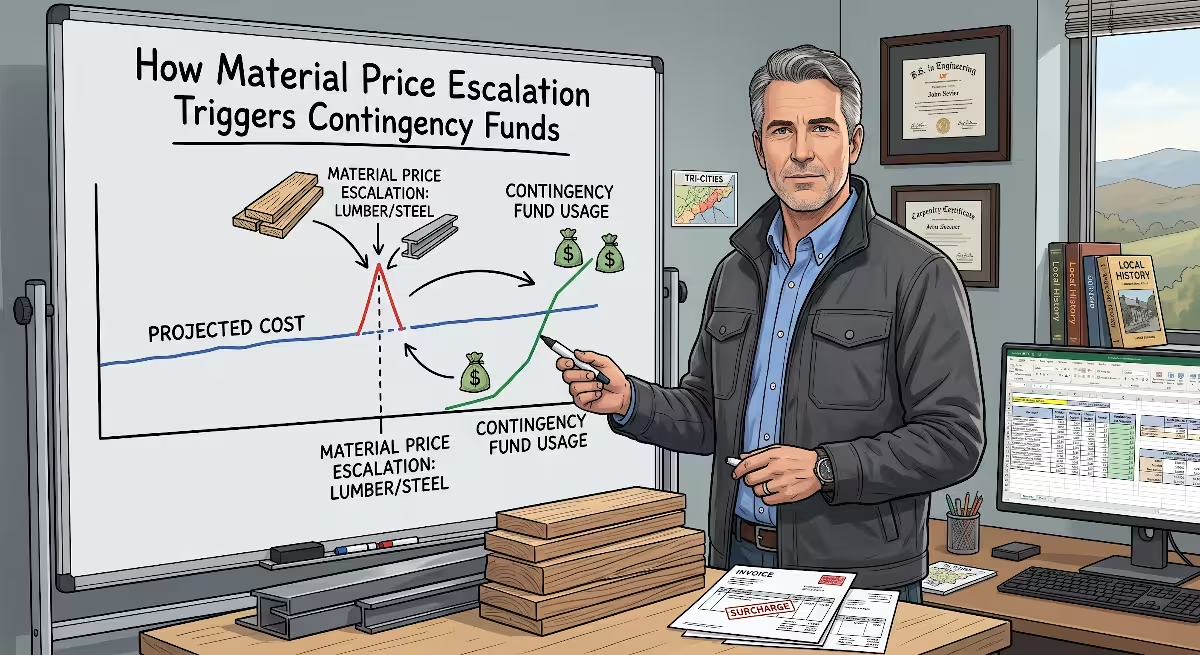
To see why you need a contingency fund, you have to look at the timeline of how a custom home is actually built. There is always a time gap between when a builder gives you a price and when the materials actually arrive on the job site.
Contract Signed (Month 1) ──► Loan Closes (Month 2) ──► Framing Package Ordered (Month 5)
      ▲                                                        ▲
      │                                                        │
Lumber quoted at baseline                              Price spikes 20%
                                                    (Contingency Fund Activated)
The Timeline Gap: Bid Date to Procurement Date
When you sign a contract with a home builder, they price your home based on current material quotes from their suppliers. But building a custom home takes time:
- Month 1: You finalize your blueprints and sign the construction agreement.
- Month 2: The lender completes the appraisal, underwrites your file, and you close the loan.
- Month 3: Site clearing, excavation, and septic or utility installation begin.
- Month 4: Foundation footers are dug, concrete walls are poured, and waterproofing is completed.
- Month 5: The framing package is finally ordered and delivered to the site.
In that four to five month gap, world events, fuel costs, mill production schedules, and regional demand can completely change the cost of lumber, trusses, and fasteners. If the price of your framing package goes up by eight thousand dollars during that time, that money must come from somewhere. That price jump is the exact trigger for your contingency fund.
How Escalation Clauses Interact with Bank Financing
Most professional custom builders include a material price escalation clause in their contracts. This clause states that if the cost of specific building materials increases by more than a certain percentage (often three to five percent) between the contract date and the purchase date, the buyer agrees to pay the difference.
Here is how an escalation clause connects with your contingency fund:
- The supplier notifies your builder that concrete prices have increased by twelve percent due to regional cement shortages.
- The builder checks the contract escalation clause. Because the increase is higher than the agreed threshold, the builder prepares a formal change order.
- The change order shows the original quote, the new supplier invoice, and the net difference.
- Instead of asking you for an immediate personal check, the builder submits that change order to your construction lender to be paid out of your contingency fund.
- The bank reviews the documentation, verifies that the contingency fund has sufficient balance, and approves the price adjustment.
Without a dedicated contingency fund built into your financing, every single escalation clause trigger turns into an immediate out-of-pocket cash crisis.
The Risk Distribution Matrix
The type of contract you sign with your builder changes how much risk you carry and how heavily you will rely on your contingency fund.
LOW BUYER RISK ◄────────────────────────────────────────► HIGH BUYER RISK

Fixed-Price Contract        Guaranteed Maximum Price (GMP)        Cost-Plus Contract
(Builder carries most risk;  (Risk is shared up to a set cap;     (Buyer carries all market risk;
contingency covers clauses)  contingency covers overages)         contingency fund is mandatory)
Fixed-Price Contracts
In a pure fixed-price contract, the builder agrees to build the home for a set dollar figure. However, almost all modern fixed-price contracts contain specific escalation clauses for volatile materials like lumber, concrete, and roofing. When those specific commodities spike, your contingency fund covers the difference above the contract baseline.
Cost-Plus Contracts
In a cost-plus contract, you pay the actual cost of all materials and labor, plus a set percentage or flat fee for the builder’s overhead and profit. In this setup, you carry the full risk of any material price increase. If drywall prices double, your building cost doubles for that line item. A large, healthy contingency fund is absolutely essential when using a cost-plus contract.
Guaranteed Maximum Price (GMP) Contracts
A Guaranteed Maximum Price contract sets an absolute ceiling on the cost of the home. The builder manages the budget, but if materials rise, the extra costs eat into the project budget until the maximum price is reached. A contingency fund is typically written directly into the GMP structure to handle price jumps before reaching that final price cap.
Sizing the Reserve: How Much Should You Fund?

Determining the right size for your contingency fund is a balancing act. If your contingency fund is too small, you risk running out of money before the drywall goes up. If your contingency fund is too large, you might borrow more than you need, which can increase your closing costs and interest payments during construction.
Total Hard Costs ($400,000)
    │
    ▼
Base Risk Percentage (10% = $40,000)
    │
    ▼
+ Volatility Buffer for High-Risk Items ($10,000)
    │
    ▼
Total Recommended Contingency Fund = $50,000
Standard Baseline Percentages
Lenders and experienced construction managers use standard percentages to set the baseline for a contingency fund:
- Simple Spec or Subdivision Builds (5% to 8%): If you are building a standard floor plan on a flat, fully developed lot with city water and sewer, your risks are relatively low. A five to eight percent contingency fund is usually enough to cover basic material fluctuations.
- Semi-Custom Homes (10%): If you are customizing an existing plan, choosing your own finishes, and building on a lot that requires standard grading, a ten percent contingency fund is the industry standard.
- Fully Custom Homes on Complex Sites (12% to 15%): If you are building a one-of-a-kind architectural home on a steep slope, a heavily wooded lot, or a property requiring long utility runs and a private septic system, your contingency fund should be at least twelve to fifteen percent. Site work surprises and unique custom materials carry much higher price volatility.
Formula for Calculating a Risk-Adjusted Fund
Rather than guessing, you can calculate a realistic contingency fund using a simple three-step approach:
Total Contingency Fund = (Base Hard Costs X Base Risk Factor) + Material Volatility Add-On
Let us walk through an example for a home with four hundred thousand dollars in base hard construction costs:
- Calculate the base contingency: Take the four hundred thousand dollar hard cost total and multiply it by your base risk factor of ten percent. This gives you a starting contingency fund of forty thousand dollars.
- Identify high-risk materials: Review the builder’s estimate to find the most volatile items. Suppose framing lumber, trusses, and ready-mix concrete make up one hundred thousand dollars of that budget.
- Apply a volatility buffer: If commodity markets are shaky, add a ten percent volatility buffer specifically to those high-risk items. Ten percent of one hundred thousand dollars is ten thousand dollars.
- Combine the totals: Add the forty thousand dollar base reserve to the ten thousand dollar volatility buffer. Your target contingency fund for this project is fifty thousand dollars.
Base Hard Costs:           $400,000
Base Contingency (10%):     $40,000
Material Volatility Buffer: $10,000
───────────────────────────────────
Total Contingency Fund:     $50,000
Project-Specific Risk Multipliers
Every job site has its own personality. You should increase your contingency fund percentage if your project involves any of the following factors:
- Steep Mountain or Hillside Topography: Excavation in rocky or uneven soil can uncover hidden boulders or underground water springs. That requires extra concrete, engineered retaining walls, and added drainage stone, all of which quickly drain your contingency fund.
- Long Lead-Time Custom Finishes: Imported tile, custom-built timber trusses, and specialty exterior cladding take months to arrive. Long lead times leave more room for freight surcharges and manufacturing price increases that require backup from your contingency fund.
- Winter Building Schedules: Pouring concrete in freezing weather requires chemical additives, thermal curing blankets, and temporary site heat. These extra materials add up fast and should be backed by an adequate contingency fund.
The Bank Draw Process: Accessing Contingency Funds
Having a contingency fund in your loan is one thing; getting the bank to release that money is another. Construction lenders follow a strict process before they disburse any money from your contingency fund. Understanding this process prevents unexpected delays and helps keep your project running smoothly.
Step 1: Price Spike Occurs ──► Supplier issues invoice higher than original estimate
Step 2: Change Order Made   ──► Contractor prepares formal change order with proof
Step 3: Owner Signs Off     ──► Homeowner reviews and signs the change order
Step 4: Bank Inspection     ──► Bank inspector verifies progress and validates need
Step 5: Fund Release        ──► Lender draws money from the contingency fund
Documentation Required: Invoices, Receipts, and Change Orders
Lenders do not release money from a contingency fund based on a phone call or an email estimate. You and your contractor must provide clear paper evidence that proves the price increase:
- The Original Line-Item Estimate: The bank looks at the original budget breakdown approved at loan closing.
- The Supplier’s Price Increase Notice: A letter or invoice from the lumber mill, concrete plant, or supply warehouse showing the new unit price.
- The Formal Change Order: A standardized document that lists the exact line item being changed, the original cost, the new cost, and the specific dollar amount requested from your contingency fund.
- Lien Waivers: Signed lien waivers from the subcontractor or supplier confirming that previous disbursements were paid in full before new contingency fund dollars are released.
The Bank Inspector Role and Underwriter Approval
Once the change order and invoices are submitted, the lender sends a professional inspector out to the job site. The inspector is not there to judge the beauty of your home. Their job is to verify that the work matches the draw request:
- The inspector walks the property with a clipboard or tablet, checking off completed work.
- If the request from the contingency fund is for delivered materials, such as a framing package sitting on the subfloor, the inspector confirms the lumber is physically on site and protected from weather.
- The inspector files a report with the bank’s construction loan administration department.
- An underwriter reviews the report, compares it to the remaining balance of your contingency fund, and approves the disbursement.
This process ensures that your contingency fund is only spent on real, verified building expenses that add value to the property.
┌─────────────────────────────────────────────────────────────┐
│                 SAMPLE CONTINGENCY DRAW LOG                 │
├───────────┬──────────────────────┬─────────────┬────────────┤
│ Draw No.  │ Description          │ Amount Used │ Remaining  │
├───────────┼──────────────────────┼─────────────┼────────────┤
│ Baseline  │ Initial Loan Balance │ $0.00       │ $45,000.00 │
│ Draw 02   │ Framing Lumber Spike │ $6,200.00   │ $38,800.00 │
│ Draw 04   │ Concrete Surcharge   │ $2,400.00   │ $36,400.00 │
│ Draw 07   │ Copper Wire Increase │ $1,850.00   │ $34,550.00 │
│ Total End │ Unused Balance       │ $10,450.00  │ $34,550.00 │
└───────────┴──────────────────────┴─────────────┴────────────┘
Avoiding Draw Freezes and Out-of-Pocket Cash Calls
A draw freeze happens when a bank stops releasing money because the project is over budget, behind schedule, or missing critical documentation.
To prevent a draw freeze:
- Never let your builder order materials that exceed the budget without creating a change order for the contingency fund first.
- Keep an active spreadsheet tracking every dollar spent from your contingency fund.
- Always maintain a minimum cushion in your contingency fund until mechanical rough-ins and insulation are fully completed, as this is when the biggest material spikes occur.
If your contingency fund runs dry before the home is finished, the lender will freeze all further loan draws until you deposit cash into an escrow account to cover the remaining budget. Keeping a close eye on your contingency fund protects you from this scenario.
Strategic Risk Mitigation Beyond the Loan Buffer
While a construction loan contingency fund is your primary financial shield, you should not rely on it alone. Smart planning before and during construction can reduce how much you need to draw from your contingency fund. This leaves more money in your reserve for true emergencies.
Contingency Fund Protection Strategies
├── 1. Upfront Material Buy-Downs (Pre-purchasing lumber, trusses, plumbing)
├── 2. Index-Linked Escalation Caps (Splitting price increases with the builder)
└── 3. Value Engineering (Pre-approving alternative materials and sizes)
Early Procurement and Supplier Price-Lock Agreements
One of the most effective ways to protect your contingency fund is to lock in material pricing as early as possible.
Talk to your builder about upfront buy-downs. If you close your construction loan in March but will not need your roofing shingles, windows, or plumbing fixtures until August, ask your builder if their supply yard will lock in the price if you buy them early. Many suppliers will store materials in their warehouse for a small monthly fee or deliver them to a secure storage container on your site.
Paying a small storage fee is often much cheaper than paying a twenty percent price increase out of your contingency fund five months down the road.
Value Engineering and Specification Substitution Protocols
Value engineering means finding smarter, more cost-effective ways to achieve the same structural performance and visual quality. You can protect your contingency fund by writing pre-approved material substitutions directly into your building specifications.
Consider these practical examples:
- Engineered Lumber vs. Dimensional Lumber: If traditional two-by-ten joists experience a price spike, your builder can automatically switch to engineered I-joists or open-web floor trusses if your plans allow it.
- PEX vs. Copper Plumbing: Using flexible PEX piping instead of rigid copper protects your contingency fund from volatile metals markets while speeding up installation time.
- Composite Decking vs. Cedar: If natural cedar prices soar, having an approved composite alternative in your contract keeps the project moving without burning through your contingency fund.
Material Volatility Comparison

Copper Pipe:      ████████████████████ (High Risk)
PEX Piping:       █████ (Low Risk)

Cedar Framing:    ████████████████ (High Risk)
Treated Pine:     ██████ (Moderate Risk)

Dimensional 2x10: █████████████ (Moderate Risk)
Engineered I-Joist:████████ (Stable Pricing)
Structuring Mutual Escalation Caps in Your Building Contract
When you negotiate your building contract, do not accept an open-ended escalation clause that leaves your contingency fund completely exposed. Instead, work with your builder to create a balanced clause that shares the risk fairly.
A great approach is a tiered escalation cap:
- Tier 1 (The First 3%): The general contractor absorbs minor price increases as part of their normal cost of doing business.
- Tier 2 (3% to 10%): The price increase is paid directly out of your loan contingency fund via an approved change order.
- Tier 3 (Above 10%): The builder and the homeowner split any remaining increase equally, or both parties agree to pause and select an alternative, lower-cost material.
This shared-risk structure prevents the builder from relying on your contingency fund for minor price shifts, preserving your money for substantial market changes.
Frequently Asked Questions About Construction Loan Contingency Reserves
What happens to an unused contingency fund at permanent conversion?
One of the most common questions homeowners ask is what happens to the money in their contingency fund if material prices remain stable and the reserve is not fully spent.
Construction Phase: Total Loan includes $50,000 Contingency Fund
                           │
                           ▼
                    Build Completes
             (Only $15,000 was drawn from fund)
                           │
                           ▼
Permanent Mortgage Conversion: Unused $35,000 is removed from balance
                           │
                           ▼
Result: Lower principal balance and smaller monthly payments
The money in your contingency fund is not free cash handed to you at the end of the build. If you have a fifty thousand dollar contingency fund in your loan and you only spend fifteen thousand dollars to cover material increases, the remaining thirty-five thousand dollars is simply never borrowed.
When your construction loan converts into a permanent thirty-year mortgage, the bank adjusts your final loan balance downward by that unspent thirty-five thousand dollars. This lowers your final mortgage balance, reduces your monthly payment, and saves you thousands of dollars in interest over the life of your loan.
Can you use a contingency fund for discretionary upgrades?
Homeowners often wonder if they can use leftover money in their contingency fund to upgrade their kitchen cabinets, install high-end hardwood floors, or add an outdoor fireplace near the end of the project.
In almost all cases, the answer is no, at least not while major structural phases are still underway. Banks establish a contingency fund to protect the completion of the home, not to finance luxury upgrades. Lenders will generally refuse draw requests from the contingency fund for upgraded finishes until all hard building phases are finished, all inspections are passed, and the certificate of occupancy is issued.
Only when the home is fully complete and all subcontractor liens are cleared will some lenders allow remaining contingency fund dollars to be applied toward approved final upgrades.
Who pays if material costs exceed the contingency fund?
If a series of historic supply chain crises or unexpected site issues completely drains your contingency fund, the financial responsibility falls squarely on you as the property owner.
The bank will not automatically increase the size of your construction loan. Your loan amount was capped during underwriting based on your income, your credit profile, and the appraised future value of the home. If your contingency fund reaches a zero balance, you must pay all future material price increases out of your own pocket using personal cash.
This is why proper sizing of your contingency fund before breaking ground is so critical.
Is a contingency fund included in the loan-to-value calculation?
Yes. When an appraiser evaluates your building plans and specifications, they determine what the finished home will be worth on the open market. This is called the subject-to-completion appraised value.
Your lender uses this value to set your maximum loan-to-value (LTV) ratio, which is typically eighty to eighty-five percent of the appraised value.
Your contingency fund is included as part of the total construction cost when calculating this ratio. For example:
- Appraised value of completed home: $500,000
- Maximum loan amount at 80% LTV: $400,000
- Base construction hard and soft costs: $360,000
- Maximum allowable contingency fund: $40,000
If adding a larger contingency fund pushes your total loan request above the bank’s maximum allowable LTV ratio, you will need to supply the extra contingency money in cash at closing as part of your down payment.
Key Takeaways and Pre-Closing Action Plan for Home Builders
Managing material price volatility does not have to turn your custom home journey into a stressful ordeal. By planning ahead, understanding bank requirements, and structuring a healthy contingency fund, you can protect your budget and enjoy the building process.
PRE-CLOSING ACTION CHECKLIST
[ ] 1. Finalize detailed material takeoff with builder
[ ] 2. Identify top volatile commodities (lumber, concrete, copper)
[ ] 3. Calculate minimum 10% to 15% contingency fund
[ ] 4. Align contract escalation clauses with loan draw terms
[ ] 5. Confirm remaining contingency fund reduces mortgage balance
Pre-Closing Risk Checklist
Before you head to the closing table to sign your construction loan documents, run through this final checklist with your builder and your lender:
- Verify the Contingency Line Item: Ensure that your
loan budget clearly shows a dedicated contingency fund line item separate from standard contractor fees. - Review the Escalation Clause Language: Confirm that your building contract defines exactly how, when, and by what percentage material price increases will be calculated before tapping the contingency fund.
- Establish the Change Order Protocol: Make sure you, your builder, and your lender agree on the documentation required to release money from the contingency fund.
- Stress-Test Your Personal Finances: Keep a small personal cash reserve available even if you have a full contingency fund wrapped into your bank financing.
- Confirm Mortgage Conversion Terms: Ensure your loan paperwork specifies that all unspent money in your contingency fund will be deducted from your final mortgage balance at closing.
Building a custom home is an investment in your family’s future. By respecting the volatile nature of building materials and establishing a rock-solid contingency fund, you build on a foundation of financial strength from the day excavation starts until you turn the key in your front door.