

The Intersection of Thermodynamics and Biophilic Architecture
Most modern houses rely on forced air heating systems. These systems pull air through metal ducts, heat it up with gas burners or electric coils, and blow it into rooms through ceiling or floor vents. While forced air works to raise the air temperature quickly, it creates several problems for human comfort and well-being. It stirs up dust and pollen. It creates constant background noise from fans and rushing air. Most importantly, forced air cools down the second the blower shuts off. This creates hot and cold spots that leave you feeling chilled even when the thermostat says the house is warm.
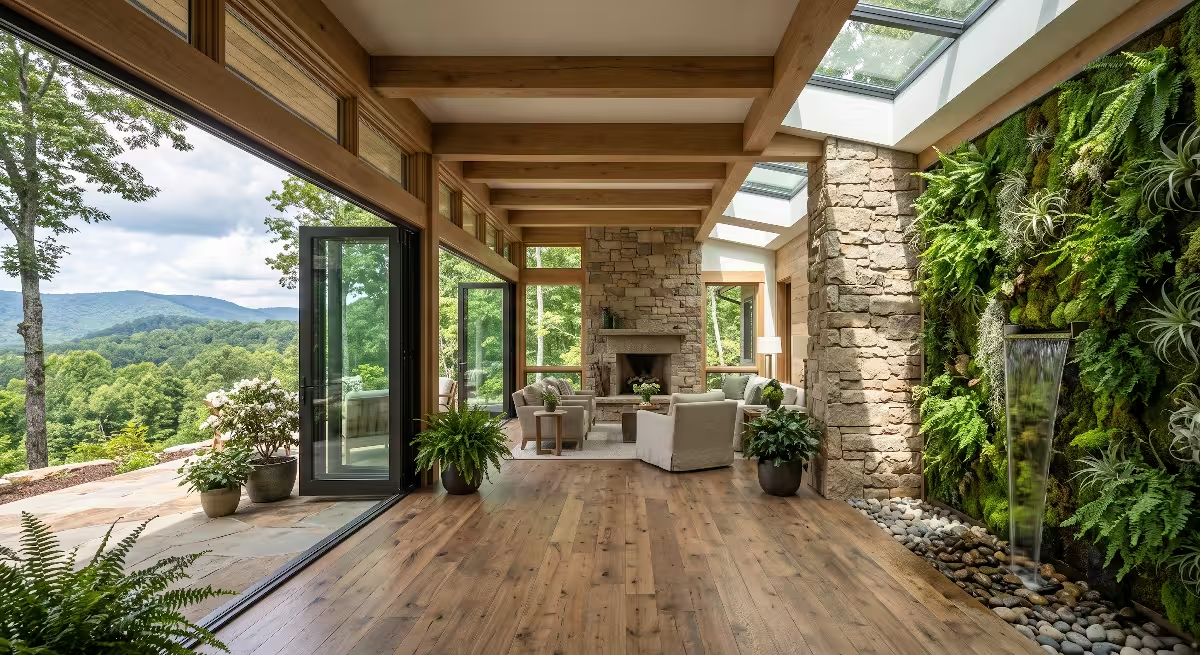
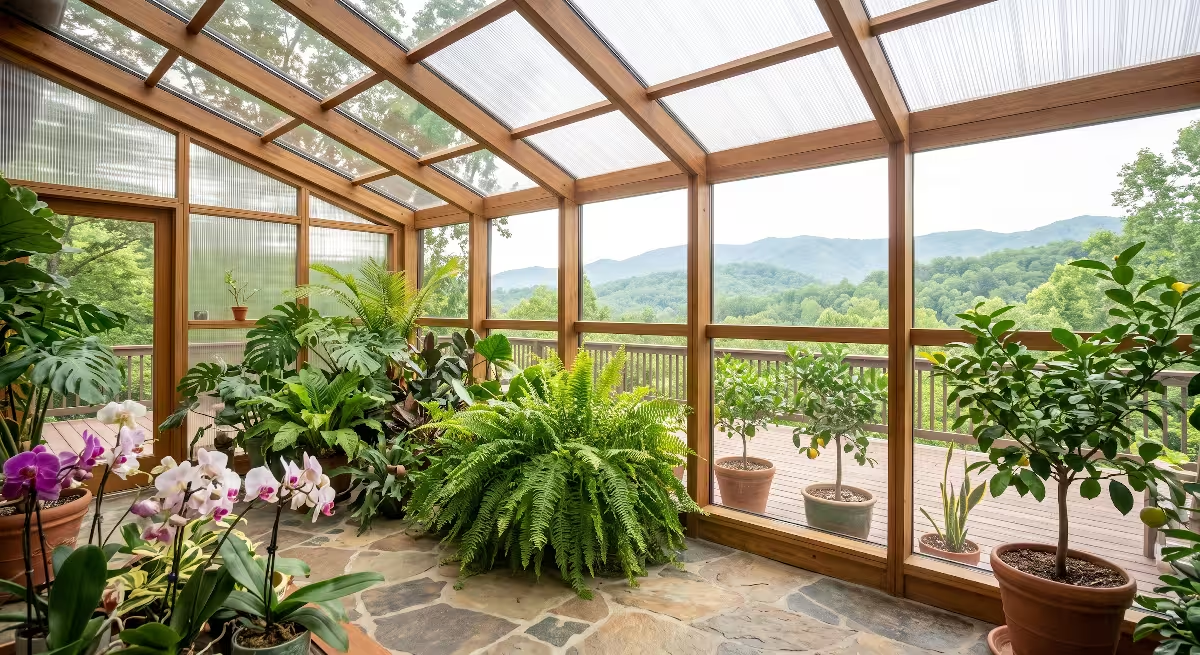
Biophilic architecture offers a different way to solve this problem. Biophilic design is the practice of connecting people to nature inside the buildings where they live and work. Instead of hiding mechanical equipment in basements or attics and fighting nature, we bring natural elements directly into living spaces. When we use local river rock inside a home, we solve both an engineering problem and an emotional problem. We create a heating system that works with the laws of physics while making the living environment feel grounded, calm, and deeply connected to the natural world.
Using local river rock inside your home turns ordinary walls and hearths into a natural thermal battery. Rocks have mass and weight. When natural sunlight or a clean heating source warms local river rock, the stones hold on to that heat. They release the warmth slowly into the room long after the primary heat source stops running. At the same time, seeing and touching real stones from our regional streams fulfills a basic human need to stay close to living landscapes. By understanding how physics and human biology work together, we can design homes that are energy efficient, quiet, durable, and deeply restorative.
The Problem with Forced-Air HVAC
Forced air heating treats human bodies like objects in a toaster oven. It tries to make you comfortable by warming only the air around you. But air has very little density. It cannot hold heat for long. The moment a draft moves through or a door opens, that heated air escapes outside. Your heating furnace must cycle on and off all day and night to keep up.
This cycling creates rapid shifts in room temperature that stress the human body. As the furnace runs, the air dries out your skin, eyes, and nasal passages. The dry air leads to scratchy throats and makes people more vulnerable to winter colds. The high-speed air movement also lifts fine dust, pet dander, and microscopic allergens into the breathing zone.
There is also the acoustic problem. Standard HVAC systems produce constant low-frequency rumbling. The mechanical hum of blowers and the vibration of sheet metal ducts add chronic background noise to a home. Research in biophilic engineering shows that continuous mechanical hums keep the human nervous system in a subtle state of alert. In contrast, radiant heating built with local river rock operates in total silence. It eliminates the dry drafts, leaves dust undisturbed on surfaces, and creates steady warmth without mechanical racket.
Defining the Strategy: Integrating Vernacular Geology
Every region has its own unique geology. Vernacular architecture means building with the materials that belong naturally to the surrounding land. When we build in the Appalachian valleys, we are surrounded by ancient river corridors. These waterways have carved through rock layers for millions of years, leaving smooth, heavy stones along alluvial beds and river plains.
Instead of ordering manufactured brick or synthetic tiles shipped across the country, we can look directly to our local river rock. Sourcing local river rock means we use stones shaped by the local water, gravity, and weather. These stones carry the exact minerals, weights, and textures of our region.
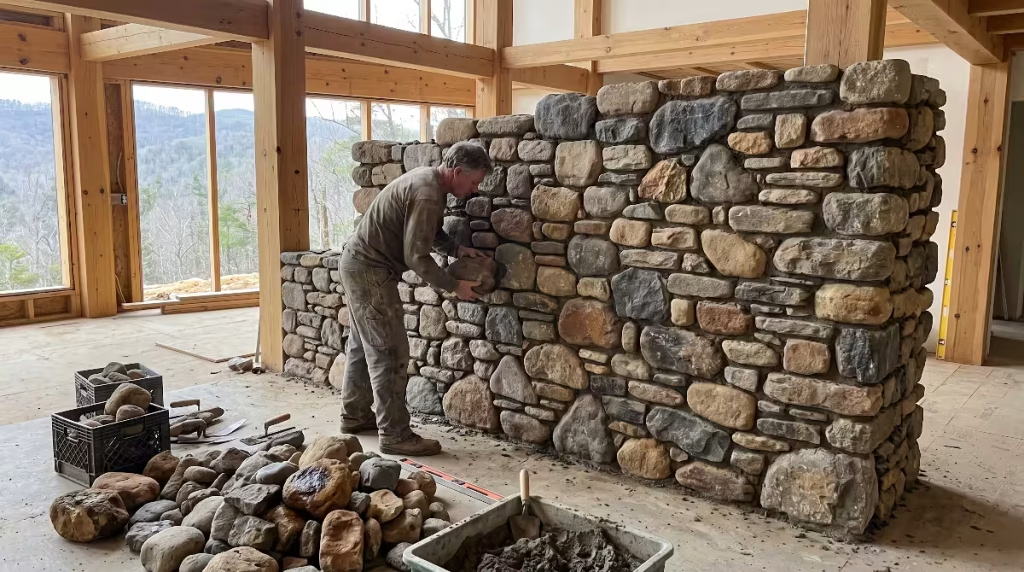
When we integrate local river rock directly into the structural and thermal envelope of a house, we make the home part of the landscape. We are not adding fake river stones or thin plastic veneers glued to drywall. We are using thick, dense, genuine local river rock laid into solid masonry assemblies. This vernacular strategy keeps building supply chains short, supports local quarries, and roots the building firmly in its geographic place.
Thermal Battery and Evolutionary Affinity
Here is the central principle: using indigenous local river rock as a thermal battery delivers measurable energy conservation while reinforcing our evolutionary affinity with natural materials through tactile, radiant, and visual engagement.
Humans evolved over hundreds of thousands of years alongside stone, fire, sunlight, and flowing water. Our bodies do not respond well to sterile, plastic, synthetic environments. We are hardwired to feel safe and relaxed when we are near natural elements like wood, water, and genuine stone.
When you sit near a wall made of local river rock that has been warmed by the winter sun, your body experiences deep physical comfort. The physics of solid stone allows it to absorb energy, store it, and gently release it back into the living space. The biology of the human body recognizes that radiant energy as safe, steady, and natural. By pairing physics with human biology, local river rock transforms from a simple decorative feature into an active, high-performance heating engine.
Thermodynamic Mechanics: How River Rock Functions as a Thermal Battery
To understand why local river rock works so well for heating, you must look at basic physics. Everything around us can store heat, but different materials store it at wildly different rates. The ability of a material to absorb, store, and hold heat is known as its thermal mass.
A thermal battery operates on the exact same idea as an electrical battery. When you plug in an electrical battery, it takes in electrical power and stores it in chemical bonds. Later, when you need power, the battery discharges that energy over several hours. A thermal battery does the exact same thing, but with heat energy instead of electricity.
When sunlight streams through a south-facing window, or when heat from a stove pipe passes through a masonry assembly, the local river rock absorbs that energy. The heat does not vanish. It moves slowly into the center of each dense stone. Once the stones reach their maximum heat capacity, they cannot take in any more without warming up further. When the sun goes down or the stove burns down, the surrounding room air becomes cooler than the local river rock. Heat naturally moves from warmer objects to cooler spaces. The stored energy begins to migrate out of the stone, warming your living space for hours without burning any extra fuel.
Volumetric Heat Capacity and Density
Two physical measurements determine how well any stone works as a thermal battery: specific heat capacity and material density.
Specific heat capacity measures how much energy it takes to raise one pound of a material by one degree in temperature. Density measures how many pounds of that material are packed into a single cubic foot. When you multiply density by specific heat capacity, you get volumetric heat capacity. This number tells you how much total heat can fit inside a given volume of space, such as an eight-inch-thick wall.
Air has very low density, which is why it cannot hold onto heat. Wood has low to medium density and acts more like an insulator than a heat sponge. But local river rock is exceptionally dense. A cubic foot of stacked local river rock set in mortar weighs between 130 and 150 pounds.
Because local river rock was tumbled and compressed under intense natural forces, the stones have few open air pores. Dense quartzites, sandstones, and granitic stones found in our regional waterways have high specific heat values. This means a solid wall of local river rock can hold massive amounts of thermal energy in a relatively compact footprint, far outperforming lightweight framing materials or hollow concrete blocks.
The Physics of Thermal Lag and Diurnal Dampening
Heat does not move through solid stone instantly. It creeps slowly from molecule to molecule through conduction. The time it takes for heat to travel from the outside face of a stone wall all the way through to the inside face is called thermal lag.
In an assembly made with dense local river rock that is ten to twelve inches thick, the thermal lag is usually between eight and twelve hours. This timing matches the natural rhythm of day and night, which scientists call the diurnal cycle.
Think about how a typical winter day works:
- Midday: The winter sun reaches its highest point between eleven in the morning and two in the afternoon. Solar rays pour through large south-facing glass windows and hit an interior feature made of local river rock.
- Heat Absorption: The face of the local river rock absorbs this intense daytime heat. Instead of the living room overheating and forcing you to open a window or turn on a fan, the rock soaks up the excess heat like a sponge.
- Heat Travel: Over the next eight hours, that heat moves slowly toward the center and back of the rock assembly.
- Nighttime Release: Around eight or nine o’clock in the evening, the outdoor temperature plummets and the house begins to cool. Right at that moment, the heat stored inside the local river rock finally reaches the surface and begins radiating out into the room.
- Morning Balance: The wall continues releasing warmth all night long, keeping the living room comfortable until the sun comes up again the next morning.
This process dampens the wild temperature swings of the outdoors. It levels out the highs and lows, creating steady indoor comfort.
Biophilic Dimensions: Mental Well-Being, Tactile Comfort, and Sensory Grounding
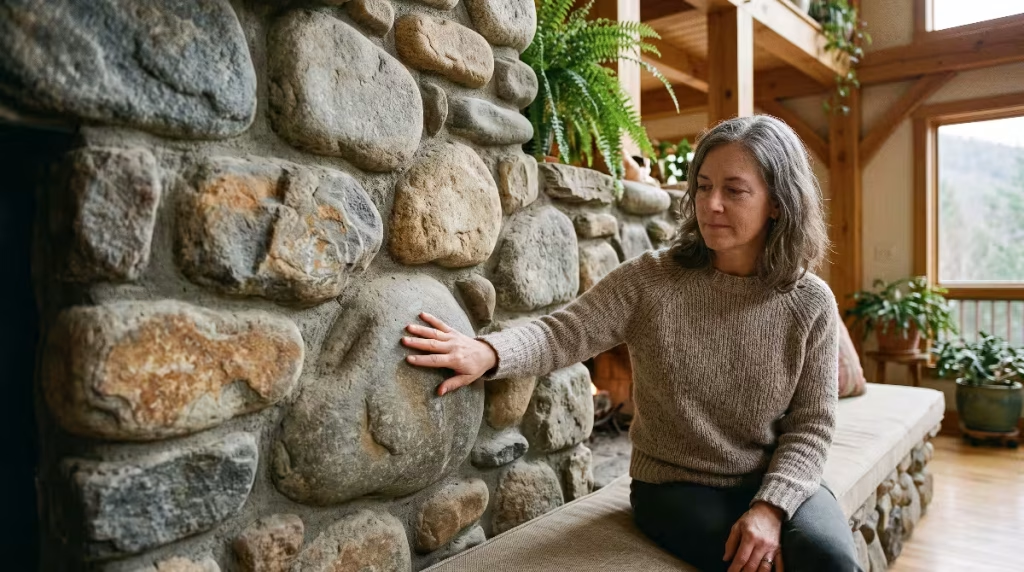
Heating is about more than just numbers on a thermostat. It is about how human beings feel inside a space. Biophilic design looks closely at how natural environments reduce human stress, lower blood pressure, and improve focus.
When you spend your entire day surrounded by drywall, plastic trim, laminate floors, and synthetic fabrics, your senses become dulled. Everything feels flat, uniform, and artificial. Integrating local river rock into a primary living area reintroduces physical variation that human senses crave.
When local river rock is warmed, it stimulates your senses in ways that manufactured heaters cannot match. You can see the mineral patterns formed over millions of years. You can run your hands over the smooth, water-worn contours of the local river rock and feel the deep, penetrating warmth stored inside. This sensory connection calms the autonomic nervous system, moving your body out of a stressed state and into a state of rest and recovery.
Direct Nature Experience: Radiant vs. Convective Heat Transfer
To understand why a heated wall of local river rock feels so comforting, we must look at how human skin perceives warmth. There are two primary ways heat moves into your body: convection and radiation.
Convective heat happens when hot air blows across your skin. The air warms your outer skin surface, but it also evaporates moisture rapidly. Convective heating often feels stuffy, uneven, and drying.
Radiant heat works completely differently. Radiant heat travels across the room as long-wave infrared waves. It does not heat the air directly. Instead, radiant waves travel straight through the room until they strike a solid object, such as a chair, a rug, or a person.
When you stand in front of a wall of warmed local river rock, the radiant waves travel through the air and warm your skin, muscles, and clothing directly. It is the exact same sensation you feel when you step out of the cold shade into a patch of warm sunlight on an autumn morning. Because the air itself is not being superheated and blown through vents, your eyes and airways stay moist and comfortable. A room with radiant heat from local river rock can actually be kept at a cooler air temperature while keeping the occupants feeling warmer and more relaxed.
Indirect Nature Experience: Geomorphic Texture and Visual Connection
Biophilic design recognizes two forms of contact with nature: direct and indirect. Direct contact involves living plants, fresh outdoor air, and water. Indirect contact involves natural geometries, patterns, colors, and textures that remind us of natural systems.
Local river rock provides rich indirect contact with nature. Dimensional stone that comes out of a modern factory is cut into flat, square slabs with diamond saws. Every edge is ninety degrees, and the face is polished flat. But local river rock has geomorphic texture. It was rounded, tumbled, and smoothed by running water over thousands of years. No two stones are the exact same shape or size.
When you look at an expanse of local river rock, your eyes take in natural fractal patterns and organic curves. The mineral variations create rich visual interest. You will see deep gray silicates, warm tan sandstones, crystalline quartz streaks, and reddish iron oxide veins. These natural color variations match the outdoor colors of our regional landscape. Looking at these organic shapes gives the human brain a sense of visual refuge, preventing the mental fatigue caused by staring at flat screens and plain white walls.
Place-Based Resonance: Local Identity
A building should feel like it belongs to the land it sits upon. When you walk into a house that could be in Florida, California, Ohio, or Tennessee without any change in materials, the house lacks place-based resonance. It feels detached from its home ground.
Using local river rock connects your home directly to the local river basins, valleys, and mountain ridges of our home area. The local river rock found in this part of the country carries the geological history of the ancient Appalachian chain, one of the oldest mountain systems on earth.
When you gather and use local river rock from regional suppliers, your fireplace or thermal mass wall becomes an authentic anchor. It reminds you every single day of the hills, gaps, and hollows that define our region. This sense of place gives homeowners a feeling of pride and stewardship. You are not living in an isolated box; you are living inside an architectural expression of your home watershed.
Structural Systems: Integrating River Rock into Passive and Active Heating
To make local river rock work as an effective heater, you cannot simply glue stones onto drywall like decorative wallpaper. You must build structural systems designed from the ground up to capture, store, and transfer thermal energy.
There are three primary ways to build with local river rock for home heating:
- Passive direct-gain mass walls
- Contraflow masonry heaters
- Hydronic radiant thermal storage systems
Each method uses the weight and density of local river rock to solve a specific engineering challenge. The right choice depends on the layout of your home, your access to winter sunlight, and how you prefer to heat your living spaces.
Passive Direct-Gain Trombe Walls and Interior Mass Partitions
A passive direct-gain system is the simplest and most reliable way to heat with local river rock because it has no moving parts, no pumps, no motors, and no utility bills. It runs purely on the angle of the sun and the physics of thermal mass.
In a passive solar layout, the home features large, well-insulated windows facing true south. During the winter, the sun sits low in the southern sky. The solar rays cut deep into the living space, shining directly onto an interior partition wall built of solid local river rock.
The wall of local river rock sits in the center of the house where it can absorb sunlight all day long. Because it is an interior wall, any heat that escapes from either side stays inside the conditioned space of the home.
A variation of this is a Trombe wall, named after the French engineer Felix Trombe. In a Trombe wall design, a thick wall of local river rock is built right behind south-facing exterior glass, with only a small air gap between the rock and the window pane. The sun heats the dark exterior face of the local river rock. Air inside the gap warms up and rises into the living space through upper vents, while cool room air is pulled in through lower vents. Meanwhile, the solid local river rock conducts heat straight through to its interior face, keeping the house warm throughout the night.
Contraflow Masonry Heaters and River Stone Enclosures
A conventional metal wood stove gets blazing hot within minutes of lighting a fire. However, it often makes the room uncomfortably hot right away, and once the wood burns out, the thin metal cools down immediately. You wake up in the middle of the night to a freezing room and an empty firebox.
A contraflow masonry heater solves this problem with high-performance engineering. Inside the heater is a specialized core built with dense refractory firebrick. You burn a small, extremely hot fire for just an hour or two. Because the fire burns at very high temperatures, it consumes almost all the smoke, particulate matter, and creosote, making it remarkably clean.
Instead of shooting the scorching hot exhaust straight up a metal chimney and out the roof, the contraflow design forces the hot gases to travel down through internal masonry channels. Surrounding these internal channels is a massive exterior shell built of local river rock.
As the hot exhaust moves through the internal passages, the local river rock absorbs almost all of the heat before the clean exhaust exits the chimney. The exterior local river rock warms to a gentle, comfortable temperature of about 120 to 140 degrees. It never gets hot enough to burn human skin on contact, making it exceptionally safe for children and pets.
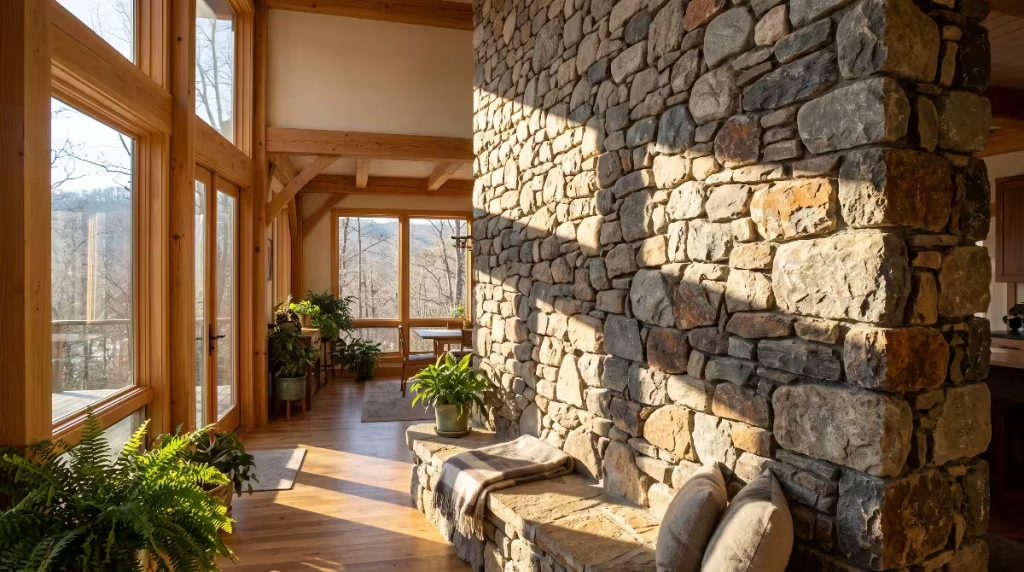
You can even integrate a heated bench made of smooth local river rock right into the base of the heater. Sitting on a warm bench of local river rock on a cold January evening delivers an extraordinary sense of physical relief, soothing tight back muscles and melting away stress.
Hydronic Thermal Storage Systems
What if your home does not have ideal south-facing solar access, or you prefer not to burn wood? You can still use local river rock as a primary radiant heater by pairing it with hydronic technology.
Hydronics is the use of water to move heat from one place to another. Water has an incredible ability to hold thermal energy. In a hydronic rock wall system, flexible, durable plastic tubing known as PEX tubing is woven across a structural backup wall. Then, skilled masons lay a thick face of local river rock directly over and around the tubing, embedding the pipes completely inside a solid bed of mortar.
Hot water produced by a high-efficiency electric heat pump, a geothermal ground loop, or rooftop solar thermal panels is pumped through the tubing inside the wall. As the warm water circulates, it transfers its thermal energy directly into the mortar and the surrounding local river rock.
The entire vertical wall of local river rock transforms into a low-temperature radiant heating panel. It gently heats the room using silent infrared energy. Because the local river rock stores so much mass, the heat pump can be programmed to run only during off-peak electrical hours when utility rates are low. The local river rock holds that heat and warms the living space during peak hours when electricity costs the most.
Regional Material Specifications and Structural Feasibility
Building with local river rock requires respect for structural engineering and material science. You cannot simply walk out to any creek, pick up armfuls of random stones, and toss them into a wall with standard mortar. Doing so can cause structural failure or even physical danger.
To design a durable system, builders and architects must understand:
- Stone mineral composition
- Structural dead load support
- Environmental protection regulations
When you plan carefully and follow proper building codes, your local river rock installation will easily outlast the house itself, functioning effectively for generations without degrading.
Geological Selection: Choosing the Right Stone
Not all river stones are the same. If you cut into a riverbed, you will find a wide variety of rock types that have washed down from high mountain ridges over millions of years. Choosing the wrong type of stone can ruin your heating project.
When choosing local river rock for thermal mass, look for dense metamorphic and igneous stones, as well as dense quartzites. These stones have tightly bound mineral grains:
- Dense quartzites and granitic river cobbles are strong and have very few internal pores. They hold heat exceptionally well and will not break down over time.
- Sandstone river cobbles that are well-cemented also make fantastic thermal storage materials, offering warm, earthy tones.
Avoid soft shales, mudstones, and siltstones. Soft stones are layered and weak. They absorb water like a sponge and tend to split apart along their bedding planes when heated and cooled repeatedly.
Also avoid stones with visible micro-fissures or hollow pockets. If water remains trapped inside a porous stone that is exposed to intense, direct heat, that moisture can turn into steam. Steam expands rapidly, which can cause the stone to crack, spall, or break apart. Selecting dense, solid local river rock guarantees safe and consistent heating performance.
Dead Load Calculations and Foundation Engineering
The biggest structural challenge of building with local river rock is its immense weight. In structural engineering, the permanent weight of the building materials themselves is called the dead load.
A standard interior wall built with wood studs and drywall weighs around five to seven pounds per square foot of surface area. A solid twelve-inch-thick wall built with local river rock and mortar weighs between 130 and 150 pounds per square foot. If you build an interior thermal mass wall that is ten feet high and twenty feet long, you are adding roughly 25,000 to 30,000 pounds of weight to your home.
You cannot place that kind of weight on standard wooden floor joists. A normal residential wood subfloor will sag, crack, and fail under that load.
When building with local river rock, the foundation must be engineered from day one:
- Slab-on-grade construction: The concrete slab directly beneath the wall of local river rock must have a thickened concrete footing reinforced with steel rebar.
- Crawlspace or basement: The builder must pour a continuous concrete foundation wall or install heavy steel columns resting on wide concrete footings directly beneath the local river rock assembly to carry that massive dead load straight down into solid bedrock or undisturbed subsoil.
Sustainable Sourcing Protocols
Biophilic design is rooted in deep environmental ethics. It makes no sense to damage a living natural ecosystem just to make our homes look and feel more natural.
You should never go out to wild, natural mountain streams or public river corridors to dig up local river rock. Removing stone from active waterways destroys crucial aquatic habitats. It tears up the gravel beds where native fish spawn, destabilizes riverbanks, increases erosion, and violates state and federal clean water laws. In our region, agencies like the Tennessee Department of Environment and Conservation (TDEC) strictly regulate work in and around stream beds.
Instead, always source your local river rock through licensed, commercial landscape suppliers and aggregate quarries. These commercial suppliers extract local river rock from approved ancient alluvial gravel terraces and permitted agricultural plains far back from active, sensitive riverbanks. Sourcing your local river rock this way ensures that you support the regional economy without causing damage to the pristine mountain streams we love.
Your Questions Answered about Local River Rock
When homeowners, builders, and designers start researching the use of local river rock for heating, they run into practical questions. Understanding these real-world details helps prevent costly mistakes during construction.
Can You Use River Rock Around a Fireplace or Stove Without It Cracking or Exploding?
Yes, you can safely use local river rock around a fireplace or wood stove, but you must install it correctly and select the right stones.
The primary danger with any river stone is trapped moisture. Because stones sit in wet riverbeds for thousands of years, porous stones absorb moisture into microscopic pockets. If you place a wet, porous river stone directly next to an open, roaring flame, that trapped water can heat up, turn to steam, and expand. If the steam cannot escape through the rock pores, internal pressure builds up until the rock cracks or spalls.
To use local river rock safely:
- Never place local river rock in direct contact with open flames or inside the firebox. The firebox must always be lined with certified refractory firebrick and heat-rated refractory mortar.
- Use local river rock as the exterior mass shell or facing material outside the firebrick core. In this position, the stones absorb heat gently through conduction rather than direct flame contact.
- Make sure your local river rock has cured and dried thoroughly in a warm, dry area before firing the stove or fireplace.
- Select dense stones like quartzites and avoid soft, porous sedimentary stones that soak up water.
When installed as an external thermal battery around a proper refractory core, local river rock is safe, durable, and will last for decades without cracking.
Does River Rock Hold Heat Well Compared to Standard Brick or Soapstone?
River rock holds heat exceptionally well, easily rivaling standard brick and offering competitive performance against specialized stones like soapstone.
To compare how materials perform, look at their density and heat storage capacity:
- Standard clay brick has a density of roughly 120 pounds per cubic foot and a specific heat of about 0.20. It stores heat well and has been used for chimneys for centuries.
- Local river rock has an average density between 135 and 150 pounds per cubic foot, with a specific heat between 0.20 and 0.22. Because local river rock is significantly denser than common clay brick, a wall of local river rock actually stores more heat per cubic foot of wall volume than a standard brick wall.
- Soapstone is often considered the gold standard for thermal mass because of its high density (nearly 180 pounds per cubic foot) and its high magnesite content. Soapstone absorbs heat very quickly and holds it for a long time. However, soapstone is extremely expensive, must be quarried in distant areas, and is usually cut into flat, formal slabs.
Local river rock gives you nearly the same practical thermal performance as high-end stone at a fraction of the material cost. At the same time, local river rock delivers a natural, textured aesthetic that manufactured brick and flat soapstone cannot replicate.
How Thick Should a Thermal Mass Rock Wall Be for Effective Home Heating?
The ideal thickness for an interior thermal mass wall made with local river rock is between eight and twelve inches.
If your wall of local river rock is too thin (less than four to six inches):
- The stones will absorb heat quickly, but they will also release it too fast.
- The wall will lack the thermal capacity needed to hold warmth through a cold twelve-hour night.
- You will experience hot spots in the afternoon and cold rooms by early morning.
If your wall of local river rock is too thick (more than sixteen to eighteen inches):
- Heat moving from the outside face takes too long to reach the interior.
- The thermal lag can stretch past fourteen or sixteen hours.
- Solar heat absorbed at noon might not reach the living space until the following afternoon, completely missing the cold nighttime window when you need that warmth the most.
An eight-to-twelve-inch thickness matches the natural twelve-hour day-to-night cycle of our winter climate. It allows daytime solar gain or short, hot stove burns to soak through the rock, reaching the opposite side right when outdoor temperatures hit their coldest point.
How Does Thermal Mass Contribute to Summer Cooling in Mixed-Humid Climates?
A major advantage of building with local river rock is that it works in reverse during the hot, humid summer months. A thermal battery does not just store heat; it absorbs thermal energy from whatever space is warmer than the stone.
In our mixed-humid climate, summer days get hot and muggy, but summer nights often cool down into the sixties. We can take advantage of this with a technique called night-flush ventilation:
- Nighttime Flush: At night, open high windows or run a quiet whole-house fan to pull cool night air across the interior wall of local river rock. The rock releases whatever heat it gathered during the day and chills down overnight.
- Daytime Radiant Cooling: In the morning, close the windows and blinds to keep the hot, humid outdoor air out. During the heat of the day, that massive wall of local river rock stays cool.
- Indoor Absorption: As the indoor air and the bodies of the occupants warm up, the local river rock absorbs heat out of the room. Standing near a cool wall of local river rock feels like standing near a natural mountain cave. It provides natural radiant cooling without running the air conditioning compressor as often.
This dual-season benefit makes local river rock one of the most versatile, high-return investments you can make in home energy efficiency.
Summary & Technical Best Practices
Using local river rock for home heating brings together the best principles of building physics, regional geology, and human biology. It replaces noisy, dry, artificial forced air with quiet, steady, natural radiant comfort.
To make sure your project is successful, keep these key best practices in mind:
- Design for the Sun: If you are building a passive solar thermal mass wall, calculate your window areas carefully. Make sure your south-facing glass has proper roof overhangs that let low winter sun shine directly onto the local river rock while blocking high summer sun to prevent unwanted heat.
- Build Strong Foundations: Never underestimate the weight of solid stone masonry. Work with a licensed structural engineer to make sure your concrete footings, stem walls, and steel posts can easily support the massive dead load of local river rock.
- Choose Dense, Non-Porous Stone: Use quartzites and well-cemented sandstones. Avoid soft, layered shales or rocks with visible internal fractures that could spall under heat.
- Source Ethically: Protect regional mountain ecosystems. Buy your local river rock exclusively through reputable, licensed quarry suppliers who source legally from ancient alluvial flats, leaving active waterways healthy and undisturbed.
- Prioritize Direct Contact: Place your local river rock where people can interact with it every single day. Design heated stone benches, broad hearths, and textured walls near reading areas, dining tables, and gathering spaces.
When you heat your home with local river rock, you are doing more than just saving money on heating bills. You are creating a living space that feels calm, stable, and deeply rooted in the natural world. You are choosing a heating system that works in quiet harmony with the laws of nature, bringing the beauty, strength, and steady warmth of our regional rivers directly into the heart of your home.