Executive Summary and Purpose Statement
Building a custom home in East Tennessee should feel like an act of creation, not an assembly line transaction. When you walk into many brand new subdivisions around Johnson City, you often notice something missing. The walls are clean, the trim is straight, and the counters shine, but the space feels hollow. It lacks a soul. That missing piece is what drives so many thoughtful women and families toward architectural salvage. When you weave architectural salvage into your home, you change the entire character of your living space. You take something cold and give it warmth, texture, and deep emotional grounding.
Many buyers look at custom homes as a woman who manages a household, hosts family gatherings, and wants her home to feel like a safe, inviting sanctuary. A house is not just a collection of two-by-fours, drywall panels, and modern vinyl. It is the backdrop of your daily life. Incorporating authentic architectural salvage allows you to build a bridge between modern structural engineering and timeless Appalachian history.
Many women who build custom homes are exhausted by the disposable culture of modern construction. They visit home improvement stores and see fiberboard cabinets covered in plastic film, hollow interior doors that rattle when they close, and simulated wood floors that feel cold and slippery under bare feet. They want genuine materials. They want solid wood that tells a story. They want hand-cut iron hardware that feels heavy in their hands. They want items that carry a natural patina earned through decades of honest human use. This is where architectural salvage steps in as a design choice and a building philosophy.
Choosing architectural salvage is also one of the most environmentally responsible decisions you can make when building in Washington County. Every beam of architectural salvage you rescue from an old tobacco barn or industrial warehouse is lumber that does not need to be cut down from a living forest. Every salvaged brick you use on a kitchen hearth keeps heavy, reusable materials out of our local landfills. It creates a closed loop of regional materials that preserves our East Tennessee heritage while protecting our mountain landscapes for future generations.
In this comprehensive guide, we will explore the entire process of bringing architectural salvage into your new custom home or major remodel. We will examine the local woods and stones that define our mountain region, and we will look at exactly where to source architectural salvage throughout the Tri-Cities area. We will look into the technical engineering tests required to make sure your materials are sound, safe, and stable before they ever cross your threshold.
We will also address vital environmental health issues like lead paint and hidden pests, and look closely at the real economics of budgeting for architectural salvage in your builder contract. Most importantly, we will look at how to live with architectural salvage in a way that nourishes your well-being, supports your daily lifestyle, and turns your house into a permanent, comforting home.
Regional Material Identification and Provenance Mapping
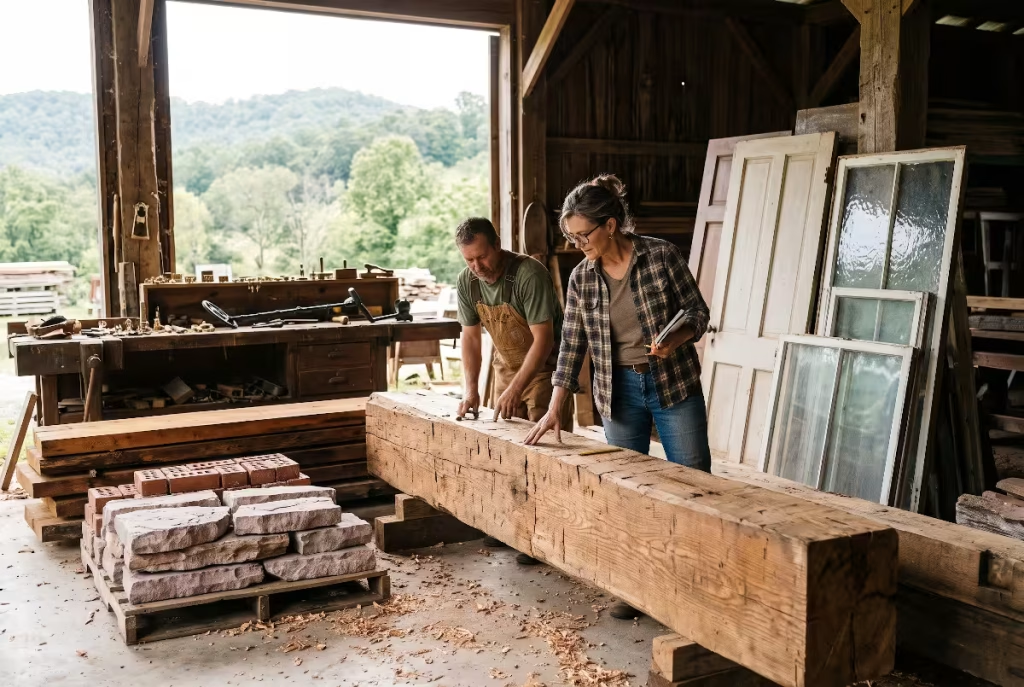
When you look for architectural salvage across East Tennessee, you are looking at the natural history of the Southern Appalachian Mountains. The old buildings of Johnson City, Jonesborough, and Bristol were built with the finest virgin-growth timber and local earth that existed anywhere in North America. Learning to identify these regional materials helps you select the right pieces of architectural salvage for your specific home building projects.
Appalachian Hardwoods and Conifers
The crown jewel of Southern Appalachian architectural salvage is American chestnut. Before the blight struck our mountains in the early twentieth century, nearly one out of every four hardwood trees in our region was an American chestnut. These trees grew huge, often reaching five to seven feet in diameter, with straight, fine grain. Because the wood is naturally rot-resistant, regional builders used it for everything from massive barn sills to roof rafters and exterior cladding. Today, salvaged American chestnut has a warm, honey-caramel hue and a distinctive open grain that you cannot buy from modern lumber yards. It is light in weight but remarkably durable, making it an extraordinary choice for interior trim, mantels, and custom cabinetry.
Heart pine is another staple of regional architectural salvage. Unlike the fast-grown, plantation-harvested yellow pine you see in lumber yards today, historic heart pine came from virgin longleaf and shortleaf pines that grew slowly over hundreds of years. The wood is dense, heavy, and saturated with natural resin. When cut, it shows tightly packed growth rings, often twenty to thirty rings per inch, giving it a rich amber color that glows in natural light. Heart pine makes magnificent, durable flooring that stands up to kids, pets, and decades of foot traffic without wearing through.
White oak and
When you find salvaged white oak, you will notice its beautiful olive-tan coloring and prominent medullary rays, often called tiger stripes, which show up when the wood is quarter-sawn. Salvaged black walnut, sourced from old regional homesteads and historic downtown buildings, carries a deep chocolate-purple tone that modern kiln-steamed walnut simply cannot match. Using walnut architectural salvage for a kitchen island or a dining tabletop brings an immediate sense of elegance to your living space.
Masonry and Native Stone
Beyond wood, our local architectural salvage includes incredible historic masonry. In downtown Johnson City, you will find historic brick marked with the names of local brickyards that operated along the regional rail lines in the late nineteenth and early twentieth centuries. These bricks were formed from local river clays and fired in periodic kilns, resulting in rich variations of color ranging from deep terracotta red to burned purple and iron-spotted charcoal. Reclaimed brick from regional architectural salvage has softened, rounded edges that bring instant warmth when used for an indoor fireplace, an accent kitchen wall, or an outdoor patio.
Architectural Hardware and Metalwork
True architectural salvage also extends to the small details that you interact with every single day. Modern door knobs and cabinet pulls are often made of stamped, pot-metal alloys with thin artificial coatings that wear away after a few years of regular use. Historic regional architectural salvage offers solid cast bronze, pressed brass, and hand-forged iron.
When you grasp an original late-Victorian or Craftsman-era interior door knob made of solid brass, you immediately feel the difference. It has a substantial weight and a silky, cool smoothness that has been polished by generations of hands. Salvaged rim locks, mortise locksets with solid steel skeletons, and decorative cast-iron backplates bring historic charm to everyday routines. You can also discover hand-blown restoration glass panes in salvaged window sashes. This glass features gentle ripples, waves, and occasional air pockets that catch the morning sun in your breakfast nook and refract it across the room in ways that flat modern plate glass can never reproduce.
Local Sourcing Guide: Johnson City and Surrounding Tri-Cities
Finding the right architectural salvage takes patience, curiosity, and a willingness to explore. In our region, there are several dedicated locations where you can source authentic materials, along with informal channels that every custom home builder should know.
Holston Habitat for Humanity ReStore
Located on Kimberly Court in Johnson City, the Holston Habitat for Humanity ReStore is one of the most accessible community resources for architectural salvage. The ReStore receives regular donations from homeowners, historic remodels, and commercial renovations across the Tri-Cities area.
When shopping at the ReStore for architectural salvage, consistency is key. Inventory moves quickly, and you will find everything from solid wood five-panel interior doors and vintage light fixtures to solid brass cabinet hardware, plumbing sinks, and bundles of salvaged tongue-and-groove flooring. The pricing is very reasonable, and your purchases directly support local affordable housing initiatives in our community. I always advise my custom home clients to visit the Kimberly Court ReStore every couple of weeks during their planning phase with a tape measure and a small notebook in hand.
Old Farm Reclaimed Lumber Works and Regional Timber Yards
For substantial timber architectural salvage, Johnson City is home to specialized purveyors like Old Farm Reclaimed Lumber Works on East Springbrook Drive. Businesses like this focus on deconstructing historic agricultural barns, industrial warehouses, and mills across East Tennessee and Southwest Virginia.
Here you can source large-dimension structural timbers, hand-hewn mantel beams, rough-sawn shiplap, and antique wide-plank flooring that has already been pulled, organized, and prepared for residential projects. While specialized yards command higher prices than a standard thrift yard, you are paying for curated, high-grade architectural salvage that has already been inspected, sorted by species, and often denailed and stabilized, which saves your framing and trim carpenters hundreds of hours on the job site.
Highway 11E and Regional Outlets
As you travel between Johnson City, Jonesborough, and Greeneville along the historic Highway 11E corridor, you will find independent salvage yards, antique barns, and building surplus outlets. Places like Yankee Salvage near Telford and vintage yards stretching toward Greeneville and Knoxville provide a treasure hunt atmosphere.
In these open-air yards, you can browse through stacks of corrugated tin roofing, salvaged porch columns, cast-iron clawfoot tubs, wrought-iron gates, and stacks of exterior window assemblies. When shopping these rural yards for architectural salvage, always bring work gloves, a heavy-duty flashlight, and a measuring tape. Be prepared to look past the surface dust and cobwebs to see the true grain and quality of the materials underneath.
Field Sourcing and Community Connections
Some of the finest architectural salvage never appears in a storefront. It is found through local relationships and community networking. In Washington and Carter counties, historic barns, sheds, and homesteads are occasionally slated for demolition to make way for new roads or developments. Connecting with local excavation contractors, deconstruction teams, and agricultural landowners can allow you to purchase and salvage materials directly from the site before the bulldozers arrive.
If you choose this field-sourcing route for your architectural salvage, always ensure that you have written permission, clear liability waivers, and property access agreements from the landowner. Safety must always come first when walking through unstable, partially collapsed, or abandoned structures.
The Engineering and Structural Vetting Protocol (The Builder’s Lens)
While architectural salvage brings warmth and romance to a custom home, wood and stone do not care about romantic ideas; they obey the laws of physics and materials science. Bringing raw architectural salvage directly from an old barn and nailing it into a modern, climate-controlled home without proper testing is a recipe for expensive structural failures. You must follow a disciplined engineering protocol before using these materials.
+-----------------------------------------------------------------------------------------+
|                  ARCHITECTURAL SALVAGE INTAKE & VETTING PROTOCOL                        |
+-----------------------------------------------------------------------------------------+
|  STEP 1: MECHANICAL SCANNING                                                            |
|  --> Multi-pass industrial metal detection to locate concealed cut nails & spikes.      |
+-----------------------------------------------------------------------------------------+
                                             |
                                             v
+-----------------------------------------------------------------------------------------+
|  STEP 2: MOISTURE CONTENT TESTING                                                       |
|  --> Deep-pin resistance meter testing (Target: 6% to 9% Equilibrium Moisture Content). |
+-----------------------------------------------------------------------------------------+
                                             |
                                             v
+-----------------------------------------------------------------------------------------+
|  STEP 3: THERMAL SANITIZATION                                                           |
|  --> Kiln heat treatment: 140°F core temperature for 3 to 4 hours (kills all pests).   |
+-----------------------------------------------------------------------------------------+
                                             |
                                             v
+-----------------------------------------------------------------------------------------+
|  STEP 4: STRUCTURAL & SAFETY CLEARANCE                                                  |
|  --> Structural PE review (if load-bearing) + Chemical swab testing for lead & toxins.  |
+-----------------------------------------------------------------------------------------+
                                             |
                                             v
+-----------------------------------------------------------------------------------------+
|  STEP 5: CONDITIONED ACCLIMATION                                                        |
|  --> Minimum 14-day rest inside the climate-controlled home envelope prior to trimming. |
+-----------------------------------------------------------------------------------------+
Moisture Testing and Equilibrium Moisture Content
Wood is a hygroscopic material. It breathes moisture in and out based on the relative humidity and temperature of the surrounding air. An old timber beam resting in an unheated, open-sided tobacco barn in Washington County might have an internal moisture content of 16% to 22% during our humid summer months. If you install that piece of architectural salvage directly into a modern home where the HVAC system keeps the relative humidity at 45% and the temperature at 70 degrees, the wood will rapidly dry down to its Equilibrium Moisture Content (EMC), which is usually between 6% and 9%.
As the moisture leaves the wood cells, the timber shrinks unevenly. This causes severe warping, twisting, checking, and surface cracking. If that board is installed as a cabinet face, the joints will pull apart. If it is nailed down as flooring, huge gaps will open between the planks, or the wood will cup and lift off the subfloor.
Before using any wood architectural salvage, test it with a professional, calibrated moisture meter. You should use a deep-pin resistance meter rather than a surface pinless meter, as the core of a thick timber beam can remain wet long after the exterior surface has dried out. Never install wood architectural salvage until its internal moisture reading matches the indoor living environment of your new home.
Kiln Drying and Thermal Sanitation
Moisture is only half the battle; the other half is insect life. Old timber in East Tennessee is the natural home of the powderpost beetle, wood-boring weevils, and carpenter ants. Powderpost beetle eggs and larvae can live silently inside the dry interior of antique wood for years. If you install unheated architectural salvage inside your finished walls, you may wake up months later to find tiny pinholes appearing across your custom woodwork, accompanied by fine, flour-like wood dust known as frass. The beetles have emerged and are now eating your new framing.
The only safe, non-toxic way to neutralize this threat is through thermal kiln treatment. The architectural salvage must be placed in a commercial drying kiln where the core temperature of the wood is brought to at least 140 degrees Fahrenheit and held there for a minimum of three to four hours. This steady, deep heat destroys all life stages of wood-destroying insects, including adult beetles, pupae, larvae, and dormant eggs. It also crystallizes the natural sap and pitch inside resinous woods like heart pine, ensuring that sticky sap will never bleed through your paint or clear protective finishes years down the road.
Structural Load Ratings and Building Codes
One of the biggest mistakes custom home buyers and inexperienced builders make is assuming that because an antique beam feels heavy and hard as rock, it can automatically be used as a structural beam over a wide opening. Modern residential building codes require that any member carrying structural loads, such as floor joists, ceiling rafters, or load-bearing wall headers, must have a certified lumber grade stamp verifying its fiber bending strength and modulus of elasticity.
Architectural salvage does not come with a grade stamp. An antique hand-hewn beam may look magnificent, but internal rot, hidden insect tunnels, mortise pocket cutouts, and grain runout from the hewing axe can cut its actual load-bearing capacity by more than half. Under the local building codes enforced in Johnson City and Washington County, you cannot simply drop an antique timber into a structural location without engineering approval.
When we use architectural salvage as a load-bearing element, we have two professional options:
- Hire a Licensed Structural Engineer: A registered Professional Engineer (PE) must inspect the piece of architectural salvage on-site, evaluate its species, grain, knots, and defects, calculate the required design loads, and stamp a formal calculation letter for the local building inspector.
- Use Structural Concealment: Install a modern, code-compliant, engineered micro-lam (LVL) beam or steel flitch plate to carry the actual building weight, and then wrap or box that hidden support using thin, beautiful skins milled from your antique architectural salvage. This gives you the historic appearance you love without compromising the safety of your home.
Metal Detection and Surfacing Preparation
Old wood is filled with metal. Over seventy-five or a hundred years of service on an Appalachian homestead, people pounded iron cut nails, wire fence staples, screw eyes, hanging hooks, and even lead buckshot into barn boards.
Before any piece of architectural salvage touches a woodworker’s jointer, surface planer, or saw blade, it must undergo thorough metal detection. Running high-speed industrial planer knives into a concealed square-headed spike will instantly shatter expensive carbide tooling, send dangerous metal fragments flying across the workshop, and ruin the salvaged board.
We scan every surface of our architectural salvage using an industrial wand-type metal detector. Once an iron signal is located, we use fine gouges, dental picks, and specialty nail pullers to extract the metal by hand. While this requires careful labor, the resulting black oxidation rings left around old nail holes are one of the most stunning, authentic visual hallmarks of genuine architectural salvage.
Safety, Remediation, and Environmental Compliance
When you welcome architectural salvage into your home, you must prioritize the health and safety of your family. Old building materials carry remnants of the eras in which they were manufactured, which means you must inspect and remediate hazardous substances like lead paint, mold, and chemical preservatives.
Lead-Based Paint Testing and Encapsulation
If you are sourcing painted architectural salvage, such as five-panel interior doors, decorative beadboard, mantel surrounds, or window frames built before 1978, you must assume the material contains lead-based paint. Lead was added to historic paints to increase durability, brighten white pigments, and resist moisture. While lead paint creates a gorgeous, cracked porcelain finish known as alligatoring, lead dust is a serious neurotoxin, especially for young children and pregnant women.
Never take a sander or a wire brush to painted architectural salvage inside your home or garage. That creates airborne lead dust that settles into carpets, furniture, and air ducts. Instead, follow a safe remediation approach:
- Chemical Swab Testing: Use EPA-recognized lead test kits to test every paint layer down to the bare wood.
- Wet Stripping: If you want to reveal the natural wood beneath, use safe, biodegradable chemical paint strippers that keep the paint wet during removal, preventing toxic dust from becoming airborne.
- Encapsulation: If you want to preserve the aged, chippy patina of the historic paint, clean the piece gently using wet rags and a HEPA vacuum. Then, apply a high-solids, non-yellowing, matte clear finish or conversion varnish specifically rated for lead encapsulation. This locks the historic paint layers tightly to the substrate, preventing paint flakes or invisible dust from ever entering your living space.
Bio-Contaminants and Mold Remediation
Agricultural architectural salvage from East Tennessee barns has often spent decades exposed to rain, roof leaks, bird droppings, and damp soil. As a result, these materials can carry mold spores, mildew, and fungal dry rot (Serpula lacrymans).
Before bringing porous architectural salvage into your house, clean it thoroughly outdoors. Scrub the wood with a firm, non-metallic nylon brush and a mild, botanical disinfectant solution. Avoid harsh bleach, which breaks down delicate surface wood fibers and leaves behind harmful chemical residues. Let the material dry completely in direct sunlight, where natural ultraviolet light acts as an organic disinfectant.
If any piece of architectural salvage shows soft, spongy wood fibers, deep internal decay, or heavy black mold colonization, do not bring it inside. Cut away the damaged sections and discard them, keeping only the dense, healthy core of the board for your home.
Architectural Integration: Modern Appalachian and Mountain Modern Design
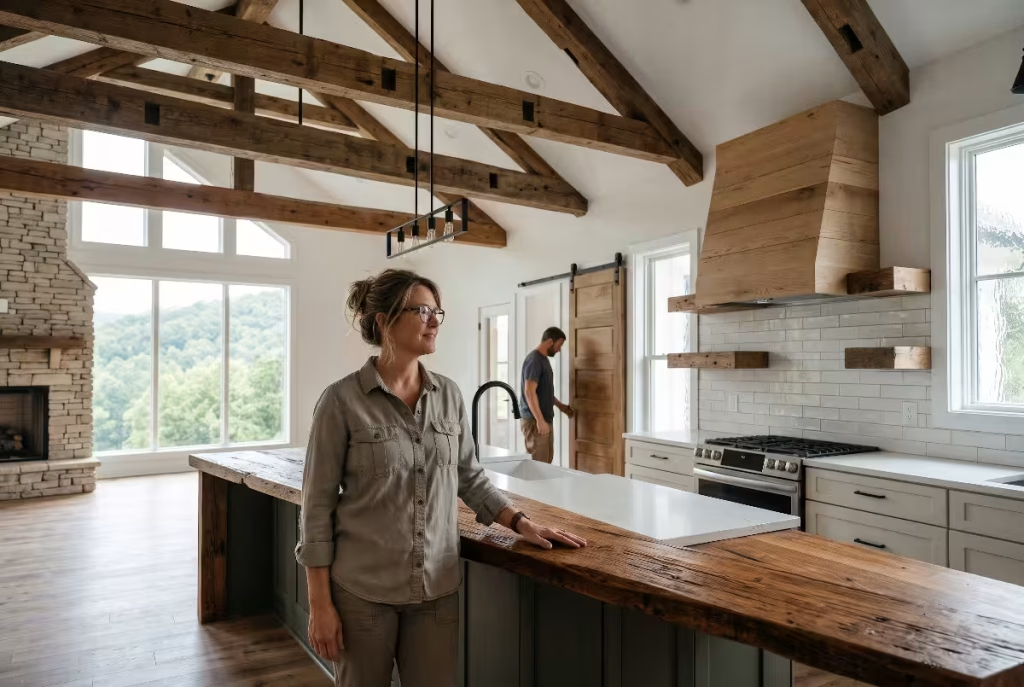
Integrating architectural salvage into a custom home requires balance and restraint. If you put salvaged materials on every wall, ceiling, and floor, your house will look like an antique store or a rustic theme park. But when you place architectural salvage thoughtfully against crisp, clean modern surfaces, the historic materials act like fine art. They draw the eye, soften sharp angles, and provide human-scale texture.
Statement Kitchen Elements
The kitchen is the emotional center of the home. It is where you prepare family meals, bake holiday treats, and gather with close friends over coffee or wine. Because modern kitchens feature so many hard, smooth surfaces, like polished quartz countertops, stainless steel appliances, and smooth porcelain tile, they can easily feel cold and sterile.
Using architectural salvage in your kitchen creates an immediate feeling of warmth. A great place to start is the range hood. Framing a custom ventilation hood in reclaimed white oak or antique chestnut shiplap turns a utilitarian appliance into a stunning architectural centerpiece.
Another wonderful design element is using salvaged heart pine boards to finish the vertical face of a kitchen island. Footrests and kicking feet will only add more character to antique wood, sparing you the worry of denting or scuffing fresh paint. You can also pair clean, painted perimeter cabinets with open floating shelves crafted from thick, rough-sawn architectural salvage. These sturdy shelves let you display daily dishware, ceramic mugs, and regional cookbooks against a backdrop of deep Appalachian history.
Entryways, Mudrooms, and Interior Transitions
The entryway of your home sets the emotional tone for everyone who walks through the front door. It should offer a sense of calm, welcome, and safety. Installing an antique, salvaged front entry door with original iron hardware creates an unforgettable first impression.
Inside the home, consider replacing standard hollow-core doors with salvaged solid-wood five-panel or four-panel doors. Each door can be cleaned, sealed, and hung on modern jambs with heavy brass hinges. The tactile experience of turning a solid brass latch and feeling the satisfying weight of an antique door closing into its frame changes how your entire home feels to live in.
In transition zones like mudrooms and laundry spaces, architectural salvage shines. An antique church pew, rescued from a historic East Tennessee chapel, makes a charming mudroom bench where children can sit to take off their boots. A salvaged marble vanity top or an enameled cast-iron utility sink brings historic beauty to hardworking family spaces.
Ceilings and Vertical Feature Walls
When designing large, open-concept living rooms, sound can easily bounce off tall ceilings, causing echoes and background noise. Adding architectural salvage to the ceiling is a wonderful way to solve this acoustic problem while creating visual interest.
Installing reclaimed timber beams across a vaulted ceiling breaks up expansive drywall planes and brings the ceiling down to a comfortable, human proportion. If structural limits prevent you from hanging heavy solid timbers overhead, you can build hollow box beams using three pieces of matched one-inch architectural salvage. These lightweight faux beams look identical to solid structural timbers from the floor, but they put almost no load on your roof trusses and provide an easy hollow chase for running hidden wiring, recessed light fixtures, or speaker cables.
Budgeting, Procurement Economics, and Contract Management
There is a widespread myth that using architectural salvage will save you money on your custom home build. Many people assume that because materials were pulled from an old barn or bought from a local salvage yard, they must cost less than purchasing new materials from a commercial lumber yard.
As a professional builder, I must be direct with you: architectural salvage is rarely cheaper than new construction materials, and it often costs more once it is fully installed. You are not choosing architectural salvage to cut costs; you are investing in unmatched craftsmanship, high material quality, and authentic historic character that modern materials cannot reproduce.
| Material Phase | New Construction Material | Architectural Salvage | Key Economic & Labor Differences |
| Raw Material Purchase | Moderate to High ($/sq ft) | Low to High ($/sq ft) | Salvage raw purchase price varies wildly; antique rare species (Chestnut, Walnut) command high premiums. |
| Preparation & Cleaning | Zero (Factory pre-finished/milled) | High Labor Cost | Salvage requires manual de-nailing, pressure washing, metal detection, and surface scrubbing. |
| Sanitation & Drying | Included (Commercial kiln dried) | Extra Expense | Salvage requires thermal kiln treatment (140°F) to kill insects and bring moisture to 6%–9%. |
| Milling & Squaring | Zero (Standardized dimensions) | High Artisan Labor | Salvage requires edge jointing, face planing, and ripping to fit modern plumb wall jambs. |
| Material Waste Factor | Low (5% to 10%) | High (20% to 30%) | Salvage yields high loss due to split ends, deep rot pockets, severe twists, and irregular grain. |
| Final Installed Cost | Baseline Benchmark | 1.25x to 1.75x Baseline | Labor shifts from automated industrial manufacturing to hands-on custom job-site carpentry. |
The Real Cost Equation: Material vs. Labor
When you buy standard factory flooring or pre-hung interior doors, the manufacturing labor was handled by industrial machines overseas or in automated domestic factories. The boards are straight, square, smooth, and ready for quick installation. A trim carpenter can hang a modern pre-hung door in twenty minutes.
When you purchase architectural salvage, the equation flips. You might buy an antique five-panel solid wood door at a local yard for seventy-five dollars, which sounds like an amazing bargain compared to a five-hundred-dollar custom wood door. But that antique door is out of square. Its edges are uneven, it has layers of old paint that must be safely removed, and its hinge mortises do not match modern standards. Your carpenter must carefully strip the door, build a custom wood jamb from scratch, chisel new hinge pockets by hand, cut a new threshold bevel, and plane the perimeter to fit the opening. That single door installation may take five or six hours of skilled artisan labor.
When you account for de-nailing, metal detection, kiln sanitation, custom milling, and meticulous installation, the final installed cost of architectural salvage is usually twenty-five to seventy-five percent higher than standard new materials. Knowing this upfront protects your build budget and helps you choose where to use your salvage investments for the greatest emotional impact.
Factoring in the Waste Margin
With standard dimensional lumber, builders calculate a material waste factor of ten percent to account for end cuts and job-site trimmings. With architectural salvage, you must budget for a waste factor of at least twenty to thirty percent.
Old boards often have split ends, internal rot around nail penetrations, deep surface checking, or severe bows that cannot be flattened out. If you need five hundred square feet of reclaimed wood for an accent ceiling or a wood floor, you should purchase at least six hundred and fifty square feet of raw architectural salvage. Having this buffer ensures that your carpenters can cut out damaged sections and select only the finest, most stable grain for your living spaces without running short halfway through the installation.
Structuring Builder Contracts and Allowances
If you plan to incorporate architectural salvage into your new custom home, you must discuss it with your general contractor before signing the construction contract. Most custom homes are built using either a fixed-price contract or a cost-plus contract.
In a fixed-price contract, a builder agrees to deliver a completed house for a set dollar amount based on detailed architectural plans. If you introduce unpredictable architectural salvage mid-project, the builder’s carpenters will run over their estimated labor hours, resulting in costly change orders and project friction.
To avoid this, create a clear, dedicated line item for your architectural salvage:
- Define Sourcing Responsibility: Clarify in writing who is responsible for finding, transporting, and storing the materials. If you are supplying the architectural salvage yourself, specify the date by which it must be delivered to the job site.
- Specify Preparation Standards: Detail who is responsible for de-nailing, kiln-drying, and planing the materials before installation begins.
- Agree on Labor Rates for Custom Milling: Include an hourly artisan rate for custom trim work involving reclaimed materials, or hire an independent custom furniture maker or millwork shop to prepare the architectural salvage off-site so it arrives at the job site ready for standard installation.
- Warranty Clarifications: Understand that no builder can provide a standard warranty on the movement of antique wood. Reclaimed lumber will shrink, expand, and develop fine surface checks as seasons change in East Tennessee. Your builder contract should clearly state that natural movement, seasonal grain shifting, and historic surface imperfections are celebrated aesthetic characteristics of architectural salvage, not construction defects.
Biophilic Wellness and Living in the Reclaimed Home
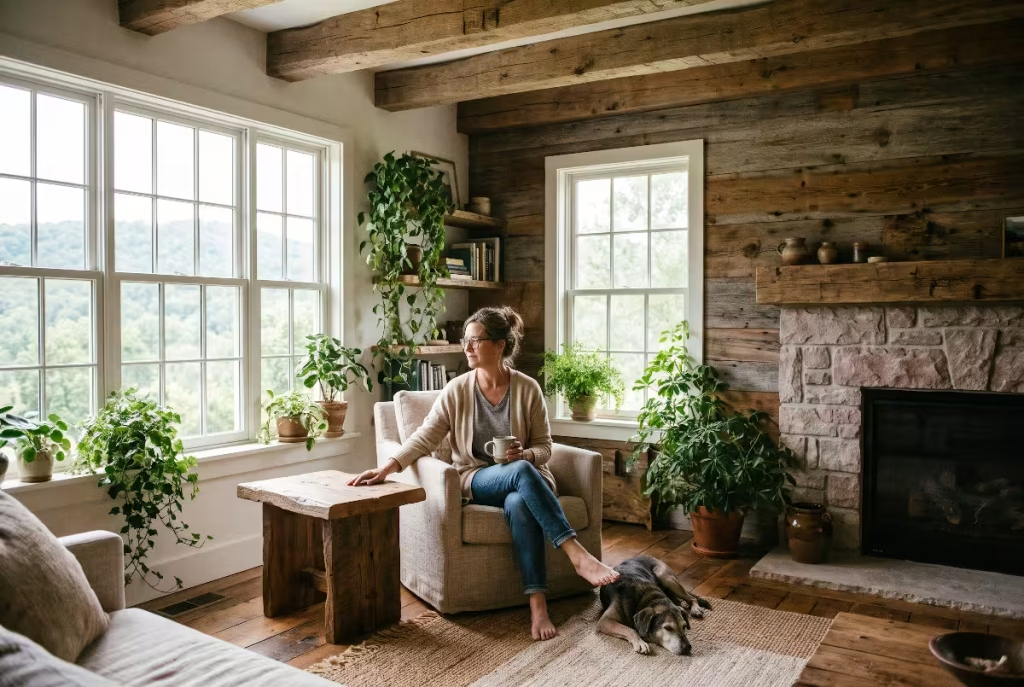
Biophilic design is the practice of connecting human beings to nature within our built environments. As women, we spend countless hours caring for our families, managing careers, and creating nurturing spaces where our loved ones can rest and recharge. The materials we touch, smell, and see in our homes directly influence our nervous systems, stress levels, and emotional wellness. Architectural salvage is one of the most powerful biophilic tools we have in home building.
Natural Textures and Sensory Groundedness
Modern synthetic building materials are designed to be smooth, uniform, and frictionless. But our human sensory systems evolved over thousands of years in rich natural environments filled with organic variance, subtle textures, and shifting grain patterns. When we live in spaces surrounded entirely by synthetic drywall, plastic laminates, and uniform paints, our senses experience an unconscious sensory deprivation.
Architectural salvage reintroduces healthy tactile diversity into our living environments. When you run your hand across a reclaimed heart pine mantel, you feel the soft dip of the earlywood grain and the firm ridge of the latewood rings. You feel the faint, rhythmic tooth marks left by an Appalachian water-powered saw mill over a century ago. This tactile feedback grounds us in the present moment. It invites us to slow down, breathe, and connect with the physical reality of our home.
To maximize these biophilic benefits, finish your interior architectural salvage with natural, low-luster protective coatings. Modern high-gloss polyurethane plasticizes wood, sealing its organic texture beneath an artificial synthetic film. Instead, use natural plant-based hardwax oils, pure tung oils, or organic beeswax finishes. These penetrating finishes sink deep into the wood pores, protecting the grain from spills while leaving the organic surface exposed to your touch. They emit zero harmful volatile organic compounds (VOCs), ensuring that your indoor air quality remains fresh, clean, and healthy for your children and pets.
Acoustic Comfort and Spatial Softness
One of the most common complaints I hear from women living in modern custom homes is that the spaces feel loud and echoey. High vaulted ceilings, hardwood floors, large glass windows, and open-concept layouts reflect sound waves back and forth, creating a chaotic acoustic environment where conversation feels tiring and background noises are amplified.
Rough-sawn wood architectural salvage acts as a fantastic natural acoustic diffuser. Unlike smooth drywall panels, which reflect sound waves directly across the room, the varied grain depths, saw marks, and softened fibers of antique wood scatter and absorb high-frequency sound waves. A ceiling wrapped in reclaimed architectural salvage or an accent wall finished in rough-cut barn wood softens the ambient acoustics of a great room, making family conversations clearer, reducing listening fatigue, and creating a peaceful, quiet sanctuary.
Historical Continuity and Emotional Permanence
There is a profound psychological comfort in knowing that your home is anchored to the history of the land beneath it. When you build with regional architectural salvage, your house is no longer an isolated modern structure; it becomes part of a continuous regional story that stretches back across generations of Appalachian builders, craftspeople, and families.
Every time you look at that reclaimed chestnut beam above your living room fireplace or grasp that antique brass door latch leading into your pantry, you are reminded of human resilience, patience, and time. In our fast-paced modern world, where everything from cell phones to home decor is treated as temporary and disposable, surrounding yourself with architectural salvage provides a reassuring sense of permanence. It reminds your family that what is built with care, integrity, and good wood can endure for centuries.
Common Questions Answered about Architectural Salvage
Is reclaimed wood cheaper than buying new lumber in Tennessee?
No, reclaimed wood is rarely cheaper than buying new lumber once it is ready to install. While you might find rough, untreated reclaimed wood at an affordable price from an old barn, turning raw salvage into usable building material requires significant labor. The wood must be scanned for hidden nails, cleaned of dirt and mold, heated in a kiln to kill insects, and squared with professional woodworking machinery. When you combine the purchase price with the custom labor required to prepare and install it, reclaimed wood often costs twenty-five to seventy-five percent more than standard modern lumber. However, it delivers unmatched durability, tighter growth rings, and a historic character that new wood cannot duplicate.
How do you disinfect and clean salvaged building materials before bringing them inside?
To disinfect and clean salvaged materials safely without ruining their natural patina, start outdoors. Use a dry, stiff nylon brush and a vacuum with a HEPA filter to remove loose surface dirt, spiderwebs, and debris. Never use a high-pressure pressure washer on antique wood, as the forceful water stream will tear up soft wood grain and drive water deep into the core. Next, scrub the surface with a gentle solution of warm water and a plant-based, non-acidic soap or mild botanical disinfectant. Avoid chlorine bleach, which damages wood fibers and lightens the rich, aged color.
If you are working with antique masonry or brick, use a wire brush and a mild masonry cleaner. Allow all materials to dry completely in direct sunlight for several days. Finally, ensure wood materials undergo heat treatment in a kiln to eliminate any hidden insect larvae before installation.
Where can I find architectural salvage in the Tri-Cities area?
The Tri-Cities area offers several great resources for finding architectural salvage:
- Holston Habitat for Humanity ReStore: Located on Kimberly Court in Johnson City, this store regularly receives donations of vintage interior doors, salvaged architectural trim, kitchen cabinets, plumbing fixtures, and vintage hardware.
- Specialized Regional Timber Yards: Businesses like Old Farm Reclaimed Lumber Works in Johnson City and timber salvagers in Elizabethton focus specifically on structural beams, antique barn wood, and wide-plank flooring.
- The Highway 11E Corridor: As you travel between Johnson City, Jonesborough, Telford, and Greeneville, you will find independent salvage dealers, architectural surplus stores, and antique barns featuring vintage building supplies.
- Local Deconstruction Contacts: Connecting with regional general contractors, roofing specialists, and demolition companies in Washington, Sullivan, and Carter counties can help you find materials directly from historic farmsteads and homes before they are demolished.
Can reclaimed beams be used as load-bearing structural supports?
Yes, but they cannot be installed directly without professional engineering verification. Modern building codes require that all load-bearing structural members have a certified lumber grade stamp to guarantee their strength.
Because salvaged timbers lack factory stamps, and because hidden rot, knot clusters, insect damage, or old mortise pockets can weaken their structural integrity, building inspectors in Johnson City and Washington County will not allow them to carry loads without approval. You must either have a licensed Professional Engineer (PE) inspect the beam and provide stamped engineering calculations, or you must install a modern engineered beam (such as a steel beam or an LVL header) to carry the structural load and wrap that hidden support with thin skins of your salvaged wood.
Practical Step-by-Step Execution Plan and Decision Framework
Successfully bringing architectural salvage into your custom home requires careful timing. Salvaged materials cannot be picked out at the last second; they must be planned and integrated from the very beginning of the design process. Use this step-by-step framework to guide your project smoothly from schematic concepts to the final coat of finish.
Step 1: Define Your Focal Points During Architectural Design
Before your architectural drafts are finalized, decide exactly where your architectural salvage will live. Pick two or three primary focal points where the materials will have the greatest impact, such as the living room fireplace mantel, the kitchen island surround, the primary bedroom accent ceiling, or the main entrance door. By choosing these locations early, your architect or structural designer can size the wall framing, ceiling headers, and floor spans to fit the exact weight and dimensions of your salvaged elements.
Step 2: Source and Purchase Your Materials Early
Begin shopping for your architectural salvage at least six months before your framing carpenters break ground. Unlike modern building materials that can be ordered from a catalog on a few days’ notice, finding the right architectural salvage takes time. You may need to visit several salvage yards over several months to gather enough matching boards or the right size beam. Once you find your pieces, bring them to your builder or architect so they can measure the exact dimensions and build those measurements into the framing plans.
Step 3: Complete Safety and Quality Intake Screening
As soon as your architectural salvage arrives at your workshop or storage site, complete your safety and quality screening:
- Use EPA-approved chemical swabs to test all painted surfaces for lead.
- Scan every square inch of wood with an industrial wand metal detector, pulling all cut nails, spikes, and staples.
- Measure the internal moisture content across all boards with a calibrated pin-type moisture meter.
- Check thoroughly for soft rot pockets, active wood-boring beetle holes, or insect frass.
Step 4: Complete Off-Site Thermal Treatment and Custom Milling
Transport your wood architectural salvage to a local kiln operator to complete thermal heat treatment. Ensure the core of the timber reaches 140 degrees Fahrenheit for at least three hours to kill all insects and stabilize internal sap. Once the wood is sanitized, take it to a qualified millwork shop or custom carpenter. Have the boards planed, jointed, and straight-line ripped to uniform widths and thicknesses so they will fit together cleanly on the job site. If you are preserving an original rough-sawn surface, have the boards planed only on the back and edges, leaving the historic face intact.
Step 5: On-Site Acclimation Inside the Conditioned Home
Never let your carpenters install wood architectural salvage the same day it arrives at the house. The materials must acclimate to the home’s permanent indoor climate. Bring your architectural salvage inside the house only after the drywall has been finished, the exterior doors and windows are sealed, and the permanent HVAC system has been running continuously for at least a week. Stack the boards flat on stickers (thin wood strips placed between layers to allow air circulation) inside the conditioned living space for at least fourteen days. Recheck the wood with your moisture meter; only when the wood reaches internal equilibrium moisture content (between 6% and 9%) is it ready to install.
Step 6: Professional Installation and Natural Finishing
Have your trim carpenters install your architectural salvage using appropriate mechanical fasteners. Because dense antique hardwoods like white oak, chestnut, and heart pine will bend modern finishing nails or split the wood, all fastener holes should be pre-drilled. Use structural screws, hidden cleats, or finish nails set into pre-drilled holes, filling the heads with matching wood plugs carved from salvage scrap. Finally, apply a high-quality, plant-based hardwax oil or penetrating natural oil finish to protect the surface, highlight the historic wood grain, and lock in its timeless Appalachian beauty for your family to enjoy for decades to come.