

When you plan a dedicated work area in your house, standard store-bought furniture often falls short. Many homeowners in our area find that a custom built-in setup is the only way to get the exact layout, storage, and look they want. A well-crafted home office executive desk is one of the most rewarding interior investments you can make.
A custom build changes how your room functions. It turns empty wall space into an efficient command center. However, the price tag for such work can vary wildly depending on how you build it. In this guide, we will look closely at what goes into the cost of custom work, what materials make sense, and how you can budget properly for your project.
What Does a Custom Built-In Executive Desk Really Cost?
Building a dedicated workstation is very different from buying a desk at a local showroom. A built-in piece becomes part of the permanent structure of your house. It ties into your subfloors, studs, trim, and power outlets.
Because of this level of detail, a custom built-in home office executive desk generally costs between $3,500 and $12,000 for standard room configurations. If you want a full architectural suite with bookcases from floor to ceiling, integrated filing banks, and matching wall paneling, your total investment can easily reach $15,000 to $25,000 or more.
Direct Answer Box: Realistic Pricing Ranges
To give you a quick summary of what to expect when hiring a skilled finish carpenter or custom cabinetmaker, here are the average cost bands:
- Entry-Level Built-In Desk: $2,500 to $4,500 (Basic painted cabinet boxes, butcher-block or laminate work surface, simple drawer banks).
- Standard Custom Executive Setup: $4,500 to $9,500 (Cabinet-grade hardwood plywood, solid wood face frames, dovetailed drawers, basic cable management).
- High-End Architectural Executive Suite: $9,500 to $16,000 (Premium solid hardwoods, custom returns, upper library shelving, integrated task lighting, concealed wire chases).
- Bespoke Luxury Estate Millwork: $16,000 to $28,000+ (Exotic or locally sourced select hardwoods, motorized sit-to-stand mechanisms hidden in wood trim, matching wainscoting, coffered ceiling trims).
These price ranges cover both materials and labor. When you hire an experienced builder or cabinet shop, labor often accounts for 50% to 65% of the total bill. Building furniture that fits an existing room requires precision scribing, careful leveling, and hours of sanding and finishing.
The Definition of an Executive Built-In
What makes a piece of furniture an executive desk rather than a simple computer counter? The difference comes down to scale, depth, utility, and visual presence.
A simple
An executive build also features dedicated knee clearance, an integrated modesty panel across the front or back, and deep pedestal storage on both sides. A home office executive desk is designed to serve as the visual anchor of the room. When someone walks into the space, the desk commands attention through its proportions, crown molding, and high-quality woodwork.
Rule of Thumb Metrics: Cost Per Linear Foot
In the residential construction and cabinetry industry, builders often estimate projects using linear feet. A linear foot is simply a straight one-foot measurement along the wall where the cabinetry will sit.
For standard kitchen or utility cabinets, prices might run between $250 and $500 per linear foot. However, a custom built-in home office executive desk demands far more detail. Desk units have deep pull-out trays, heavy-duty file rails, finished modesty panels, and wire chases. Because of this, custom office cabinetry typically runs between $600 and $1,500 per linear foot.
If your home office executive desk includes tall upper bookcases that rise eight or nine feet to the ceiling, the linear foot price climbs toward the higher end of that scale. A ten-foot wall run of base cabinetry and upper shelving can easily price out at $8,000 to $12,000 before adding specialty tops or premium lighting.
2026 Cost Breakdown by Investment Tier
To help you decide which level of construction matches your budget, we can break custom desk construction into three clear investment tiers. Each tier uses different building techniques, materials, and hardware.
| Investment Tier | Typical Price Range | Core Materials | Hardware & Features | Best Suited For |
| Mid-Range / Semi-Custom | $3,500 to $6,500 | Paint-grade birch plywood, maple face frames, butcher block top | Standard soft-close drawer glides, desktop grommets, factory spray paint | Everyday remote work, dedicated spare bedroom conversion |
| High-End Architectural | $6,500 to $14,000 | Appalachian white oak, cherry, or black walnut; solid matching top | Undermount Blum glides, dovetailed solid maple drawers, LED lighting | Executives, attorneys, business owners wanting lasting woodwork |
| Bespoke Luxury Suite | $14,000 to $25,000+ | Select-grade quarter-sawn hardwoods, bookmatched grain, stone/leather accents | Concealed motorized sit-stand lifts, hidden touch-latch panels, matching wall trim | High-end custom homes, dedicated library suites, formal home offices |
Mid-Range / Semi-Custom ($3,500 to $6,500)
The mid-range category represents the entry point for true built-in construction. At this price point, a local cabinetmaker will build your home office executive desk using cabinet-grade hardwood plywood, such as Baltic birch or maple veneer core. The cabinet face frames are usually milled from solid soft maple or poplar, which accepts paint smoothly without showing heavy grain lines.
For the work surface, mid-range builds often use prefabricated solid wood butcher block, quartz remnants, or high-pressure laminate with a solid wood edge band. The drawers feature durable side-mount or standard undermount soft-close slides.
While you might not get hand-carved corbels or rare wood species in this tier, you get a solid, durable home office executive desk that fits your wall perfectly. The cabinet boxes are anchored securely to your wall framing, and baseboards are scribed to the floor so everything looks original to the house.
High-End Architectural Custom ($6,500 to $14,000)
Moving into the high-end tier brings superior materials, tighter tolerances, and fine craftsmanship. In this tier, your home office executive desk is constructed from domestic hardwoods like Appalachian black walnut, white oak, or Pennsylvania cherry.
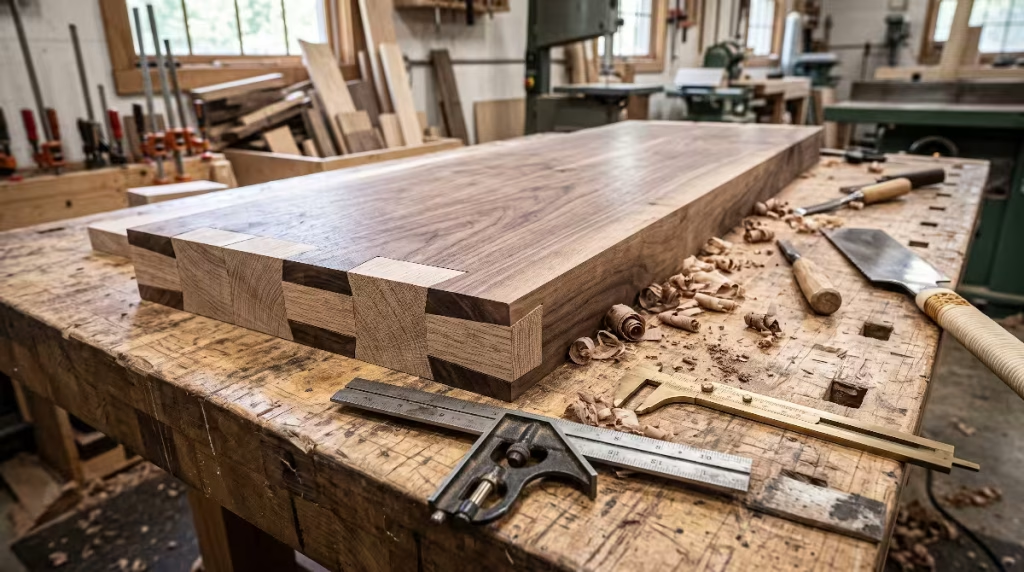
The desktop is typically made from wide, solid wood planks that are hand-selected, edge-glued, and planed flat in the shop. Drawer boxes are made from solid five-eighths-inch maple, assembled with English dovetail joints that will never pull apart under heavy weight.
In this bracket, the home office executive desk usually includes an L-shaped return or an integrated credenza along the back wall. You will also see warm LED strip lighting recessed into routed channels beneath the upper shelves. The finishes are applied in a professional spray booth using conversion varnish or durable two-part polyurethane, protecting the wood against hot coffee cups and pen pressure.
Bespoke Luxury Suite ($14,000 to $25,000+)
The bespoke tier is for homeowners who want their workspace to look like a historic library or an executive boardroom. At this level, your home office executive desk is part of a complete architectural package.
Cabinetmakers will build matching raised-panel wainscoting, integrated radiator or vent covers, and coffered ceilings that line up with the desk pedestals. Many clients also request hidden technology. For instance, a bespoke home office executive desk can feature a concealed motorized lift that allows a section of the solid wood top to rise into a standing desk while keeping all machinery hidden inside traditional wood columns.
Storage in this luxury tier often includes hidden compartments, touch-to-open panels disguised as decorative trim, and integrated leather or natural soapstone writing surfaces. The materials are top-tier, featuring quarter-sawn white oak, figured walnut, or rift-sawn timber. Every transition between the desk and the walls is trimmed with custom-milled crown molding and detailed base trim.
Key Cost Drivers & Engineering Variables
When you look at quotes from different builders, you might wonder why one estimate is thousands of dollars higher than another. The difference comes down to three main variables: lumber selection, desk size, and shop labor. Understanding these factors will help you make smart choices when designing your home office executive desk.
Lumber Species & Materials
Wood is not just a decorative surface; it is an engineered material that reacts to changes in household humidity. The species you pick directly affects both the material bill and the labor needed to work with it.
- Paint-Grade Poplar and MDF: These are the most budget-friendly options. Medium-density fiberboard (MDF) provides an exceptionally flat, stable surface for painted cabinet doors, while poplar makes sturdy face frames. A paint-grade home office executive desk keeps material costs reasonable while delivering a clean, modern look.
- Red Oak and Hard Maple: These classic domestic hardwoods offer great dent resistance. Red oak is economical and very strong, though its heavy grain pattern requires careful finishing. Hard maple has a tight, smooth grain that looks great with clear stains or durable paint.
- White Oak: White oak is one of the most popular woods in custom home building today. It has a beautiful neutral tone, high rot resistance, and outstanding hardness. However, prime white oak lumber commands a price premium of 30% to 50% over red oak.
- Black Walnut and Cherry: Walnut is the undisputed king of executive offices. Its rich, dark brown color and smooth working properties make it ideal for a luxury home office executive desk. However, rough walnut lumber is expensive, often costing double the price of oak. Cherry is slightly more affordable and ages into a rich reddish patina over time, but it scratches more easily than oak.
Another major engineering detail is whether the work surface uses solid wood or hardwood veneer plywood. A solid wood slab top must be attached using special clips that allow the wood to expand and contract across its width as indoor humidity changes between summer and winter. If a carpenter fastens a wide solid top directly to rigid cabinet bases with rigid screws, the top will crack. Designing for natural wood movement requires extra shop hours, which reflects in the final cost of your home office executive desk.
Scale, Footprint, and Layout
The overall layout of your workspace has a major impact on framing, assembly, and installation labor.
A single straight-wall run is the simplest and most affordable design. In this configuration, the desk sits between two wall-mounted cabinet towers or rests against a single feature wall. The cabinetmaker builds rectangular boxes, joins them on site, and drops the worktop into place.
An L-shaped layout adds complexity. The corner where the two desk wings meet requires specialized joinery to keep the work surface flat and seamless. It also requires careful planning for legroom and corner storage solutions, such as blind corner pull-outs.
A U-shaped layout or a peninsula layout is the most labor-intensive design. A peninsula home office executive desk projects outward into the middle of the room, leaving its back and sides exposed to view. This means the back of the desk cannot be simple unfinished plywood; it must feature finished furniture panels, decorative stiles, and an executive modesty panel. Building a desk that looks beautiful from all 360 degrees takes substantially more labor than building a desk that backs against drywall.
Cabinetry Labor & Fabrication
Labor makes up the largest portion of your invoice when building a home office executive desk. Woodworking labor generally falls into two categories: shop time and on-site trim installation.
In the woodshop, a cabinetmaker uses precision table saws, planers, edge-banders, and CNC routers to mill the parts. Shop labor rates typically range from $75 to $140 per hour. A standard executive desk with matching upper storage might take 40 to 80 hours of shop time, which includes building the carcass boxes, assembling dovetail drawers, gluing the large desktop, and spraying multiple coats of finish.
On-site installation is handled by a finish carpenter, with billing rates usually between $60 and $120 per hour. In new construction or remodeling, walls are rarely perfectly straight, and floors are rarely completely level. When installing your home office executive desk, the trim carpenter must spend several hours leveling the bases with wooden shims, scribing the end panels to the irregular drywall, and cutting crown molding to fit the ceiling angles tightly.
The Hidden Infrastructure: Electrical, Data, and HVAC Integration
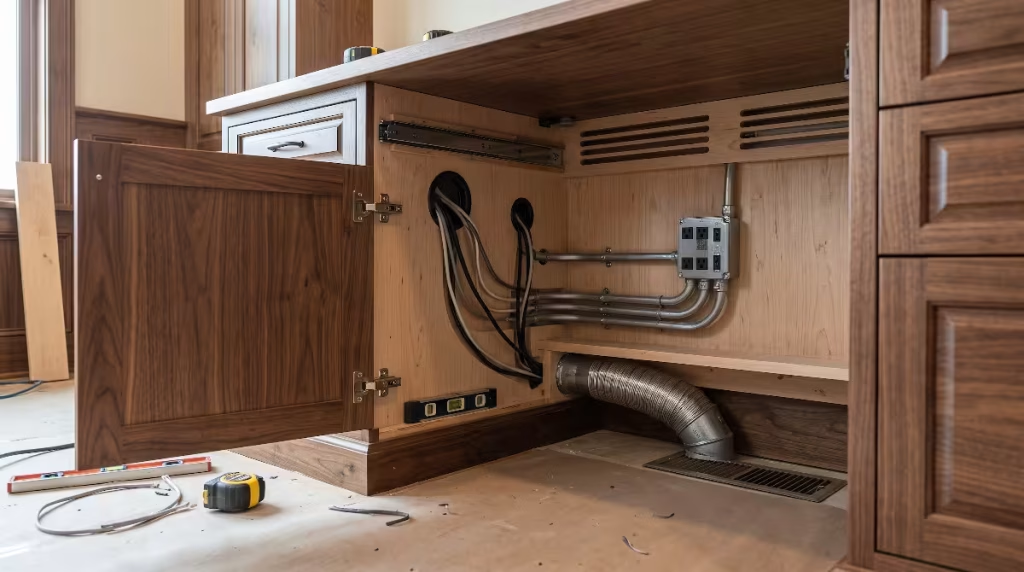
A beautiful desk is useless if you cannot plug in your computer, charge your phone, or stay comfortable while working. One of the biggest mistakes homeowners make is treating cabinetry as isolated furniture rather than an integrated part of the home’s mechanical systems. When we build a custom home office executive desk, we plan the wiring and ventilation long before the wood arrives on site.
Rough-In Electrical & Conduit Paths
A modern home office executive desk often powers a desktop workstation, two or three high-resolution monitors, a printer, external backup drives, audio speakers, and phone chargers. Plugging all of that equipment into a single 15-amp bedroom circuit that also powers the hallway lights is a recipe for tripped breakers.
When planning your office, you should bring in a licensed electrician to rough in a dedicated 20-amp circuit for the desk area. This circuit should feed a series of outlets mounted inside the desk cabinetry, behind the knee-well, and just above the work surface. Installing flexible plastic conduit inside the wall studs allows you to pull new network cables or display cords in the future without tearing out your expensive custom cabinetry.
Cable Management Channels
Nothing ruins the appearance of a handsome home office executive desk faster than a tangled mess of black wires hanging down to the floor. A well-designed custom desk hides every wire while keeping them easy to access.
To achieve this, the cabinetmaker routes hidden horizontal chases through the dividers inside the lower cabinets. Removable false backs in the knee-well allow you to mount heavy power strips, surge protectors, and power bricks out of sight.
On the surface of the desk, you can install matching wood grommets or low-profile metal flip-up panels that provide direct access to USB charging ports and standard electrical plugs. Underneath the desktop, raceways and J-channels cradle monitor cables, keeping your leg area completely open and clutter-free.
Thermal Management for Hidden Tech
Many professionals prefer to hide their noisy computer towers, network routers, and storage drives behind closed cabinet doors. However, high-performance electronics generate a massive amount of heat. If you trap a computer inside an unventilated wooden cabinet box, the interior temperature will rise quickly, causing the computer hardware to overheat and fail.
When building a home office executive desk designed to house computers, thermal management is essential. The cabinetmaker should incorporate passive ventilation slots into the toe kicks and the upper face frames to let cool air enter at the bottom and warm air escape at the top.
For high-end computer setups, installing an ultra-quiet, temperature-activated fan kit inside the cabinet is the best approach. These small fans plug into a standard USB port and automatically turn on when the cabinet temperature exceeds 85 degrees Fahrenheit, exhausting hot air through the back or side of the desk.
HVAC Register Relocation
In many homes, heating and cooling supply vents or cold air returns are cut into the floor along exterior walls, directly beneath windows. Because windows are also the most popular spot to place a desk, built-in cabinetry often lands right on top of an HVAC register.
You must never simply build a cabinet over an open vent and trap the airflow. Doing so creates mold risks, dries out your cabinet lumber, and makes the room drafty or overheated.
Before anchoring your home office executive desk, your contractor should build a sealed sheet metal or rigid duct extension. This duct channels the air from the floor opening through the toe kick of the desk, discharging it into the room through a matching wood or metal grill. Planning for this ductwork adds a modest cost to the project, but it ensures your home office stays comfortable all year long.
Built-In Executive Desk vs. Standalone Furniture: The Practical ROI
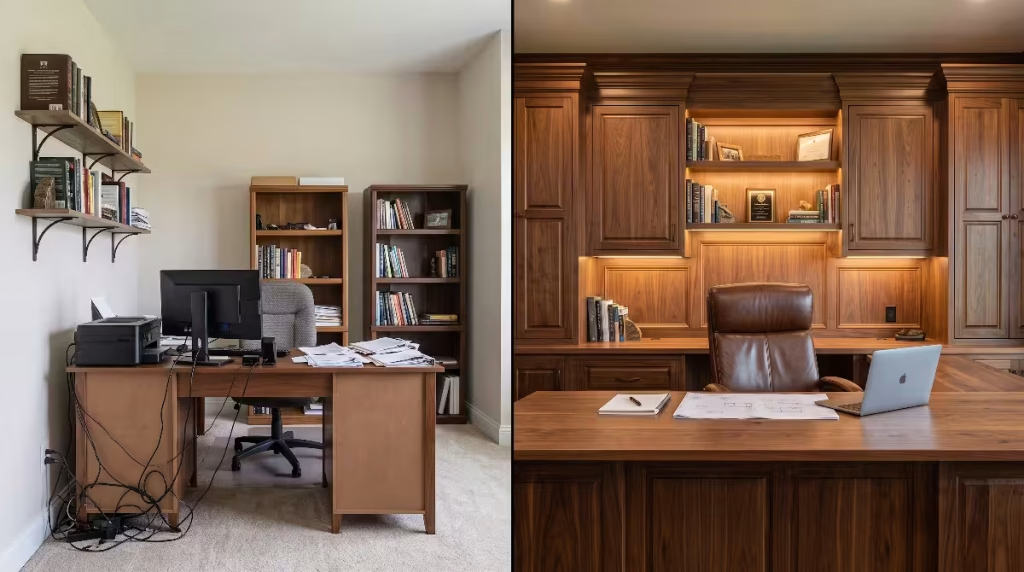
Before committing to a custom build, homeowners often ask whether a built-in home office executive desk is genuinely worth the money compared to buying a factory-made freestanding desk from a furniture retailer. Both options have distinct pros and cons that depend on your long-term living plans.
Permanence vs. Portability
The most obvious difference between the two styles is portability. If your career requires you to move every three to five years, spending thousands of dollars on a built-in home office executive desk makes little sense. A built-in desk is custom-tailored to the exact dimensions of one specific room; it cannot be packed into a moving truck and relocated to your next house.
On the other hand, if you are living in your long-term home, permanence becomes a huge advantage. A built-in home office executive desk makes maximum use of every square inch. Store-bought desks leave awkward gaps of three to six inches on either side, which collect dust and waste valuable space. A built-in desk integrates tightly with the architecture of your house, providing a polished look that freestanding furniture cannot match.
Appraisal & Real Estate Value
How does a custom office built-in affect your home’s resale value? In the residential building and real estate market, custom millwork is classified as a permanent fixture, meaning it becomes part of the real estate itself rather than personal property.
High-quality architectural millwork adds tangible appeal for prospective buyers, especially in today’s housing market where remote work has become permanent for millions of professionals. A dedicated workspace featuring a custom home office executive desk signals to buyers that the home was thoughtfully designed and maintained. While you may not recoup 100% of the cost in direct dollar-for-dollar appraisal increases, a beautiful office can shorten the time your home sits on the market and help justify a higher asking price in competitive neighborhoods.
Ergonomics & Square Footage Optimization
Freestanding desks are manufactured to standard commercial heights, usually 29 to 30 inches above the floor. If you are very tall or very short, that fixed height can lead to neck strain, shoulder tension, and back pain over an eight-hour workday.
When you hire a cabinetmaker to build a custom home office executive desk, the work surface can be set at the exact height that matches your body and chair setup. If you have physical limitations or specific ergonomic needs, the desk can be tailored accordingly.
Furthermore, custom millwork can turn difficult architectural spaces into functional offices. If your room has an odd alcove under a dormer, an angled ceiling, or an exposed support post, a skilled carpenter can wrap the home office executive desk around those obstructions, converting wasted square footage into usable work area.
Frequently Asked Questions about Home Office Executive Desks
When people research custom office furniture online, several common questions arise repeatedly. Here are direct, practical answers to the questions homeowners ask most often.
How Much Does a Carpenter Charge to Build a Custom Desk?
A finish carpenter or custom cabinetmaker typically charges between $50 and $150 per hour for custom furniture work. However, most professionals do not bill on an open-ended hourly clock for custom millwork. Instead, they evaluate the design, calculate the material expenses, estimate the shop and installation hours, and provide a fixed-price bid for the entire project.
For a straightforward custom home office executive desk with basic drawers and a stained hardwood top, a carpenter will typically charge between $2,500 and $5,000 for labor alone. If the project involves tall bookshelves, intricate crown molding, and on-site wall scribing, labor costs can easily reach $6,000 to $10,000. Always confirm whether the carpenter’s estimate includes shop finishing, delivery, and final on-site installation, as some shops bill these as separate line items.
Is a Custom Built-In Desk Cheaper Than Buying High-End Furniture?
In most cases, a custom built-in desk is not cheaper than buying standard, mass-produced furniture, but it is often comparable to, or even cheaper than, buying luxury furniture from high-end designer brands.
If you compare a custom build to flat-pack furniture or budget commercial desks costing $500 to $1,500, the custom desk will always cost significantly more. However, if you shop at luxury furniture retailers like Restoration Hardware, Ethan Allen, or Arhaus, high-end standalone executive desks regularly cost between $4,000 and $9,000.
For that same $4,000 to $9,000 investment, a custom built-in home office executive desk gives you furniture that fits your room’s exact dimensions, uses real solid hardwoods of your choice, and provides integrated storage that matches your specific equipment. Dollar for dollar, custom construction offers vastly superior value compared to high-end retail furniture.
What is the Best Wood for a Custom Executive Desk?
The best wood for your project depends on your visual taste and how hard you are on furniture surfaces. In the woodworking trade, we measure wood hardness using the Janka rating scale, which measures the force required to embed a steel ball halfway into the wood.
- White Oak (Janka ~1,360): White oak is widely considered the best all-around wood for a home office executive desk. It is very hard, resists dents from pens and dropped objects, and features a subtle, attractive grain that works well with modern stains.
- Hard Maple (Janka ~1,450): Hard maple is even harder than oak. Its surface is exceptionally smooth and light in color, making it an outstanding choice if you want a sleek, modern desktop or a glass-smooth painted base cabinet.
- Black Walnut (Janka ~1,010): Walnut is somewhat softer than oak and maple, meaning you should use a desk pad or blotter to prevent ballpoint pen impressions on the bare wood. However, its natural chocolate-brown color and swirling grain patterns make it the premier aesthetic choice for a classic, luxurious home office executive desk.
- Cherry (Janka ~950): Cherry is a moderately hard wood with a warm tone that darkens naturally as it is exposed to ambient daylight. It machines cleanly and creates a warm, traditional atmosphere, though it requires slightly more care to avoid surface scratches.
Does Adding a Built-In Office Decrease Home Value or Remove a Bedroom?
This is a critical concern for homeowners who are converting a spare bedroom into a home office. If you eliminate a bedroom, you could reduce your home’s market value, because homes with more official bedrooms generally appraise higher.
Under building codes and real estate appraisal guidelines, a legal bedroom must meet specific requirements: it must have a minimum square footage (usually at least 70 to 80 square feet), an egress window for emergency escape, adequate ceiling height, and, in many regional markets, a dedicated clothing closet.
If you build a home office executive desk inside a spare room, you will not harm your home’s value as long as you do not tear out the clothing closet. Even if the room is completely outfitted with custom library cabinets, real estate agents can still list the space as a bedroom or a flexible guest room. If you do plan to remove a closet to make room for a wide desk alcove, consult with a local real estate appraiser first to understand how losing an official bedroom count might impact your property value.
Step-by-Step Budget Planning & Contractor Checklist
Planning a custom built-in project requires clear communication between you and your builder. Taking the time to organize your needs before hiring a contractor will save you money and prevent costly change orders during construction. Here is the step-by-step process I recommend to every client planning a home office executive desk.
Step 1: Documenting Hardware, Monitor Count, and Paper Storage Requirements
Before contacting a cabinet shop, take a complete inventory of everything you plan to store in the office.
- Count your computer monitors and measure their total width and height, including the desktop stands or monitor arms.
- Note the dimensions of your computer tower, printer, paper shredder, and network modem.
- Decide whether you need hanging letter-size or legal-size file drawers, and determine how many linear inches of filing space you require.
- List any specialty tools you use regularly, such as drawing tablets, reference books, or photography equipment.
Providing these specific dimensions to your cabinetmaker ensures that the openings in your home office executive desk are built to fit your gear on day one, eliminating the need to modify shelves or drill holes after the cabinets are finished.
Step 2: Site Measurement and Electrical Audit
Next, examine the room where the desk will be installed. Measure the overall wall length, ceiling height, and the distance from corner walls to window casings.
Take close note of all existing mechanical features on the walls and floors:
- Where are the electrical wall outlets located?
- Where does the internet cable or ethernet jack enter the room?
- Are there any heating and air conditioning registers or return air grills on the floor or baseboard?
- Does the room have ceiling crown molding or tall baseboards that will need to be removed and re-installed around the desk?
Sharing these details with your builder during your initial consultation allows them to anticipate electrical relocations and duct extensions, giving you a far more accurate preliminary estimate for your home office executive desk.
Step 3: Comparing Bids and Quotes
When you are ready to gather bids, contact at least two or three established local custom cabinetmakers or finish carpentry contractors. To compare their estimates fairly, make sure every contractor is bidding on the exact same scope of work.
Ask each contractor to specify the following details in their written bid:
- Cabinet Box Material: Are they using three-quarter-inch cabinet-grade plywood, or are they using particleboard with wood veneer?
- Drawer Construction: Are the drawer boxes built with five-eighths-inch solid wood and dovetail joints, or are they pinned plywood boxes?
- Hardware Brands: What brand of drawer slides and door hinges are included? High-quality brands like Blum, Grass, or Salice cost more but offer lifetime durability.
- Finishing Process: Will the desk be hand-painted on site with a roller, or will it receive a factory-grade spray finish in the shop before delivery?
- Scope of Installation: Does the price include scribing the trim to your walls, caulking, electrical hookups, and final cleanup?
Evaluating bids against these standards will help you spot unusually low estimates that cut corners on materials, ensuring you get a high-quality home office executive desk that lasts for decades.
Step 4: Installation Verification and Quality Inspection
Once construction is complete of your home office executive desk and the installation crew finishes their work, walk through the space with the lead carpenter to inspect the build before signing off on the final payment.
Use this quick quality verification checklist:
- Check for Level: Place a four-foot carpenter’s level across the main work surface in multiple directions. The bubble should sit dead center.
- Test the Drawers: Open and close every drawer bank. The drawer slides should glide smoothly without rubbing against the face frames, and the soft-close mechanisms should engage quietly.
- Inspect the Seams: Look closely at the joints where the desk meets the drywall and the floor. Scribe moldings and caulk lines should be neat, narrow, and consistent.
- Examine the Finish: Run your hand across the work surface. The finish on your home office executive desk should feel completely smooth, free from rough spray dust, drip marks, or sharp edges.
- Verify Wiring Access: Confirm that all wire grommets, outlet faceplates, and hidden cable pathways allow your computer cords to pass through freely.
Taking these inspection steps guarantees that your investment delivers the beauty, comfort, and
Long-Term Maintenance and Wood Care
Once your new built-in workspace is installed, taking proper care of the woodwork will keep it looking like new for decades. Wood is a natural material that responds to the environment inside your home, so maintaining stable indoor conditions is the first line of defense.
During summer months in our region, indoor relative humidity can rise quickly, while winter heating systems dry out the air. Aim to keep your home’s indoor humidity between 35% and 50% year-round. Using a central humidifier in the winter prevents the solid wood panels of your home office executive desk from shrinking or developing hairline surface cracks, while air conditioning in the summer keeps drawer boxes from swelling and sticking.
For routine cleaning, avoid heavy silicone furniture polishes or abrasive commercial sprays, which can build up a cloudy wax film on modern clear coats. Instead, wipe down the desktop weekly with a clean, slightly damp microfiber cloth, followed immediately by a dry towel. If you use a computer mouse daily, use a quality desk pad or mouse pad to prevent the bottom of the mouse from polishing a shiny spot into the satin wood finish of your home office executive desk.
With thoughtful planning, quality materials, and skilled installation, a custom built-in workspace provides a comfortable, organized environment that makes every workday more productive. It is an investment in your home and your daily peace of mind that pays dividends for years to come.