

The Intersection of Hydrology and Biophilic Design in East Tennessee
Living in the foothills of East Tennessee gives us a front-row seat to the beauty of the Southern Appalachian landscape. From the peaks of Roan Mountain to the valleys of Johnson City, Kingsport, and Bristol, our region is shaped by moving water. We receive between 44 and 48 inches of rainfall every single year. That is a massive volume of clean precipitation landing right on our rooftops. Yet, on most residential properties, this water is treated as a problem to get rid of quickly. It runs off roofs, rushes across turf grass, picks up lawn chemicals, and washes down storm drains. This process creates soil erosion on our steep hills and burdens our local municipal storm systems.
We can take a much smarter path through biophilic design. Biophilic design is the practice of connecting our built living spaces with natural systems. In residential design, one of the most powerful tools we have is sustainable rainwater harvesting. Instead of sending clean runoff into the street, sustainable rainwater harvesting captures this water at the roofline and routes it into living landscape elements. By pairing roof catchment with recirculating streams, waterfalls, and wetland bogs, we create a closed-loop system that transforms stormwater into a stunning architectural feature.
A closed-loop system is simple in concept: no water is wasted, and the system powers itself through natural biological processes. When you design sustainable rainwater harvesting for your outdoor living space, you replace noisy mechanical top-off valves and chlorinated tap water with pure, oxygen-rich rain. The sound of moving water masks nearby traffic noise, lowers stress, and brings native wildlife right to your patio. At the same time, your yard actively manages stormwater on site. Let us explore the engineering, local regulations, soil dynamics, and planting strategies required to build functional, long-lasting residential water features powered by sustainable rainwater harvesting in East Tennessee.
Tennessee Water Law, Regulations, and Local Building Codes in Regards to Sustainable Rainwater Harvesting

Before digging into the earth or redirecting downspouts, you must understand the legal landscape. A common question among local property owners is: Is it legal to collect rainwater in Tennessee?
The answer is yes. The State of Tennessee and the Tennessee Department of Environment and Conservation (TDEC) allow residential rainwater collection for non-potable outdoor uses like landscape irrigation and decorative water features. Tennessee does not follow the restrictive water rights doctrines found in some Western states. The rain that falls on your private roof is yours to capture, store, and utilize on your land.
Roof Catchment -> First-Flush Filter -> Sub-Surface Reservoir -> Biological Wetland -> Water Feature Stream
While sustainable rainwater harvesting is fully legal, you must follow specific building practices:
- Cross-Connection and Backflow Prevention: If your water feature has an automatic municipal water backup line for severe droughts, local plumbing codes require an approved backflow preventer or a physical air gap. Rainwater must never backflow into the public drinking water supply.
- Electrical Safety Codes: Water pumps and lighting require dedicated GFCI (Ground Fault Circuit Interrupter) circuits. Exterior conduit and junction boxes must meet National Electrical Code (NEC) standards for wet locations.
- Grading and Utility Clearances:Do I need a permit for a residential water feature in TN? For most standard residential water features, a specific water permit is not required. However, if your excavation changes the broader drainage pattern of your neighborhood or exceeds local grading thresholds, your city or county building department may require a basic site development or grading permit.
- Call Before You Dig: You must always call Tennessee 811 before digging to ensure your sub-surface storage matrix does not intersect buried gas, electric, fiber optic, or water utility lines.
- Homeowners Association (HOA) Rules:While state law permits sustainable rainwater harvesting, some local HOAs restrict visible above-ground rain barrels. Implementing sustainable rainwater harvesting through underground storage reservoirs solves this issue completely, as all storage tanks and matrix blocks remain entirely hidden beneath natural gravel and stone.
Hydrological Sizing and Engineering Calculations for East TN Rainfall Patterns
Engineering a successful system requires accurate math. If your storage reservoir is too small, water will spill out through overflow pipes during minor storms, wasting collection potential. If your reservoir is oversized, your construction costs rise without adding real benefit.
To size your system correctly, use the standard runoff volume formula:
V = A X P X C X 0.623
Here is what each variable means in plain language:
- V is the harvested water volume in gallons.
- A is the footprint of your roof catchment area in square feet (the horizontal area, not the sloped roof pitch).
- P is the precipitation depth in inches.
- C is the runoff coefficient, which accounts for water lost to evaporation or splashing. For metal roofs, $C = 0.95$. For standard asphalt shingle roofs, $C = 0.85$.
- 0.623 is the constant factor that converts inches of rain per square foot into gallons.
Example Catchment Calculation:
Roof Area (A): 1,500 sq ft
Rain Event (P): 1.0 inch
Asphalt Shingle (C): 0.85

V = 1,500 x 1.0 x 0.85 x 0.623 = 794.3 gallons of harvestable water
In East Tennessee, our rainfall is spread throughout the year, but we experience distinct seasonal shifts. July is often our wettest month, averaging over 5 inches of precipitation, while October tends to be our driest, with around 2.4 to 2.7 inches.
When planning sustainable rainwater harvesting, you must calculate both the active basin volume and the surge storage capacity. Active basin volume is the water needed to keep your pump submerged and fill your stream or waterfall while it runs. When the pump turns on, water rises across the rocks and fills the stream channel. When the pump turns off, that water drains back down into the reservoir. Your reservoir must hold that moving water volume without overflowing, plus maintain a safety buffer of at least 12 inches of standing water over the pump intake.
Summer evaporation rates in our humid climate range from 1 to 2 inches of water depth per week across open water surfaces. By using sustainable rainwater harvesting with a subterranean reservoir, open water surface area is minimized. This design drastically reduces evaporative losses and ensures your feature remains full even during dry late-summer weeks.
Sub-Surface Storage Architecture and Mechanical Pre-Filtration
Traditional decorative ponds store water in an open, excavated basin. While open ponds have their place, they collect leaves, warm up quickly under the summer sun, grow algae, and present safety concerns for young children and pets. Modern sustainable rainwater harvesting uses sub-surface storage modules, often called matrix blocks or water storage cells (such as AquaBlox or Atlantis cells).
These modular structural blocks look like heavy-duty plastic crates. They provide over 95% void space for water storage while supporting heavy surface loads from gravel, decorative boulders, and pedestrian traffic. Compare this to filling an excavation with round river stone, which provides only 30% to 35% void space. A matrix block system stores nearly three times more water in the same excavated hole.
+-------------------------------------------------------------+
|               Finished Landscape / River Gravel             |
+-------------------------------------------------------------+
|             Non-Woven Geotextile Protective Layer           |
+-------------------------------------------------------------+
|                45-mil EPDM Waterproof Liner                 |
+-------------------------------------------------------------+
|     Modular Matrix Storage Blocks (95% Void Volume)         |
|     +-------------------------------------------------+     |
|     |  Pump Vault & Snorkel Tube                      |     |
|     |  [Submersible Pump] ----> Out to Biofilter      |     |
|     +-------------------------------------------------+     |
+-------------------------------------------------------------+
|             Heavy Geotextile Underlayment Fabric            |
+-------------------------------------------------------------+
|                    Native Excavated Soil                    |
+-------------------------------------------------------------+
To keep your stored water crystal clear, sustainable rainwater harvesting relies on a multi-stage mechanical pre-filtration process before runoff ever enters the main underground reservoir:
- Downspout Debris Diverters: Rainwater leaves the roof gutters and passes through angled stainless-steel mesh screens that shed large leaves, twigs, and acorn debris out onto the lawn.
- First-Flush Diversion: The first 0.05 inches of rain carries the heaviest concentration of dust, pollen, bird droppings, and loose roof grit. A first-flush diverter captures this initial dirty surge in a separate vertical chamber. Once that chamber fills, clean water diverts into the sustainable rainwater harvesting storage matrix.
- Sediment Settlement Chambers: Water flows through an inline settling vault where fine silts settle to the bottom for easy seasonal cleanout.
- Protective Membrane Envelope: The entire excavated storage basin is lined with a durable 45-mil EPDM (ethylene propylene diene monomer) rubber liner. This liner is sandwiched between layers of thick, non-woven geotextile underlayment fabric to shield it from sharp shale and limestone rocks common in local soils.
Regional Geological and Site Constraints: Navigating Karst and Clay
East Tennessee has a unique geological landscape that directly impacts earthwork, excavation, and water movement. Our region sits within the Ridge and Valley physiographic province, characterized by folded limestone, dolomite bedrock, and heavy clay soils.
           TYPICAL EAST TENNESSEE SLOPE PROFILE

  [ Ridge Top: Shallow Topsoil / Exposed Sandstone ]
                     \
                      \  [ Mid-Slope: High-Clay Ultisol Soil ]
                       \   (Slow drainage, needs positive overflow)
                        \
                         \  [ Valley Base: Karst Formations ]
                            (Limestone fissures, avoid concentrated infiltration)
Karst Formations and Limestone Bedrock
Much of the Tri-Cities area contains karst topography. Karst forms when rainwater slowly dissolves soluble limestone bedrock over thousands of years, creating underground caves, fissures, and sinkholes. When designing sustainable rainwater harvesting on karst-prone parcels:
- Never discharge large, concentrated volumes of overflow water into unlined pits directly above known limestone fractures. Concentrated infiltration can wash out soil plugs and trigger sinkholes.
- Always design an engineered, lined overflow system. When your sustainable rainwater harvesting reservoir reaches 100% capacity during heavy downpours, excess water should safely sheet-flow through a vegetated bioswale or connect to an approved storm drainage outlet.
High-Clay Soils (Ultisols)
Most residential properties in Washington, Sullivan, and Carter counties have dense, reddish clay soils. Clay has a very low percolation rate. Water that escapes an unlined feature will sit on top of the clay, creating muddy bogs and destabilizing nearby hardscapes. When installing sustainable rainwater harvesting in clay:
- Over-excavate your trench lines and reservoir edges slightly to allow for a thick bed of washed gravel and protective fabric.
- Account for hydrostatic soil pressure. When heavy clay becomes saturated during prolonged spring rains, it expands and exerts lateral pressure against buried vaults. Using rigid, structurally engineered matrix blocks prevents reservoir walls from collapsing inward.
Freeze-Thaw Cycles and Frost Lines
In USDA Hardiness Zones 7a and 7b across the Tri-Cities, our winter frost line reaches between 12 and 18 inches deep. Repeated freezing and thawing can crack rigid PVC pipes and heave shallow basins. To protect your sustainable rainwater harvesting investment:
- Bury all pressurized supply lines at or below 18 inches.
- Pitch all return lines with a minimum 2% slope back toward the reservoir so water drains automatically when the pump is shut down.
- Keep the main water volume inside the deep underground matrix, well below the freezing zone.
Biophilic Water Feature Typologies Powered by Rainwater
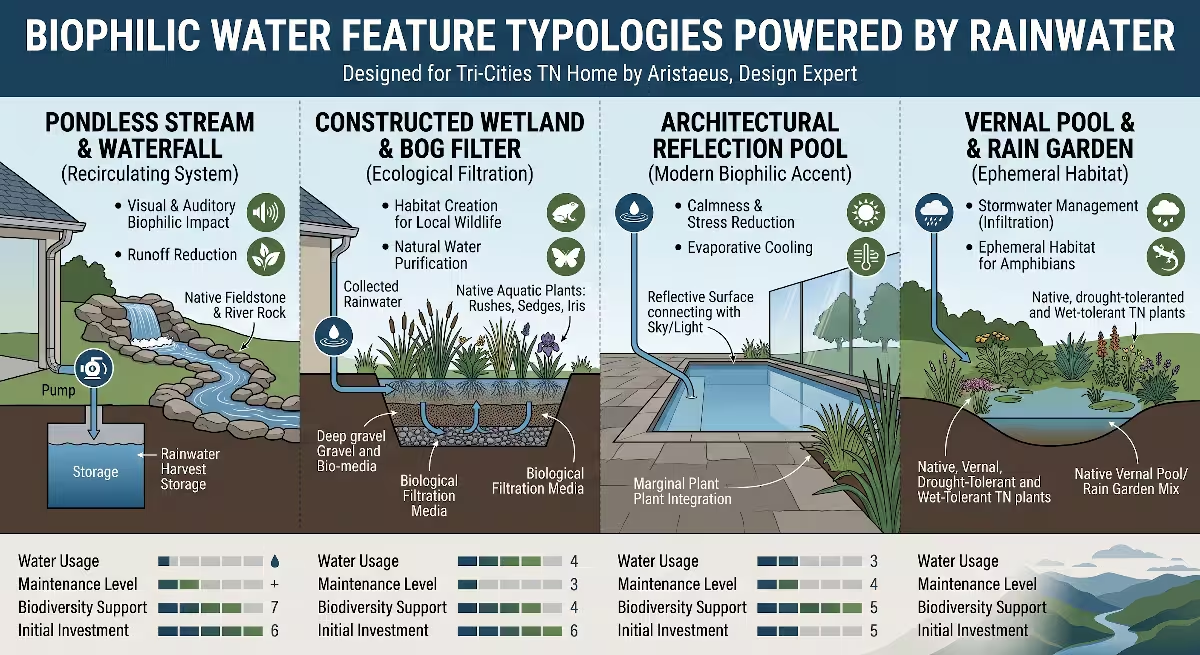
Biophilic design focuses on bringing natural light, native materials, organic shapes, and sensory water experiences into our daily environment. By pairing sustainable rainwater harvesting with specific water feature styles, you can create a customized outdoor living space tailored to your site’s topography.
+-------------------------------------------------------------------------------+
| WATER FEATURE TYPOLOGY COMPARISON                                              |
+----------------------+--------------------+-----------------+-----------------+
| Feature Style        | Maintenance Level  | Safety Profile  | Wildlife Value  |
+----------------------+--------------------+-----------------+-----------------+
| Pondless Waterfall   | Very Low           | Maximum (No     | Moderate        |
|                      |                    | standing water) | (Birds/Insects) |
+----------------------+--------------------+-----------------+-----------------+
| Wetland Bog Stream   | Low to Moderate    | High (Shallow   | Exceptional     |
|                      |                    | gravel base)    | (Full Habitat)  |
+----------------------+--------------------+-----------------+-----------------+
| Architectural Basin  | Moderate           | Moderate (Open  | Low to Moderate |
|                      |                    | water surface)  | (Reflective)    |
+----------------------+--------------------+-----------------+-----------------+
1. Pondless Waterfalls and Cascades
The pondless waterfall is one of the most reliable styles for residential sustainable rainwater harvesting. Water pumps up from the underground matrix blocks, flows over natural stone drops, and immediately vanishes back into a bed of decorative river stone at the base.
Because there is no open pond of standing water, maintenance is minimal. There are no fish to feed, no open water for algae blankets to form, and zero drowning risk for neighborhood children or visiting pets. You enjoy the natural, relaxing sound of splashing water against native Tennessee fieldstone, fully powered by clean, stored rain.
2. Recirculating Wetland Bog Streams
If you want to maximize biodiversity, a recirculating stream integrated with a wetland bog is an ideal choice. Harvested rainwater is pumped into the bottom of a shallow gravel bog. The water slowly upwells through layers of pea gravel and plant roots before spilling into a winding stream that returns to the underground reservoir.
This typology acts as a living biological engine. The wetland plants consume excess nutrients, while the stream provides a drinking and bathing station for native songbirds, tree frogs, and pollinators.
3. Modern Architectural Reflection Basins
For contemporary homes with clean geometric lines, sustainable rainwater harvesting can power formal reflection basins. These features use dark, submerged stone surfaces to create mirror-like water planes that reflect the sky, mature trees, and architectural details. Overflow channels drop water through narrow slots into hidden storage blocks below, maintaining pristine surface tension and clean visual lines.
Biological Water Treatment: Eliminating Chemicals via Ecological Balance
A properly engineered water feature should never smell like a swimming pool or turn into a murky green mess. Traditional water features often rely on harsh chlorine tablets or copper algaecides to stay clear. However, adding chemicals destroys beneficial bacteria and makes the water toxic to local wildlife.
Through sustainable rainwater harvesting, we achieve crystal-clear water using natural biological filtration. The heart of this approach is the natural nitrogen cycle:
[ Organic Matter & Pollen ]
             |
             v
[ Heterotrophic Bacteria ]  ---> Produces Ammonia (Toxic)
             |
             v
[ Nitrosomonas Bacteria ]   ---> Converts Ammonia to Nitrites (Toxic)
             |
             v
[ Nitrobacter Bacteria ]    ---> Converts Nitrites to Nitrates (Plant Food)
             |
             v
[ Native Wetland Plants ]   ---> Consumes Nitrates (Leaves Water Pure & Clear)
In this closed-loop ecosystem:
- Beneficial aerobic bacteria establish dense colonies on the immense surface area provided by the gravel bed and bio-media.
- These microscopic allies break down organic dust, pollen, and leaves washed into the system during sustainable rainwater harvesting cycles.
- The bacteria convert harmful ammonia into nitrites, then into benign nitrates.
- Native aquatic plants absorb these nitrates through their root systems, starving unwanted single-celled algae of food.
Addressing Mosquito and Vector Concerns
Two of the most common questions from homeowners exploring sustainable rainwater harvesting are:
- How do you keep harvested rainwater clean in a water feature?
- Can harvested rainwater create bad odors or mosquito breeding grounds?
Mosquitoes require stagnant, motionless water for 5 to 7 days to complete their life cycle from egg to biting adult. A system built around sustainable rainwater harvesting eliminates mosquito breeding in two ways:
- Constant Movement: When the water feature operates, moving water across waterfalls and stream beds prevents female mosquitoes from laying eggs on the surface.
- Sub-Surface Storage: When the system is turned off, all water rests beneath the surface within the matrix blocks and gravel layer. Mosquitoes cannot reach the dark, underground reservoir.
For open, slow-moving wetland edges, you can introduce natural biological controls like Bacillus thuringiensis israelensis (BTI). BTI is a naturally occurring soil bacterium that targets mosquito larvae without harming birds, frogs, honeybees, or pets.
Native Appalachian Planting Palettes for Bio-Retention and Edge Zones
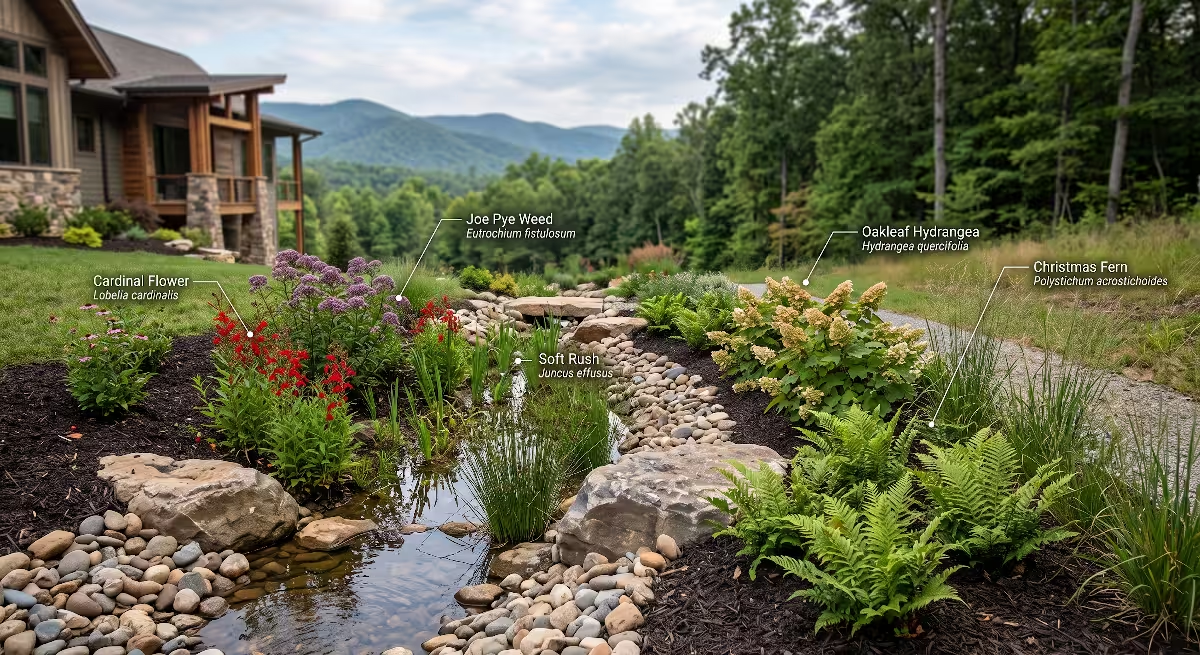
Plants are the working lungs and kidneys of sustainable rainwater harvesting systems. Selecting native species from the Southern Appalachian region ensures that your plantings thrive in local weather, tolerate wet-and-dry soil cycles, and support native pollinators.
       CROSS-SECTION: WATER FEATURE PLANTING ZONES

  Zone 1: Deep Bog / Water Flow     Zone 2: Shallow Edge / Margin     Zone 3: Riparian Upland Buffer
  [ Caltha palustris / Iris ]       [ Lobelia / Carex stricta ]       [ Clethra / Cornus sericea ]
  ~~~~~~~~~~~~~~~~~~~~~~~~~~~~~
  [   Gravel & Bio-Matrix    ]     [       Moist Topsoil       ]     [     Native Garden Soil    ]
Zone 1: Submerged and Emergent Wetland Plants (Active Biofiltration)
These species sit directly in the moving water or pea-gravel filtration bogs of your sustainable rainwater harvesting installation:
- Marsh Marigold (Caltha palustris): Features bright yellow buttercup flowers in early spring. It awakens early, absorbing excess nutrients from winter runoff before algae has a chance to grow.
- Blue Flag Iris (Iris versicolor): A structural plant with sword-like foliage and deep violet blooms. Its dense fibrous root system anchors gravel beds and extracts heavy nitrogen loads.
- Pickerelweed (Pontederia cordata): Displays glossy lance-shaped leaves and spikes of violet-blue flowers that bloom from June through September, providing continuous nutrient filtration through hot summer months.
Zone 2: Marginal Edge Plants (Moisture Transition Zone)
These plants grow along the damp perimeters, rock crevices, and overflow bioswales connected to your sustainable rainwater harvesting system:
- Cardinal Flower (Lobelia cardinalis): Produces brilliant scarlet spikes from late summer into early fall. It thrives in rich, moist soil and is a magnet for ruby-throated hummingbirds.
- Tussock Sedge (Carex stricta): A clumping native sedge whose extensive, fine root system locks edge soils in place, preventing loose garden dirt from washing into your water reservoir.
- Soft Rush (Juncus effusus): Features smooth, cylindrical green stems that add architectural texture and absorb residual runoff nutrients.
Zone 3: Riparian Buffer Shrubs and Trees (Landscape Integration)
To blend your water feature into the broader East Tennessee landscape, surround the perimeter with native woody plants:
- Sweetspire (Itea virginica): A native deciduous shrub with arching branches, fragrant white flower spikes in spring, and deep red autumn foliage.
- Red Osier Dogwood (Cornus sericea): Offers bright red winter stems that provide striking visual contrast against cold gray stone and white snow.
- Summersweet (Clethra alnifolia): Provides late-summer white flowers with a spicy honey scent that attracts butterflies and native bees.
System Maintenance, Seasonal Protocols, and Longevity
One of the greatest benefits of pairing residential water features with sustainable rainwater harvesting is low operational maintenance. However, regular seasonal inspections protect your equipment and ensure optimal water quality year after year.
        ANNUAL MAINTENANCE CALENDAR

  [ SPRING ] -> De-winterize pump, inspect check valves, clear fine sediment.
  [ SUMMER ] -> Check mechanical pre-filter screens after major storms; thin bog plants.
  [ AUTUMN ] -> Place temporary protective netting during peak leaf drop; clear diverters.
  [ WINTER ] -> Drain exposed plumbing lines or maintain continuous circulating flow.
Component Lifespan and Failure Prevention
Understanding the lifespan of your equipment helps you avoid unexpected system failures:
| System Component | Expected Lifespan | Primary Failure Mode | Preventative Protocol |
| 45-mil EPDM Liner | 25 to 35+ Years | Puncture from roots or sharp rocks | Install 8-oz non-woven geotextile underlayment below and above liner |
| Submersible Water Pump | 3 to 6 Years | Dry-running or impeller debris clog | Install float-switch auto shutoffs and clean pump intake vault screens |
| Matrix Blocks (AquaBlox) | 50+ Years | Structural crushing from improper backfill | Use clean, angular washed stone backfill and observe maximum burial depth limits |
| Schedule 40 PVC Plumbing | 30+ Years | Freeze fractures along surface transitions | Pitch pipes to gravity-drain below the 18-inch regional frost line |
| First-Flush Diverters | 15 to 20 Years | Silt accumulation and ball-float jamming | Unscrew bottom drain caps twice yearly to flush settled grit and sediment |
Seasonal Maintenance Protocols
- Spring Protocol: Pull the submersible pump from its protective vault, inspect the impeller for mineral buildup, and test your GFCI breaker. Flush any accumulated fine sediment from the bottom of your settlement chamber before turning the system on for the season.
- Summer Protocol: Check your roof downspout debris diverters after severe summer thunderstorms. Trim vigorous emergent plants in your biofilter bog to encourage new vegetative growth, which consumes more nutrients.
- Autumn Protocol: In our heavily forested Oak-Hickory Appalachian region, falling leaves can overwhelm any water system. Lay a temporary 1/2-inch leaf net across open stream beds during October and November. Clear downspout diverters weekly to ensure heavy autumn rains flow freely into your sustainable rainwater harvesting matrix.
- Winter Protocol: You can run pondless waterfalls year-round in East Tennessee. Moving water forms sculptural ice formations over boulders without freezing solid. However, if you choose to shut your system down for the winter, remove the pump, store it in a bucket of clean water indoors to keep the internal seals moist, and drain all exterior plumbing lines.
Frequently Asked Questions About Sustainable Rainwater Harvesting
Can harvested rainwater sustain a fish pond with native Tennessee species?
Yes, but it requires careful design. Rainwater is naturally soft and slightly acidic because it absorbs atmospheric carbon dioxide as it falls. To support native fish species such as bluegill or minnows, you must buffer the water. Passing harvested rainwater through local crushed limestone rock beds naturally dissolves calcium carbonate into the water, stabilizing the pH between 7.2 and 7.8. Additionally, you must ensure your first-flush diverter is operating properly to prevent roof debris and airborne pollutants from entering the aquatic habitat.
What is the cost difference between a traditional decorative fountain and a rainwater-harvesting water feature in TN?
A decorative fountain running on city water has a lower initial installation cost because it does not require deep excavation, matrix blocks, or roof downspout piping. However, traditional fountains have much higher long-term operating costs. They continuously evaporate chlorinated water, require expensive chemical algae treatments, and often suffer pump burnouts when water levels drop. A system engineered for sustainable rainwater harvesting costs more upfront due to excavation, liners, and storage matrix cells, but it has minimal ongoing utility costs, requires zero harsh chemicals, and provides stormwater management that protects your landscape investment.
How does East Tennessee’s freeze-thaw cycle affect subterranean water storage?
Subterranean water storage blocks (such as AquaBlox) are buried below the local frost depth of 12 to 18 inches, where the surrounding earth remains at a stable, above-freezing temperature throughout the winter. The large volume of stored water resists freezing. As long as your supply plumbing is pitched to drain back into the reservoir when the pump is shut off, the underground system remains completely protected from freeze-thaw damage.
Will a rainwater-harvesting water feature attract unwanted wildlife?
A closed-loop water feature using sustainable rainwater harvesting primarily attracts desirable wildlife like songbirds, tree frogs, dragonflies, and pollinators looking for a clean drink. Because the water is constantly circulating through natural biological filters, it does not create stagnant odors that attract pests. Sub-surface pondless designs have no open standing water, which prevents unwanted burrowing animals or mosquitoes from establishing breeding colonies on your property.
How often do I need to clean the underground water storage blocks?
When your mechanical pre-filtration is designed correctly with downspout leaf diverters and first-flush systems, large debris never reaches the underground matrix blocks. You should inspect the pump vault and settlement chamber once or twice a year. Using a standard submersible cleanout pump or wet-vac to remove fine sediment from the vault base every two to three years is all that is required to keep the system running cleanly for decades.
Conclusion and Strategic Next Steps: Designing for Permanence
Adopting sustainable rainwater harvesting for your residential water feature bridges the gap between functional civil engineering and biophilic landscape art. In East Tennessee, our generous annual rainfall is an abundant natural resource waiting to be utilized.
By capturing clean roof runoff, storing it safely within underground matrix blocks, and filtering it through native wetland ecology, you create an outdoor space that:
- Eliminates the waste and expense of municipal tap water.
- Mitigates stormwater runoff, preventing soil erosion on sloped mountain properties.
- Provides sensory relaxation and biophilic stress relief through the natural sound of running water.
- Creates a welcoming oasis for native birds, butterflies, and amphibians.
       PROJECT PLANNING PHASES

Phase 1: Measure Roof Area & Calculate Harvestable Gallons
   |
Phase 2: Check HOA Guidelines & Call Tennessee 811
   |
Phase 3: Excavate Reservoir & Install EPDM Liner + Matrix Blocks
   |
Phase 4: Place Native Stone & Establish Biological Wetland
   |
Phase 5: Connect Downspouts, Fill with Rain, & Power the System
To begin your project, step outside and calculate your roof catchment area. Check your property slope, identify your downspout locations, and visualize where a recirculating stream or pondless cascade can enhance your daily living environment. With thoughtful design, proper sizing, and native plantings, sustainable rainwater harvesting will deliver a dynamic, self-sustaining water feature that enriches your home for decades to come.