

More Than a Side Dish: Why Shuck Beans Defined Mountain Survival
Walk onto an old wooden porch in Upper East Tennessee on a crisp October afternoon, and you might spot one of the oldest culinary traditions in North America swaying gently in the mountain breeze. Long garlands of wrinkled, russet-brown green bean pods hang from rafters like edible wind chimes. As the cool autumn wind blows down from the Blue Ridge Mountains, those dry pods rustle and rattle against one another. To an untrained eye, they might look like dried autumn decorations or forgotten garden leftovers. To anyone raised in the kitchens of Southern Appalachia, however, those hanging strands represent pure winter security and deep, concentrated flavor.
Understanding the history of Appalachian shuck beans food preservation opens a window into how mountain families survived and thrived long before grocery stores or electric refrigerators existed. Across the Tri-Cities region of Northeast Tennessee, Western North Carolina, Southwest Virginia, and Eastern Kentucky, preserving the summer harvest was a matter of life and death. When frost killed the last garden vines in October, families had to rely entirely on what they had put away during the warmer months.
Rooted in centuries-old Indigenous agricultural wisdom and refined by generations of mountain homesteaders, Appalachian shuck beans became a cornerstone of regional survival. Today, that same humble preservation method is experiencing an exciting revival. Chefs, seed savers, and home cooks are rediscovering that drying green beans on a string does far more than keep food from spoiling. It transforms an ordinary summer vegetable into a rich, savory delicacy with a texture and depth of flavor that fresh or canned beans simply cannot match.
What Are Appalachian Shuck Beans?
Appalachian shuck beans are mature green beans that are threaded onto heavy cotton string and air-dried whole inside their pods for long-term winter storage. Also known across the mountains as leather britches or shucky beans, they are rehydrated by soaking overnight and slow-simmered for hours with seasoned meat to create a hearty, protein-rich dish.
A Rose by Any Other Name: Decoding Appalachian Bean Terminology
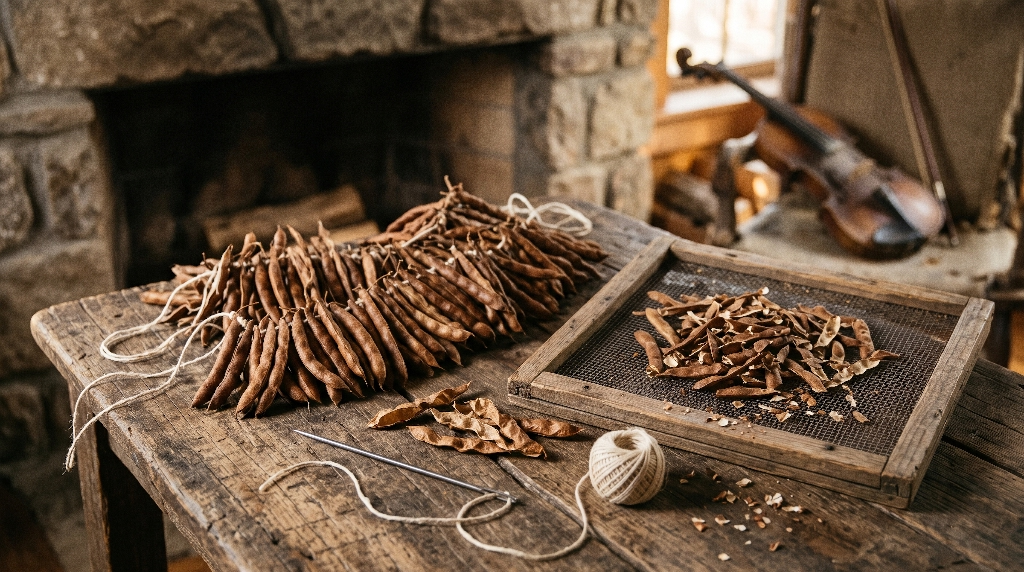
Language in the Appalachian Mountains tells the story of the people who settled the coves and ridges. Depending on which valley you visit, the exact same strand of dried green beans might go by two or three different names. Each term reflects how families prepared the pods and how neighbors described their appearance once the autumn sun had finished its work.
Why Are Dried Green Beans Called Leather Britches?
Dried green beans are called leather britches because of how dramatically they change shape and color during dehydration. As fresh green pods lose their water over several weeks, they shrink, wrinkle, and turn a deep tan or saddle-brown color. Hanging in long pairs from the porch rafters, the shriveled pods look remarkably like weathered buckskin trousers worn by early frontier hunters.
In the nineteenth century, buckskin breeches were everyday workwear for mountain farmers and woodsmen. Naming a winter staple after a familiar piece of rugged clothing fit the practical humor of Appalachian households. When a cook reached up to pull down a pair of leather britches for Sunday dinner, everyone at the table knew a warm, filling pot of beans was on the way.
What Is the Difference Between Shuck Beans and Leather Britches?
While many cooks use the names interchangeably, traditional mountain kitchens often draw a clear line between leather britches and Appalachian shuck beans. Leather britches almost always refers to whole, unbroken green bean pods threaded onto a long string and dried intact from stem to blossom end. Appalachian shuck beans, sometimes called shucky beans, often refers to mature pods that are snapped into two or three pieces before being spread on screens or strung up to dry.
In parts of Eastern Kentucky and Southwest Virginia, families also call them fodder beans. That nickname comes from the way the brittle, brown pods rustle like dry corn stalks bundled up as winter livestock fodder in the barn. Whether left whole on a thread or snapped into bite-sized pieces in a flour sack, Appalachian shuck beans and leather britches rely on the exact same method of natural air-drying.
From Hearthside to Fiddle Tune: Cultural Echoes in Appalachian Music
Few foods in American history have earned their own musical tribute, yet leather britches lives on in one of the most famous old-time fiddle tunes ever written. Played at square dances, front-porch jam sessions, and fiddlers conventions across Tennessee and North Carolina, the lively melody of “Leather Britches” mirrors the cheerful, rhythmic work of preparing the autumn harvest.
Oral historians preserved these memories in the famous Foxfire book series during the twentieth century. Mountain elders recounted how children sat beside the fireplace after supper, armed with large steel darning needles and spools of white cotton thread. While grandparents told stories and fiddles played in the background, small hands pushed needles through the centers of plump green pods, turning an evening chore into a lasting cultural tradition.
Cherokee Roots and the Evolution of Mountain Food Preservation
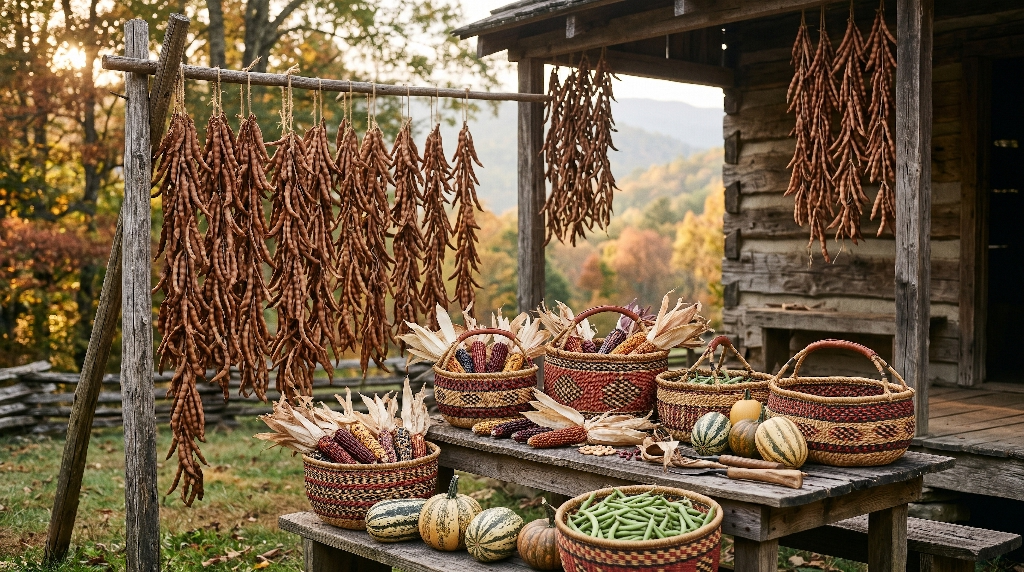
Long before European pioneers crossed the Blue Ridge Mountains, the Cherokee people had perfected sustainable farming and food storage in Southern Appalachia. Every aspect of making Appalachian shuck beans traces its lineage directly back to Indigenous knowledge of native plants, seasonal weather patterns, and zero-waste living.
Who Invented Leather Britches? Cherokee Harvest Wisdom and the Three Sisters
The Cherokee people of Southern Appalachia invented the technique of air-drying green beans on strings long before European settlers arrived in North America. Working within the Three Sisters agricultural system, Cherokee farmers planted climbing beans alongside corn and squash so the bean vines could wind up the tall corn stalks while enriching the soil with nitrogen.
At the end of summer, Cherokee families harvested surplus pods, strung them on natural plant fibers, and hung them inside rafters or on outdoor drying racks. Drying the beans whole inside their hulls protected the seeds from insects and allowed families to carry lightweight, nutrient-dense food on long winter hunting trips or store it safely in woven baskets.
Scots-Irish Settlers and the Early Watauga and Holston Homesteads
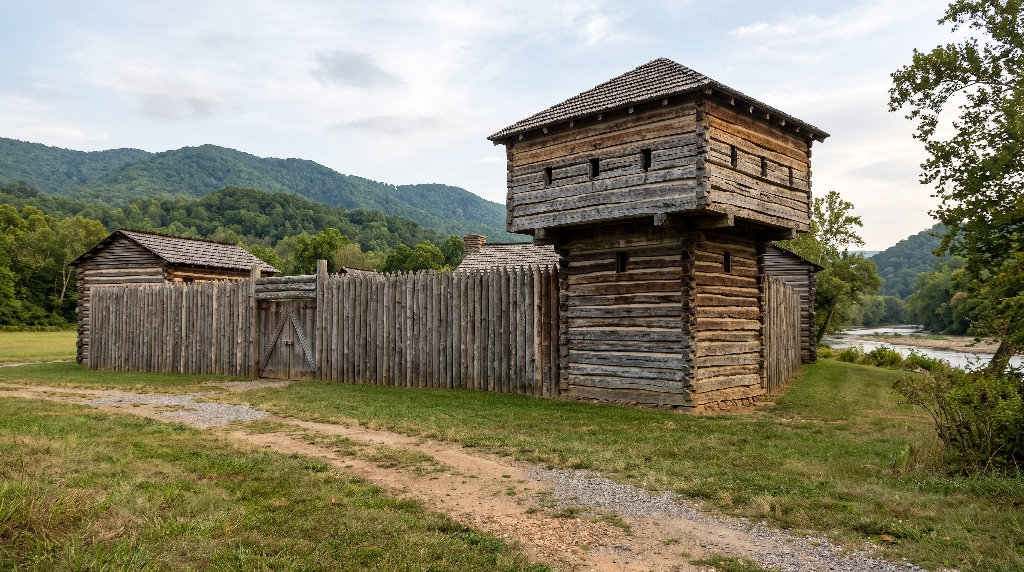
During the late 1700s, Scots-Irish, English, and German settlers poured over the mountain passes into the fertile valleys of the Watauga and Holston rivers in what is now the Tri-Cities area of Northeast Tennessee. Settlements around present-day Jonesborough and Johnson City became vital crossroads on the western frontier. These newcomers arrived with farming traditions suited to cool, damp European climates, and they quickly realized they needed new strategies to survive harsh Appalachian winters.
Through trade and close contact with Cherokee neighbors, early frontier families adopted corn agriculture, wild foraging, and string-drying green beans. Settlers adapted the technique using home-spun flax thread or store-bought cotton string, hanging garlands of Appalachian shuck beans from the ceiling joists of log cabins where gentle heat from the stone hearth helped finish the drying process.
Horace Kephart and Early Twentieth-Century Documentation
By the early 1900s, outside writers began documenting the unique foodways of the Southern Highlands. In his landmark 1913 book Our Southern Highlanders, writer and outdoorsman Horace Kephart lived among mountain families in the Great Smoky Mountains and recorded their daily cooking habits in vivid detail.
Kephart noted with fascination how highlanders preserved their summer bean crop by stringing pods on long threads and hanging them from cabin rafters until they cured into tough, brown leather-breeches. He observed that mountain cooks boiled the dried pods “hull and all” with a piece of salt pork, turning what looked like dry brush into a tender, savory winter meal. Kephart’s firsthand account remains one of the most important historical records of Appalachian shuck beans in American literature.
Why Drying Beat Canning in the Pre-Electric Mountains
Today, modern home cooks have chest freezers, pressure canners, and vacuum sealers at their fingertips. To understand why Appalachian shuck beans remained essential well into the twentieth century, we have to look at the harsh economic realities of mountain life before rural electrification.
Life Before the 1930s Power Grid in the Blue Ridge Foothills
Until the Tennessee Valley Authority and rural electric cooperatives began stringing power lines across the mountains in the late 1930s and 1940s, most Appalachian homesteads had zero electricity. There were no refrigerators, no electric deep freezers, and no electric dehydrators. Springhouses cooled by cold mountain streams could keep milk and butter fresh for a few days, and underground root cellars stored potatoes, turnips, and winter squash.
Green beans, however, rot within days if kept damp in a root cellar. Without freezing temperatures, dehydration was the only reliable way to keep green beans edible from October until the next garden came in during June. Hanging Appalachian shuck beans in dry attic rafters took advantage of natural airflow and required no fuel, no ice, and no electricity.
The High Cost of Glass Mason Jars Versus a Needle and Cotton Thread
Even after glass Mason jars became widely available in the late nineteenth century, canning remained an expensive luxury for cash-poor mountain households. Buying dozens of glass jars, zinc screw caps, and single-use rubber sealing rings required hard cash at the country store, which was always in short supply.
Furthermore, low-acid vegetables like green beans were prone to spoilage if water-bath canning temperatures fell short, risking dangerous foodborne illness. Smart mountain cooks saved their precious glass jars for high-acid foods like tomatoes, peaches, blackberries, and pickled beets. Meanwhile, a single spool of cotton thread and a steel needle cost almost nothing and could preserve five or six bushels of Appalachian shuck beans year after year.
Communal Bean Stringings as Social Glue
Preserving enough food to feed a family of eight or ten through a five-month winter required massive amounts of labor. Rather than facing mountains of freshly picked beans alone, neighbors turned harvest preservation into community events known as bean stringings.
Families gathered on front porches or under shade trees with wash tubs overflowing with crisp pods. Everyone pitched in to snap off the tough stem ends, pull away the fibrous side strings, and thread the pods onto long strands. While hands stayed busy, neighbors traded local news, shared seed varieties, sang hymns, and kept mountain traditions alive. Those shared afternoons built strong community bonds that helped isolated settlements weather tough economic times together.
Not All Green Beans Make Good Shuck Beans: Heirloom Varieties That Shine
Anyone who tries to make Appalachian shuck beans using modern grocery store green beans is in for a disappointing surprise. Over the last seventy years, commercial agriculture bred green beans for mechanical harvesting, uniform straightness, and long shelf life in refrigerated trucks. Those commercial traits actually ruin a bean when you try to dry it on a string.
Why Modern Supermarket Bush Beans Fail on the String
Standard commercial bush beans, such as the popular Blue Lake variety, have very thin pod walls and high water content, along with tiny, underdeveloped seeds. When you string these modern beans and hang them to dry, they lose nearly ninety percent of their weight and shrivel into paper-thin, hollow husks. Once cooked, they fall apart into mushy strings with very little flavor or body.
Traditional Appalachian shuck beans require heirloom pole beans that were selected over centuries specifically for drying. Mountain gardeners saved seeds from vines that produced thick, fleshy pod walls and plump, meaty seeds inside the hull. Those sturdy walls hold their structure during months of hanging and rehydrate into substantial, satisfying bites.
Greasy Beans, White Half-Runners, and Lazy Wife Pole Beans
Across Northeast Tennessee and Western North Carolina, heirloom seed savers treasure several classic varieties bred for making Appalachian shuck beans:
- Greasy Beans: Despite their funny name, greasy beans contain no oil at all. Their name comes from their smooth, shiny skins that lack the tiny, fuzzy hairs found on ordinary green beans. Because their thick, glossy cuticles slow down moisture loss slightly, greasy beans cure evenly without turning brittle, developing a remarkably rich, sweet flavor when dried.
- White Half-Runners: Beloved throughout East Tennessee, White Half-Runners produce tender pods packed tightly with plump white seeds. When left on the vine slightly longer than usual before picking, the developing seeds give dried Appalachian shuck beans a creamy, nutty richness.
- Lazy Wife Pole Beans: This nineteenth-century heirloom earned its name because its thick, stringless pods require no tedious string-pulling before cooking or threading. Its broad, meaty hulls dry into heavy, flavorful strands that hold up beautifully during long simmering.
Bill Best and the Legacy of Appalachian Family Beans
Much of what we know today about these rare mountain varieties is thanks to the lifelong work of heirloom bean historian Bill Best. In his acclaimed book Saving Seeds, Preserving Taste: Heirloom Seeds in Appalachia, Best documented hundreds of distinct “family beans” passed down through individual mountain households for more than a century.
In isolated mountain coves, beans occasionally cross-pollinated or mutated naturally, creating new genetic variations that farmers called “sports.” When a gardener noticed a vine with superior flavor or thicker pods for drying, they saved its seeds and named it after their family or valley. Varieties like Turkey Craw, Case Knife, and Cutshort beans survived solely because mountain families guarded those seeds and kept making Appalachian shuck beans every autumn.
What Happens Inside the Pod? The Food Science of Shuck Beans
From a culinary science perspective, air-drying green beans in their pods is a brilliant example of controlled natural preservation. Unlike modern industrial freeze-drying or high-heat oven dehydration, slow ambient curing triggers subtle chemical changes inside the vegetable that build extraordinary flavor.
Controlling Water Activity Without Heat
Every fresh vegetable contains moisture that bacteria, yeast, and mold need in order to grow. Food scientists measure this available moisture as water activity. Fresh green beans have a very high water activity, which is why they turn slimy and spoil within a week on a kitchen counter.
When you string Appalachian shuck beans with space between each pod and hang them in dry, moving air, gentle evaporation pulls moisture steadily out of the plant cells. As the water activity drops below the threshold where microbes can survive, the pod enters a safe, dormant state. Because this drying happens at cool autumn air temperatures rather than high oven heat, the natural starches and sugars inside the bean do not scorch or turn bitter.
Enzymatic Transformation and Umami Concentration
Slow dehydration over two to four weeks gives natural enzymes inside the bean pod time to work before moisture drops too low. These enzymes gently break down complex proteins into free amino acids, including glutamates, while concentrating natural sugars inside the thickening hull.
This gradual biochemical shift creates deep, savory umami notes that resemble dried wild mushrooms, roasted chestnuts, and cured country ham. Fresh green beans taste bright, grassy, and crisp because of volatile green plant compounds. Once cured into Appalachian shuck beans, those grassy notes evaporate, leaving behind an earthy, deeply comforting richness that transforms the entire pot of soup or stew.
Cell Wall Breakdown: Why Rehydrated Hulls Turn Silky
James Beard Award-winning Appalachian food writer Ronni Lundy famously described the magic of cooked shuck beans in her book Victuals. She noted that when properly soaked and slow-cooked, the dried outer hull turns remarkably silky while the plump bean inside turns soft and velvety.
Culinary science explains exactly why this happens. During dehydration, the cellulose fibers and natural pectin holding the pod walls together shrink and tighten. When you soak Appalachian shuck beans overnight in cool water, water molecules slowly work their way back into those compressed cell walls. Simmering the beans gently for two to three hours breaks down the softened pectin into a smooth gel, giving the hulls a tender, luxurious texture that melts on the tongue rather than feeling fibrous or chewy.
Preserving the Harvest: Traditional Air-Drying and Storage Methods
Making your own Appalachian shuck beans at home requires no fancy equipment, no canning jars, and very little hands-on time. Following a few time-tested rules from mountain kitchens ensures your pods dry safely without molding and keep their rich flavor all winter long.
Harvesting at Peak Maturity: Plump Seeds and Tender Pods
Timing your harvest is the single most important step in making great Appalachian shuck beans. For fresh eating, gardeners pick green beans when the pods are slender and the seeds inside are tiny. For drying, you want to wait several days longer until the pods are fully grown and the seeds inside have swelled into noticeable bumps along the hull.
At this stage, the pod should still feel firm, crisp, and green rather than yellow or papery. Plump interior seeds add essential protein, starch, and creamy texture to the finished dish, while the mature hull provides structure and deep flavor. Avoid picking wet beans after a heavy rain or morning dew, as surface moisture can invite mold before air circulation takes hold.
Threading Technique: Darning Needles, Cotton String, and Airflow Spacing
Once you have a basket of clean, dry pods, gather a sturdy three-inch steel darning needle and a spool of unbleached, heavy-duty cotton kitchen twine. Never use synthetic nylon thread, which can slip or cut into the pods, and avoid waxed string that leaves residue behind.
- Prep the pods: Snap off the tough stem tip of each bean and pull down gently along the seam to remove any fibrous side strings. Do not wash the beans unless they have visible garden dirt; if you must rinse them, pat them completely dry with a clean towel first.
- Cut your string: Cut a length of cotton twine roughly four to six feet long, tying a thick double knot at the bottom end so the first bean cannot slide off.
- Thread through the center: Push the darning needle straight through the middle of each pod, perpendicular to its length, right between two developing seeds. Piercing the center balances the pod so it hangs horizontally without drooping onto its neighbor.
- Leave breathing room: Slide each bean down the string, leaving about a half-inch gap between pods. Good airflow around every surface of every pod prevents trapped moisture and ensures even drying.
- Hang in a dry, airy spot: Tie the finished strand to rafters on a covered front porch, inside a well-ventilated attic, or near a warm woodstove away from direct rain and harsh afternoon sun.
Screen-Drying Versus Modern Electric Dehydrators
If you do not have time to thread dozens of needles, you can make snapped Appalachian shuck beans using flat drying screens. Snap clean pods into one-inch pieces and spread them in a single, uncrowded layer across clean window screens framed in wood. Set the screens on sawhorses in a warm, breezy spot out of direct sunlight, stirring the pieces once a day with your hands until they dry completely.
Modern home cooks can also use an electric food dehydrator when autumn weather turns unusually humid. Set the dehydrator to a low temperature between 115 and 125 degrees Fahrenheit. Running the machine at low heat mimics a warm October breeze, drying whole or snapped pods in twelve to twenty-four hours without cooking the delicate starches.
How Long Do Shuck Beans Last in Storage?
Properly dried Appalachian shuck beans easily last one to two years in storage, and many mountain families keep well-sealed jars for up to three years without any loss of quality. Before packing your beans away, perform the traditional mountain rattle test: shake a dried strand vigorously near your ear. The pods should sound dry and papery, and individual beans should snap cleanly in half rather than bending.
Traditional cooks stored dried strands inside breathable white flour-sack cotton bags hung from ceiling hooks in a cool, dry pantry, tucking one or two dried cayenne peppers inside each bag to naturally repel pantry moths. Today, you can also pack fully dried Appalachian shuck beans into airtight glass Mason jars or vacuum-sealed bags stored in a dark cupboard away from heat and moisture.
From Hard-Times Food to High-End Appalachian Cuisine
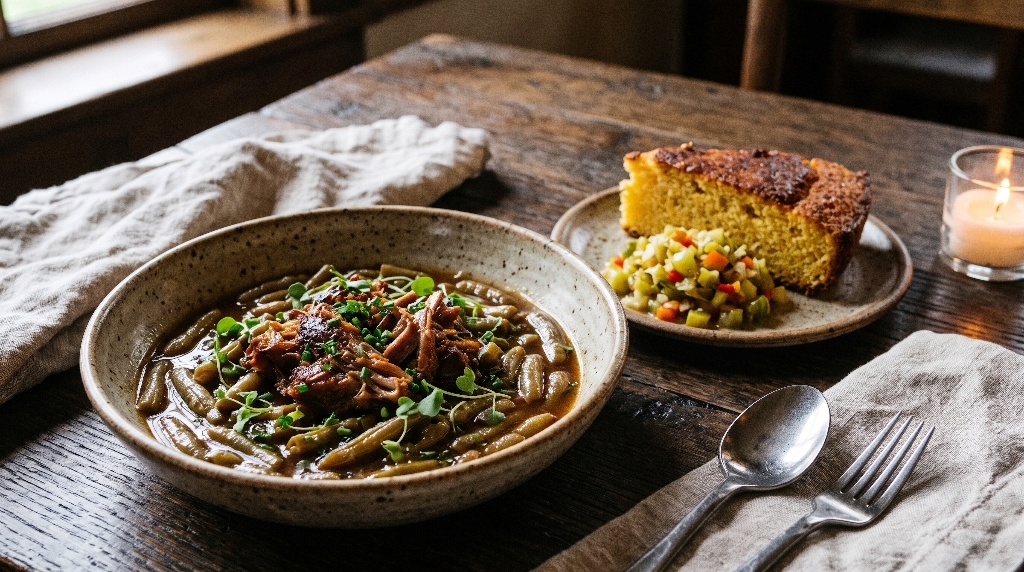
Like many traditional regional foods around the world, Appalachian shuck beans nearly vanished during the second half of the twentieth century before experiencing an extraordinary culinary comeback.
Post-World War II Industrialization and Stigma
Following World War II, paved highways, rural electrification, and suburban supermarkets transformed daily life across Southern Appalachia. Suddenly, canned green beans, frozen vegetables, and year-round fresh produce were available at affordable prices in every town.
For many families who had endured the hardships of the Great Depression, hanging dried beans on the porch felt like an embarrassing reminder of poverty and “hard-times food.” Younger generations eagerly embraced modern convenience foods, and the art of stringing Appalachian shuck beans survived mostly among older gardeners, dedicated homesteaders, and isolated rural communities.
Seed Savers and Chefs Reclaiming Mountain Heritage
Beginning in the late 1990s and accelerating over the past two decades, a powerful farm-to-table movement swept through Southern Appalachia. Historians, local farmers markets, and chefs working in towns from Johnson City, Tennessee to Asheville, North Carolina began looking closely at the ingredients unique to their own mountains.
Celebrated chefs realized that Appalachian shuck beans possessed a complex, savory character that imported pantry ingredients could never imitate. Prominent restaurants across the Blue Ridge, including celebrated kitchens like Buxton Hall Barbecue in Asheville and farm-driven dining rooms throughout Northeast Tennessee, placed slow-simmered shuck beans proudly on their menus alongside heritage pork and stone-ground cornbread. Today, Appalachian shuck beans are celebrated by food lovers nationwide as one of America’s finest heirloom culinary treasures.
From Rattle-Dry to Velvet-Tender: Mastering the Pot
Cooking dried pods requires patience, low heat, and respect for the ingredient. Rushing the pot with high boiling heat will leave the outer hulls tough while splitting the inner seeds. Treat Appalachian shuck beans with the same gentle care you give dried heirloom soup beans, and they will reward you with rich, velvety perfection.
How Do You Cook Dried Shuck Beans?
To cook dried shuck beans, start by pulling the pods off the cotton string, rinsing them well in cool water, and soaking them overnight in a large bowl of fresh cold water. Drain the soaking liquid, place the plump beans in a heavy pot with fresh water or broth and a piece of smoked ham hock or fatback, and simmer gently over low heat for two to three hours until tender.
Building the Potlikker: Fatback, Ham Hocks, and Vegetarian Alternatives
In Southern Appalachian cooking, the seasoned broth left in the bottom of the pot is known as potlikker, and it is every bit as prized as the beans themselves. Traditional mountain cooks build deep flavor by simmering Appalachian shuck beans with cured pork:
- Smoked Ham Hock or Shank: Adds rich smoky aroma, savory saltiness, and natural gelatin that gives the potlikker a silky, lip-coating body.
- Streak-o’-Lean or Fatback: Cured pork belly sliced into thick strips renders out rich, savory fat that coats every tender bean hull.
- Vegetarian Umami Option: For plant-based cooks, skip the pork and simmer the beans in rich roasted vegetable broth with two dried shiitake mushrooms, three tablespoons of good olive oil or unsalted butter, a minced garlic clove, and a half-teaspoon of smoked paprika. The mushrooms echo the natural earthy flavor of the dried pods remarkably well.
Classic Cast-Iron Shuck Beans Recipe and Traditional Pairings
A heavy enameled cast-iron Dutch oven holds steady, gentle heat better than thin metal pots, preventing scorching during a long afternoon simmer.
Ingredients:
- 4 ounces dried Appalachian shuck beans (about 4 tightly packed cups dry)
- 8 cups cold water for soaking, plus 6 cups fresh water for cooking
- 1 medium smoked ham hock (about 12 ounces) or 4 ounces thick-cut streak-o’-lean pork
- 1 small yellow onion, peeled and halved
- 1/2 teaspoon freshly cracked black pepper
- Kosher salt to taste (add only at the end after tasting the salty cured pork)
- 1 tablespoon apple cider vinegar (optional, for brightening the finished pot)
Cooking Steps:
- Unstring and rinse: Slide the dried pods off their cotton string, discarding any stems. Place the pods in a colander and rinse thoroughly under cool running water to remove any pantry dust.
- Soak overnight: Transfer the rinsed beans to a large bowl and cover with 8 cups of cold water. Let them soak at room temperature for 8 to 12 hours until the pods swell and turn pliable. Drain and discard the soaking water.
- Start the pot: Place the rehydrated beans, fresh 6 cups of water, smoked ham hock, halved onion, and black pepper into a heavy Dutch oven. Bring the liquid just to a gentle boil over medium heat, then immediately reduce the heat to the lowest setting.
- Simmer slowly: Cover the pot with a tight-fitting lid and simmer gently for 2.5 to 3 hours. Check the pot every 45 minutes, adding a splash of hot water if needed so the beans stay just barely submerged.
- Finish and season: Once the hulls are silky-tender and the interior beans are creamy, remove the ham hock and onion. Shred any tender meat from the ham hock back into the pot, taste the potlikker, and season with kosher salt and a splash of apple cider vinegar.
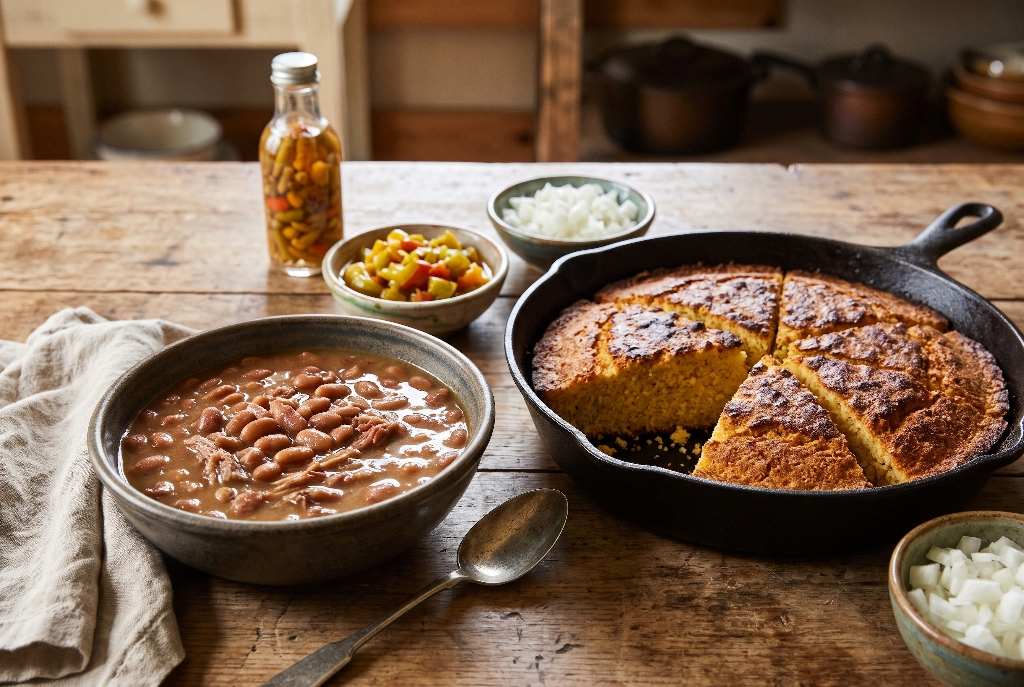
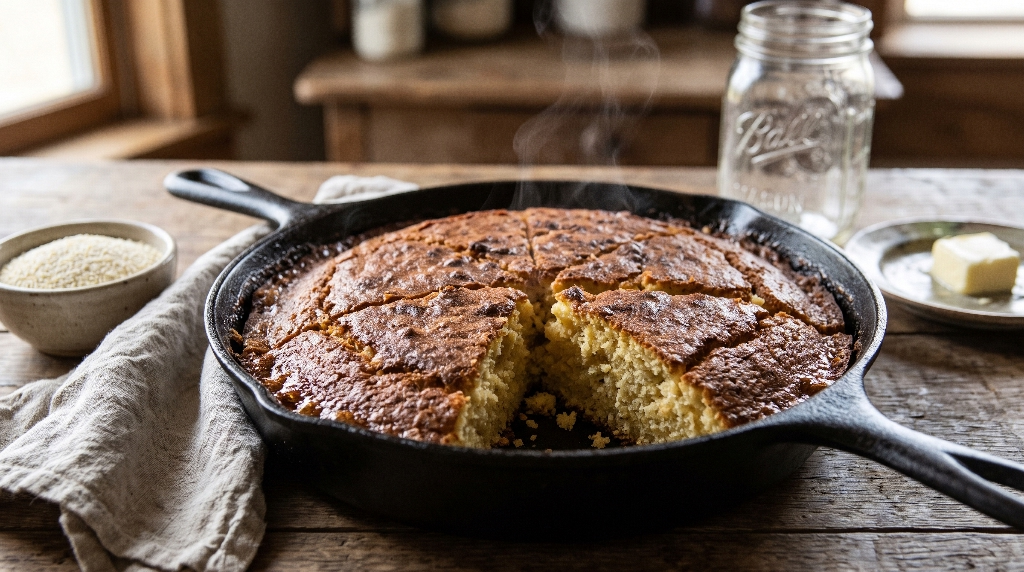
Serve your steaming bowl of Appalachian shuck beans alongside hot skillet cornbread baked in bacon drippings, crisp green onions, thick slices of ripe summer heirloom tomatoes, and a spoonful of sweet-and-tangy mountain chow-chow relish to cut through the richness.
Keeping the Tradition Alive in Your Own Garden and Kitchen
Every string of dried beans hanging on an autumn porch connects modern cooks to centuries of mountain resilience, agricultural biodiversity, and thoughtful hospitality.
Where to Buy Authentic Heirloom Bean Seeds
If you want to grow your own heirloom beans for drying next spring, skip the standard seed racks at big-box hardware stores and support dedicated heritage seed organizations:
- Southern Exposure Seed Exchange: Based in Virginia, this worker-owned cooperative offers an outstanding selection of authentic Appalachian greasy beans, White Half-Runners, and pole beans tested for humid Southern summers.
- Seed Savers Exchange: Maintains one of North America’s largest collections of rare family heirloom beans, complete with historical notes on where each variety originated.
- Appalachian Sustainable Development & Regional Seed Swaps: Across Northeast Tennessee, Southwest Virginia, and Western North Carolina, local agricultural groups host annual spring seed swaps where mountain gardeners freely share heirloom seeds and growing tips.
Why a String of Dried Beans Still Matters
Here in the Tri-Cities and across the broader Southern Appalachian mountains, food has always been about making the most of what the land provides and sharing the table with neighbors. Taking an afternoon each fall to string a basket of garden beans requires slowing down, working with your hands, and planning ahead for colder days. When January snow blankets the ridges and you lift the lid off a simmering pot of Appalachian shuck beans, the rich, earthy aroma filling your kitchen proves that the old ways of preserving food were never merely about survival. They were about capturing the very best of the harvest so nothing good ever went to waste.