

Walk into almost any modern home in the middle of July, and you can feel the heavy, sticky air the moment the front door closes. Walk into that exact same house in January when the furnace has been running all night, and the air feels so dry that your throat scratches and static shocks your fingertips every time you touch a doorknob. Large indoor humidity swings are one of the biggest hidden problems in residential construction. Most builders try to fix this by throwing bigger heating and cooling equipment at the house, yet there is a much smarter, quieter solution built right into the walls: clay plaster.
When applied properly, clay plaster acts like a giant, silent humidity sponge that naturally keeps your indoor air inside the healthy 40 to 60 percent relative humidity (RH) zone. Building scientists and health organizations point to this specific range as the biological sweet spot for human health and home durability. Both the well-known Arundel Relative Humidity Chart and the WELL Building Standard (under Feature T07 for Humidity Control) show that keeping indoor air between 40% and 60% RH dramatically lowers health risks inside a home.
Step outside that 40 to 60 percent window, and trouble starts fast. When winter indoor humidity drops below 40% RH, the moist lining inside your nose and throat dries out. Without that protective layer, airborne cold and flu viruses survive longer and infect people much more easily. Dry air also cracks skin, irritates eyes, and concentrates airborne dust and chemical pollutants.
On the flip side, when summer humidity climbs above 60% RH, dormant mold spores wake up and begin growing behind furniture and inside closets. House dust mites multiply rapidly in damp air, triggering allergies and asthma, while glues and resins inside cabinets and flooring release higher levels of formaldehyde and other harmful gases.
By harnessing the natural physics of unfired earth, clay plaster smooths out those daily spikes and drops without using a single watt of electricity. In this guide, we will look at the building science behind how clay plaster manages moisture, what lab test numbers actually mean for your walls, and how to specify the right thickness and mix so your home stays comfortable all year long.
How Unfired Clay Acts as a Passive Humidity Sponge (Adsorption vs. Desorption)
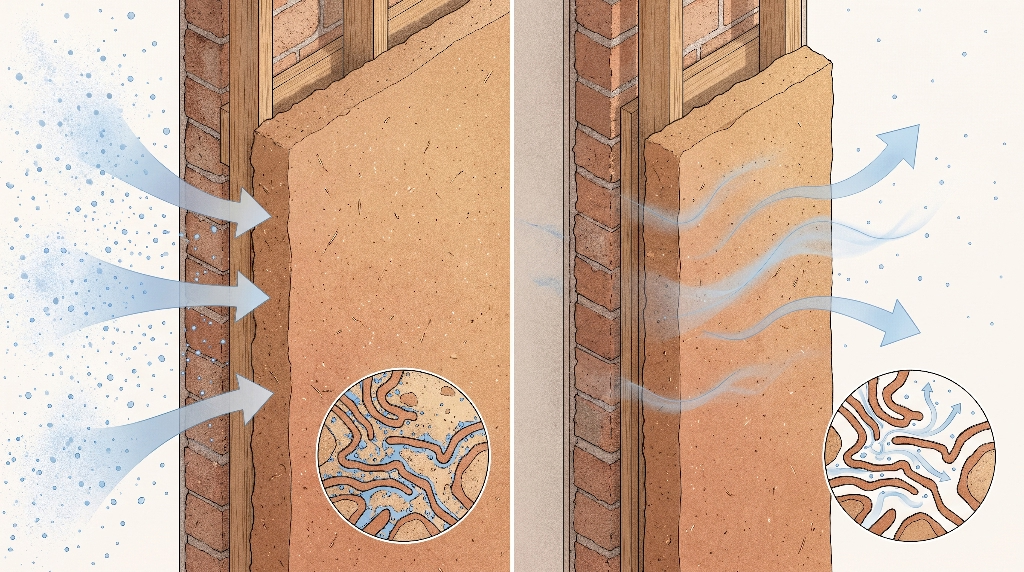
To understand why clay plaster controls indoor humidity so well, you have to look at how it holds together at a microscopic level. Portland cement and gypsum drywall rely on chemical reactions that lock their molecules into dense, rigid crystals. Unfired clay works differently. Natural clay minerals such as kaolinite, montmorillonite, and illite are made of millions of microscopic, flat platelets. When you mix raw clay with water and sand, those tiny platelets stack together and hold fast through physical electrical attraction rather than a permanent chemical bond.
Because there is no chemical glue sealing the gaps between those platelets, cured clay plaster stays packed with millions of microscopic open pores. Building engineers refer to this open, moisture-storing capacity as hygric mass. Just as thermal mass stores heat energy during the day and releases it at night, hygric mass stores water vapor when a room gets humid and releases that moisture back into the air when the room dries out.
Scientists split this two-way process into two simple actions:
- Adsorption: When someone takes a hot shower, boils a pot of pasta, or hosts a crowded dinner party, moisture levels in the air shoot up. The microscopic pores inside clay plaster attract those extra water vapor molecules and hold them onto their inner surfaces. Notice the spelling: adsorption with a “d” means water vapor clings to the pore walls as a thin molecular film without turning into liquid puddles or making the wall feel wet to the touch.
- Desorption: Later that night or the next morning, when the air conditioner or winter furnace dries out the indoor air, the moisture balance flips. The clay plaster gently releases its stored water molecules back into the room as invisible vapor, raising the indoor relative humidity back toward that comfortable 40 to 60 percent range.
It is also important not to confuse dynamic moisture buffering with simple vapor permeability. Builders often measure vapor permeability using a water vapor diffusion resistance factor, known as the mu-value. A low mu-value simply means water vapor can pass through a wall assembly over weeks or months without getting trapped as interstitial condensation inside the framing. Dynamic moisture buffering is much faster and more active. It measures how quickly the surface of your interior wall reacts to sudden, everyday moisture spikes over a 24-hour cycle.
The real-world numbers in a standard room are impressive. In a typical bedroom with about 33 square meters (roughly 355 square feet) of exposed wall surface, a well-designed layer of clay plaster can absorb around 660 grams of water vapor during a sudden 10% jump in relative humidity. That equals nearly a pound and a half of water pulled out of the air silently by your walls. Across an entire home, that passive buffering cuts daily indoor humidity swings by 15% to 35%, taking a massive load off your mechanical equipment.
Measuring Moisture Buffer Value (MBV): What the Lab Numbers Mean
If you compare product data sheets from different plaster manufacturers, you will quickly run into technical lab ratings. Knowing how to read these numbers keeps you from buying an expensive decorative finish that looks pretty but does very little for your indoor air quality.
The single most useful metric for comparing breathable wall finishes is the Moisture Buffer Value, shortened to MBV. Engineers measure MBV in grams per square meter per percent relative humidity. In plain language, MBV tells you exactly how many grams of water vapor one square meter of wall surface can soak up and release every time the room’s relative humidity shifts by 1%. The higher the MBV number, the stronger the wall’s ability to steady your indoor climate.
To make sure different materials are tested fairly, building science laboratories rely on three main international testing standards:
- The NORDTEST Protocol: Developed by Scandinavian building researchers, this is the gold standard for dynamic moisture testing. Lab technicians seal the back and edges of a plaster sample so moisture can only enter through the front face, just like a real wall. They place the sample in a climate chamber set to 75% RH for 8 hours to mimic daytime cooking, showering, and breathing, then drop the chamber to 33% RH for 16 hours to mimic dry overnight conditions. They repeat this 24-hour cycle until the sample reaches a steady rhythm, then calculate its MBV.
- DIN 18947: This strict German national standard governs factory-made earth plasters. Alongside strength and abrasion rules, DIN 18947 tests how much water vapor a clay plaster absorbs over 12 hours when humidity jumps from 50% to 80% RH, sorting products into three official water vapor adsorption classes (WS I, WS II, and WS III).
- ISO 24353: This international standard measures hygrothermal adsorption and desorption behavior under cyclic humidity changes, including targeted testing right inside the 40 to 60 percent RH band where people actually live and sleep.
Under the NORDTEST grading scale, building materials fall into five clear performance tiers:
- Negligible (0.0 to 0.2): Materials like glass, metal, and vinyl wallpaper that absorb virtually zero moisture.
- Limited (0.2 to 0.5): Standard painted drywall and concrete block.
- Moderate (0.5 to 1.0): Unpainted gypsum board, softwood lumber, and basic lime plasters.
- Good (1.0 to 2.0): Standard earthen renders and natural clay plaster mixes.
- Excellent (Above 2.0): High-performance, fiber-reinforced clay plaster engineered specifically for maximum moisture buffering.
When you specify a clay plaster that scores in the Good or Excellent tier, you are putting an active, proven climate stabilizer on every wall of your house.
Clay Plaster vs. Lime, Gypsum Drywall, and Cement: Buffering Showdown
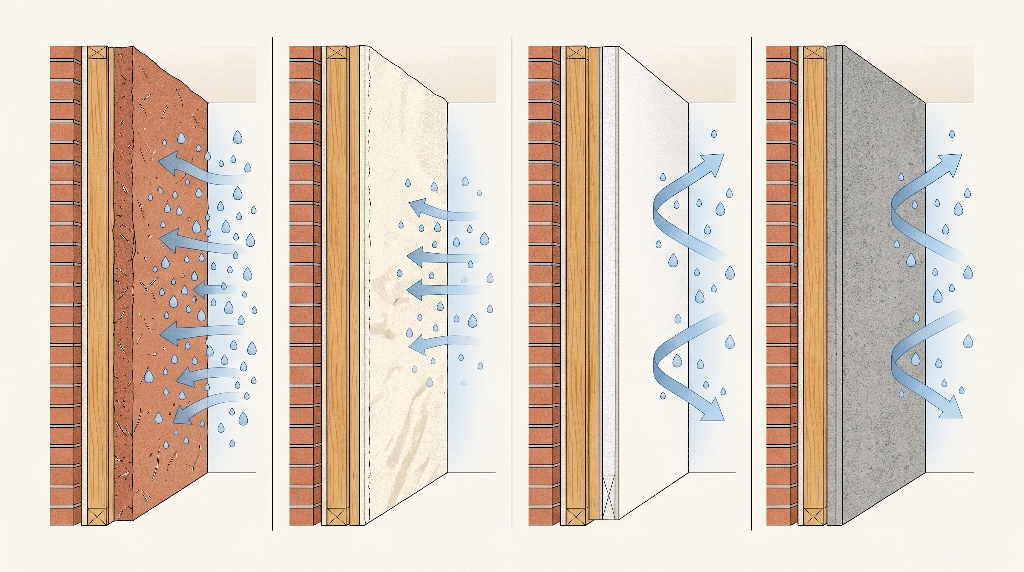
Homeowners often ask me whether they really need clay plaster, or if standard drywall, hydraulic lime plaster, or cement stucco will give them similar results. While all four materials go onto walls with a trowel or sheets, they behave like completely different worlds when moisture hits the room.
Unfired clay plaster sits at the top of the heap for dynamic moisture buffering. Depending on the clay minerals and fibers in the mix, clay plaster typically posts an MBV between 1.23 and 2.38, storing anywhere from 20 to 70 grams of water vapor per square meter during a daily humidity cycle. In side-by-side university chamber tests, clay plaster absorbs roughly 5 to 10 times more moisture than standard gypsum drywall and nearly twice as much as lime plaster. Even more importantly, clay reacts almost instantly when steam enters a room.
Natural hydraulic lime plaster (commonly sold as NHL 3.5 or NHL 5) is a wonderful traditional building material, especially on exteriors and wet walls. Lime plasters generally achieve an MBV between 0.6 and 1.4 and buffer around 10 to 30 grams of moisture per square meter. While lime breathes very well and stops trapped moisture inside masonry walls, its harder crystalline structure absorbs and releases humidity much more slowly than unfired clay.
Gypsum drywall is the standard wall finish across North America because it is cheap and fast to hang. Bare, unpainted gypsum board has a modest MBV between 0.3 and 0.7, holding only 5 to 10 grams of water per square meter. However, nobody leaves raw paper-faced drywall bare. The moment a painter rolls on PVA primer and two coats of standard acrylic latex paint, that thin plastic paint film seals the gypsum pores shut, dropping its effective MBV down near 0.1.
Portland cement render sits at the very bottom. With an MBV around 0.1 to 0.3, cement is dense, rigid, and virtually non-buffering. Worse yet, cement traps moisture behind it, often leading to peeling paint and dampness issues in older homes.
| Wall Finish Material | Moisture Buffer Value (MBV) | Daily Moisture Uptake | Reaction Speed to RH Spikes | Spot Repair Difficulty | Liquid Water Resistance |
| Unfired clay plaster | 1.23 to 2.38 (Good to Excellent) | 20 to 70 g per sq meter | Very fast (immediate) | Very easy (mist and re-trowel) | Low (softens if soaked) |
| Hydraulic lime plaster | 0.60 to 1.40 (Moderate to Good) | 10 to 30 g per sq meter | Moderate | Moderate (requires patching blend) | High (weather and splash proof) |
| Painted gypsum drywall | 0.10 to 0.30 (Negligible to Limited) | Under 5 g per sq meter | Very slow | Moderate (sand, mud, and repaint) | Low (paper and core degrade) |
| Portland cement render | 0.10 to 0.30 (Negligible to Limited) | Under 5 g per sq meter | Extremely slow | Difficult (visible patch seams) | Very high |
How Thick Should Clay Plaster Be for Maximum Moisture Buffering?
One of the most common mistakes I see on custom home projects is treating clay plaster like a coat of thick paint. Some suppliers sell thin, 2-millimeter decorative finish coats and imply you will get full climate control from a paper-thin skim coat. The physics simply do not back that up.
Researchers at the University of Bath, including Professor Pete Walker and Dr. Daniel Maskell, ran detailed tests to measure how deep moisture actually travels into clay plaster over a normal 24-hour day. By testing plaster samples at different thicknesses under cyclic humidity swings, they discovered a clear rule of thumb called the active daily penetration depth. Over a single 24-hour cycle, airborne water vapor mainly interacts with the outermost 10 millimeters (roughly 3/8 of an inch) of the wall surface.
If you only apply a 2-millimeter or 3-millimeter skim coat of clay plaster over painted drywall, the moisture hits that sealed drywall backing almost right away. The wall runs out of storage space in less than an hour, leaving the rest of the room’s steam to condense on your window glass.
To capture the full power of clay plaster dynamic moisture buffering capacity, follow these practical thickness guidelines:
- Standard Living Spaces (10 mm to 15 mm): Applying a basecoat and finish coat that total 10 to 15 millimeters (about 3/8 to 5/8 inch) captures peak 24-hour buffering performance. This thickness gives water vapor the full 10-millimeter active zone it needs to cycle in and out smoothly every single day.
- High-Moisture Rooms (15 mm to 20 mm): In bathrooms, laundry rooms, or tight super-insulated homes where moisture loads stay elevated for days at a time, stepping up to 15 to 20 millimeters (about 5/8 to 3/4 inch) adds deeper multi-day storage capacity behind that active surface layer.
Think of thickness as the size of your home’s moisture battery. A 2-millimeter skim coat is like a tiny watch battery, while a 12-millimeter build-up of clay plaster is a deep-cycle bank that easily handles whatever your family throws at it.
How Hemp Shiv, Straw, and Pumice Supercharge Clay Plaster Performance
Thickness gives your walls storage volume, but the recipe inside the bag determines how fast that moisture moves in and out. Plain clay and sand already outperform drywall by a wide margin, yet adding natural plant fibers and lightweight volcanic aggregates turns good clay plaster into an extraordinary building material.
In another landmark study at the University of Bath, engineers tested standard clay plaster mixes against mixes blended with hemp shiv (the chopped, woody inner core of the industrial hemp stalk) and natural plant fibers. The lab results were eye-opening. Adding hemp shiv and plant fibers boosted total moisture buffering capacity by an impressive 54%. Even better, those natural fibers sped up the initial adsorption and desorption rates by more than 60%.
Why does speed matter so much in a real house? Think about what happens when someone takes a 15-minute hot shower or boils water on the stove. Relative humidity in that room does not creep up slowly over six hours; it explodes in minutes. A slow-reacting wall lets that sudden cloud of steam drift onto cold window panes and bathroom mirrors, creating condensation drips and mildew. Because hemp shiv and plant fibers act like tiny capillary straws embedded right in the surface of the clay plaster, they wick that sudden burst of humidity straight into the wall before it ever turns into liquid droplets.
Other natural additives bring equally valuable benefits to the mix:
- Chopped Straw and Flax Fibers: Fine, clean straw or flax fibers weave through the basecoat like microscopic rebar. As thick clay plaster dries on the wall, these fibers distribute tension evenly, preventing hairline shrinkage cracks while opening up extra air channels for vapor movement.
- Pumice Aggregate: Crushed volcanic pumice is full of tiny sealed and open air pockets. Replacing heavy river sand with lightweight pumice lowers the overall weight of the plaster, improves its gentle thermal insulation value, and increases internal surface area for moisture storage.
When shopping for bagged clay plaster or working with a plastering contractor, always check the ingredient list for natural plant fibers or lightweight aggregates in the basecoat rather than settling for plain sand and clay alone.
Beyond Humidity: Passive VOC Removal, Acoustics, and Lower HVAC Loads
Keeping indoor air inside the 40 to 60 percent relative humidity zone is reason enough to choose clay plaster, yet homeowners quickly notice three bonus benefits once they move in.
First is cleaner, fresher indoor air. Modern homes are packed with synthetic carpets, engineered wood cabinets, cleaning sprays, and plastic finishes that slowly release volatile organic compounds (VOCs) into the air. At the same time, outdoor air pollution and certain electronics bring trace amounts of ground-level ozone indoors. Laboratory testing by building researchers, including teams at the University of Kassel, has shown that raw clay surfaces actively capture and neutralize indoor ozone and airborne VOC molecules. Better yet, natural clay plaster contains zero synthetic solvents, acrylics, or formaldehyde, meaning it adds zero chemical off-gassing of its own to your home.
Second is lower heating and cooling bills. HVAC engineers call moisture removal “latent cooling load.” In humid summer climates, your air conditioner spends a huge chunk of its runtime just wringing water out of the air before it can even cool the room down. By absorbing peak daytime humidity spikes and releasing that moisture at night when outdoor temperatures drop, clay plaster reduces the latent load on your heat pump or air conditioner.
In the winter, the benefit works in reverse. Dry winter air pulls moisture off your skin, making a 70-degree room feel chilly. When clay plaster holds your indoor humidity steady near 45% RH, your body feels noticeably warmer at a lower air temperature, letting you dial the thermostat back one or two degrees without sacrificing comfort.
Third is peaceful room acoustics. Open-concept floor plans with hardwood floors, big glass windows, and painted drywall bounce sound waves around like an echo chamber. Because clay plaster has a micro-porous, subtly textured surface, it absorbs sound energy instead of reflecting it. Acoustic testing shows that a 10-millimeter layer of clay plaster reaches a Noise Reduction Coefficient (NRC) around 0.25, roughly five times better at absorbing mid-frequency speech noise than standard painted drywall. Dinner conversations sound clearer, footsteps feel softer, and the whole house feels calmer.
Don’t Kill Your Wall’s Breathability: Substrates, Primers, and Topcoat Rules
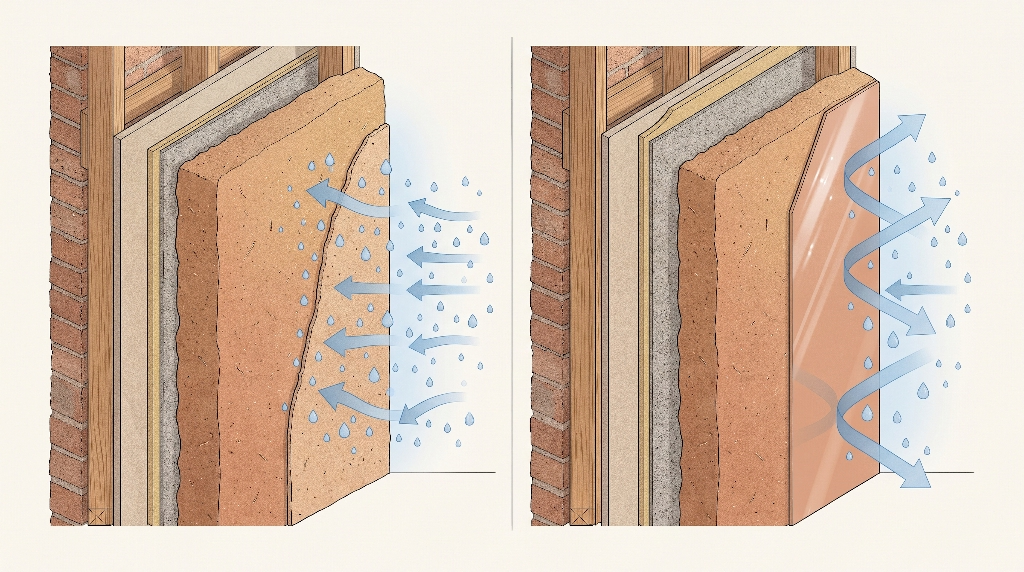
You can buy the highest-rated clay plaster on the market and apply it at a full 15-millimeter thickness, yet a single trip to the local paint store can ruin all of that performance in one afternoon. Knowing how to prep the wall underneath and how to finish the surface on top is essential.
Preparing Substrates for Strong Adhesion
One of the best things about clay plaster is its versatility. You do not need exotic straw-bale or adobe walls to use it. Builders regularly apply clay plaster over standard paper-faced gypsum drywall, blueboard, brick, concrete block, and even existing painted walls in remodel projects.
However, raw clay needs mechanical grip so it does not slide or flake off smooth surfaces. Before troweling on your basecoat, roll on a specialized quartz-grit mineral primer. This primer dries into a rough, sandpaper-like mineral texture full of tiny silica grains. When you press the wet clay plaster onto that gritty surface, the clay locks around those mineral grains like Velcro, creating a permanent mechanical bond without blocking vapor movement.
Avoiding the Sealer Trap
Here is the golden rule every homeowner and painting contractor must follow: never apply acrylic sealers, PVA primers, polyurethane, or standard latex paint over clay plaster.
Standard wall paints and clear sealers work by forming a continuous plastic film across the surface. That plastic film acts just like wrapping your entire bedroom in kitchen plastic wrap. Once those microscopic clay pores are sealed shut, water vapor can no longer enter or leave the wall. Your dynamic moisture buffering capacity drops to zero overnight, and you lose the entire health and comfort benefit you paid for.
If you want to change the color of your clay plaster or wipe away dust, stick strictly to vapor-permeable mineral finishes:
- Integral Natural Pigments: Earth ochres, iron oxides, and mineral pigments mixed directly into the wet finish coat give rich, permanent color that never peels.
- Clay Paints and Limewashes: Pure clay paint or natural limewash bonds directly into the plaster surface while leaving every microscopic pore wide open.
- Potassium Silicate Mineral Paints: True mineral silicate paints chemically fuse with the sand in the plaster without forming a plastic film, offering high scrub durability with near-zero vapor resistance.
Effortless Jobsite Spot Repairs
From a carpenter and builder standpoint, clay plaster offers a maintenance advantage that no other wall finish can match. If a kid bangs a bicycle handlebar into painted drywall, you have to cut out the torn paper, apply joint compound, wait for it to dry, sand a cloud of white dust all over your furniture, prime, and repaint the whole wall so the sheen matches.
With clay plaster, you simply grab a spray bottle of plain water, mist the dented spot for ten seconds until the clay softens back into paste, smooth it flush with a small trowel or damp sponge, and let it dry. Because there is no chemical cure and no paint film, the repaired spot blends seamlessly with zero visible patch lines and zero sanding dust.
Where to Use Clay Plaster (and Where to Switch to Lime)
While clay plaster shines across most of a home’s interior, smart homebuilding means putting the right material in the right spot. Because unfired clay relies on physical water-soluble bonds rather than a waterproof chemical set, it will soften and wash away if hit directly with running liquid water.
Here is how to map out your floor plan for long-term durability:
- Bedrooms and Nurseries (Top Priority): Two sleeping adults release roughly a pint of water vapor into a bedroom every night just by breathing and perspiring. In a closed bedroom with painted drywall, humidity often climbs above 65% RH by 3:00 AM, leading to stuffy air and restless sleep. Coating bedroom walls with clay plaster buffers that overnight moisture spike effortlessly.
- Living Rooms, Dining Areas, and Home Offices: These spaces host family gatherings, houseplants, and daily foot traffic. Clay plaster keeps humidity steady, softens room echo, and adds warm, natural visual depth that flat paint simply cannot imitate.
- Upper Bathroom Walls and Ceilings: Bathrooms generate the biggest daily moisture bursts in any home. Using clay plaster on the upper walls and ceiling absorbs steam clouds immediately and prevents fogged mirrors and ceiling mildew.
- Wet Splash Zones (Switch to Hydraulic Lime or Tadelakt): Inside shower stalls, directly around bathtubs, and right behind kitchen sinks where water splashes constantly, switch to hydraulic lime plaster or traditional burnished Tadelakt. Lime cures chemically into waterproof limestone, giving you seamless visual beauty and vapor breathability in wet zones while standing up to daily water spray.
Frequently Asked Questions About Clay Plaster and Indoor Humidity
Does clay plaster really regulate indoor humidity?
Yes. Unfired clay plaster contains millions of microscopic open pores that pull excess water vapor out of humid air through adsorption and release it back when rooms get dry through desorption. Lab and real-room studies show that properly applied clay plaster cuts daily indoor humidity swings by 15% to 35%, keeping rooms comfortably inside the healthy 40 to 60 percent RH range.
How thick does clay plaster need to be for moisture buffering?
For maximum daily moisture buffering, clay plaster should be applied at a total thickness of 10 to 15 millimeters (about 3/8 to 5/8 inch). University of Bath research shows that daily humidity swings interact primarily with the outermost 10 millimeters of the wall. Thin 2-millimeter skim coats lack enough pore volume to buffer large moisture spikes effectively.
Is clay plaster better than lime plaster or gypsum for humidity control?
Yes, for passive indoor humidity regulation, clay plaster outperforms both lime and gypsum. Clay plaster typically achieves a Moisture Buffer Value between 1.23 and 2.38, absorbing roughly twice as much moisture as hydraulic lime plaster and 5 to 10 times more than unpainted gypsum drywall, while reacting much faster to sudden steam spikes.
Can you paint or seal clay plaster without ruining its breathability?
You must never use standard latex paint, acrylic sealers, or PVA primers on clay plaster, because they form a plastic film that blocks the pores and stops moisture buffering. Instead, tint the plaster with natural earth pigments, or coat it with pure breathable clay paint, limewash, or potassium silicate mineral paint so water vapor moves freely.
Can you use clay plaster in a bathroom or kitchen?
Yes, you can use clay plaster on bathroom ceilings, upper bathroom walls, and main kitchen walls to absorb cooking and shower steam before condensation forms. However, because unfired clay softens on contact with liquid water, avoid using it inside shower enclosures or directly behind sinks, where waterproof hydraulic lime or Tadelakt belongs instead.
Does clay plaster prevent mold, dust mites, and dry winter air?
Clay plaster helps prevent all three by holding indoor air inside the 40 to 60 percent relative humidity sweet spot. Keeping summer humidity below 60% RH stops mold spores from germinating and slows dust mite growth, while releasing stored moisture in winter keeps humidity above 40% RH to protect dry skin and nasal passages.
5-Step Builder and Homeowner Specification Checklist
If you are planning a custom home build or an interior remodel and want to lock in genuine passive humidity control, review these five essential steps with your builder or plastering contractor before work begins:
- Verify Your Wall Substrate and Vapor Profile: Confirm that your exterior walls are built with a smart, breathable assembly that dries outward or inward without trapping condensation inside the framing. Coat existing drywall or masonry with a high-grip quartz mineral primer before plastering.
- Specify a Full 10 mm to 15 mm Build-Up: Write the exact finished thickness directly into your construction contract. Require a sturdy basecoat plus a fine finish coat totaling at least 10 millimeters (3/8 inch) so your walls have the full active hygric mass needed for 24-hour moisture cycles.
- Choose Fiber-Reinforced Basecoats: Select a clay plaster basecoat blended with natural plant fibers such as hemp shiv, chopped straw, or flax. This boosts total moisture storage by over 50%, speeds up steam capture during showers and cooking, and prevents shrinkage cracks.
- Ban Film-Forming Paints and Sealers: Put a clear note in the painting specifications prohibiting latex, acrylic, oil, or polyurethane coatings on any plastered wall. Stick exclusively to integral mineral pigments, clay paints, or potassium silicate washes.
- Pair Passive Walls with Balanced Mechanical Ventilation: Combine your clay plaster walls with a properly sized Energy Recovery Ventilator (ERV) or Heat Recovery Ventilator (HRV). Together, balanced fresh-air ventilation and high-buffering clay walls deliver unmatched indoor air quality, quiet comfort, and rock-steady 40 to 60 percent relative humidity all year round.