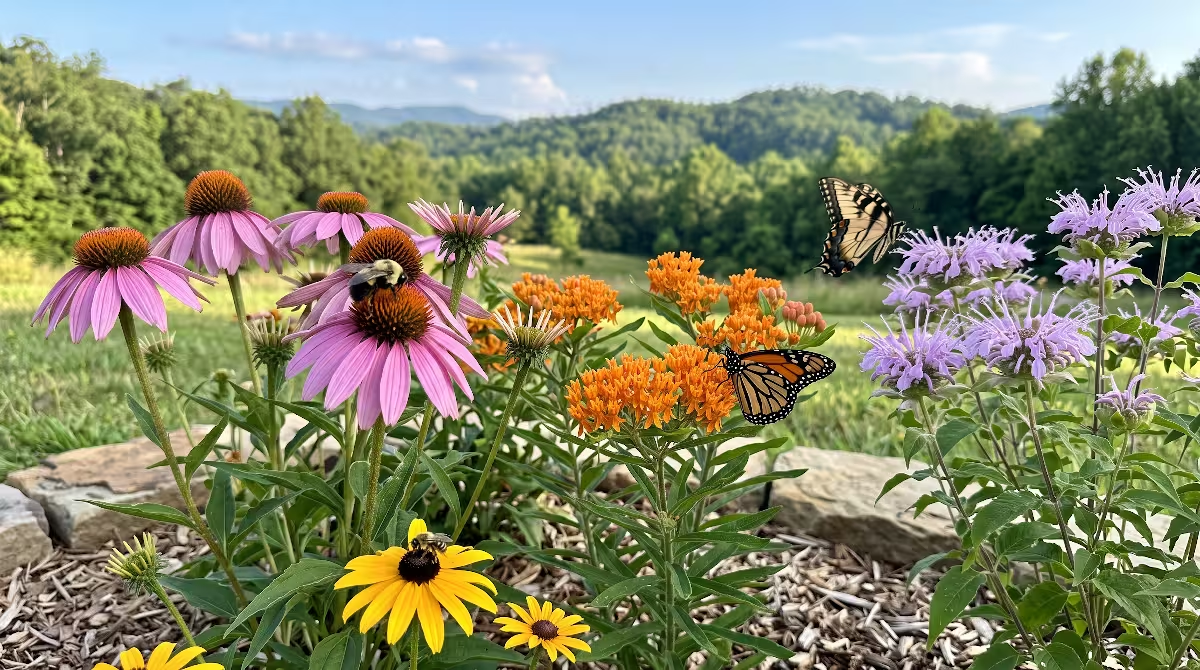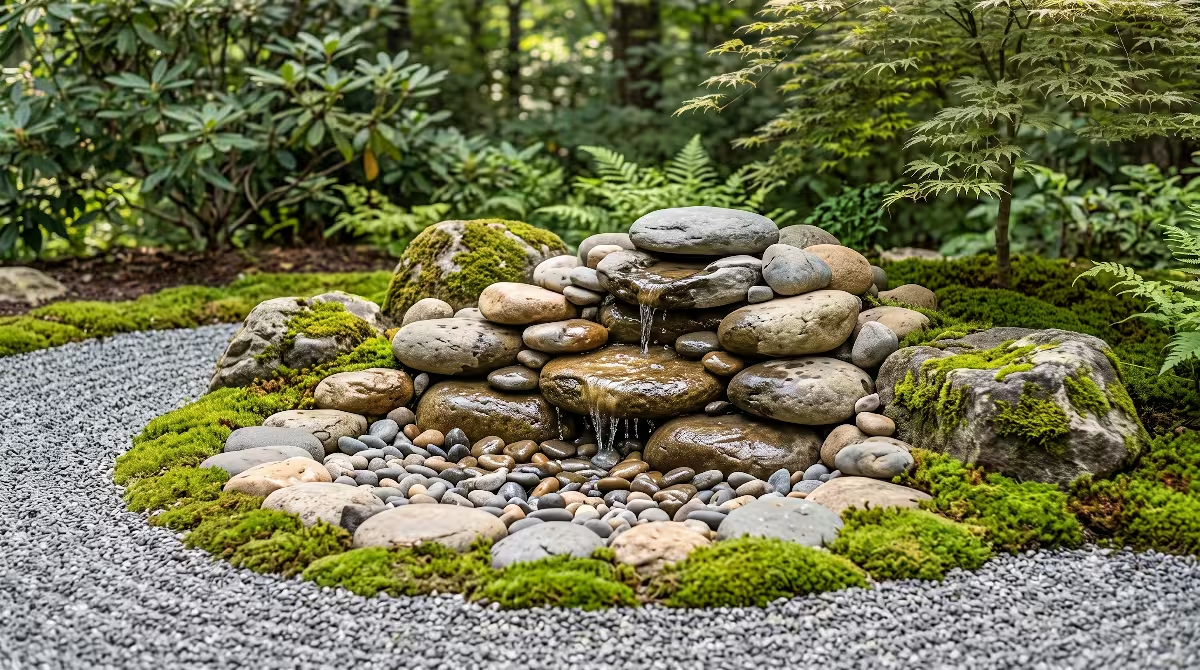

Foundational Biophilic Architecture and Regional Context
A well-crafted sensory outdoor living landscape brings the natural wealth of the Southern Appalachian region directly to your back door. When we look at sustainable home building today, we often see outdoor spaces treated like simple outdoor rooms with flat wooden decks and bare turf grass. True biological design demands a much deeper connection.
Building a sensory outdoor living landscape requires us to look closely at the ancient, rugged ecology of the Southern Blue Ridge mountains and the unique Ridge and Valley area of East Tennessee. This discipline blends landscape engineering with regional biology, creating a living system where the edge between the home interior and the open woods disappears.
+---------------------------------------------------------------+
|                    THE MONTANE FOREST CANOPY                  |
|          Oak, Sugar Maple, Tulip Poplar, Sourwood             |
+---------------------------------------------------------------+
                               |
                               v
+---------------------------------------------------------------+
|                    UNDERSTORY & SHRUB MATRIX                  |
|       Mountain Laurel, Catawba Rhododendron, Witch Hazel      |
+---------------------------------------------------------------+
                               |
                               v
+---------------------------------------------------------------+
|                    LIVING GROUNDCOVER LAYER                   |
|           Wild Ginger, Foamflower, Native Ferns               |
+---------------------------------------------------------------+
                               |
                               v
+---------------------------------------------------------------+
|                    REGIONAL GEOLOGY & SOIL                    |
|       Crab Orchard Sandstone & Ancient Loam Profiles          |
+---------------------------------------------------------------+
The landscape of East Tennessee, covering communities like Johnson City, Kingsport, and Bristol, sits within an
By applying proven biophilic ideas, we tap into a basic human need for direct contact with nature. Pioneer researchers showed that when people view, hear, and feel living natural systems, their physical stress levels drop quickly. Heart rates slow down, and mental focus returns. In our busy digital lives, building a functional sensory outdoor living landscape restores this daily balance. Every stone pathway, running stream of clean water, and fragrant flower bed helps anchor your family into the cycles of the East Tennessee mountain season.
The Multi-Sensory Ecology Framework
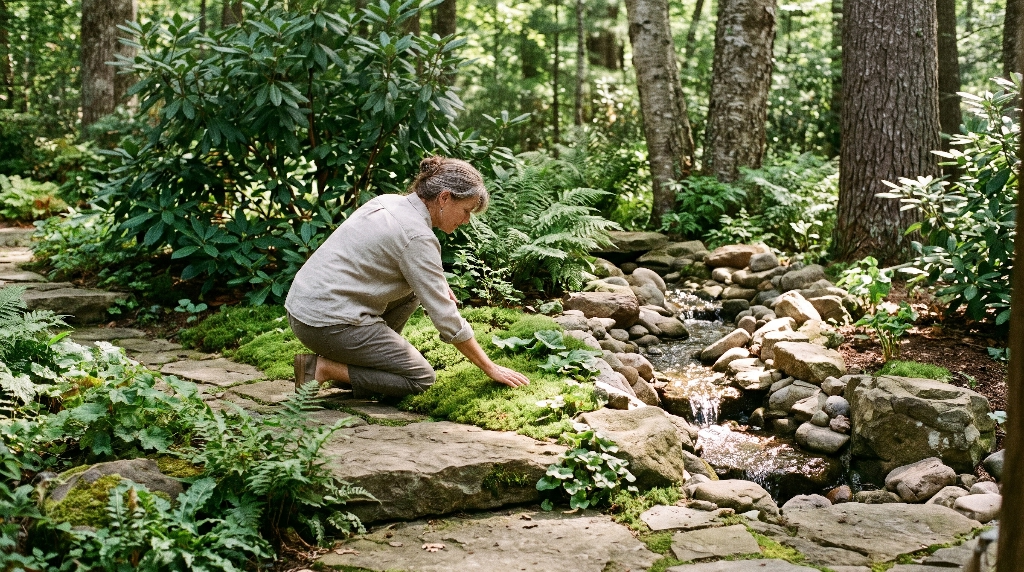
Designing a rich sensory outdoor living landscape requires careful attention to how our five senses take in an environment. Traditional landscaping focuses almost entirely on how a yard looks from the street. An ecological living area engages touch, hearing, smell, and temperature shifts. By balancing these inputs, your yard becomes a restorative personal retreat.
Acoustic Engineering with Water and Wind
[Mechanical Noise: 70-85 dB] ---> [Deflection: Pine & Cane Screen]
                                         |
                                         v
[Acoustic Masking: Falling Water 50 dB] ---> [Sensory Calm Zone]
To create the best masking sounds, you can design
Along with moving water, mountain breezes make distinct sounds through plant foliage. Planting Eastern white pine trees along the path of prevailing mountain winds creates a gentle whispering sound. Combining white pine with native river cane forms a dense screen that rustles in the wind while physically deflecting incoming street noise. This turns your sensory outdoor living landscape into a private, quiet sanctuary.
Tactile Engagement and Native Geolithology
Touch connects us immediately to the physical reality of a place. Many modern yards rely on manufactured concrete pavers and plastic composite decking that feel artificial and overheat under the summer sun. A regionally authentic sensory outdoor living landscape uses genuine stones and woods harvested from local quarries and sustainable regional forests.
Wood choices also matter. Using naturally rot resistant black locust timbers for structural framing, railings, and arbors gives the space a hand-built feel. The tight grain of local hardwoods connects the architecture of the house to the wild mountain woods surrounding it.
Olfactory Phasing Across Seasons
Scent bypasses our conscious filters and speaks directly to memory and mood. A sensory outdoor living landscape should smell fresh, vibrant, and changing throughout the year. Instead of relying on artificial sprays or foreign garden flowers, native mountain plants offer delicate scents that match each season.
+---------------------------------------------------------------+
|                      SEASONAL SCENT PHASING                   |
+---------------------------------------------------------------+
|  EARLY SPRING : Crushed Spicebush twigs and sweet sap         |
|  MID-SUMMER   : Clethra sweet pepperbush blossoms             |
|  LATE AUTUMN  : Yellow Witch Hazel citrus floral blooms       |
|  YEAR-ROUND   : Forest petrichor and pine needle resins       |
+---------------------------------------------------------------+
When spring arrives in East Tennessee, the early buds of the spicebush (Lindera benzoin) release a pleasant citrus aroma when brushed along pathways. Moving into the warm summer months, sweet pepperbush fills outdoor living zones with a rich honey scent that drifts across seating areas during evening hours. As autumn sets in and other plants go dormant, native witch hazel opens its ribbon-like yellow petals, releasing a clean floral scent into the brisk air.
Underneath these blooms, the forest floor itself creates a deep aroma. Decaying oak leaves and healthy organic topsoil release geosmin after rain showers. This classic mountain scent grounds the mind and confirms that the yard is alive with healthy soil activity.
Dynamic Visual Rhythm and Appalachian Chromatics
Visual design in an authentic sensory outdoor living landscape moves away from formal geometry and sterile rows of foundation plants. Instead, it mirrors the dynamic, layered sightlines seen in Appalachian forests. When walking along an open mountain trail, your eyes scan through several visual layers: tall tree canopies, open understory trunks, flowering shrubs, and a carpet of green forest floor.
Recreating this multi-tier layering in your home landscape creates depth in small suburban lots. The lowest level starts with wild ferns and creeping groundcovers. Above that, massed native shrubs like Catawba rhododendron (Rhododendron catawbiense) provide deep evergreen structure that holds color through cold mountain winters. Understory trees like Eastern redbud (Cercis canadensis) provide intense magenta blooms in early spring, followed by vibrant heart-shaped leaves that filter sunlight into soft patterns across your patio.
The visual display changes month by month:
- April: Bright pink redbud flowers and fresh green emerging ferns.
- June: Large white and purple blossoms of native mountain laurel (Kalmia latifolia) and great rhododendron (Rhododendron maximum).
- October: Bright scarlet sourwood (Oxydendrum arboreum) leaves, golden sugar maples (Acer saccharum), and bronze oak foliage.
- January: Structural evergreen leaves, textured tree barks, and mossy stone outcrops.
Spatial Layout: Programmatic Rooms and Terrain Synthesis
A practical outdoor area must serve daily human needs while respecting natural site contours. In a sensory outdoor living landscape, we divide the yard into open-air rooms that invite dining, conversation, quiet study, and active family recreation.
+-------------------------------------------------------------------+
|                            RESIDENCE                              |
|                       (Indoor Comfort Zone)                       |
+-------------------------------------------------------------------+
                                  |
                                  v
+-------------------------------------------------------------------+
|               COVERED PAVILION (The Refuge Zone)                  |
|     Low stone seat-walls, outdoor fireplace, sheltered views      |
+-------------------------------------------------------------------+
                                  |
                                  v
+-------------------------------------------------------------------+
|               TERRACED PATIO (Transition Zone)                    |
|   Crab Orchard stone paving, trickling runnel, sensory herbs      |
+-------------------------------------------------------------------+
                                  |
                                  v
+-------------------------------------------------------------------+
|               MEADOW & WOODLAND (The Prospect Zone)               |
|      Open sightlines to mountain ridges, deep native plantings    |
+-------------------------------------------------------------------+
Prospect and Refuge Dynamics
Biophilic architecture relies heavily on the concepts of
You can create this balance in a sensory outdoor living landscape by pairing covered structures with open view corridors. A timber-framed porch or stone pavilion serves as the refuge. With a sturdy roof overhead, a solid stone fireplace at your back, and low seat walls enclosing the space, you feel protected from wind, rain, and bright sun.
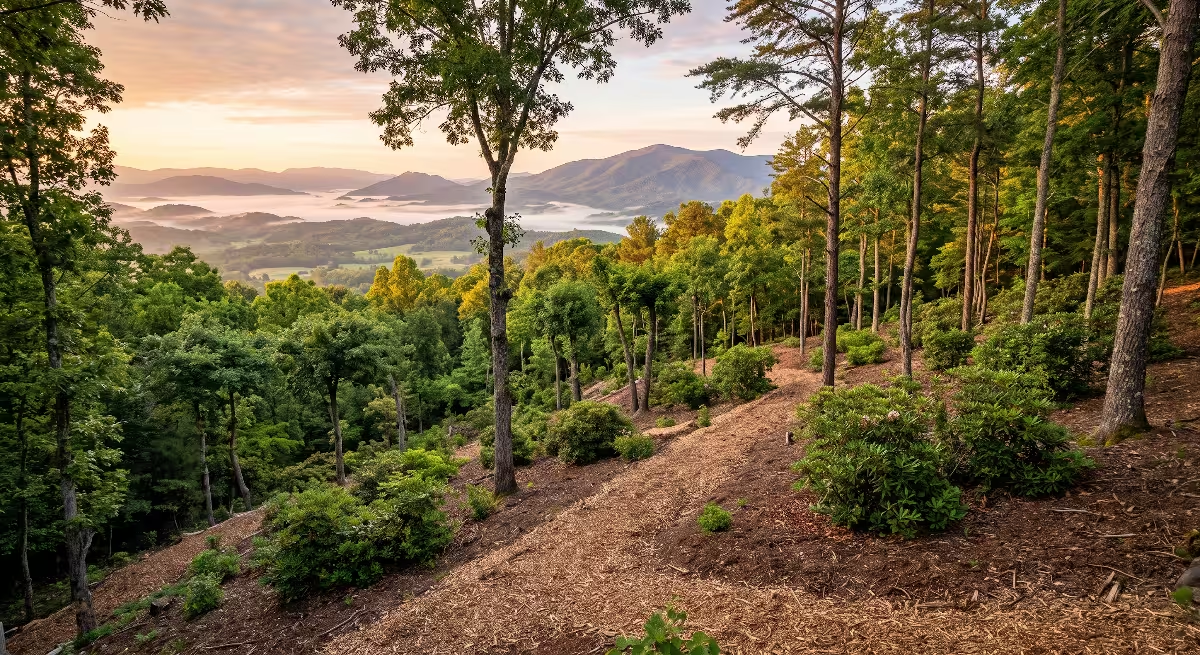
From this sheltered space, the eye travels outward across open stone terraces toward panoramic views of nearby mountain ridges. Even on small residential lots where mountain views are blocked by neighbors, you can build a smaller view by framing a garden focal point, a reflection pool, or a copse of birch trees. This gives your eye a long line of sight, creating an open, unconfined feeling.
Topographical Negotiation on Montane Slopes
Building on the rolling hills and steep mountainsides of East Tennessee presents real engineering hurdles. Standard construction methods often cut deep into the hillside with heavy machinery, leaving ugly, exposed cuts held up by industrial concrete blocks. Over time, these sterile walls crack, move, and destroy the natural beauty of the lot.
A well-planned sensory outdoor living landscape
Natural Slope Profile:
========================================= High Ridge
        \
         \    [Terrace 1: Dining Pavilion]
          +-----------------------+
          | Native Stone Wall     |
          +-----------------------+
                   \
                    \    [Terrace 2: Fire Feature & Seating]
                     +-----------------------+
                     | Stone Retaining Step  |
                     +-----------------------+
                              \
                               \    [Terrace 3: Rain Garden Basin]
                                +-----------------------+
                                ========================= Valley Basin
Stepping down through multiple levels adds interest to the yard. You can place an outdoor dining table on an upper terrace near the kitchen, a quiet fire feature on a mid-level terrace, and a bioswale or rain garden on the lowest level. This approach protects existing tree roots and honors the mountain terrain.
Microclimate Optimization for Extended Seasonal Living
A big challenge with outdoor spaces is that they sit empty when the weather turns slightly cold or uncomfortably hot. By planning for seasonal sun angles and wind paths, your sensory outdoor living landscape stays comfortable for up to ten months out of the year in East Tennessee.
+-------------------------------------------------------------------+
|                     SEASONAL CLIMATE CONTROLS                     |
+-------------------------------------------------------------------+
|  SUMMER STRATEGY : High canopy deciduous shade (Tulip Poplar)     |
|                    Cooling mist from cascading water runnels      |
|                                                                   |
|  WINTER STRATEGY : Low winter sun warms thermal stone walls       |
|                    Northwest evergreen tree windbreak             |
|                    Massive Cumberland Plateau stone fireplace     |
+-------------------------------------------------------------------+
During warm summer days, broad deciduous trees like tulip poplars and sugar maples provide high shade over outdoor seating areas. Their leaves block intense overhead sunlight while their natural transpiration cools the air underneath. In winter, these trees drop their leaves, allowing low-angle winter sunlight to pass straight through and warm your stone patios.
To extend use into chilly spring and autumn evenings, incorporate thermal mass. Building a thick outdoor fireplace or sitting wall using dense Cumberland Plateau sandstone lets the stonework absorb heat from the fire or afternoon sun. The stones slowly release this warmth into the seating area well into the night. Combined with evergreen plantings that block cold northwest winter winds, your outdoor space stays warm and inviting even when frost coats the grass.
The Native Plant Palette: Keystone Taxa for Sensory Performance
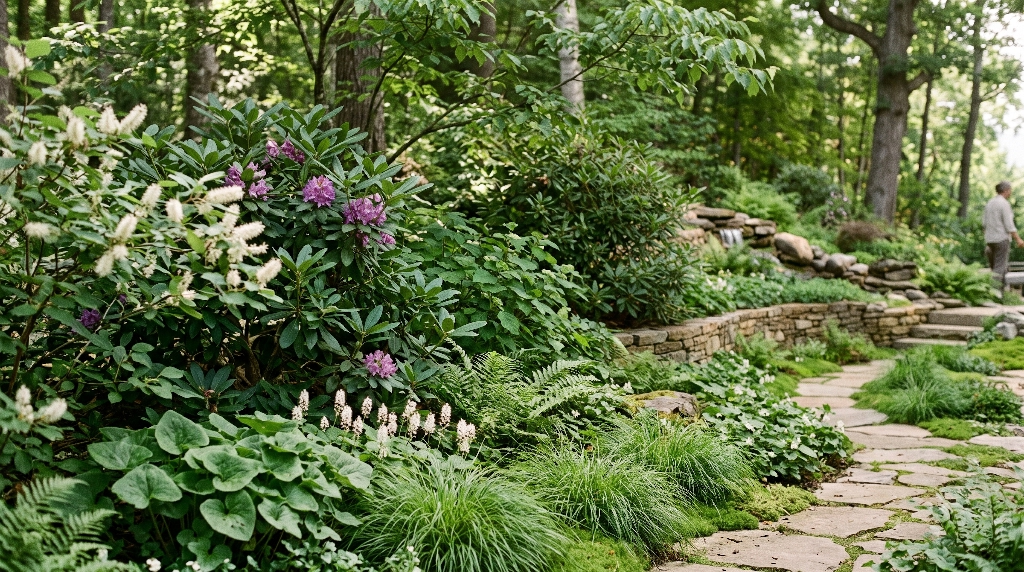
Selecting plants for a sensory outdoor living landscape goes beyond choosing pretty flowers at a garden center. We focus on indigenous plants adapted to the acid soils, rainfall patterns, and native insects of East Tennessee. These plants thrive without chemical fertilizers, artificial weedkillers, or excessive watering, all while providing rich sensory interest.
+-----------------------------------------------------------------------+
|                 APPALACHIAN NATIVE CANOPY AND UNDERSTORY              |
+-----------------------------------------------------------------------+
|  Overstory Trees  : Quercus alba (White Oak)                          |
|                     Acer saccharum (Sugar Maple)                      |
|                     Liriodendron tulipifera (Tulip Poplar)            |
|                                                                       |
|  Understory Trees : Amelanchier arborea (Downy Serviceberry)          |
|                     Oxydendrum arboreum (Sourwood)                    |
|                     Cercis canadensis (Eastern Redbud)                |
+-----------------------------------------------------------------------+
                                  |
                                  v
+-----------------------------------------------------------------------+
|                 KEYSTONE SHRUB AND GROUNDCOVER MATRIX                 |
+-----------------------------------------------------------------------+
|  Structural Shrubs: Kalmia latifolia (Mountain Laurel)                |
|                     Rhododendron maximum (Great Laurel)               |
|                     Fothergilla major (Mountain Witch Alder)          |
|                     Hydrangea arborescens (Smooth Hydrangea)          |
|                                                                       |
|  Living Ground    : Carex pensylvanica (Pennsylvania Sedge)           |
|  Cover Matrix     : Tiarella cordifolia (Foamflower)                  |
|                     Polystichum acrostichoides (Christmas Fern)       |
+-----------------------------------------------------------------------+
Canopy and Understory Structural Trees
Trees define the ceiling of your sensory outdoor living landscape. They frame views, supply cooling shade, and support wildlife like native songbirds and beneficial pollinators.
The downy serviceberry makes an exceptional understory tree near patios. In early spring, it produces airy white flower clusters before other trees wake up. By early summer, these blossoms become sweet, edible purple berries that your family can pick fresh from the branch. In autumn, the foliage turns brilliant shades of orange and gold. Its smooth, grey bark features subtle stripes that catch the eye in winter.
Sourwood serves as another standout tree native to Appalachian ridges. Blooming in midsummer, it produces drooping clusters of white, bell-shaped flowers that resemble lily of the valley. These blossoms release a sweet scent and provide nectar for honeybees. In autumn, sourwood foliage turns a rich crimson color, standing out against evergreen backdrops.
Shrub Layer Massing
Shrubs form the living walls of your sensory outdoor living landscape, dividing outdoor areas into private zones and muffling neighborhood noise.
+---------------------+-------------------+---------------------+
| PLANT SPECIES       | SENSORY ROLE      | SEASONAL HIGHLIGHT  |
+---------------------+-------------------+---------------------+
| Mountain Laurel     | Tactile / Visual  | Geometric Flowers   |
| Witch Alder         | Olfactory / Color | Honey Scent / Fall  |
| Smooth Hydrangea    | Moisture / Texture| Giant Pale Blooms   |
| Catawba Rhododendron| Year-Round Cover  | Purple Spring Caps  |
+---------------------+-------------------+---------------------+
Mountain witch alder brings exceptional sensory value to small outdoor spaces. In spring, it produces white, bottlebrush-like flowers that release a sweet honey scent. Its thick, blue-green leaves have a pleasing leathery texture, and in autumn, the shrub turns deep shades of orange, yellow, and red.
Smooth hydrangea brings bold foliage textures into shaded outdoor rooms. Its large, pale flower heads brighten dark corners under porch eaves or tree canopies. Because it loves moisture, planting smooth hydrangea around drainage areas or next to downspouts creates a lush green border that slows and filters rainwater runoff.
Herbaceous and Ground Matrix
The forest floor teaches us that bare soil does not exist in healthy ecosystems. Instead of using dyed wood mulch that breaks down and needs yearly replacement, an authentic sensory outdoor living landscape uses a living carpet of native groundcovers and sedges.
Living Mulch Profile:
-------------------------------------------------- Soil Line
  ( )   ( )   ( )   Carex pensylvanica (Soft Green Mat)
   |     |     |
  ===   ===   ===   Tiarella cordifolia (Spring Texture & Bloom)
 ##### ##### #####  Asarum canadense (Broad Velvet Foliage)
~~~~~~~~~~~~~~~~~~~~~~~~~~~~~~~~~~~~~~~~~~~~~~~~~~ Root Network
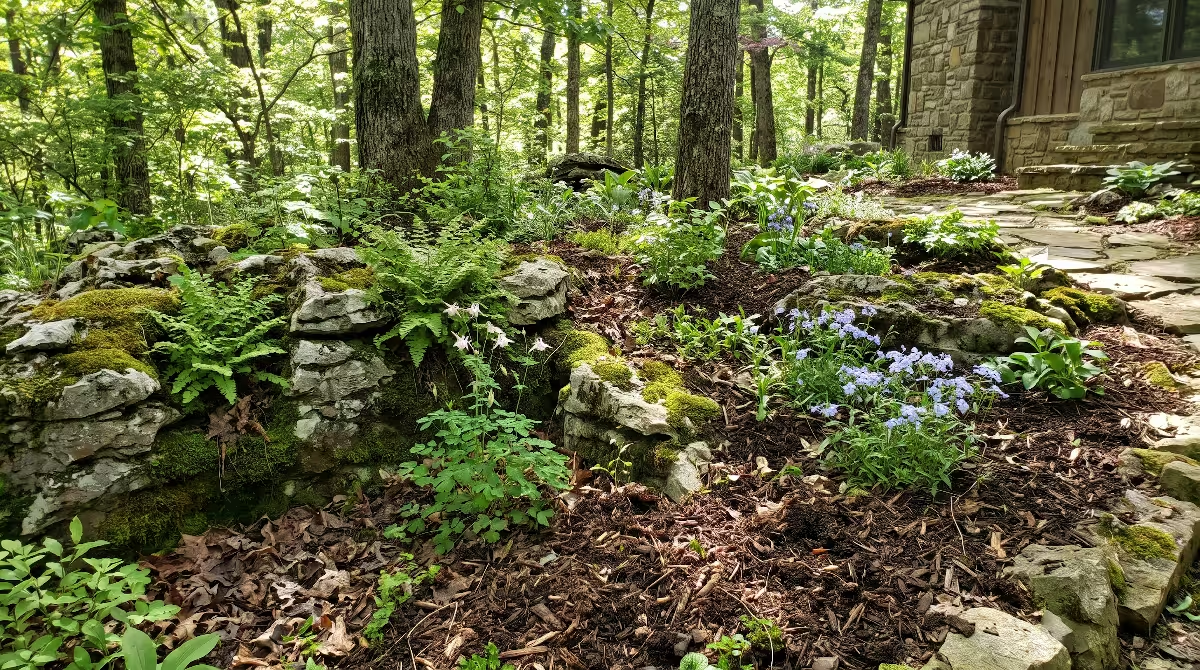
Pennsylvania sedge serves as a low-care alternative to traditional lawn turf. It forms soft, flowing green carpets that ripple in the breeze. It thrives in partial shade and stays short, eliminating the need for weekly lawn mowing. Interplanting sedges with flowering foamflower brings a dusting of starry white flower spikes in spring. The heart-shaped, veined leaves of foamflower hug the ground, keeping weeds from taking root.
Wild ginger finishes this living ground layer. Its broad, kidney-shaped leaves have a velvety, matte texture that feels soft to the touch. When crushed or brushed by passing feet along stone pathways, the roots release a warm, spicy ginger scent that adds to the sensory experience.
Technical Implementation and Hydrological Integration
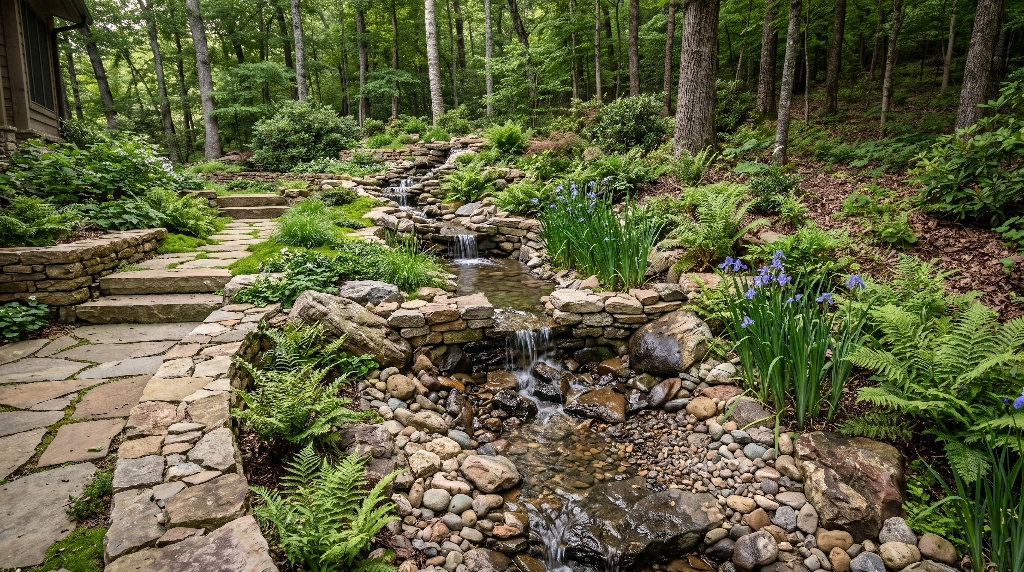
A successful sensory outdoor living landscape balances artistic planting design with solid civil and hydrological engineering. Appalachian storms bring heavy rainfall, often dumping inches of water in just a few hours. If this water is not handled correctly, it can wash away soil, flood foundations, and kill delicate plant roots.
Appalachian Bioswale Cross-Section:
====================================================== Surface Flow
  \   Native Rocks & River Stones                   /
   \      (Asarum, Ferns, & Iris Along Banks)      /
    \---------------------------------------------/   Top Soil Filter
     \       Engineered Sand/Organic Matrix      /    (Bioretention)
      \-----------------------------------------/     Crushed Stone
       \       Perforated Collector Pipe       /      (Storage Basin)
        \=====================================/       Subsoil Base
Stormwater Stewardship and Appalachian Bioswales
Instead of burying stormwater in plastic underground pipes that dump runoff into overloaded municipal storm sewers, an ecological design treats rainwater as an asset. We guide runoff into engineered bioswales and rain gardens designed to look like Appalachian mountain streambeds.
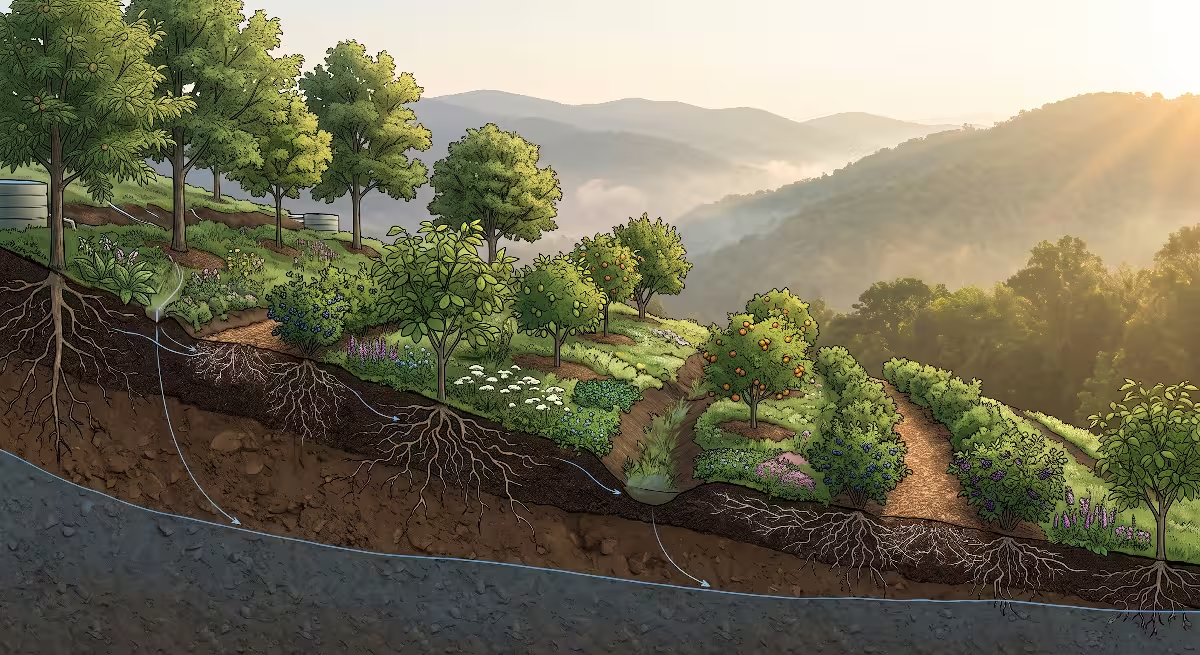
These bioswales use rounded river rocks, weathered boulders, and gravel layers to slow rushing water. As stormwater moves through the swale, gravel filters out silt and debris. Deep plant roots absorb excess water and process nutrients before clean water filters into the groundwater table.
Along the damp edges of these swales, native plants like blue flag iris, soft rush, and cinnamon fern thrive. During dry spells, the rock-lined swale looks like a dry mountain creek bed. During heavy rains, it transforms into a flowing stream that brings movement, sound, and life to your sensory outdoor living landscape.
Runoff Velocity Comparison:
Piped Drainage : [====== High Speed / High Erosion Risk ======]
Bioswale System: [== Low Speed / Deep Root Water Infiltration ==]
Soil Regeneration and Fungal Networks
Many new homes in East Tennessee sit on severely damaged ground. Heavy construction equipment strips away rich topsoils, leaving behind compacted red clay subsoil. This dense clay lacks oxygen, drains poorly, and suffocates plant roots.
Rebuilding this soil is critical for a lasting sensory outdoor living landscape. Rather than applying synthetic chemical fertilizers that destroy natural soil life, we use organic compost, aged hardwood leaf mold, and liquid compost teas. This food source awakens native mycorrhizal fungi and beneficial soil bacteria.
+---------------------------------------------------------------+
|                    HEALTHY SOIL FOOD WEB                      |
+---------------------------------------------------------------+
|  Leaf Mold & Compost ---> Feeds Mycorrhizal Fungal Networks   |
|                                       |                       |
|                                       v                       |
|  Fungal Hyphae Unbind Red Clay ---> Creates Air & Root Channels|
|                                       |                       |
|                                       v                       |
|  Native Roots Expand Freely   ---> Strong Plants Without Chemicals|
+---------------------------------------------------------------+
These underground fungal networks form partnerships with native plant roots, helping plants absorb minerals and water from tough clay soils. Over time, earthworms and fungi break up the dense clay, turning it into rich, crumbly topsoil. This living ground smells fresh, absorbs water like a sponge, and supports lush plantings without artificial plant foods.
Low-Impact Night Illumination
The sensory experience of your yard should not end when the sun dips behind the mountains. However, standard exterior floodlights and bright white spotlights ruin your eyes’ night vision, disturb wildlife, and pollute the dark night sky.
A sensory outdoor living landscape uses dark-sky lighting techniques to provide safety and beauty without harsh glare. We select low-voltage fixtures with
Glare-Heavy Lighting (Unshielded):
   \   |   /
  --- LIGHT ---  ===> Causes harsh glare, blinds night vision,
   /   |   \          and disrupts wildlife sleep patterns.

Dark-Sky Compliant Lighting (Fully Shielded):
      === (Cover Cap)
      | |
       v         ===> Warm downward light cone illuminates paths,
  ===========         textures, and steps while keeping the night sky dark.
All lighting fixtures feature protective shields that direct light downward onto walking paths, stone steps, and sitting areas. We avoid lighting up the open sky. By tucking subtle fixtures behind low walls and beneath shrubs, we highlight the rough bark of river birch trees and the patterns of stone walls without blinding guests. This gentle illumination leaves the stars visible overhead, making your evening gatherings magical and peaceful.
Frequently Asked Questions about Sensory Outdoor Living Landscape
What distinguishes an Appalachian sensory garden from traditional residential landscaping?
A traditional residential yard typically relies on lawns of non-native turf grass, imported nursery shrubs trimmed into geometric balls, and heavy applications of synthetic fertilizers and chemical pesticides. These spaces demand constant mowing, trimming, and watering, yet they offer little real sensory engagement or wildlife value.
In contrast, an Appalachian sensory outdoor living landscape relies on plants and materials native to the Southern Blue Ridge mountains. It actively engages sight, sound, touch, smell, and seasonal comfort through biophilic design. It works with natural site contours, manages stormwater on-site, and provides a sustainable, living environment that grows more self-sufficient over time.
How do native plants reduce irrigation and long-term maintenance costs in East Tennessee?
Native plants evolved over thousands of years to thrive in the soils and weather patterns of the East Tennessee region. They are naturally adapted to wet springs, humid summers, and periodic summer droughts. Once their root systems settle into the soil during the first growing season, they rarely need supplemental garden watering, saving money on your water utility bill.
Because they evolved alongside native insects and soil microbes, native plants resist local pests and common plant diseases without chemical spray applications. Furthermore, using native sedges and running groundcovers forms a dense living mulch layer. This green carpet blocks weed seeds from receiving sunlight, drastically cutting down on weekly weeding chores and eliminating the annual cost of purchasing bags of wood mulch.
Can sensory landscape integration function effectively on steep mountain slopes?
Yes. In fact, steep slopes provide wonderful opportunities for multi-level sensory living. Rather than spending thousands of dollars grading a mountain slope into a single flat lawn, an ecological approach uses the natural hillside to create a series of terraced outdoor spaces.
Using dry-stacked native stone retaining walls, we can build a sequence of stepped rooms, such as an upper dining balcony, a mid-level reading nook, and a lower fire pit circle. Moving between levels lets you experience different layers of the forest canopy up close. You can look directly into the flowering branches of understory trees from upper decks and hear cascading water runnels drop through stone steps, turning steep terrain into an exciting landscape asset.
What local natural stones are ideal for biophilic outdoor living patios in the Tri-Cities region?
Crab Orchard sandstone, quarried on the Cumberland Plateau in nearby central Tennessee, is the top choice for outdoor patios, paths, and pool surrounds. It features a unique, fine-grained texture that remains slip-resistant even when soaked with water. Its natural color palette blends warm tans, grays, soft pinks, and rich rust tones, fitting right in with native soils and plantings.
For heavy retaining walls, stone steps, and naturalistic water features, local limestone and river fieldstone provide unmatched structural strength. These stones weather naturally over time, developing soft coatings of moss and lichens that root the hardscape into its woodland setting. Sourcing stone from local quarries supports our regional trade economy and reduces transportation fuel costs.
Maintenance Cycles and Evolutionary Stewardship
An authentic sensory outdoor living landscape is a living ecosystem that evolves, rather than a static showroom display. Traditional landscaping fights nature to keep everything looking frozen in time. Biophilic stewardship works alongside natural plant growth, guiding the space through simple seasonal checkups.
+---------------------------------------------------------------+
|                YEAR-ROUND STEWARDSHIP CYCLE                   |
+---------------------------------------------------------------+
|  SPRING : Clear drainage swales, assess winter growth,         |
|           apply fresh organic leaf mold to thin areas         |
|                                                               |
|  SUMMER : Monitor water feature flow, pull stray weeds,       |
|           harvest fresh native herbs, berries, and fruits     |
|                                                               |
|  AUTUMN : Leave fallen leaves in planting beds, gather        |
|           firewood for outdoor hearth, enjoy fall colors      |
|                                                               |
|  WINTER : Leave decorative seed heads for birds, prune        |
|           dormant hardwoods, enjoy open mountain sightlines   |
+---------------------------------------------------------------+
Embracing Ecological Succession
Over time, plants grow, spread, and interact with one another. Fast-growing sun lovers eventually yield space to shade-tolerant woodland species as tree canopies expand. In an ecological sensory outdoor living landscape, we welcome these subtle transitions.
Instead of shearing shrubs into unnatural spheres, we prune them lightly with hand shears, preserving their graceful, arching branches. If a patch of foamflower spreads across a stone border, we allow it to soften the hard edges of the stonework. This relaxed approach reduces weekly yard chores and lets the landscape develop a timeless character that looks like it grew there naturally.
Winter Architecture and Wildlife Support
A common mistake in yard care is cutting all plants flat to the ground during late autumn cleanup. Stripping a yard bare in November leaves the soil cold and removes food sources and nesting spots for native wildlife.
In a functional sensory outdoor living landscape, we leave the architectural seed heads of native coneflowers, asters, and goldenrods standing throughout the winter. When freezing fog and light snow roll over the mountains, these dried seed heads catch the frost, creating crystalline sculptures that sparkle in the morning sunlight.
These standing plants provide critical food for overwintering songbirds like American goldfinches, dark-eyed juncos, and chickadees. Watching these colorful birds feed outside your living room window brings movement, sound, and life to the winter garden. Underneath, leaving a blanket of fallen leaves protects soil moisture, shields sleeping beneficial insects, and builds organic topsoil for the coming spring.
Seasonal Stewardship Checklist
Keeping your living environment balanced requires simple, mindful tasks across the four seasons:
- Late Winter (February):
- Prune damaged tree limbs before spring sap starts rising.
- Inspect stone paths and dry-stacked walls for any shifting caused by deep soil freezes.
- Clear leaf debris from bioswale drainage points to ensure smooth spring runoff.
- Early Spring (April):
- Spread a thin layer of shredded leaf mold around new plantings if bare soil is showing.
- Check automated low-voltage lighting timers to match longer daylight hours.
- Clean pump filters in moving water runnels and fill basins with clean water.
- Mid-Summer (July):
- Harvest ripe berries from downy serviceberry and spicebush shrubs.
- Trim back any groundcovers that cross too far into high-traffic barefoot pathways.
- Enjoy the cooling shade of the high tree canopy and the fragrance of sweet pepperbush blossoms.
- Autumn (October):
- Gather dried hardwood logs for evening fires in the stone fireplace.
- Clean excess leaves out of deep water basins while leaving leaves alone in garden planting beds.
- Plant spring-blooming native woodland bulbs like trout lily and Virginia bluebells beneath dormant trees.
By following these simple seasonal rhythms, your yard remains a source of relaxation rather than a list of unending chores. A thoughtful sensory outdoor living landscape bridges the gap between your living room and the wild beauty of the Appalachian mountains. It gives your home a welcoming, natural extension where your family can unplug, breathe deeply, and reconnect with the living world every day.