If you have spent any time around Kingsport or Johnson City, you know that our weather here in East Tennessee can be a bit of a roller coaster. One day it is crisp and dry, and the next, the humidity is so thick you could almost swim through it. When you are building a custom home in this region, you have to think about more than just the floor plan and the kitchen cabinets. You have to think about how your house is going to handle that moisture.
Think of your home like a high-end rain jacket. You want it to keep the rain out, but you also do not want to sweat like crazy inside of it because the fabric cannot breathe. In the world of construction, we call this “breathability” or vapor control. As an engineer with a background in project management, I tend to look at homes as a set of complex systems.
One of the most important numbers in those systems is the perm rating. This little number is a silent protector for your house. It tells us how much moisture can move through your walls. If we get this number wrong, your beautiful new home could end up with mold or wood rot hidden inside the walls where you cannot see it. In this guide, I am going to walk you through everything you need to know about what a perm rating is and why it is the key to a healthy, long-lasting home right here in the Tri-Cities.
What is a Perm Rating?
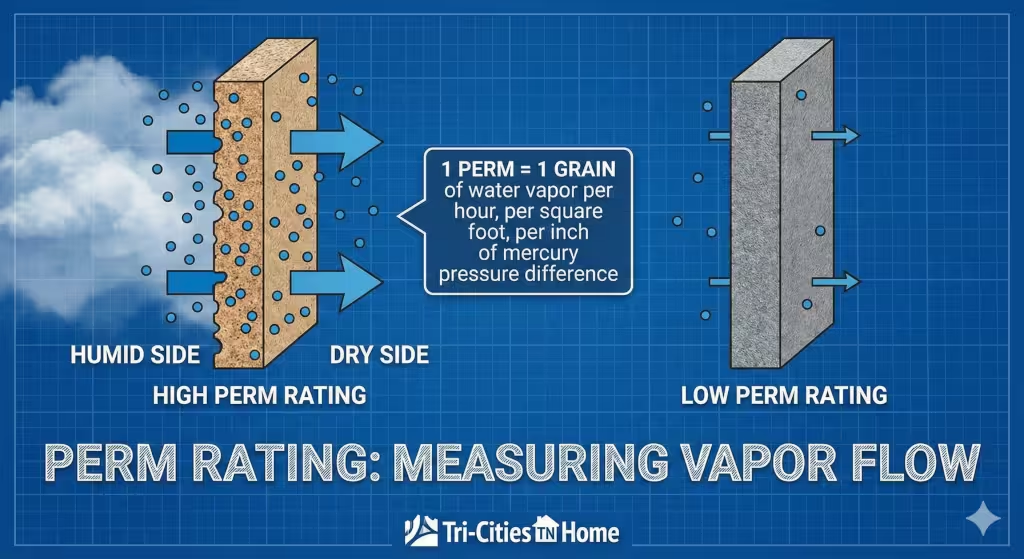
When we talk about a perm rating, we are looking at a technical measurement of how easily water vapor can pass through a building material. To understand this, we first have to realize that water is a bit of a shape-shifter. It can be a solid like ice, a liquid like what comes out of your tap, or a gas which we call water vapor. Even when your walls look solid, water vapor is constantly trying to push through them. It moves from areas where there is a lot of moisture to areas where there is less. This process is called vapor drive.
The perm rating is the score we give a material to show how much of that gas it lets through. Specifically, one perm is defined as one grain of water vapor passing through one square foot of a material in one hour when there is a specific amount of air pressure pushing on it. To give you an idea of how small a “grain” is, it takes seven thousand grains to make up just one pound of water. So, a perm rating measures very tiny amounts of moisture.
You need to look at the perm rating of every layer of your wall. This includes the house wrap on the outside, the insulation in the middle, and the paint on the inside. A high perm rating means the material is very “breathable” and lets a lot of vapor pass through. A low perm rating means the material acts like a shield and stops most of the vapor.
The goal for any custom home in Johnson City is to find the right balance. You do not want your house to be like a plastic bag that traps all the moisture inside. But you also do not want it to be like a sponge that lets everything in. We use the perm rating to make sure the “breathability” of the house matches our local climate.
The Three Classes of Vapor Retarders
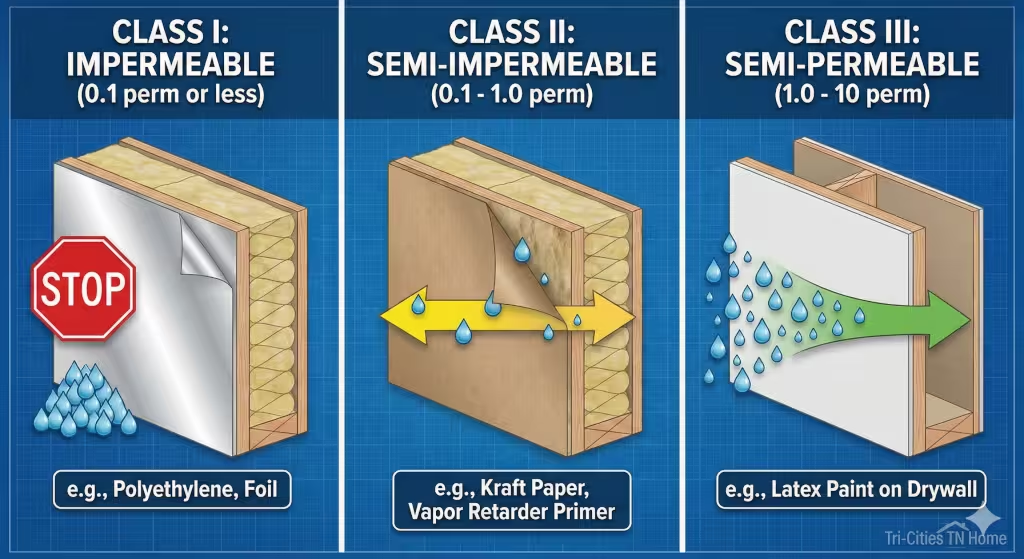
It is great that you want to dig deeper into the three classes of vapor retarders. When we talk about a perm rating, we are really talking about how we manage the life of your home. If we do not understand these classes, we are just guessing, and guessing is not a good way to build a house in Johnson City.
The International Residential Code, or IRC, uses these classes to help builders decide what goes where. Each class behaves differently when it comes to moisture and air. Let us break them down so you can see exactly how they work.
Class I Vapor Retarders: The Total Shield
A Class I vapor retarder is what most people are talking about when they use the term “vapor barrier.” These materials have a perm rating of 0.1 or less. In simple terms, they are nearly waterproof and vapor-proof. They act like a solid wall against moisture.
In our area, you will most often see Class I materials used in crawlspaces and under concrete slabs. If you are building a new home in Kingsport, your builder should lay down a thick sheet of 6-mil or 10-mil polyethylene plastic before the concrete is poured. This plastic has a very low perm rating. Its job is to stop the dampness from the Tennessee soil from soaking up into your floor.
However, we have to be very careful with Class I materials in our walls. Because the perm rating is so low, moisture cannot pass through it at all. If moisture gets trapped behind a piece of plastic in your wall during a hot, humid summer, it has nowhere to go. This can cause the wood to rot or mold to grow behind your drywall. This is why we usually advise against using plastic sheets inside wall assemblies in the Tri-Cities. Our climate is just too humid for that kind of “total seal” most of the year.
Class II Vapor Retarders: The Semi-Shield
A Class II vapor retarder has a perm rating between 0.1 and 1.0. These are designed to slow down moisture significantly without stopping it entirely. The most common Class II material is the kraft paper facing on fiberglass insulation.
Some builders use kraft-faced batts all the time. The paper is treated with a thin layer of asphalt or similar material to give it a specific perm rating. In the winter, this paper helps keep the moisture from your warm shower or cooking from moving too quickly into the cold wall cavity.
Another great Class II option is vapor retarder paint. This is a special type of primer that has a lower perm rating than standard latex paint. It is a smart choice for bathrooms or laundry rooms where there is a lot of steam. It provides an extra layer of protection without being as risky as a full plastic sheet. It allows for a tiny bit of “drying potential,” which means if the wall does get a little damp, it can still dry out over time.
Class III Vapor Retarders: The Breathable Layer
A Class III vapor retarder has a perm rating between 1.0 and 10. These are the most common materials used on the interior of modern homes. Regular latex paint and standard drywall fall into this category.
The beauty of a Class III perm rating is that it allows the wall to “breathe.” In a climate like ours, where the weather changes from wet to dry and hot to cold, we want our walls to be able to dry out in both directions. If moisture gets into the wall from a small leak or from humidity, a Class III material lets that moisture slowly evaporate through the paint and back into the room where your air conditioner or dehumidifier can catch it.
Using a material with a Class III perm rating is often the safest bet for custom homes in East Tennessee. It provides enough resistance to keep most moisture out, but it is “forgiving” enough to let the house dry out if things go wrong.
Your Material Selection Checklist
To help you with your project, I have put together this checklist. You can use this when you are walking through your home site or talking to your contractor. Remember, the goal is to have the right perm rating for the right location.
Foundation and Crawlspace (Keep the Ground Out)
6-mil Polyethylene (Plastic): 0.06 perm rating (Class I) – Essential for crawlspace floors.
10-mil Polyethylene: 0.03 perm rating (Class I) – Even better for high-end builds.
Aluminum Foil Facings: 0.05 perm rating (Class I) – Often found on rigid foam boards.
Interior Walls (Managing Indoor Humidity)
Kraft Paper Insulation Facing: 0.40 perm rating (Class II) – Standard for most local homes.
Vapor Retarder Primer: 0.50 to 1.0 perm rating (Class II) – Great for high-moisture rooms.
Standard Latex Paint: 5.0 to 10.0 perm rating (Class III) – Allows walls to dry toward the inside.
Vinyl Wall Covering (Wallpaper): 0.05 to 0.50 perm rating (Class I or II) – Careful with this! It can trap moisture in humid climates.
Exterior Sheathing and Wrap (Letting the House Dry Out)
Plywood (1/2 inch): 0.7 to 2.0 perm rating (Class II/III) – Changes based on how wet it is.
OSB (7/16 inch): 2.0 perm rating (Class III) – Commonly used in new construction.
Extruded Polystyrene (XPS) 1 inch: 1.1 perm rating (Class II) – Commonly called “pink” or “blue” board.
Expanded Polystyrene (EPS) 1 inch: 2.0 to 5.0 perm rating (Class III) – White beadboard foam.
House Wrap (like Tyvek): 50.0+ perm rating (Highly Permeable) – Lets vapor out while keeping rain out.
Why Perm Ratings Matter
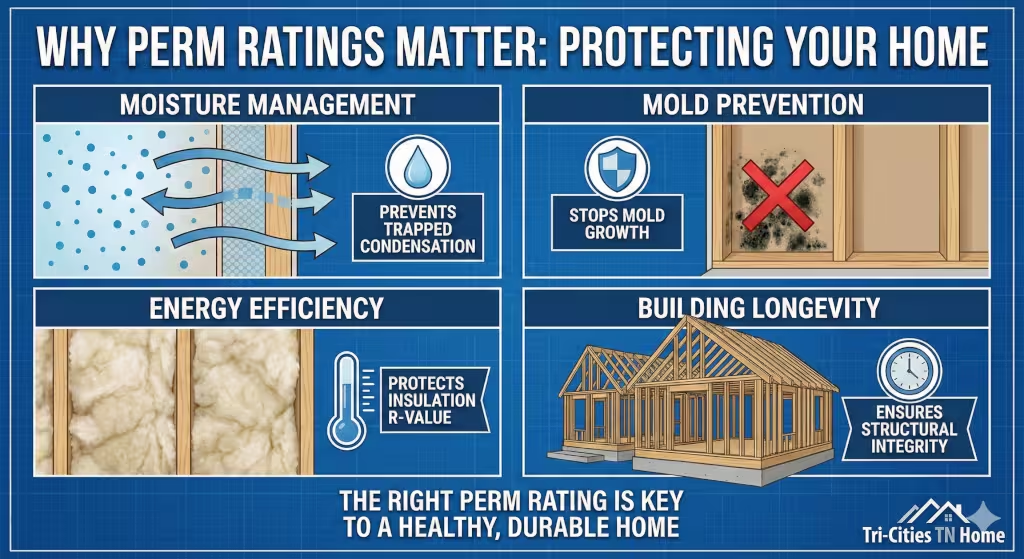
You might be wondering why we spend so much time worrying about a perm rating when we are building a house. The reason is simple: moisture is the number one enemy of a home. If moisture gets trapped inside your walls, it can lead to several major problems that are expensive and difficult to fix.
Moisture Management and Condensation
The biggest job of a perm rating is managing where condensation happens. Imagine a cold glass of sweet tea on a hot Kingsport summer day. Water droplets form on the outside of the glass because the warm, moist air hit the cold surface. This is the “dew point.” In a house, if warm air from your living room hits a cold surface inside your wall during the winter, you will get condensation inside the wall. If the materials have the wrong perm rating, that water will stay trapped against the wood studs. Over time, that leads to rot.
Mold Prevention and Air Quality
Where there is trapped water, there is eventually mold. Mold does not just eat your house; it can also make your family sick. By choosing materials with the correct perm rating, we ensure that moisture can always move toward a side of the wall where it can evaporate. This keeps the wall cavity dry and prevents mold from ever getting a foothold. This is why I always tell my clients that the invisible details, like a perm rating, are just as important as the floor tiles.
Protecting Your Insulation
Insulation works by trapping tiny pockets of air. If that insulation gets wet, it loses its ability to keep your home warm or cool. This is called a loss in R-value. A material with a low perm rating can protect your insulation from getting damp. On the other hand, if your insulation does get wet, you need the surrounding materials to have a high enough perm rating to let that moisture escape so the insulation can dry out and do its job again.
Building Longevity
A custom home is a huge investment. You want it to last for a hundred years, not twenty. Using the right perm rating for your climate ensures that the structural components of your home, like the wooden framing and the OSB sheathing, stay dry and strong. Precision in these technical specs is what separates a “builder” from a true “craftsman.”
Questions about Perm Rating Answered
Since I spend a lot of time talking to homeowners in the Tri-Cities, I hear a lot of the same questions. Here are a few common things people ask about the perm rating and moisture.
What is a good perm rating for house wrap?
For most homes in our area, a “good” house wrap usually has a perm rating between 10 and 50. We want the house wrap to be very breathable. Its job is to keep liquid water (rain) out while letting water vapor (gas) escape from the inside. If the house wrap has too low of a perm rating, it could trap moisture inside the wall.
Is a higher perm rating always better?
Not necessarily. It depends on where the material is located and what climate you live in. If you are putting a vapor barrier under a concrete basement floor, you want a very low perm rating (close to zero) to stop the damp ground from making your basement humid. But for your exterior walls, a higher perm rating is usually better to allow for drying. It is all about the right tool for the right job.
What is the difference between a vapor barrier and a vapor retarder?
Technically, they are all vapor retarders. We just use the word “barrier” to describe the ones with a very low perm rating (Class I). Think of a “barrier” as a wall and a “retarder” as a speed bump. One stops the moisture, while the other just slows it down.
The Tri-Cities Climate Factor
The Department of Energy puts the Tri-Cities in Climate Zone 4. This is what we call a “mixed-humid” climate. This means we have cold winters where we run the heater and hot, sticky summers where the air conditioner stays on.
In the winter, the “vapor drive” pushes moisture from the warm inside of your house toward the cold outside. In the summer, the “vapor drive” reverses. The hot, humid outside air tries to push moisture into your cool, air-conditioned home. Because the direction of the moisture changes with the seasons, we have to be very careful with the perm rating of our materials.
If we put a plastic vapor barrier (low perm rating) on the inside of the wall, it might be great in the winter. But in the summer, that plastic can trap moisture that is trying to move inward, causing condensation on the back of your drywall. This is why many experts now recommend “smart” vapor retarders. These are high-tech materials that actually change their perm rating based on the humidity. When it is dry, they stay tight. When it is humid, they “open up” to let the wall dry out. For a high-end custom home in the Tri-Cities, this kind of precision is exactly what I recommend.
Common Building Materials and Their Ratings
To help you visualize how different materials stack up, I have put together this table. You can see how the perm rating changes depending on what the material is made of.
| Material | Typical Perm Rating | Category |
| 6-mil Polyethylene (Plastic) | 0.06 | Class I (Barrier) |
| Aluminum Foil | 0.05 | Class I (Barrier) |
| Kraft Paper (on insulation) | 0.40 | Class II (Retarder) |
| Plywood (1/2 inch) | 0.7 to 2.0 | Class II or III |
| OSB (7/16 inch) | 2.0 | Class III (Retarder) |
| Latex Paint (Standard) | 5.0 to 10.0 | Class III (Retarder) |
| House Wrap (Tyvek) | 50.0+ | Highly Permeable |
| Unpainted Drywall | 50.0 | Highly Permeable |
As you can see, a simple coat of paint can change the perm rating of your wall significantly. This is why we have to look at the “wall assembly” as a whole, rather than just looking at one material at a time.
Understanding the Technical Side: ASTM E96 and the IRC
If you really want to get into the weeds, you will see the term ASTM E96 on the data sheets for building materials. This is the official test used to find the perm rating of a product. There are two ways to do the test: the “dry cup” method and the “wet cup” method. Since materials often behave differently in high humidity, the “wet cup” test gives us a better idea of how a material will act in a sticky Tennessee summer.
The International Residential Code (IRC) uses these tests to set the rules for where we must use certain vapor retarders. For example, in very cold climates (like Zone 7 or 8), the code might require a Class I or II vapor retarder on the inside of the house. In our Zone 4, the rules are more flexible because we have to worry about moisture moving in both directions.
When you are interviewing builders, ask them about their strategy for vapor drive and how they select the perm rating for their wall systems. A builder who knows these terms is a builder who cares about the long-term health of your home. They are focusing on the integrity of the structure, not just the “curb appeal.”
Precision in the Details
Building a home is about more than just wood and nails. It is about physics and biology. The perm rating is a small detail, but it has a huge impact on whether your home will be a healthy place to live for decades to come. Whether you are looking at a house wrap with a high perm rating to help your walls dry out, or a vapor barrier for your crawlspace to keep the dampness away from your floor joists, understanding these numbers is the first step to a better build.
We hope this guide has helped clear up some of the mystery around what a perm rating is. It is all about managing moisture and making sure your home can “breathe” in a way that matches our East Tennessee climate. If you get the perm rating right, you are well on your way to a home that is as sturdy and reliable as the mountains around us.