Women look at a house differently. We do not just see a structure; we see a sanctuary, a legacy, and a space that needs to work for every stage of our lives. In the Tri-Cities area, from the rolling hills of Kingsport to the quiet streets of Johnson City, we have seen a beautiful shift toward homes that combine high-end style with real-world function.
One of the most important trends I am seeing right now is the move toward a zero-entry or curbless garage. For years, we accepted that big, clunky concrete step as a necessary evil to keep water out. But thanks to the modern linear drain, those days are over.
A linear drain allows us to create a perfectly flat, seamless floor that looks like a high-end gallery while keeping our homes safe from moisture. Whether you are thinking about aging in place, making your home more accessible for a loved one, or you just want that clean, minimalist look, understanding how a linear drain works is the first step. It is about more than just a pretty floor; it is about precision engineering and protecting your investment. Let’s examine why this specific drainage solution is the secret to a perfect custom home.
What is a Linear Drain System?

When you imagine a standard floor drain, you probably think of that small, round metal plate with holes in it that you see in older basements or public locker rooms. That is what we call a “point drain.” To make water go into a point drain, the floor has to be shaped like a shallow bowl. This means the floor has to slope down from every corner of the room to hit that one little spot.
While that works for a small shower, it is a nightmare for a garage. Imagine trying to park a heavy SUV on a floor that is shaped like a soup bowl. It is awkward, it feels unstable, and it makes it very hard to install high-end flooring like large tiles or a smooth epoxy coating.
A linear drain changes the entire geometry of the floor. Instead of a small circle, a linear drain is a long, narrow rectangle. It usually spans several feet, often the entire width of a garage door or a shower entry. Because the drain is a long line, the floor only needs to slope in one single direction. Think of it like a ramp instead of a bowl.
This “single-slope” design is what allows us to create a curbless entry. Since the floor is flat from side-to-side and only tilts slightly forward, there is no need for a big concrete hump or curb to catch the water. The linear drain acts like a long safety net at the bottom of the ramp.
The Anatomy of the System
To really understand a linear drain, you have to look at what is happening beneath the surface. It is made up of several key parts that all work together to protect your garage foundation:
The Channel (or Trough): This is the “body” of the linear drain. It sits recessed into your concrete floor. In high-quality custom homes in Johnson City, we prefer these to be made of 316-grade stainless steel. This material is incredibly strong and won’t rust when it comes into contact with the salt and melting snow that drops off your car in the winter.
The Integrated Flange: This is a flat “wing” that sticks out from the sides of the linear drain body. It is there so the builder can overlap a waterproofing membrane onto the drain. This ensures that water doesn’t seep into the tiny crack between the metal drain and the concrete floor. Without a good flange, you might get moisture under your slab, which can lead to cracks or mold over time.
The Grate: This is the only part of the linear drain you actually see. It sits on top and protects the channel. You can choose different styles, from a simple slotted metal look to a “tile-in” grate. A tile-in grate is essentially a hollow tray that the builder fills with your garage flooring material. When it is finished, the linear drain is almost invisible—all you see is a tiny gap around the edge where the water disappears.
The Debris Basket: Inside the linear drain, there is usually a small, removable basket. This is a lifesaver for maintenance. It catches hair, leaves, or road gravel before it can enter your pipes. In a garage, where we deal with a lot of grit, having an easy-to-clean linear drain basket is essential for preventing expensive plumbing clogs.
How it Handles Water Flow
Precision is everything when it comes to water. In our part of Tennessee, we can get sudden, heavy rain. A linear drain is designed to handle what we call “sheet flow.” When water runs off a flat surface like a garage floor or a driveway, it moves in a wide sheet. A round point drain is too small to catch a wide sheet of water; most of it will just wash right past the drain.
A linear drain, however, is positioned to “intercept” that sheet. Because it stretches across the path of the water, every drop has to fall into it. The technical term for this is “gallons per minute” (GPM). A standard 36-inch linear drain can often handle between 8 to 10 gallons of water every minute. That is more than enough to handle a soaking wet car or a hose-down after you’ve spent the day cleaning out the garage.
Why the “Linear” Design Matters for Accessibility
As an engineer, I look at the math, but as a neighbor here in the Tri-Cities, I look at the people. A linear drain is the foundation of “barrier-free” living. Because the linear drain can be placed right at the entrance of the garage, we can make the driveway and the garage floor meet at the exact same height.
This creates a “zero-threshold” transition. For a mom pushing a stroller, a homeowner moving heavy boxes on a dolly, or someone using a wheelchair, this transition is life-changing. There is no “thump-thump” as you drive over a curb, and there is no risk of tripping when you walk inside with your arms full of groceries. The linear drain makes the floor feel like one continuous, high-end surface from the outside world into your private sanctuary.
Choosing the Right Size and Location
Not every linear drain is the same. When we are planning a custom home in Kingsport, we have to decide where the linear drain will do the most work.
At the Threshold: This is the most popular spot for a garage. The linear drain sits right under where the garage door closes. It catches rain blowing against the door and prevents water from the driveway from “wicking” inside.
Against the Back Wall: If your garage floor slopes toward the back of the house, we put the linear drain against the far wall. This is great for “wash-down” garages where you might be hosing off mountain bikes or fishing gear.
Wall-to-Wall: To get the best look and performance, a linear drain should go from one side of the opening to the other. If you leave gaps on the sides, water will find a way around.
In my professional opinion, the linear drain is one of the smartest investments you can make in a new build. It combines the technical precision of an engineered drainage system with the sleek, clean lines of modern interior design. It is about making sure your home works for you, rather than you having to work around the limitations of your home.
Benefits for the Custom Homeowner
If you are building a custom home in the Tri-Cities, you want it to be perfect. One of the biggest benefits of a linear drain is what we call Universal Design. This is a fancy way of saying that the home is easy for everyone to use, regardless of their age or physical ability. By using a linear drain to create a curbless garage, you remove a major trip hazard. If you have children running in and out, or if you are thinking about a time when a walker or wheelchair might be needed, that smooth floor is a blessing.
Another benefit is the way it looks. We spend a lot of money on beautiful garage floors these days, using epoxy coatings or high-end tiles. A round drain in the middle of a beautiful floor looks like an eyesore. A linear drain, however, can be placed right at the edge of the room or under the garage door. It stays out of the way and looks like a deliberate part of the design.
Finally, a linear drain is much better at catching water. When you drive a wet car into a garage during a Tennessee thunderstorm, the water runs off in sheets. A small round drain can easily be overwhelmed. A linear drain acts like a long safety net, catching that water across the entire width of the garage and whisking it away before it can puddle or cause mold issues.
Engineering the Curbless Transition: How it Works
Creating a floor with no curb requires a bit of math and a lot of precision. In a standard garage, the floor is usually flat, and then there is a step down to the driveway. To use a linear drain for a curbless entry, we have to change how the concrete is poured.
The most common way to do this is to create a single slope. This means the entire garage floor tilts very slightly, usually about one-quarter of an inch for every foot of distance, toward the linear drain. We often place the linear drain right where the garage door closes. This way, any rain that tries to blow under the door or any water dripping off your SUV goes straight into the linear drain.
Another option is to place the linear drain at the back or sides of the garage. This depends on how the land around your house sits. As an engineer, I always look at the “grade” of the land first. You want to make sure the water is moving away from the foundation of the house. The linear drain is the tool that makes this movement possible without needing a steep, dangerous hill in your garage floor.
Is a Curbless Garage Entry Safe From Flooding?
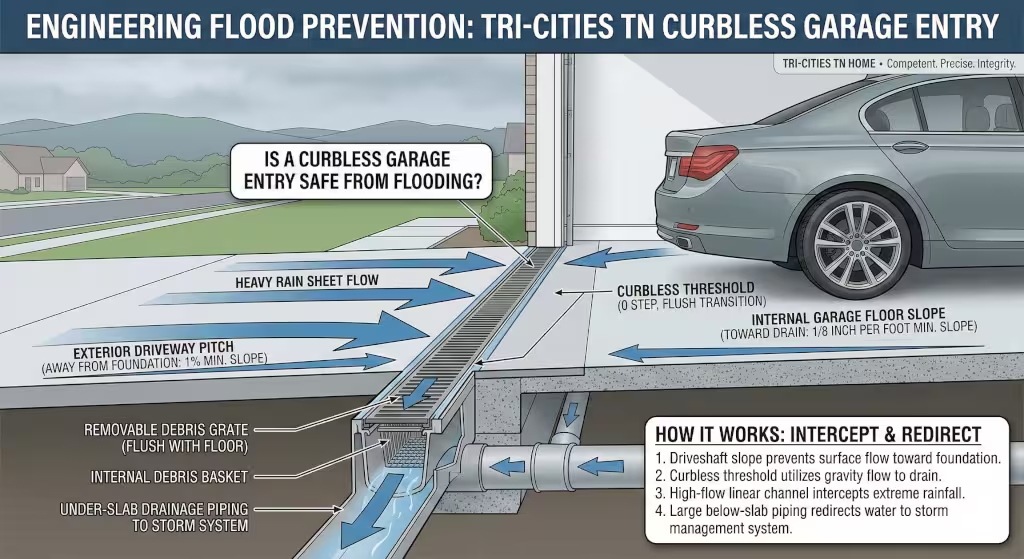
Many homeowners have this question, because of the level area. People worry that if there is no curb, the water will just come right into the house. The answer lies in the “flow rate” of the linear drain. A high-quality linear drain can move a surprising amount of water, often many gallons per minute.
Because the linear drain spans the entire opening of the garage door, it intercepts the water before it can even think about entering the garage. In the Tri-Cities, we can get some heavy downpours. A well-installed linear drain paired with proper outdoor grading means your garage stays dry. It is actually often safer than a traditional curb because a curb can sometimes trap water inside the garage if a pipe leaks or a water heater breaks. With a linear drain, that water has an easy exit path.
How Much Slope is Needed for a Curbless Garage Floor?
You cannot just have a flat floor and expect a linear drain to work. Gravity needs to do its job. For a garage, we usually look for a slope of 1% to 2%. To put that in simple terms, for every ten feet of floor, the height should drop by about one or two inches toward the linear drain.
If the slope is too flat, the water will just sit there in puddles. If the slope is too steep, it will feel weird to walk on, and your car might feel like it is rolling. A professional builder knows how to find that “sweet spot” where the floor looks flat to the eye but functions perfectly with the linear drain to keep things dry.
Do Linear Drains Clog Easily?

Maintenance is something every woman thinks about when managing a home. No one wants to spend their Saturday poking at a clogged drain. The good news is that a linear drain is actually easier to clean than a standard one. Most systems come with a removable grate. You just lift the grate, and inside you will usually find a debris basket.
In a garage, you might get some sand, leaves, or salt from the roads. All of that gets caught in the basket of the linear drain. You just dump the basket out, rinse it, and put it back. Because the linear drain is long and narrow, it is also much easier to see if there is a problem before it becomes a total blockage.
Related Terms and Technical Details
When you are talking to your contractor about a linear drain, you might hear some other terms. They might call it a trench drain or a channel drain. While they are very similar, a linear drain is usually the term used for high-end residential work where the look and the fit are very precise.
You should also ask about the “flange.” The flange is the part of the linear drain that connects to the floor’s waterproofing layer. In a garage, this is very important because you don’t want water seeping under the concrete and causing cracks. Using a high-quality linear drain with a solid flange ensures that the connection is watertight.
Another term to know is “316L Stainless Steel.” This is a type of metal that does not rust easily. Since we use salt on our roads in Kingsport and Johnson City during the winter, you want your linear drain to be made of this material so it stays looking new for years to come.
Installation Steps: The Professional Approach
Installing a linear drain in a garage is not a simple weekend DIY project. It requires a professional touch. First, the plumber has to set the location for the waste pipe. This has to be exactly where the linear drain will sit.
Next, the concrete team has to pour the slab with that specific single slope we talked about. They often leave a “trough” or a gap in the concrete where the linear drain will be “boxed out.” Once the concrete is set, the linear drain is placed into that gap and leveled perfectly.
The final step is the most important: the “tie-in.” This is where the floor finish—whether it is epoxy, stone, or tile—is brought right up to the edge of the linear drain. A bead of high-quality sealant is often used to make sure there are no gaps. When it is finished, the linear drain should be perfectly flush with the floor, so you can drive over it or walk over it without even feeling it.
Investing in Your Home’s Longevity
Choosing a linear drain for your garage is a sign of a well-built home. It shows that you care about the details, the safety of your family, and the long-term value of your property. In the Tri-Cities, our homes are our biggest investments. By using a linear drain to create a curbless entry, you are making sure your home is ready for the future.
It takes a bit more planning and a bit more precision, but the result is a garage that is easy to clean, safe to walk in, and beautiful to look at. A linear drain is the perfect example of how modern engineering can make our lives simpler and our homes better.